
N-Strike Nerf Guns: Every Blaster We Have Reviewed
N-Strike is the line that made Nerf blasters modular. Clips, stocks, barrels and rail accessories that swap between blasters, across two eras and dozens of models. This page is the map: every N-Strike blaster we have reviewed, sorted by what it actually does, and which ones are worth hunting down now that the line is retired.
Who this page is for: anyone deciding which N-Strike blaster to buy secondhand, and anyone who owns one and wants to know what else it works with.
What is on this page
- What N-Strike is
- The clip system, and why it still matters
- Motorized and full-auto blasters
- Clip and drum blasters
- Break-action and multi-dart blasters
- Pistols and pocket blasters
- Building an N-Strike loadout
- Mistakes that cost people money
- Moving to a current blaster: read this first
- What is still on shelves
- The N-Strike blasters worth hunting down
- Buying N-Strike secondhand
- Where to buy
- Frequently asked questions
What N-Strike is
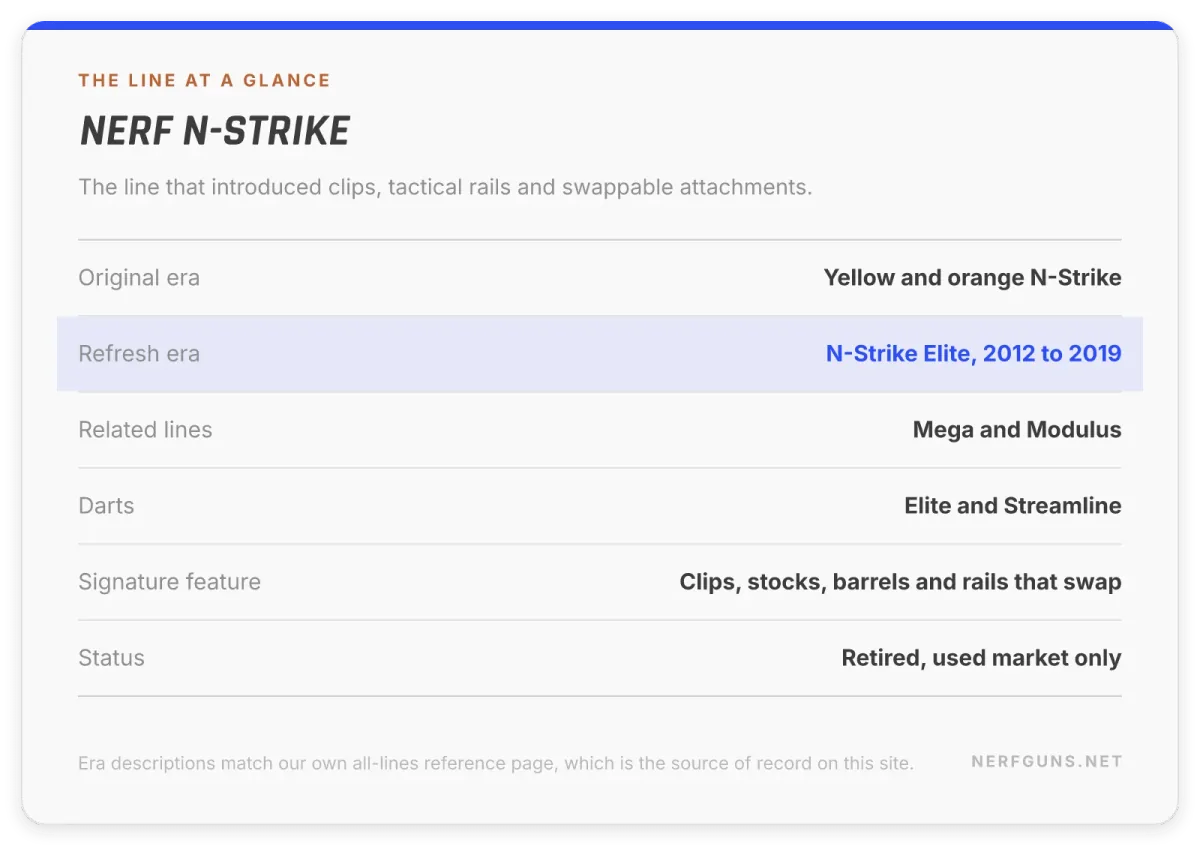
N-Strike ran in two distinct eras and it helps to keep them straight, because listings mix them up constantly.
The original N-Strike era is the yellow and orange one. Maverick, Recon, Longshot, Vulcan and Stampede are the blasters people picture. It ran through the mid and late 2000s and it is where the clip system, the tactical rail and the swappable stock all arrived.
N-Strike Elite is the 2012 to 2019 refresh: blue and white, longer stated ranges, and the Elite dart. Strongarm, Stryfe, Rampage, Disruptor and RapidStrike are the names from that era. If you want the deep buying guide for that half of the line specifically, our N-Strike Elite guide goes model by model.
Two related lines grew out of the same platform. Mega took the ideas and scaled the darts up to the oversized whistling ones. Modulus pushed the swappable-parts idea as far as it would go, with barrels, stocks, scopes and bipods sold separately.
All of it is retired. N-Strike, N-Strike Elite, Mega and Modulus are out of production, and everything on this page is written for the used market. That is not the bad news it sounds like, and the next section is why.
The clip system, and why it still matters
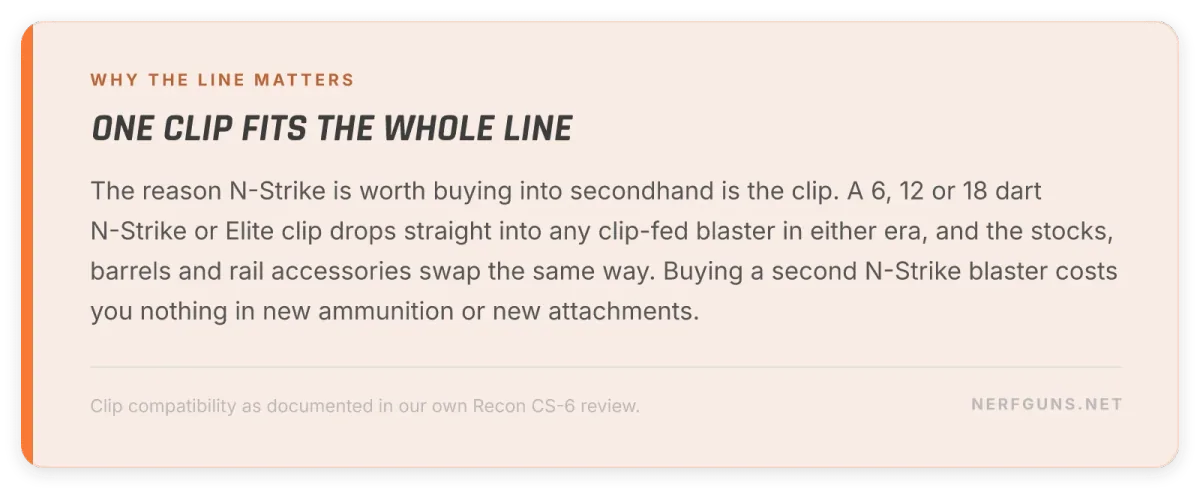
Here is the single most useful thing to know about this line. The 6-dart clip is the standard N-Strike clip, and any 6, 12 or 18 dart N-Strike or Elite clip drops straight into any clip-fed blaster in either era.
The same is true of the accessories. Any blaster with a stock mount and a tactical rail takes most of the available attachments, and those attachments move freely between blasters and between eras.
That compatibility is the reason buying into N-Strike secondhand still makes sense. Your second blaster costs you nothing in new ammunition and nothing in new accessories, which is not true of Mega, Ultra or Rival, where the ammunition is line-specific.
If you are building out the attachment side, our attachments guide covers what is worth bolting on and what is just weight.
Motorized and full-auto blasters
These are the blasters that made N-Strike famous, and the ones people still search for by name years later.
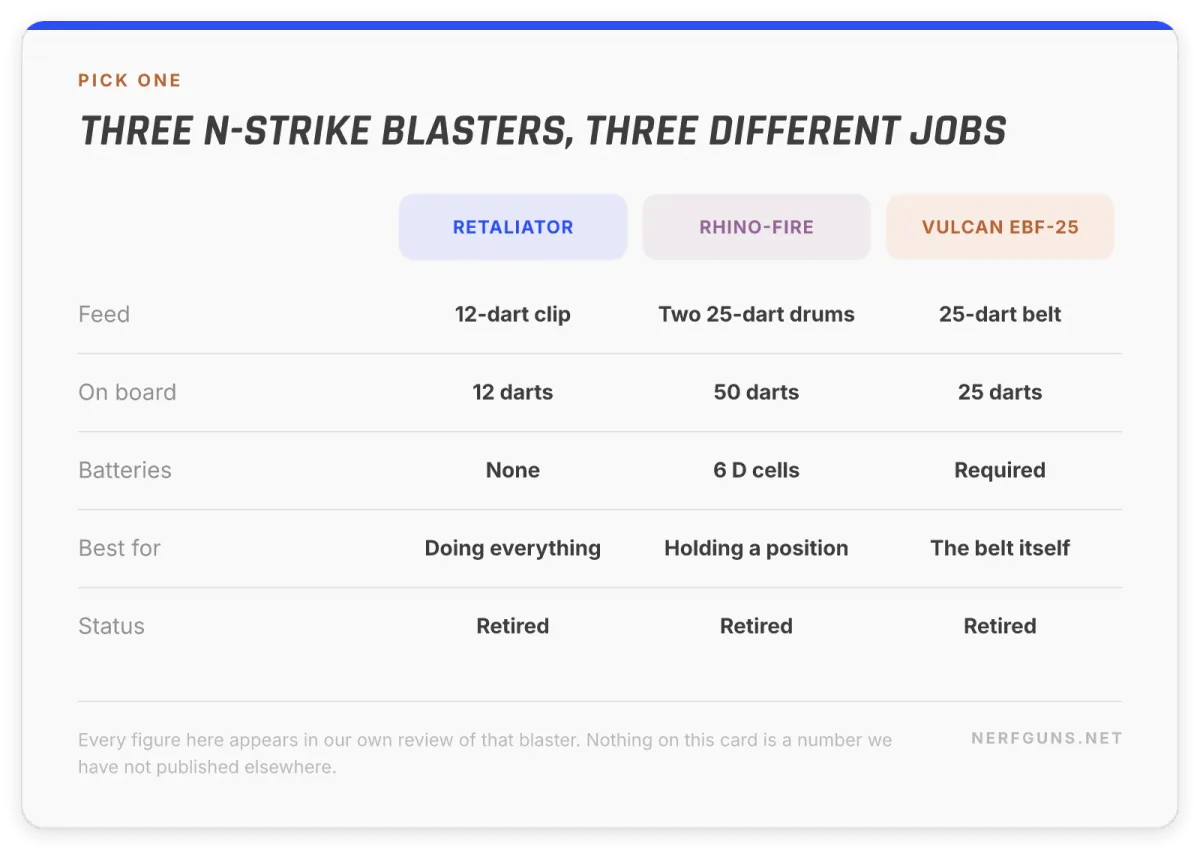
The Vulcan EBF-25 is the belt-fed original. Twenty-five darts on a visible belt, a stated 3 darts per second, and a removable tripod. It arrived in 2009 and nothing in the line worked like it before.
The Rhino-Fire is the Elite-era answer to the same idea, scaled up. Two barrels, two 25-dart drums for 50 darts on board, its own tripod, and a stated range of up to 90 feet. It runs on 6 D batteries, which is the running cost nobody mentions.
The Rapid Fire AS-20 takes a different route to the same goal. It is air powered rather than motorized, pumped by hand, and holds 20 darts in the chamber at once.
The Hailfire and the Rayven cover the middle ground: motorized blasters you can actually carry, which is the trade most players end up preferring.
Clip and drum blasters
This is the heart of the line and where most people should start.

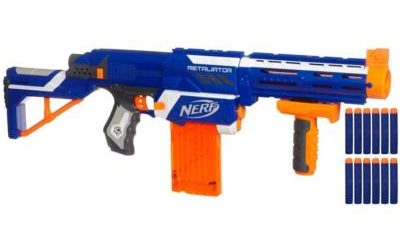
The Retaliator is the one to buy if you are buying one. A 12-dart clip, pump primed, no batteries at all, and it breaks down into four configurations: bare blaster, carbine with the stock, rifle with the barrel, or everything at once. It is the most versatile blaster in the line per dollar.
Its smaller ancestor is the blaster that taught the line what modular meant: detachable stock, removable barrel, light scope and a 6-dart clip. Our Recon CS-6 review covers the three builds it converts between and what to check on a used one.
The Longshot CS-6 and the Longstrike CS-6 are the long ones, both built around reach and both carrying a lot of removable parts. That last detail matters when you are buying used, because loose parts are the ones that go missing.
The Spectre REV-5 is the stealth option, and the Elite Centurion is the Mega-dart sniper that everyone wanted and nobody quite loved.
For the full model-by-model treatment of the Elite half, the N-Strike Elite buying guide is the deeper page.
Break-action and multi-dart blasters

The Barrel Break IX-2 is the standout here. Two barrels, hinge it open, two darts in, snap it shut and both fire. It carries eight spare darts in a rack on top and it needs no batteries, which makes it one of the more reliable used buys in the whole line.
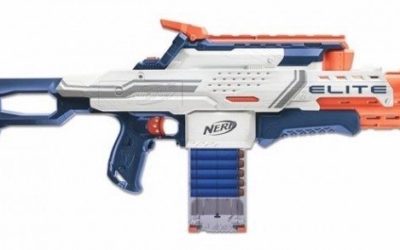
The Mega CycloneShock takes the same close-range idea onto the oversized Mega darts, and the Elite CamECS-12 is the oddity of the group, a blaster with a camera built into it.
Pistols and pocket blasters
Every loadout needs something small, and N-Strike had plenty.
The Maverick REV-6 is the famous one: a six-shot revolver-style sidearm with a chamber that flips out of the left side. It is the blaster the media reaches for whenever a Nerf product needs to be in shot, and it also got the collector treatment. Our clear special edition guide covers the transparent version and the rest of the collector runs.
If you want a sidearm from outside the line, the Zombie Strike Hammershot is the five-shot revolver we reach for most, and it uses the same Elite darts.
Building an N-Strike loadout
Buying blasters one at a time, without a plan, is how people end up with five things that do the same job. The line rewards a bit of structure, because the parts move between blasters.
Start with one clip-fed primary
Buy a pump-primed, clip-fed blaster first. It sets your ammunition standard, it gives you a stock mount and a rail to hang accessories on, and it works without batteries in any weather. The Retaliator is the obvious pick and the Recon is the cheaper way in.
Everything after this is built around that choice, which is the point of a modular line.
Add a sidearm you never have to think about
A pocket blaster with no batteries and no clip. It exists for the moment your primary runs dry with someone ten feet away, and its only job is to work. Small spring pistols are fine, and so is a five-shot revolver.
Buy clips before you buy a second blaster
This is the step most people skip and the one with the best return. Three loaded clips turn a 12-dart blaster into a 36-dart blaster with two seconds of downtime between them. A second primary costs many times more and does less for you in a game.
Then decide whether you want volume or reach
Volume means a motorized or belt-fed blaster and a fixed position to defend. Reach means something long with a barrel and a stock. Both are legitimate and neither is a first purchase.
If the answer is volume, buy in person and hear it run. If the answer is reach, count the removable parts in the listing photographs before you bid.
Accessories last, and fewer than you think
A stock genuinely helps. A sling genuinely helps. Most scopes on foam blasters are decoration, and every attachment adds weight to something you carry all afternoon. Our attachments guide is honest about which is which.
Mistakes that cost people money
Five things we see repeatedly when someone buys into this line secondhand.
- Buying a motorized blaster you have not heard run. Electronics fail silently after years in storage. Spring blasters tell you they are tired the moment you prime them. Motorized ones do not.
- Not counting the removable parts. The blasters with the most parts are the ones most often sold incomplete, and a long blaster without its barrel and stock is a different, much cheaper product than the listing implies.
- Paying a premium for range figures. Manufacturer ranges are measured at an angle in still air with fresh darts. They are comparable to each other and they are not what you will see across a yard.
- Ignoring the battery tray. Ask for a photo of the inside of it. Corrosion from a leaked cell is the single most common reason a used motorized blaster is dead on arrival.
- Buying darts to match the blaster. You do not need line-specific foam here. Elite refills run across the whole of N-Strike, which is exactly what makes the line cheap to own. Our dart guide covers which refills are worth buying.
The one-line version: check the parts count, check the battery tray, and never buy a motor you have not heard.
If you are moving to a current blaster, read this first
N-Strike is retired, so most people reading this eventually buy something current. There is one trap worth knowing about.
Hasbro’s newest lines, N Series and Loadout, fire N1 darts. Amazon’s own listings say those are compatible only with N Series blasters.
So the box of Elite darts you built up over years does not feed them. That is not a reason to avoid the new lines, it is a reason to budget for N1 refills as part of the blaster rather than a surprise afterwards.
What still takes your existing darts: anything Elite or Elite 2.0. If you want to keep one dart type across the whole cupboard, that is the shelf to stay on. Our N-Strike Elite guide covers it, and the Elite 250-dart pack is the cheap way to keep a retired collection firing.
What is still on shelves
Nothing. Being direct about it saves everybody time: N-Strike, N-Strike Elite, Mega and Modulus are all retired, and any N-Strike blaster you buy today is used or old stock.
What is on shelves is Elite 2.0 and the newer Rebel Ops line, both of which run the same Elite darts you already own. Our new Nerf guns guide covers what is currently in production.
The practical consequence for a used buyer: spring and pump blasters age far better than motorized ones. A pump blaster tells you it is tired the moment you prime it. A motorized blaster that has sat in a garage on leaking batteries tells you nothing until you power it up, and by then you have paid.
So if you are buying an N-Strike blaster sight unseen, favour the ones with no electronics. If you want a motorized one, buy it in person and hear it run.
Where Mega and Modulus fit
Both grew out of N-Strike and both are worth understanding before you buy, because they change one rule each.
Mega changes the ammunition. The darts are oversized and they whistle, and they only run in Mega blasters. That breaks the compatibility that makes the rest of the line cheap to own, so treat Mega as a separate commitment rather than an extension of your existing kit.
Modulus changes the accessories. It took the swappable-parts idea and sold the parts separately, with barrels, stocks, scopes and bipods as products in their own right. If you like building rather than buying finished blasters, that is the corner of the line to look at.
Both are retired alongside everything else here. Mega blasters in particular hold their value because the darts are scarcer, which is worth knowing before you assume a listing is overpriced.
The N-Strike blasters worth hunting down
- Retaliator, if you want one blaster that does everything. Four configurations, no batteries, standard clips.
- Barrel Break IX-2, if you want a sidearm with character. Two barrels, no batteries, genuinely satisfying to reload.
- Rhino-Fire, if you want to hold a position and you can hear it run before you pay.
- Vulcan EBF-25, if the belt is the whole reason, and only if the listing includes one.
- Recon CS-6, if you want the cheapest honest introduction to what the line is about.
Every one of those is a used purchase, and every one of them takes clips and accessories you can move to the next blaster you buy. That is the argument for N-Strike in one sentence.
And one for collectors. Several N-Strike blasters were also sold in limited colourways, and the Whiteout Series is the most coherent of them: the Deploy, Longstrike, Nite Finder and Maverick in arctic white, covering four different roles. Nothing inside them changed, so they shoot exactly like the standard versions.
Why a retired line is still the right answer for a lot of people
It sounds backwards to recommend blasters you cannot buy new, so here is the reasoning in plain terms.
A retired line has no premium on it. Nobody is paying for the newest thing, the accessories have stopped being sold at accessory prices, and the ammunition is still the current standard because Elite darts never went away. You get a modular platform with a decade of parts floating around it, at prices set by people clearing out a cupboard.
The one thing you give up is a warranty and the certainty that a blaster works. That is exactly why the checks in the section above matter more here than they would on a shelf purchase.
Buying N-Strike secondhand
Every N-Strike blaster is out of production, so this is a used-market hunt rather than a shopping trip.
Amazon occasionally has old stock, but eBay is where these actually change hands: Retaliator on eBay | Recon CS-6 | Longshot CS-6 | N-Strike lots and clips.
| What to check | Why it matters |
|---|---|
| Does it prime firmly | Springs weaken over a decade. A soft prime is the most common fault and the hardest to fix cheaply. |
| Are the clips included | Clips get separated and sold on their own, and a clip-fed blaster with no clip is half a purchase. |
| Battery bay condition | On anything motorized, these sat in cupboards with batteries in. Ask for a photo of the contacts. |
| Stock and barrel present | The attachments are worth more separately, so sellers often part them out. |
| Dart type | These take Elite darts, which are still made. That is the one thing you do not have to hunt for. |
Where to buy
As an Amazon Associate and eBay Partner, we earn from qualifying purchases.
- Current N-Strike listings on Amazon, which is the honest link for a retired line.
- N-Strike Elite 250-dart pack, the ammunition the whole line runs on.
- N-Strike Flip Clip, if you want more clips for what you already own.
- Safety glasses, which are not optional whatever you end up buying.
Bonus tip: hunting a retired line takes months, not an afternoon. Save the blasters and clips you are still missing so you know what to grab when one finally shows up at the right price.
Frequently asked questions
What is the difference between N-Strike and N-Strike Elite?
Era and colour, mostly. Original N-Strike is the yellow and orange generation. N-Strike Elite is the 2012 to 2019 refresh in blue and white, with the Elite dart and longer stated ranges. Clips and accessories cross between them.
Do N-Strike clips fit Elite blasters?
Yes. Any 6, 12 or 18 dart N-Strike or Elite clip drops into any clip-fed blaster in either era. That interchangeability is the main practical reason to buy into the line.
Is N-Strike discontinued?
Yes, along with N-Strike Elite, Mega and Modulus. Everything is used or old stock now. Elite 2.0 and Rebel Ops are the current lines and they use the same Elite darts.
What darts do N-Strike blasters use?
Elite and Streamline darts. Elite refills are easy to find and work across the line, so ammunition is not a barrier to owning a retired blaster.
Which N-Strike blaster should I buy first?
The Retaliator. It needs no batteries, it takes standard clips, and it converts between four configurations, so it covers more situations than anything else at its size.
When did the N-Strike line start?
Our own archive dates it to the mid 2000s, and the earliest blasters we have reviewed from the line come from that period. Two pages on this site have carried slightly different start years for the line over the years, so we are giving you the range rather than picking one and pretending it was verified.
Are N-Strike and Elite darts the same?
Elite darts run in both eras, which is what makes the line practical to own today. Original N-Strike blasters were designed around Streamline darts, so a very old blaster may feed slightly differently, but you are not hunting a discontinued ammunition type to use one.
Do N-Strike attachments fit any blaster?
Any blaster with a stock mount and a tactical rail takes most of the available attachments, and that covers most of the clip-fed models in both eras. Blasters without a rail, mainly the small pistols, take nothing.
Are N-Strike blasters worth buying used?
The spring and pump ones, yes, and they are among the safest secondhand blaster purchases there are. The motorized ones are worth buying used only if you can hear them run first. See every blaster we have covered for the wider picture.
Every N-Strike article on the site

Recon CS-6 Review: The Best Nerf N-Strike Classic, 3 Builds
The Nerf N-Strike Recon CS-6 is a Nerf blaster that will allow even the most creative minds to be transformed to another time and place. It is created from five different interchangeable parts that allow the user to assemble and rearrange the blaster in any number of combinations.

Nerf N-Strike Elite Mega Cyclone Shock
The Mega CycloneShock is the big-bore revolver of the Mega line: 6 whistling darts in a flip-out drum, no batteries, one prime per shot. This page used to be a pre-release rumour piece and it got the line wrong. Here is the corrected version, and what the blaster is...
Nerf N-Strike Elite Rhino-Fire
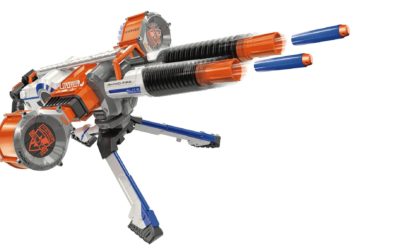
The Rhino-Fire is the closest Hasbro ever came to putting a mounted, belt-fed monster in a backyard. Two barrels, a tripod, and 50 darts on board before you reload anything. Here is what it actually does, and the two things that will annoy you before your first game...
Nerf N-Strike Elite Cam ECS-12
The Elite Cam ECS-12 is the blaster Nerf built around a video camera. Everything else about it is a competent clip-fed Elite rifle. The camera is the reason it exists, and the reason it cost more than its siblings. So the buying decision comes down to one question. Do...
Nerf N-Strike Elite Centurion
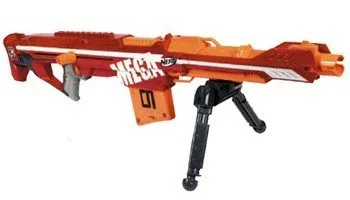
The Centurion is the blaster Hasbro put a 100 foot number on. People have argued about that number ever since. It is a clip-fed Mega rifle with a bolt, a bipod and a great deal of length. Here is what it actually is, what the 100 feet means, and who should still want...
Nerf N-Strike Elite Retaliator
The Retaliator is the blaster I hand people who ask what one blaster does everything. Clip fed, pump primed, four configurations, and not a single battery. Here is what it does well. Here is what to check before you buy a used one. And here is the one thing that turns...
Nerf N-Strike Elite Hailfire
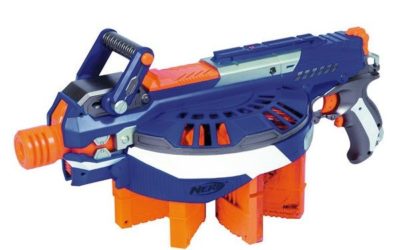
The Hailfire is the blaster with the rotating rack of clips, and the headline number is 144 darts. That number is real and it is also the most misleading thing about it. Here is what the Hailfire actually is, what our own archive got wrong, and who should buy one....
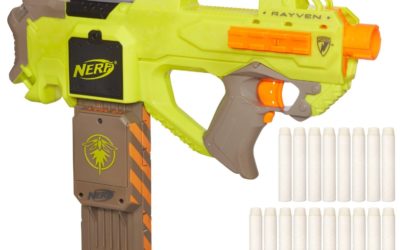
Nerf N-Strike Rayven CS-18
The Rayven CS-18 is the flywheel blaster that got the balance right: 18 darts, a compact body, glow-in-the-dark everything, and four AA batteries doing all the work. We have run one for years. Here is what it is genuinely good at, and the one thing that will annoy...
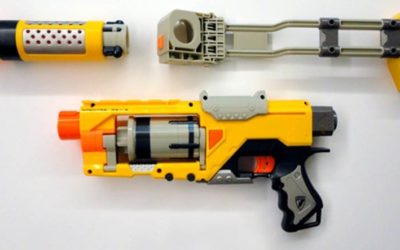
Nerf N-Strike Spectre REV-5
The Spectre REV-5 is a 5-shot revolver that comes apart into three different blasters. Stock on, barrel on, both off, and each configuration genuinely changes what it is for. That flexibility is the whole reason people still hunt for one, and here is what it costs...
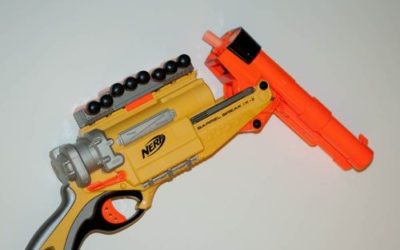
Nerf N-Strike Barrel Break IX-2
The Barrel Break IX-2 is the compact double barrel. Break it open at the hinge, drop two darts in, snap it shut, and both are ready. It is one of the few Nerf blasters that is genuinely satisfying to reload. That is most of why people still search for it 15 years...