The Rhino-Fire is the closest Hasbro ever came to putting a mounted, belt-fed monster in a backyard. Two barrels, a tripod, and 50 darts on board before you reload anything. Here is what it actually does, and the two things that will annoy you before your first game is over.
What is on this page
- The short verdict
- What you get with the Rhino-Fire
- Range and accuracy
- The battery bill nobody warns you about
- Handling, the tripod and the reload
- Where the Rhino-Fire actually wins
- Mod potential
- If the Rhino-Fire is not it
- Buying a Rhino-Fire secondhand
- What to buy now that it is gone
- Where to buy
- Frequently asked questions
The short verdict

- 50 darts on board, split across two 25-dart drums, which is more ready ammunition than anything else in the N-Strike Elite line.
- Two barrels that alternate, so the firing rhythm is a steady stutter rather than one long stream.
- A detachable tripod that turns it into a fixed position instead of a blaster you carry.
- 6 D batteries, not included, and that is a real cost every time.
- Heavy. This is a two-hand blaster at minimum, and honestly a two-hand blaster you would rather set down.
Buy it if you want to hold a doorway, a hallway or one end of a yard. This is a blaster that stays put, and that is the whole point of it. Skip it if you move, flank, or play anywhere you have to carry your loadout more than about 20 feet.
That is the whole argument in two sentences. Everything below is why.
What you get with the Rhino-Fire
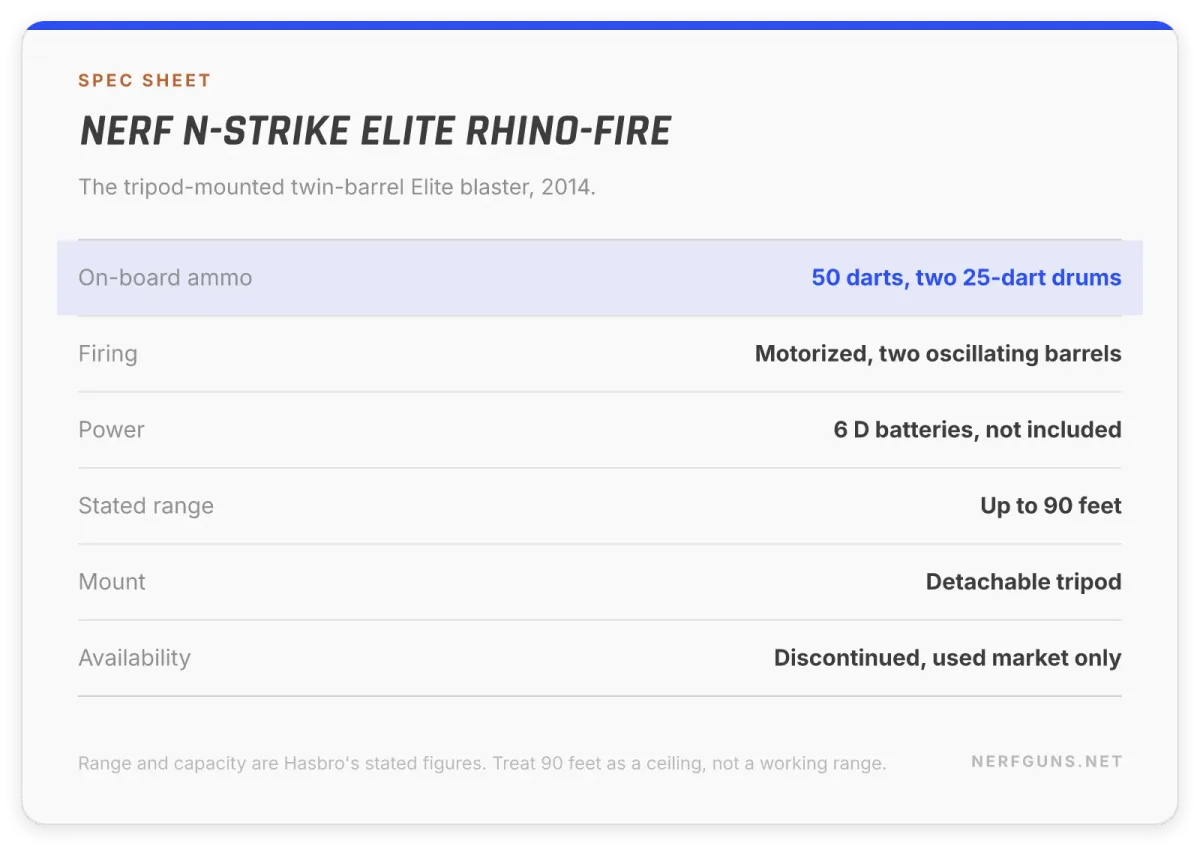
The Rhino-Fire is a motorized N-Strike Elite blaster with two barrel assemblies side by side. Each one takes its own 25-dart drum. Both drums feed at once, and the barrels oscillate, so darts leave alternately rather than from one fixed point.
The tripod is the part that defines it. It detaches, and the blaster works held, but the thing was designed around being placed. Set it on the ground at the end of a hallway and it stops being a toy you aim and becomes a position you defend.
Hasbro’s stated range is up to 90 feet. That is the number printed on the box, and it gets repeated everywhere. It is also the one figure on this page worth being careful about, so it gets its own section below.
What the two drums actually change
Fifty darts sounds like a specification. In a game it is a behaviour change.
Every other blaster in your kit makes you think about the reload. An 18-dart clip is roughly one engagement. A 12-dart clip is less. You fight, you count, you fall back and reload. The Rhino-Fire removes that clock for a stretch long enough that most backyard games end before it does.
Then it runs dry. Now you are loading 50 darts by hand into two drums, and nobody is covering you while you do it.
Range and accuracy
Up to 90 feet is Hasbro’s figure, and “up to” is doing the work in that sentence. Manufacturer ranges are measured at an angle, on a fresh set of batteries, with new darts, in still air. Every one of those conditions flatters the number.
Treat 90 feet as a ceiling. What you get on a flat shot across a yard is meaningfully less, the same way it is meaningfully less on every other blaster quoted this way. We have not chronographed a Rhino-Fire ourselves, so we are not going to publish a competing figure and pretend it is measured.
Here is the more useful truth about accuracy. This is not a blaster you aim, it is a blaster you point. The oscillating barrels spread darts by design, and a spread is the opposite of a group.
That sounds like a criticism and it is not. Area denial is the job. Want one dart in one place? That is what a pump-action blaster is for. The N-Strike Elite Retaliator does it better, at a fraction of the size.
The battery bill nobody warns you about
Six D batteries. Not included.
D cells are the expensive ones, they are the heavy ones, and six of them is a real purchase every time the blaster goes flat. This is the single most common complaint from people who own one, and it is completely fair.
Two things worth knowing before it bites you.
- Motor performance falls with the batteries. On a motorized blaster, tired cells mean slower flywheels, and slower flywheels mean shorter range. The blaster does not stop working, it quietly gets worse, which is harder to notice than a flat battery.
- Rechargeable D cells exist. If the Rhino-Fire is going to be a regular part of your games rather than a novelty, that is the difference between a running cost and a one-off.
Budget for the batteries as part of the blaster and the ownership experience improves immediately.
Handling, the tripod and the reload
It is big and it is heavy, and both of those are the point rather than a flaw. What matters is that you decide up front how you are going to run it.
On the tripod, it is excellent. Set it low, cover a fixed line, and let the 50 darts do what 50 darts do. In a game with any kind of objective or base, this is a genuinely strong piece of equipment.
Off the tripod, it is a heavy two-handed blaster with no stock. You can run it. You will not enjoy running it very far.
The reload is the honest cost of the design. Two drums, 25 darts each, loaded by hand. There is no clip to swap and no speedload path. Plan your reloads for the gaps in a game, not for the middle of a fight.
Where it fits in a loadout
Nobody should carry a Rhino-Fire as their only blaster. It works as the anchor of a position with a sidearm on your hip for when someone gets inside your arc.
A five-shot revolver is the classic pairing, and the Zombie Strike Hammershot is the one we reach for. Small, no batteries, and it does not care that your main gun is bolted to the ground.
Where the Rhino-Fire actually wins
Most reviews of a blaster this size stop at “it is big and it is fun”. That is true and it is not useful, because whether the Rhino-Fire is a good buy depends almost entirely on what you play.
Games it is built for
Base defence and objective games. Anything with a flag, a point to hold, or a room that matters. The blaster stays, the fight comes to it, and 50 darts on board means you are never the one who has to break contact to reload.
Humans versus Zombies. The format is built around a last stand, and a last stand is exactly what a tripod blaster is for. Set it covering the one approach that matters and let the volume do the work. Our war games page covers the formats worth running properly.
Indoor hallways. A corridor is a fixed line by definition, which is the one shape the Rhino-Fire fits perfectly. It is also the environment where its spread stops being a weakness, because there is nowhere for anyone to go sideways.
Games it is wrong for
Anything with respawns and movement. If the game rewards flanking, the Rhino-Fire is a liability. You will spend the round either sitting behind it while the fight moves elsewhere, or carrying nine pounds of blaster to catch up.
Outdoor open field. A field has no chokepoint to cover, so the tripod’s advantage disappears and the weight stays.
Younger players on their own. This is a heavy blaster with a hand-loaded 50-dart reload. It is a great blaster to set up for a game, and a frustrating one for a small player to run unsupported.
Here is the summary that saves people money: the Rhino-Fire is equipment, not a weapon you carry. Buy it the way you would buy a net for a garden game. It makes a certain kind of afternoon much better, and it does nothing at all for the other kind.
Mod potential
The Rhino-Fire is a motorized platform, which puts it in the category where modding actually pays. On a spring blaster you are fighting a plunger. On a flywheel blaster you are feeding motors, and motors respond to being fed better.
The honest warning first: this is not a beginner project. Two motors, two feed paths, and a lot of shell to get through. That is a harder first teardown than a single-barrel blaster. It is easy to end up with an expensive discontinued blaster in pieces.
Want the whole ladder of what is worth doing, and in what order? Our Nerf gun mods guide covers it properly. That includes the battery and wiring side, which decides whether a motor swap does anything at all.
One upgrade costs nothing and improves every session. It is not really a modification at all. Keep two full sets of D cells and swap them between games. A motorized blaster running on half-flat batteries is the most common reason someone decides a Rhino-Fire is disappointing, and it is entirely fixable.
The second free improvement is dart discipline. Foam that has been stepped on, soaked, or fired a hundred times feeds worse and flies shorter. A blaster holding 50 darts shows that up much faster than one holding 6. Retire tired darts instead of cycling them back into the drums.
The cosmetic route is the safer one. A Rhino-Fire has more surface area than almost anything else Nerf has made. That makes it a great paint project. Our paint series walks through prep, primer and clear coat.
If the Rhino-Fire is not it
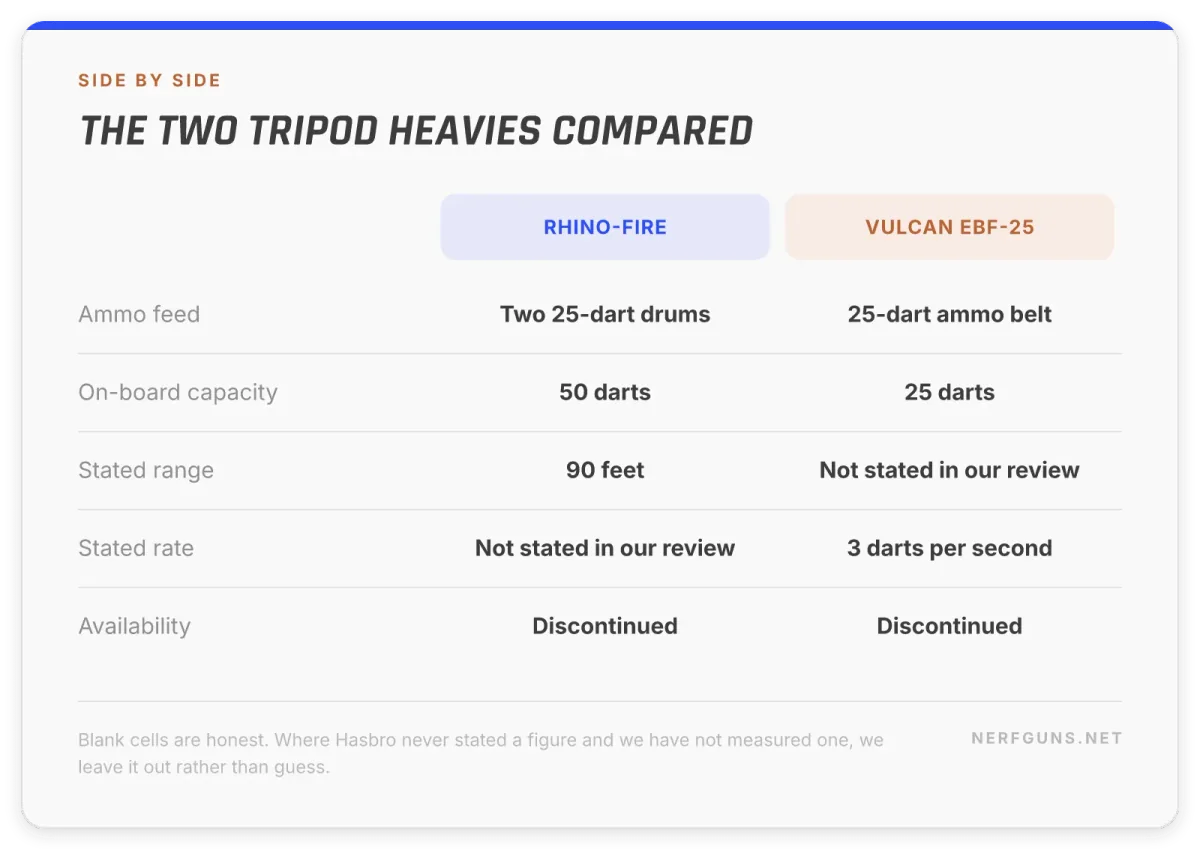
Three honest alternatives, depending on which part of the Rhino-Fire you actually wanted.
You wanted the tripod and the belt

The N-Strike Vulcan EBF-25 is the original of this idea and it is still the one people picture when they say Nerf machine gun. It feeds from a 25-dart belt at a stated 3 darts per second and it has its own removable tripod.
Half the on-board ammunition of the Rhino-Fire, and a belt instead of drums, which some people prefer purely because watching a belt feed is satisfying.
You wanted the volume without the size
A clip-fed motorized blaster gives you most of the suppression and none of the immobility. You give up the 50-dart buffer and you get to move, which in most games is the better trade. The N-Strike Elite lineup covers the options at that size.
You wanted the biggest thing available
Was the appeal scale rather than the mechanism? Our guide to the biggest Nerf guns ranks them properly. The machine gun style blasters page covers the motorized ones still on shelves.
Buying a Rhino-Fire secondhand
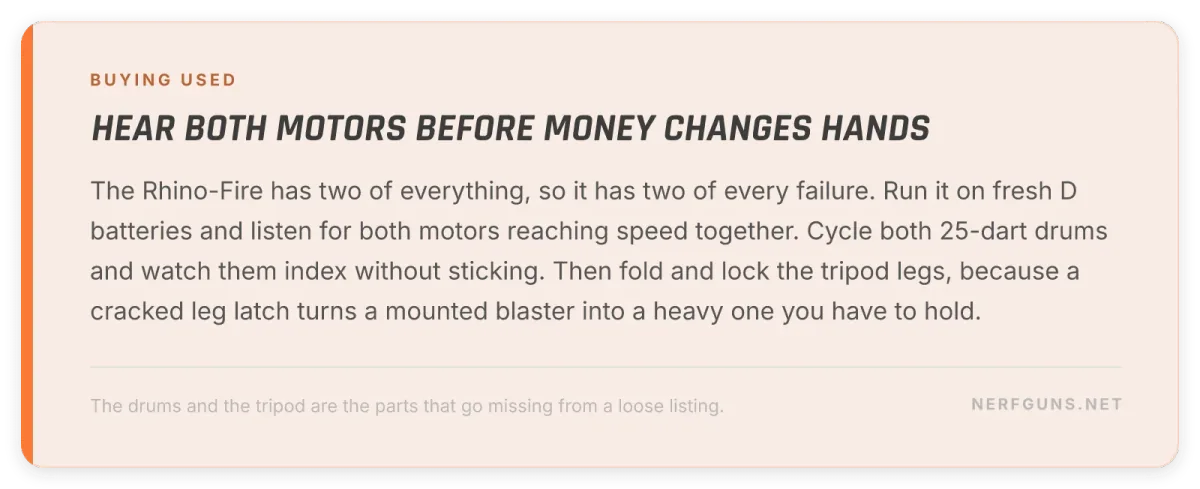
The Rhino-Fire is discontinued. Any one you find now is the used and old-stock market, so this is a secondhand purchase and it should be inspected like one.
It is also a harder used buy than most, for a specific reason: it is motorized, and motorized blasters fail invisibly. A spring blaster tells you it is tired when you prime it. A flywheel blaster can sit in a garage for eight years on a set of leaking D cells and tell you nothing. Not until you power it up.
So the rule is simple. Do not buy a Rhino-Fire you have not heard run.
What to check, in order:
- Both motors. Put fresh batteries in and listen. Two barrels means two motor assemblies, and one of them being weak or dead is the most expensive failure on this blaster.
- The battery tray. Look for the white and green crust of a leaked cell. Corroded contacts are sometimes cleanable and sometimes the end of the blaster.
- Both drums. They should rotate and index cleanly. A drum that sticks will jam mid-burst every time.
- All three tripod legs. They fold, so they have latches, and latches snap. A Rhino-Fire that will not stand up has lost the thing that made it worth owning.
- Completeness. Two drums and a tripod. A listing with one drum is a much cheaper blaster than the price is usually asking.
Darts are the easy part. Any standard Elite dart runs in it, so a missing dart count is not a reason to walk away. Our dart buying guide covers which refills are worth it.
The Rhino-Fire is gone, so what do you buy now?
The Rhino-Fire is discontinued. Here is the honest answer, in two parts.
Nothing on shelves today sits on a tripod. That is the part people actually want, and Nerf does not make it any more. If you want a blaster you set down and defend a doorway with, the used market is your only option. No new blaster is going to give you that.
But if what you wanted was the noise and the volume, that is easy. The Nerf Loadout Galactic Commander is motorized with 3 firing modes, including full auto. It ships with 48 N1 darts and two 18-dart clips, so you load one and keep the spare in the stock. Hasbro rates it 8+.
You trade 50 darts on board for 18 in the clip. What you get back is the ability to move, which in most games is the better deal. The Rhino-Fire made you choose a spot and stay in it.
One catch, and it catches everybody.
- Loadout blasters fire N1 darts, not Elite darts. Nerf’s own listings say N1 darts are compatible only with N Series blasters, so the foam from your Rhino-Fire will not feed one.
- That also means no more D cells. Budget for N1 darts instead of a shelf of batteries.
Bonus tip: nobody ever guesses the right blaster. Put the one you actually want on a free wish list, then send the link to whoever keeps asking what you want for your birthday. Start your free Nerf wish list and let them buy the right thing.
Where to buy
As an Amazon Associate and eBay Partner, we earn from qualifying purchases.
The Rhino-Fire is out of production, so listings appear and disappear and the price moves with them.
- Nerf N-Strike Elite Rhino-Fire on Amazon, the blaster itself, used or old stock.
- Current Rhino-Fire listings, which is the more reliable link when the main one is out.
- N-Strike Elite 250-dart pack, because 50 darts per fill goes faster than you think.
- Rechargeable D batteries, the single best purchase you can make alongside it.
- Used Rhino-Fire listings on eBay, usually the better hunting ground for a blaster that left shelves years ago.
If you would rather buy something currently in production, our guide to the new Nerf guns covers what is actually on shelves.
Frequently asked questions
How many darts does the Rhino-Fire hold?
50, in two 25-dart drums that feed the two barrels independently. That is the most ready ammunition of anything in the N-Strike Elite line.
What batteries does it take?
6 D batteries, and they are not in the box. Rechargeable D cells are worth the up-front cost if you plan to use it more than a couple of times.
How far does the Rhino-Fire shoot?
Hasbro states up to 90 feet. That is a manufacturer figure measured under favourable conditions, so treat it as a ceiling rather than what you will see on a flat shot in a yard.
Is the Rhino-Fire fully automatic?
It fires continuously while you hold the trigger, with the two barrels alternating. The result is a steady alternating stream rather than a single fast stream from one barrel.
Is it still being made?
No. It is discontinued, so every one available now is used or old stock. See the secondhand checks above before you commit to a listing.
Can you use it without the tripod?
Yes, the tripod detaches. It is heavy and there is no stock, so handheld works for short bursts rather than for a whole game.
What darts does the Rhino-Fire use?
Standard Elite darts, the same ones most of the N-Strike Elite line runs. There is no proprietary ammunition to hunt down, which is one of the reasons a used one is still practical to own years after it left shelves.
Can one person carry and use it in a game?
Carry it to a spot, yes. Fight with it while moving, not really. Set it up as part of your pre-game, never under pressure. Then pair it with a sidearm for anything that gets close.
Why is the Rhino-Fire so expensive secondhand?
Two reasons that have nothing to do with performance. It was a full-size flagship, so fewer sold than a mid-range blaster. It is also the one people remember. Demand outlives supply. A complete example with both drums and the tripod carries most of that premium, which is exactly why the completeness check above matters.
Is there a modern version of the Rhino-Fire?
Not really. Nothing Nerf makes today comes with a tripod, so the fixed-position idea is gone. The closest motorized blaster on shelves is the Loadout Galactic Commander, which has 3 firing modes including full auto. It carries 18 darts in a clip rather than 50 in two drums, and it fires N1 darts, so your old Elite foam will not work in it.
Is the Rhino-Fire worth buying now?
If you want a fixed-position blaster with a big ammunition buffer and you can hear it run before you pay, yes. If you want something to carry and move with, almost anything else in the N-Strike line is a better answer.
It’s Nerf or Nothin’!