
Nerf accessories divide cleanly into 2 groups: the ones that change how a game goes, and the ones that change how a blaster looks. Both are fine, and knowing which is which saves you a cupboard full of plastic you never fit.
This page covers every accessory type worth knowing, what each one actually does, and the 3 loadouts they add up to.
Who this page is for: anyone who owns a blaster and is wondering what to buy next, and anyone about to spend on an attachment because it looked good on a shelf.
What is on this page
- The accessories that actually change a game
- Clips, drums and carrying ammunition
- Stocks, grips and sights
- Barrel extensions, and the myth about them
- Holsters, vests and a second blaster
- The novelty attachments
- N-Force, the melee side of the accessories range
- The current-gen accessories: Loadout and N Series
- Ammo refills by line
- Three loadouts that work
- Will it fit your blaster?
- Storing accessories so you can find them
- Accessories to skip
- Where to buy
- Frequently asked questions
The accessories that actually change a game
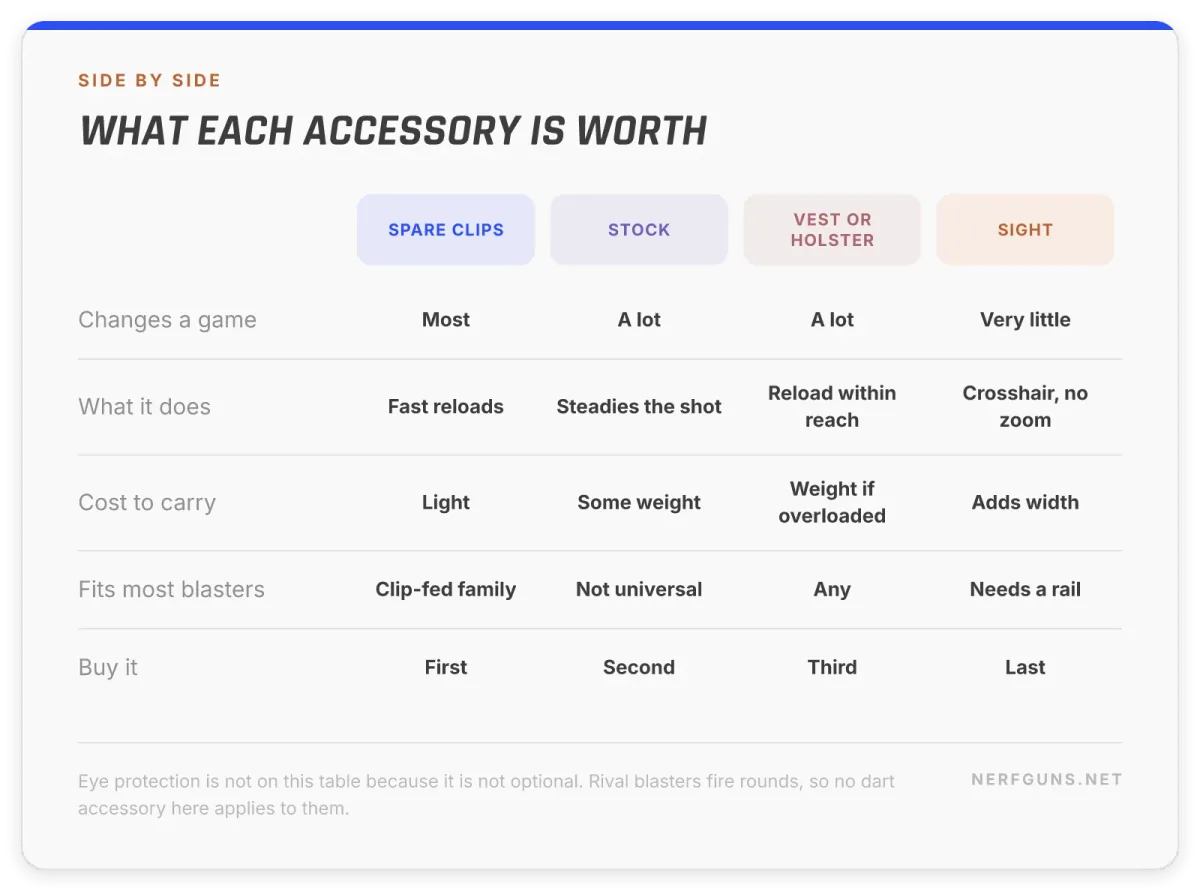
If you buy nothing else, buy these 4. Everything further down this page is a refinement of them.
- Spare clips. The single biggest upgrade available to anyone with a clip-fed blaster, and it is not close.
- Somewhere to put those clips. A vest or a holster. A spare clip in a trouser pocket is a spare clip you will not reach in time.
- A stock. Shoulder contact is what turns a blaster’s stated range into a distance you can actually hit at.
- Eye protection. Not glamorous, and the only accessory on this page that is genuinely not optional.
Notice what is missing: sights and barrel extensions. They are the 2 accessories people buy first and they are the 2 that change least, for reasons the sections below go into.
Clips, drums and carrying ammunition

This is where accessories stop being decoration and start being equipment. A reload you can do without looking down is worth more than any other change you can make.
Small clips hold fewer darts and that is partly the point. They are light, they sit flat against a vest, and you can carry several. Three 6-dart clips beat one 18-dart clip in almost every game, because the pause between them is 2 seconds instead of a minute.
Large clips trade weight for fewer reloads. They stick out further, which matters more indoors than people expect, and they are slower to fill.
Drum magazines carry the most and change what your blaster is. A drum is heavy, slow to load, and superb if your role is to hold one position rather than move. Treat it as equipment for a defensive spot rather than a general upgrade.
Ammo holsters are the cheap accessory nobody buys and everybody should. They put the reload where your hand already is.
Fill your clips before the game, not during it, and read our dart and ammo guide for which foam is worth putting in them.
Stocks, grips and sights
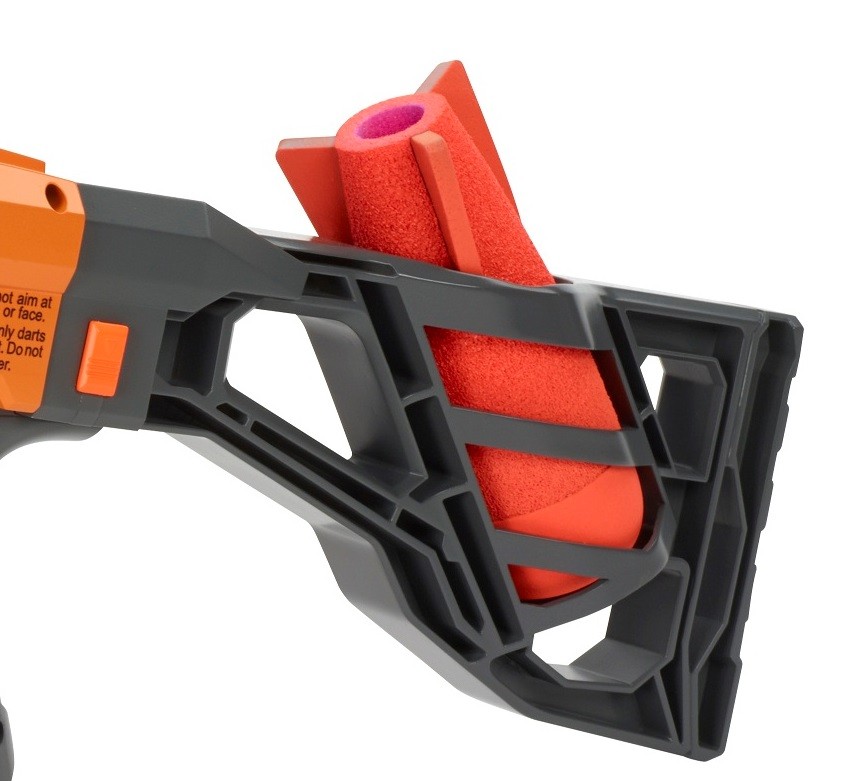
These 3 accessories are all about holding the blaster still, and they are worth very different amounts.
A shoulder stock is the one that works. Bracing against your shoulder steadies the blaster far more than any grip, which is why a stock is on the short list at the top of this page. Some stocks, like the one packaged with the Stockade, also store spare darts.
A collapsible stock is the same benefit with a size switch. Extend it for a considered shot, collapse it for a corridor. If you play indoors and outdoors on the same day, this is the better buy.
A front grip helps, modestly. It steadies your leading hand and it takes some getting used to, because your hand naturally wants the blaster’s body. Worth having, not worth prioritising.
A sight is the accessory people overrate most. Nerf sights carry a crosshair and no magnification. At the distances a foam dart actually travels, a crosshair adds much less than a stock does, and it adds width to catch on a doorframe.
These parts are also the first things missing from a used blaster, which is covered in our where to buy guide.
Barrel extensions, and the myth about them
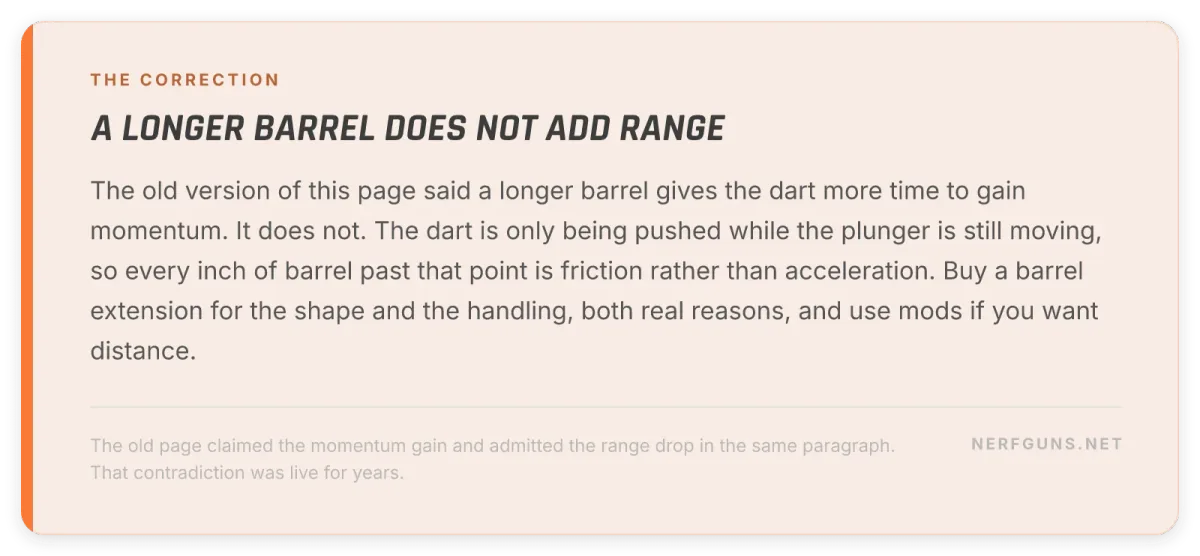
This section exists because the old version of this page got it wrong, and the wrong version is repeated all over the internet.
The claim: a longer barrel gives the dart “more time to gain momentum” before it leaves.
Why that is wrong: the dart is only being pushed while the plunger is still moving. Once that stroke ends, every extra inch of barrel is friction, not acceleration. A longer barrel cannot add speed after the air has stopped pushing.
What a barrel extension actually does is change the shape and balance of the blaster, and give you something to hold. The old page admitted the range drop in the same paragraph where it claimed the momentum gain, which is a contradiction that survived years of readers.
So buy one for the look and the handling, both of which are real reasons. Do not buy one expecting a better shot. If range is what you want, our Nerf mods guide covers what actually delivers it: better darts, then air restrictors, then the seal, then the spring.
Holsters, vests and a second blaster
Carrying accessories are the least exciting category of the lot and the one that most changes how a long game feels.
A hip holster for a sidearm is the highest-value item here. A primary that is dry or jammed is a stick until you can reach something else, and reaching means the blaster is already on your hip rather than in your other hand.
A tactical vest spreads clips and darts across your chest where both hands can reach. The trap is loading it fully because you can. Every dart on that vest is weight, and a fully loaded vest slows you down more than the extra ammunition helps.
Both together is not overkill if you are playing a long format. Ammunition on the vest, blaster on the hip.
Our Nerf vest guide covers the ones worth owning and how to load one without turning yourself into a slow target.
The novelty attachments
These are the Nerf accessories that sell themselves on a shelf. They are fun, and it is worth being clear about what you are buying.
Under-barrel rocket attachments fire an oversized foam rocket alongside the normal darts. Compatibility is narrow, the whole assembly is heavy, and it is unmistakable when one lands. Bought for the moment rather than the game.
Blast shields are translucent panels that mount to a blaster, so you can look through them rather than over them. They pair with a defensive role and a drum magazine, and they are dead weight in every other situation.
Light and sound attachments do exactly what you would expect. On a stealth-focused loadout they are actively counterproductive, which our stealth blaster guide explains.
None of these are mistakes. They are just accessories bought for enjoyment rather than for advantage, and knowing that before you spend is the whole point of this section.
N-Force, the melee side of the accessories range
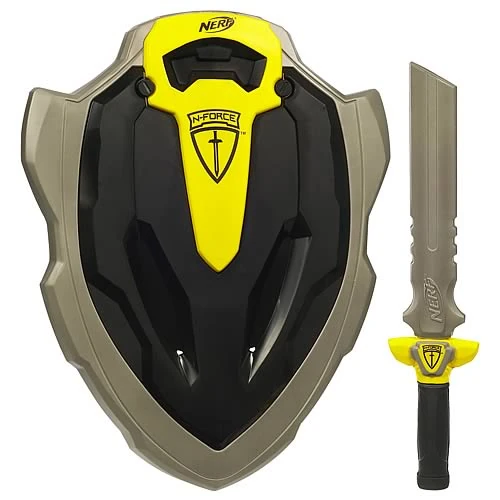
Not every accessory bolts onto a blaster. N-Force is Nerf’s foam melee line: swords, axes, maces and shields, built for the moment somebody closes the distance and your blaster is empty.
They matter more than they look. In Humans versus Zombies and similar formats, the zombie side often carries no blaster at all, and a foam melee weapon is the entire loadout.
Our coverage splits across 2 pages: the original N-Force line for the first wave, and the 5 later N-Force weapons for what came afterwards, including which of them survive an actual game.
A shield is the one to try first if you are curious, because it changes how you can approach a defended position more than any blaster accessory on this page.
The current-gen accessories: Loadout and N Series
Something changed in 2025, and it matters for this page.
Nerf built a whole line around swapping parts. Loadout blasters ship with interchangeable attachments designed to move between blasters in the line, and Hasbro claims over 1,000 combinations. Treat the number as marketing. The idea is not marketing: for the first time the factory is selling what modders have been doing for years.
If accessories are your thing, this is the line to start in. The Nerf Loadout Shadowspeed Recon is the clearest example, because it comes with a 14-dart storage attachment, so your reloads ride on the blaster instead of in a pocket. That is the “somewhere to put those clips” rule solved in the box.
The Nerf Loadout Galactic Commander is the motorized one, with 3 firing modes and 3 attachments, and the Nerf Loadout FlareFusion is the cheap way in, with a revolving 6-dart cylinder and bolt action priming.
Note: Loadout and N Series both fire N1 darts, and Amazon’s own listings say N1 darts are compatible only with N Series blasters. So the darts in your cupboard almost certainly do not fit them. Budget for N1 refills as part of the blaster, not as an afterthought.
N Series also sells accessory-shaped bundles rather than single blasters. The Nerf N Series Gear Up Pack and the Nerf N Series Party Pack are the two worth knowing about if you are kitting out more than one player. Both are still in production and both sell out on Amazon regularly, so those links show what is in stock today, and eBay lists the N Series packs when Amazon has none.
Ammo refills by line
Empty clips are just plastic. Here is what actually fits what.
| Your blaster | What it takes | Refill |
|---|---|---|
| N Series, Loadout | N1 darts, and nothing else | N1 darts, 100 pack |
| Elite, Elite 2.0, most N-Strike | Elite darts, the widest fit there is | Elite darts, 250 pack |
| Rival, Nerf Pro | Rival rounds, foam balls not darts | Rival Accu-Rounds, 50 pack |
| Zombie Strike | Elite-compatible darts | Zombie Strike dart refill |
| Vortex | Discs, which fit nothing else at all | Vortex VTX disc refill |
Buy the ammo your blasters already use, or accept that you are starting a second pile. That is the whole rule.
One safety note on that Rival row. Rival and Nerf Pro sit on Amazon’s Competitive Class shelf, which Hasbro markets to older players, and the rounds fly harder than foam darts. Amazon states no age on the refill listing itself, so we do not print one. Treat Rival ammo as gear for the competitive end of the hobby, not as a top-up for a younger child’s blaster, and wear eye protection with it.
Three loadouts that work
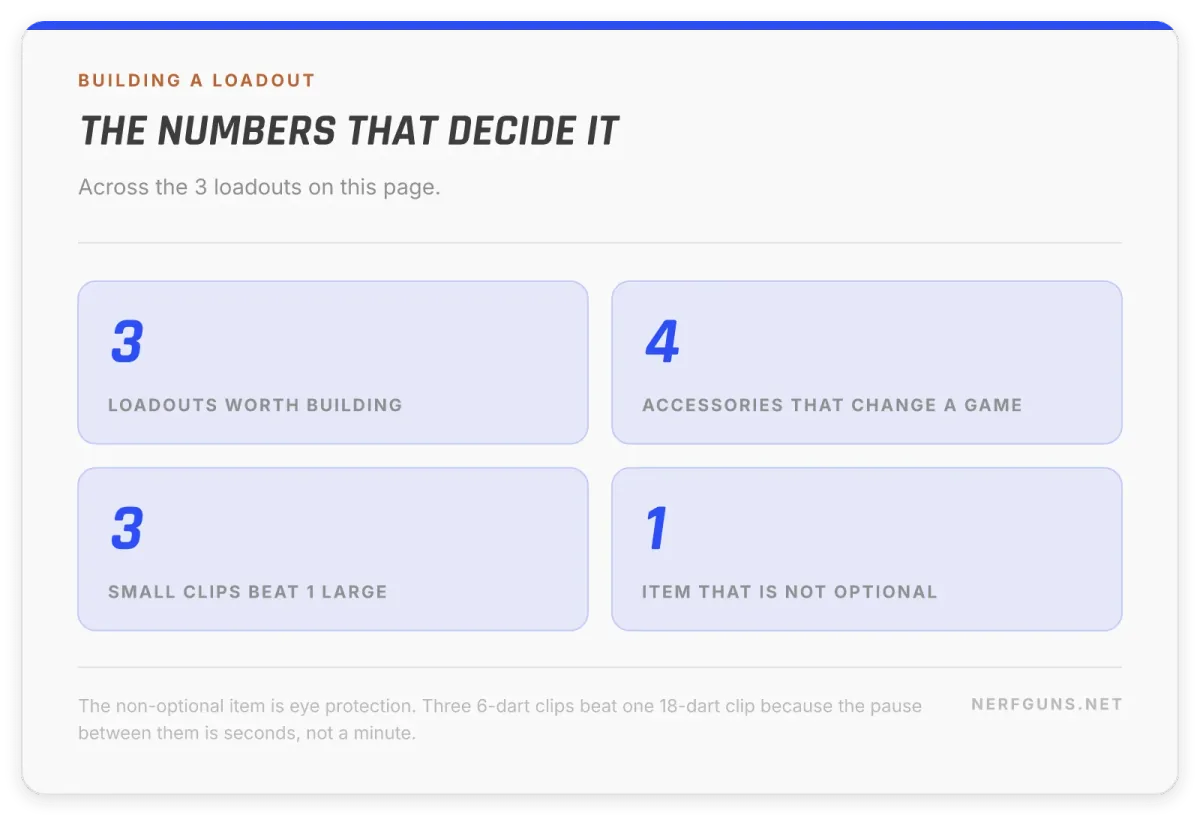
Nerf accessories only make sense as a set. These are the 3 combinations worth building toward.
The marksman loadout
A clip-fed primary with a stock, a front grip and 3 small clips on a vest. The stock is doing the work here. Skip the sight and skip the barrel extension, and spend the difference on darts.
Best for open ground and for anyone who would rather place a shot than throw 5.
The all-round loadout
A clip-fed primary with a collapsible stock, a hip holster with a battery-free sidearm, and a mix of small and large clips. This is the loadout most people should build, because it adapts instead of committing.
Our guide to the best Nerf gun to buy, mod and take to war covers which primary to build it around.
The heavy loadout
A high-capacity blaster with a drum magazine, a blast shield, a vest carrying the refills and no expectation of moving quickly. This is a role rather than a preference, and it only works if your team has somebody else doing the moving.
The Nerf machine guns page covers the blasters this loadout is built on, and the battery costs that come with them.
Bonus tip: An accessories list is basically a wishlist already. Save the parts you want, then send the link to whoever keeps asking what you want for your birthday.
Start your accessories wishlist, or see one first. Grandparents love a link.
Will it fit your blaster?
Most disappointment with Nerf accessories is a fitment problem rather than a quality one. Three things decide it.
The tactical rail. Sights, some grips and light attachments clip to it. If your blaster has no rail, none of them fit, and no adapter sold in a toy aisle changes that.
The stock attachment point. Stocks are not universal across every line and era. A stock from the classic N-Strike era and one from a later line are not interchangeable as a rule.
The clip system. This is the good news. Standard N-Strike and Elite clips are interchangeable across the whole clip-fed family, which is why spare clips are such a safe purchase. Our N-Strike hub covers which blasters share them.
Rival is its own world. Rival blasters fire rounds rather than darts, so no dart accessory on this page applies to them at all.
Storing accessories so you can find them
The honest fix for a cupboard full of loose parts is a rack on the wall: the Nerf Elite Blaster Rack holds blasters and clips where you can see them. Seeing them is the point. Accessories you cannot find do not get used.
The accessories problem nobody writes about is not buying them, it is finding them 20 minutes before a game.
Keep clips unloaded in storage. Foam takes a set, so darts left compressed in a clip for a month come out with a flat spot. This is the single most damaging storage habit in the hobby and it costs 30 seconds to avoid.
Keep small parts with the blaster they fit. A stock in a drawer is a stock nobody remembers owning. Bagging each blaster’s accessories with it is the difference between a 3-part blaster and a 3-part blaster you can actually assemble.
Photograph your loadout once. Sounds excessive and takes 10 seconds. When you rebuild it in a hurry, you will not be guessing which grip went where.
Store dry and out of the sun. Damp foam swells and swollen darts jam, and sunlight works slowly on every plastic part you own.
Accessories to skip
Anything marketed as a silencer. It does not reduce the noise a blaster makes. What gives you away is the flywheel spinning up and your feet, in that order.
A sight, if you have no stock. Buy the stock first. A crosshair on an unbraced blaster is aiming aid on top of the actual problem.
A drum, if you move. Weight and slow reloads are the price of capacity, and if you are not holding a position you are paying it for nothing.
Anything that adds width you will not use. Bipods, oversized barrels and side rails all catch on doorframes, and every catch is a noise and a delay.
A second blaster before you own spare clips. The most common accessory mistake there is, and the cheapest to avoid.
Where to buy
As an Amazon Associate and eBay Partner, we earn from qualifying purchases.
Search links rather than fixed product pages, because accessory listings change constantly and a search link cannot 404.
- Spare N-Strike and Elite clips, the accessory we would buy first.
- Tactical vests and bandoliers.
- Elite dart refills, because empty clips are just plastic.
- Eye protection, the one accessory here that is not optional.
Secondhand is worth a look for stocks and barrels specifically, because they are exactly the parts that get separated from a used blaster and sold on their own. Used Nerf stocks and barrels on eBay is usually a better hunting ground than Amazon for those, and the Modulus parts that are still made are worth knowing too: the Modulus Storage Stock and the Modulus Capacity Upgrade Kit .
- Nerf gun attachments, the deeper guide to rail-mounted parts.
- Nerf vests, compared and rated.
- Darts and ammunition, the 7 types and how to spot counterfeits.
- The original N-Force melee line.
- The 5 later N-Force weapons.
- The 10 best Nerf guns, if you still need the blaster.
- Reshaping worn darts, which costs nothing and beats most accessories.
- Nerf mods, for the changes that actually add range.
Frequently asked questions
What Nerf accessories are actually worth buying?
Spare clips, something to carry them in, a stock and eye protection. Those 4 change how a game goes. Almost everything else changes how the blaster looks, which is a fine reason to buy but a different one.
Do barrel extensions increase range?
No. The dart is only accelerating while the plunger is still moving, so extra barrel past that point is friction. Buy one for the handling and the look, and use mods rather than accessories if you want range.
Do Nerf scopes magnify?
No. They carry a crosshair and no magnification at all. At the distance a foam dart travels, a stock steadies your aim far more than a sight does, which is why the stock is on the short list and the sight is not.
Are Nerf accessories universal?
Clips largely are, across the N-Strike and Elite clip-fed family, which makes spare clips the safest purchase on this page. Stocks and rail attachments are not, and Rival takes none of it because it fires rounds rather than darts.
What is the best accessory for a beginner?
Two spare clips and a way to carry them. It costs very little, it works on any clip-fed blaster, and it changes more fights than any single attachment you can bolt on.
Is a tactical vest worth it?
Yes for long formats, and only if you resist loading it completely. Weight slows you down more than extra darts help, so carry what you will actually fire between resupplies.
What is N-Force?
Nerf’s foam melee line: swords, axes, maces and shields. It matters most in formats like Humans versus Zombies where one side carries no blaster, and our 2 N-Force pages cover both the original wave and the later weapons.
Do silencer attachments make a blaster quieter?
No. Nothing sold as a Nerf silencer reduces the noise in any way we have been able to detect. The noise that gives you away is the flywheel spinning up, and no accessory fixes that.
Should I buy accessories or a second blaster?
Accessories, until you own spare clips and somewhere to put them. After that a second blaster as a sidearm is the better purchase than another attachment.
Do I need a rail on my blaster?
Only for sights, some grips and light attachments. Clips, stocks, holsters and vests do not touch the rail at all, which is another reason the accessories at the top of this page are the safe ones to buy before you check anything.
How many spare clips is enough?
Three for most formats, and more only if resupply is a long walk. Past 3 you are carrying weight you will not fire before the game resets, and weight is the cost nobody accounts for.
Where do accessories go missing from used blasters?
Stocks, barrels, sights and clips, in that order. That is exactly why they show up secondhand on their own, and it is why completeness matters more than condition when you buy used.