
The Spectre REV-5 is a 5-shot revolver that comes apart into three different blasters. Stock on, barrel on, both off, and each configuration genuinely changes what it is for. That flexibility is the whole reason people still hunt for one, and here is what it costs you.
What is on this page
- The short verdict
- What comes in the box
- Where the Spectre came from
- The three configurations
- The rotating chamber, and why it beat the Maverick
- A stock on a pistol
- The barrel extension, honestly
- Range and accuracy
- What it fits, and what fits it
- Who this blaster is for
- Mod potential
- Buying one used
- What to buy now that it is gone
- Where to buy
- Frequently asked questions
The short verdict

- Three blasters in one box. Bare pistol, pistol with barrel, or shouldered with the stock out.
- Five darts in a rotating chamber, and the chamber turns when you prime rather than when you pull the trigger.
- That priming detail is the point. It is the fix for the problem its predecessor had.
- It is small. Stripped down it is a genuine sidearm, and it fits a vest pocket properly.
- Discontinued. Every one you find is the used market.
Buy it if you want one blaster that fills three roles and you like taking things apart. Skip it if you want capacity, because five darts runs out fast and there is no clip to swap.
What comes in the box
The Spectre shipped as the main blaster, a detachable collapsible stock, and a detachable barrel extension.
The core is a 5-dart rotating chamber with a slide-action prime, in a body small enough to work as a backup blaster.
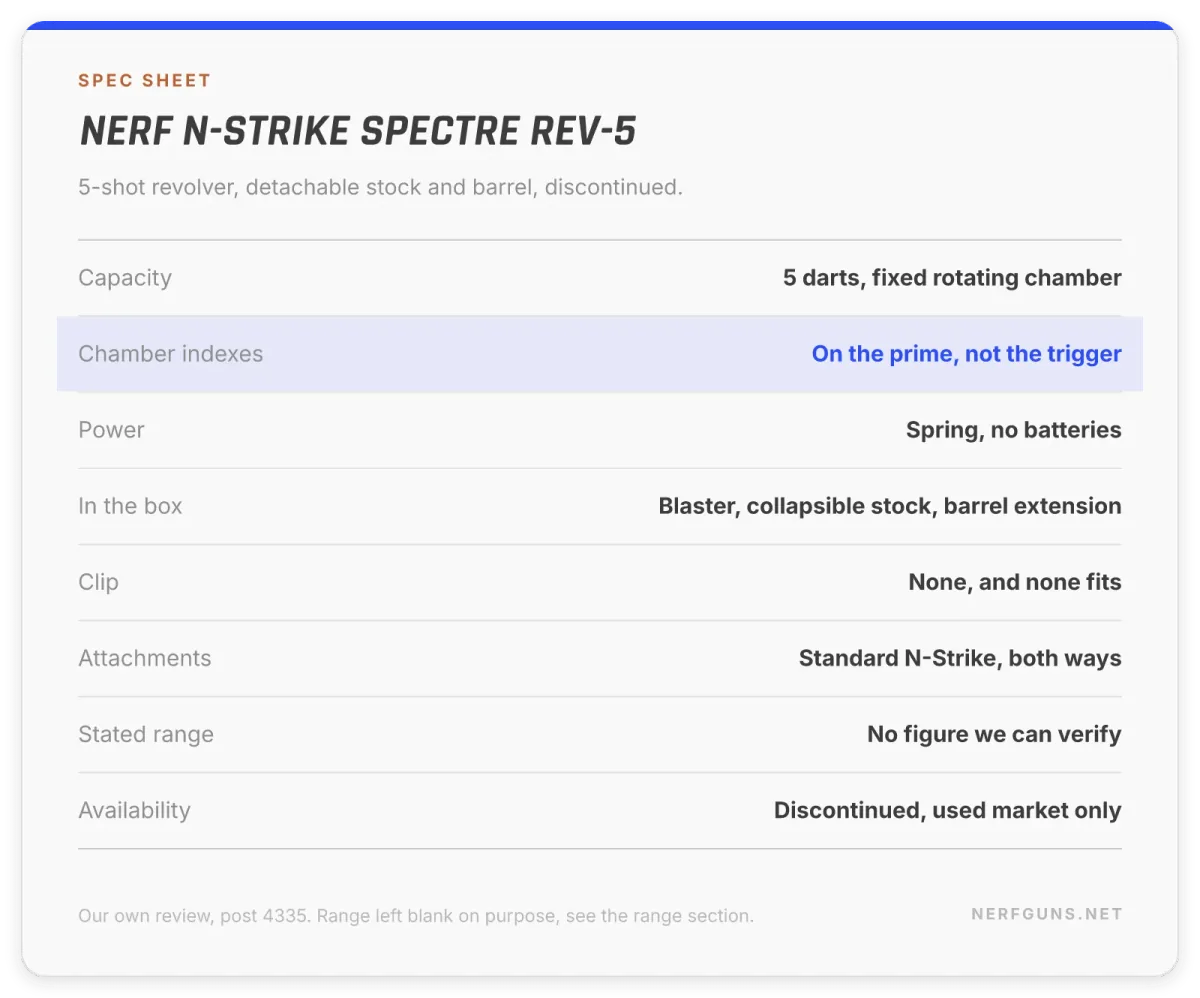
Both attachments use standard N-Strike connectors, so they come off in a second and go onto other blasters in the N-Strike line without adapters.
One correction to our own archive. The old version of this page called the front attachment a silencer. It is a barrel extension. It does not quieten anything, and describing it that way was borrowing language from somewhere this site has no business borrowing from.
Where the Spectre came from
The Spectre belongs to the run of N-Strike blasters built on one idea. Parts should come off, and they should go somewhere else.
By the time it arrived, the tactical rail and the barrel connector were standard across the line. The interesting design question had moved on. It was no longer what a blaster could do, it was what a blaster could become.
The Spectre is the purest answer to that question in the whole line. Almost every other modular blaster was a large blaster you could add to. This was a small blaster you could grow.
It also came out of a specific, visible problem. The Maverick was the most popular small blaster Hasbro made, and it had a well-known failure. The Spectre is what that failure looks like once somebody fixed it.
Our old copy called it “maybe the most versatile weapon in the current Nerf lineup”. The versatility claim still stands. The word current stopped being true more than a decade ago, and this site does not call foam blasters weapons.
That same page also described the body as modelled on a specific real handgun. That comparison is gone rather than reworded, because it was never what the blaster is about.
The three configurations
This is the reason to own a Spectre and it is worth laying out properly.
Bare: stock and barrel off. You have a compact 5-shot pistol that disappears into a vest pocket. This is the backup-blaster configuration and it is what most people carry it as.
Barrel on, stock off: a longer pistol with more to hold onto. It points better than the bare version and it still works one-handed.
Both on: a shouldered, stocked blaster for deliberate shooting at range. Small, but it behaves like a proper two-hand blaster.
There is technically a fourth, stock on and barrel off, and it is the one nobody uses. Our old page made a joke about that. The plain version is more useful. It puts the length behind your hand instead of in front of it, and that is the wrong way round for aiming.
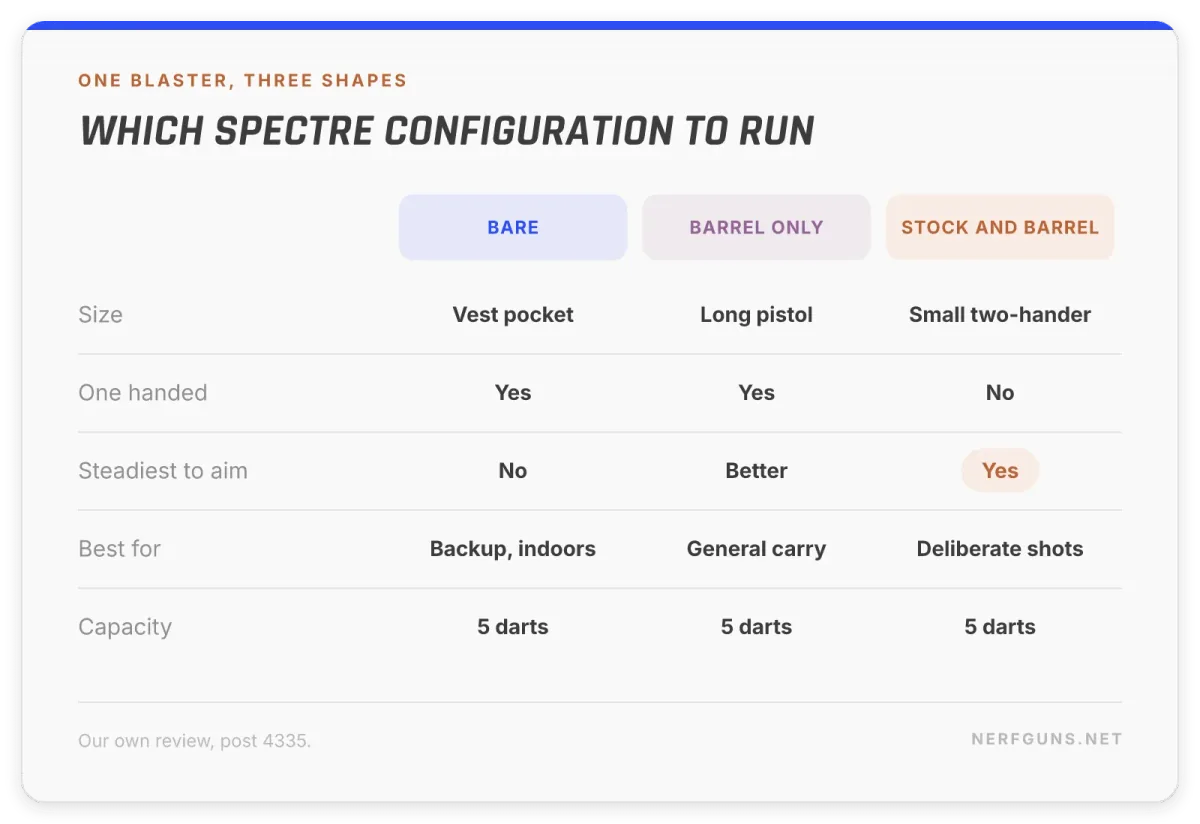
The practical value is that you decide at the start of a game rather than at the shop. That is rare.
In practice most people settle on two. Bare for indoor games and tight spaces, everything fitted for outdoor games where you have room to shoulder something.
Swapping between them takes about 5 seconds and needs no tools. So carry the parts in a pocket and change your mind between rounds.
The one thing to be careful about is losing them. Two small black attachments in long grass are two attachments you are not getting back. A Spectre missing either one loses most of what makes it worth owning.
The rotating chamber, and why it beat the Maverick
The Spectre holds 5 darts in a rotating chamber. The chamber turns to the next dart when you work the slide.
That sounds like a detail. It is not, and it is the single best engineering decision in this blaster.
The Maverick REV-6 rotated its chamber on the trigger pull instead. That left the chamber able to stop halfway between positions. You pulled the trigger, nothing happened, and the darts were still sitting in there.
Moving the rotation onto the priming stroke fixes that. By the time your finger reaches the trigger, the chamber has already arrived and locked.
It costs you one thing: the Spectre needs priming between shots and the Maverick did not. That is a fair trade and most people who have used both would take it.
A stock on a pistol
The stock collapses, which is what makes it practical rather than decorative.
Carried collapsed with the barrel on, the Spectre still comes out of a vest fast. You extend the stock only when you have a moment, and a target worth taking time over.
That is the actual use case, and it is better than it sounds. Most blasters make you choose between compact and shouldered on the day you buy. This one lets you choose mid-game.
The stock is short, because the blaster is short. It sets a shoulder position rather than a comfortable one, and taller players will find it cramped.
It also detaches and fits other N-Strike blasters, which is worth remembering if you own something that shipped without one.
The barrel extension, honestly
The barrel extension adds length, adds a mounting surface, and changes the balance. It does not add power.
That is true of every Nerf barrel extension and it is worth saying plainly, because the shape suggests otherwise.
What it can do is help or hurt accuracy, depending on fit. A barrel whose bore matches the dart guides it. A barrel that is too wide lets the dart bounce down the inside and come out worse than it went in.
The Spectre’s own barrel is one of the better ones in the line for this. That is why it keeps turning up as the recommended extension on other blasters. Our Rayven review points at it for exactly that reason.
Test yours both ways in a garden before you commit to a configuration. Ten minutes beats any figure anybody can quote.
Range and accuracy
Our old copy said the Spectre’s effective range was “around thirty feet”. That was somebody’s impression rather than a measurement, and we do not have a chronograph run for this blaster on file.
So we are not going to restate it as a spec. What we can say is that it is a small spring blaster of the pre-Elite generation, and it performs like one.
That is not a criticism. A backup blaster is used at the range where a backup blaster gets used, which is close, and the Spectre is entirely adequate there.
With the stock and barrel fitted it becomes noticeably easier to shoot accurately, and that is a handling improvement rather than a power one. Being able to hold something steady is most of accuracy at these distances.
If a published range figure is what you are shopping on, buy something current that states one. Our Elite line guide is the better starting point for that.
What it fits, and what fits it
The Spectre is one of the best-connected blasters in the line, and that is most of its value.
- Its stock and barrel go onto other N-Strike blasters, so buying a Spectre is partly buying two accessories.
- Other N-Strike attachments go onto it, including rail-mounted sights and light beam units.
- It fits a tactical vest pocket, with or without the barrel and stock attached, which not every sidearm-sized blaster does.
Our attachments guide covers what is worth fitting, and the vest guide covers carrying it.
What it does not take is a clip. The chamber is fixed to the blaster. There is no magazine to swap, and no way to speed up a reload except loading faster.
That is the Spectre’s real limit and it is worth being blunt about. Five darts is roughly one exchange. When they are gone, you are loading 5 darts by hand, one at a time. Somebody with a clip blaster is already shooting again.
The workaround people use is simple: carry the Spectre pre-loaded as a second blaster and never plan to reload it mid-fight. Used that way it is excellent. Used as something you keep feeding, it is frustrating.
Who this blaster is for
The honest answer is narrow and it has not changed in a decade.
It is a secondary blaster. Five darts and a manual prime is a backup loadout, and it is a very good one because it is small, reliable and reconfigurable.
It is also a good blaster for somebody who enjoys the kit side of the hobby. Taking it apart and putting it back together differently is genuinely part of the fun here.
It is a poor primary. Anything clip fed will out-shoot it on volume, and there is no configuration of a Spectre that fixes that.
Paired with something high capacity like the Vulcan or a clip-fed rifle, it earns its place in a loadout properly.
There is one more group worth naming: people buying a first blaster for somebody small. The Spectre is light, it primes easily, it has no batteries to go flat, and taking it apart is half the fun. Five darts is a limitation in an organised game and a non-issue in a back garden.
The catch there is the same as everywhere else on this page. You are buying used, and a used Spectre is only worth having with both of its attachments in the box.
Mod potential
The Spectre is a small, conventional spring blaster, which makes it approachable and limits how far you can take it.
There is not much room inside. That cuts both ways: less to get lost, and less space to fit anything you might want to add.
The rotating chamber is the part to leave alone. Anything that changes the forces in there risks the indexing, and a chamber that stops lining up turns a working blaster into a paperweight.
Our Nerf mod guide covers the sensible end, and the modder’s toolkit checklist covers the bench.
Buying one used
The Spectre is discontinued, so every one is second hand, and the parts are what you are really checking.
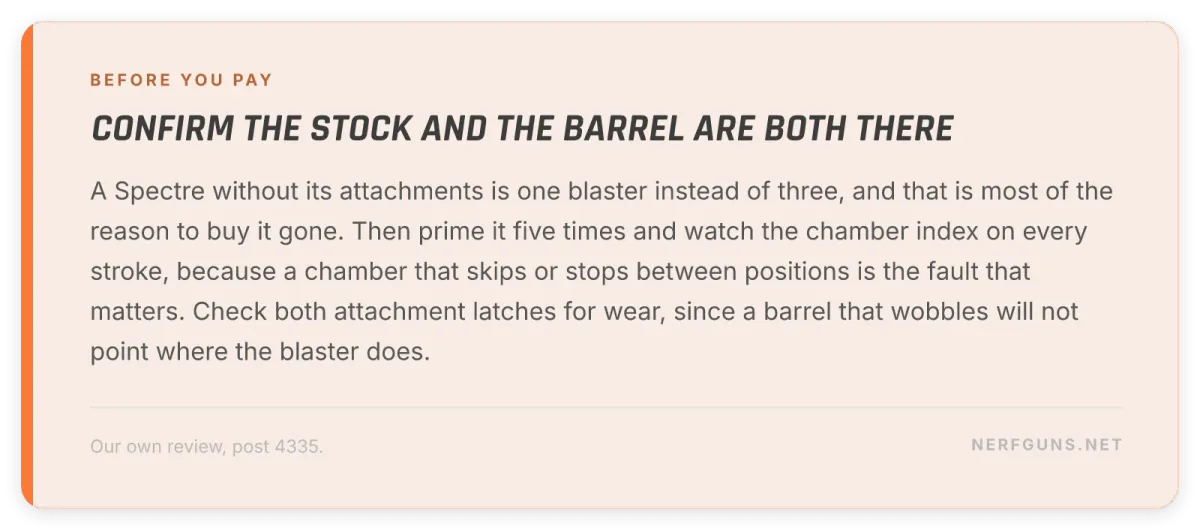
Confirm the stock and the barrel are both there. A Spectre without them is one blaster instead of three, and that is most of the reason to buy it gone.
Prime it five times and watch the chamber index each time. Skipping or stopping between positions is the fault that matters.
Check both attachment latches. They are small plastic tabs that get worn, and a barrel that wobbles will not point where the blaster does.
Work the stock through its full travel. It should extend and collapse without forcing, and it should stay where you put it. A stock that creeps closed under recoil is worse than no stock at all.
Look inside the chamber for split plastic between the dart holes. That is a thin section by design and it is where a dropped Spectre cracks.
Price it on completeness rather than condition. Scuffs mean nothing here. A missing barrel means you are buying a five-shot pistol and should pay accordingly.
The Spectre is gone, so what do you buy now?
The Spectre REV-5 is discontinued. Every one is used or old stock.
The good news is that its two best ideas both survived. A revolving cylinder, and attachments you clip on and off. Nerf sells both again in the Loadout line.
- Closest on the prime: the Nerf Loadout Shadowspeed Recon uses pump action priming and a 6-dart revolving cylinder, so working the slide and turning the cylinder feels like the Spectre does. It brings a 14-dart storage attachment and 14 darts. Hasbro rates it 8+.
- Closest on the parts: the Nerf Loadout FlareFusion ships with 3 interchangeable attachments, which is the three-configurations idea in current plastic. It also runs a revolving 6-dart cylinder, primed with a bolt rather than a slide, and comes with 18 darts. Hasbro rates it 8+.
Now the honest column.
- Neither one gives you a collapsing stock. Nerf does not say what the FlareFusion’s 3 attachments are, so we are not going to tell you a stock is one of them. Read the listing photos before you count on it.
- Your Spectre parts will not fit. The barrel and the stock use N-Strike connectors, and Loadout blasters do not have those ports. That cuts both ways: the famous Spectre barrel stays useful only on N-Strike blasters.
- The foam changes. Both fire N1 darts, and Nerf says N1 works only in N Series blasters, so start a fresh pile with N1 darts .
One more thing has not changed. A 6-dart cylinder is still 6 darts, so a current blaster fills the same backup role the Spectre did, not a bigger one. If you want volume, you want a clip.
Bonus tip: nobody ever guesses the right blaster. Put the one you actually want on a free wish list, then send the link to whoever keeps asking what you want for your birthday. Start your free Nerf wish list and let them buy the right thing.
Where to buy
As an Amazon Associate and eBay Partner, we earn from qualifying purchases.
The Spectre REV-5 is discontinued, so buying one today means hunting the used market. If you want a blaster on shelves today that works the same way, a revolving cylinder with attachments that clip on and off, the Loadout blasters in the section above are the ones we have actually checked for stock. The Nerf Elite 2.0 Commander RD-6 on Amazon is another revolver worth a look, though we have not verified its stock.
- Nerf N-Strike Spectre REV-5 listings on Amazon, used market
- Nerf Loadout FlareFusion, a current revolver with attachments, stock checked
- Nerf Elite 2.0 Commander RD-6 listings on Amazon, another revolver in the same role, stock not verified
- Nerf tactical vests on Amazon, if you are carrying it as a sidearm
- Used Spectre REV-5 listings on eBay, usually the better hunting ground for this one, and the photos tell you whether the stock and barrel are included.
Frequently asked questions
How many darts does the Nerf Spectre hold?
Five, in a rotating chamber built into the blaster. There is no removable clip, so reloading means loading darts one at a time.
Does the Spectre need batteries?
No. It is entirely spring powered. Only add-on sights and light beam units carry cells.
Is the Spectre barrel a silencer?
No, and this page used to call it one, which was wrong. It is a barrel extension. It adds length and a mounting surface, and it does not affect the noise.
Spectre or Maverick?
Spectre. It holds one dart fewer, but its chamber turns on the prime instead of the trigger. That is the fix for the Maverick’s habit of stopping between chambers with darts still loaded.
Does the Spectre stock fit other blasters?
Yes. Both the stock and the barrel use standard N-Strike connectors, so they fit any N-Strike blaster with the matching ports.
How far does the Spectre shoot?
We have no test of our own on file and we are not going to repeat the unsourced figure this page used to carry. It is a small pre-Elite spring blaster and it performs like one, which is fine for the backup role it is built for.
Is the Spectre good for a Nerf war?
As a secondary, yes, and it is one of the better ones because of how it reconfigures. As your main blaster, no, because five darts and no clip cannot keep up.
What is the best barrel extension for other blasters?
The Spectre’s own barrel is one of the better ones in the line, which is why it gets recommended for blasters that came without a good one. Fit matters more than length.
Can you carry a Spectre with the stock attached?
Yes. The stock collapses. So the sensible carry is stock collapsed and barrel fitted, which still drops into a vest pocket and extends when you want to shoulder it.
Why does my Spectre not fire with darts loaded?
Check that the chamber has indexed fully. A chamber caught between positions will not line up with the barrel, and priming the blaster fully is what moves it. This happens far less on a Spectre than on a Maverick, which is the whole reason the design changed.
Is there a modern version of the Spectre?
Close, but not exact. The Loadout Shadowspeed Recon uses pump action priming with a 6-dart revolving cylinder, which is the nearest thing to how a Spectre works. The Loadout FlareFusion comes with 3 attachments you can swap, which is the nearest thing to the three configurations. Neither takes your N-Strike stock or barrel, and both need N1 darts, so nothing you already own carries over.
Is the Spectre worth buying in 2026?
As a secondary blaster and a kit piece, yes, provided the stock and barrel are both included. Without them it is a five-shot pistol and there are cheaper ones.
It’s Nerf or Nothin’!


I dont know about this gun it’s too close to the maverick for me I don’t want to spend the money
what the heck who wood want this mav already has good range and acuracy
Cool Blaster, I saw a review on this and i like how it shoots. I think its neat.
Does adding the barrel extension actually increase accuracy? On my Recon the extension greatly reduces the range and accuracy, not sticking anything on the front gives much better results.
i have the nerf gun. its decent, though the stock is some-what pointless, and the barrel extension doesnt do very much of anything. it just makes it look cool.
it is way to close to the Mav and its just a crappy gun anyways the stock is alittle cool but no i wouldn’t tell anyone to get it for anything stick with the Mav guys its the best except for the Vulcan
hi jacob
It just looks a resell.
this gun is ok for starters but if ur like me you’ll stick with the mavrik 1: the mavrik holds more ammo
2:the mavrik looks and feels better , and 3:the mavrik shoots father and is far more accurate.
Its a maverick with less ammo. Barrels do nothing but kill range, and stocks get in the way.
its ok.
i love it. im in a huge nerf battle and its the jack of all trades. its amazing.
I think the spectre rev 5 is a great nerf gun but I dont like when a dart gets jamed in the gun barell
Recon and maverick had sex and this is the result
well the stock is a great addition, the way that it can collapse is very interesting, nerf is really on its way to some great guns, altho it does look alot like the mav witch means they might be running out of ideas, bc they also hav to look at safety, bc this is a great gun and a safe gun for the younger ones who r going to be buying this the most, i giv this a 4 out of 5 bc of the stock and the feel of the gun, but i dont like how u prime the gun from the top like the recon(witch is a discrace of a gun) but overall a nice gun for people who dont mod
i think this gun is amazing i’m getting it for my birthday
i already got the maverick and this is basically all of my complaints fixed:
not as bulky
grippier primer
you can put any stocks on it
and the tactical rail isnt on the primer
you guys check out the new nerf guns:
* nerf quickfire 16 (upgraded raider)
* nerf speedload 6 (upgraded maverick)
* nerf swarmfire (upgraded vulcan)
and a new secretshot (name yet to be released)
the first three are available in the u.s.
for more information check out the urbantaggers website (urbantaggers were first to know about these 4 new releases and they have the most information about them)
i think i like the barricade because its the only pistol you can duel wield with but it makes alot of noise
i think the spectre is ok but its not my tipe of gun.
and i like milk.
and the long barrel is pointless
i think the gun looks cool, considering the sleek barrel, but otherwise its not my tioe of gun.
i like it but only the pistol
i just got the spectre and i like it more than the maverick and it was only $5 more than a maverick
goods:
it’s thin
were the tactical rail is
the cocking handle
range accuracy
it not trigger based barrel movement
how many different types of darts it can use
bads:
5 dart barrel not 6 like maverick
no inbuilt site
longer than maverick
i think if it’s not that much difference in price than i highly suggest getting it
i think its good because it has a nice range and even though it has 5 darts its really cool and its light weight
would be good, but costs $32 and the maverick costs $9.99
I went to target three days ago and i got so MADD because i couldn’t find the dam gun so i got the buzz bee toys double shot. next time im going to walmart.
the spectre is soooo much bettter than the maverick. It hasn’t jammed on me once… so far
This is an awesome gun. One of the best, by far. It’s easier to reload than the mav, the stock makes it look 10 times cooler and it’s range is awesome compared to the mav.
mine is way better than my mav
Reasons it is better than mav 1)don’t need to slam Carthage shut 2)can be modes to look like a real 44.magnum/python/.375magnum(dependent on which you prefer) 3) no matter what you put on it, it will look somewhat awesome (ex. I took a black longstrike barrel an a orange raider stock) 4) the silencer can actually makes a small difference.
I just recently bought this gun. It’s awesome WITHOUT the barrel. Not unlike it’s cousin the Recon. However, I put the Spectre’s barrel on my Recon and it works great! It’s definitely worth the $20, especially if you’re into more stealthy missions.
I have recemtly got thiis gun and am quite supried by it. the barrel looks like a silencer which is cool, but i works better with it not on. its got good accuracy without the barrel. the barrel inproves accuracy but takes away speed and distance. i normally just use the pistol and the recon stock. the barrel makes it more annoying to hold and use. overall this is my best gun and i recomend it to people looking for a good gun to snipe other people with. i give it 9.12 out of 10
WOW real critical NOT
Hey, I am an avid nerf fan in England, and I can’t find anywhere to buy this for a reasonable price! On amazon uk it is over
yea ebay, the site was discontinued
its OK…
I got it 6 days ago at a nerf booth in West Edmonton Mall and it ROCKS!!! I Rate it 9.42 out of 10
I want to know wether this thing will work better than a maverick as a secondary, because there is a $12 difference between the two where I live, and I don’t want t pay $20.00 for something completely pointless.
I just bought a Spectre yesterday. The gun is amazing.
When I was a kid, I had one gun, for 3 months, and its been years since I got a new one. This gun was the Maverick. Problems: I was young and cocking it was troublesome. It jammed: A LOT. and my shots went from 25ft down to 15ft after a month.
Spectre: HOLY CRAP FOLKS! This gun blew me away, and Its hard to impress me. This gun comes with a silencer barrel (Get this, it actually makes the gun [Which fires very quietly to begin with] fire near dead silence, as well as quiet other N-Strike blasters, and quiets whistlers.
i got one mav and i fink that is the better nerf in the market (sorri by the wrong words i’m brazilian)
This gun is a WALMART Exclusive. They are only available in WALMART! And Maverick, step aside, there’s a new pistol in town!
thers a guy who got “MADD” because the spectre was not at target. this dud is brainless, the box itself says its only at walmart
this sone of my favorit guns because it has 1t least two attachments
HELL YEAH THIS IS EPIC!!! Near dead silence, more convienient tactical rail, This gun is my favorite (I’m getting it first chance I get).
had 1 for ages ,broke it, turned it in2 a star wars single shot (han solo ) blaster -100% air seal fires nerf and buzz bee darts up to 70 ft totally rocks