
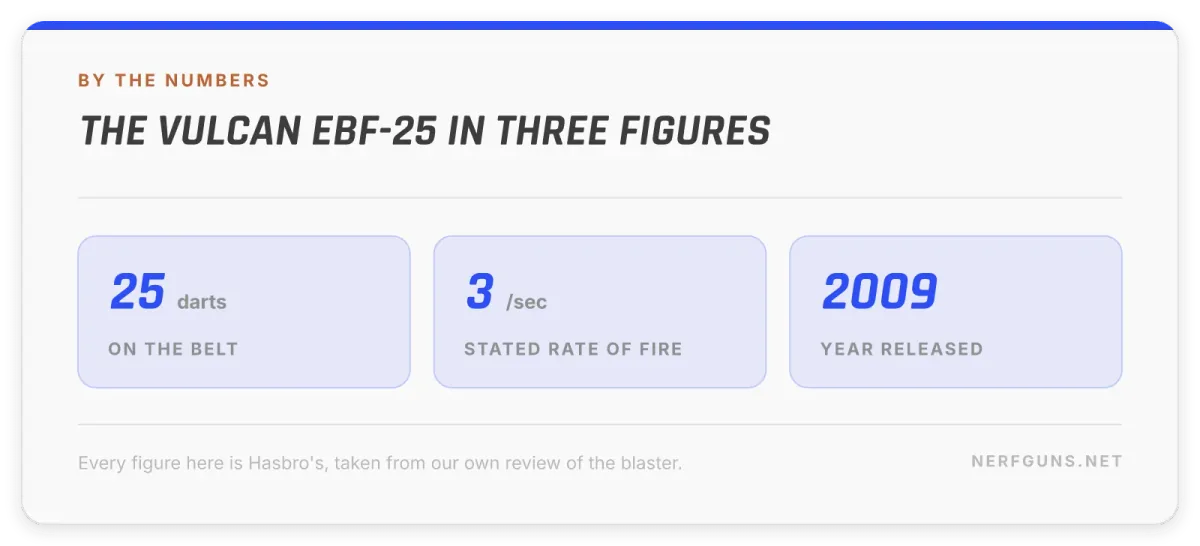
The Vulcan EBF-25 is the blaster people picture when they say Nerf machine gun. A 25-dart belt, a removable tripod, and a stated 3 darts per second. Here is what it is genuinely good at, and why the used market for it is more complicated than the listings admit.
What is on this page
- The short verdict
- What the Vulcan is
- The belt, and why it matters
- Automatic and single shot
- The tripod and how it plays
- Batteries and the overvolting question
- Mod and paint potential
- Why the Vulcan is still the one people remember
- If the Vulcan is not it
- Buying a Vulcan secondhand
- What to buy now that it is gone
- Where to buy
- Frequently asked questions
The short verdict

- A 25-dart belt that feeds through the blaster, which is still the most satisfying ammunition system Nerf has built.
- A stated 3 darts per second in automatic, with a single shot mode when you want to place a shot instead of spraying one.
- A removable tripod, so it works as a fixed position or as a very heavy handheld.
- Discontinued, and the belt is the part that goes missing from used listings.
Buy it if the belt is the reason you want it and you can confirm the listing includes one. Skip it if you want the best modern option for holding a position. Newer motorized blasters do that job with less weight and easier ammunition.
What the Vulcan is
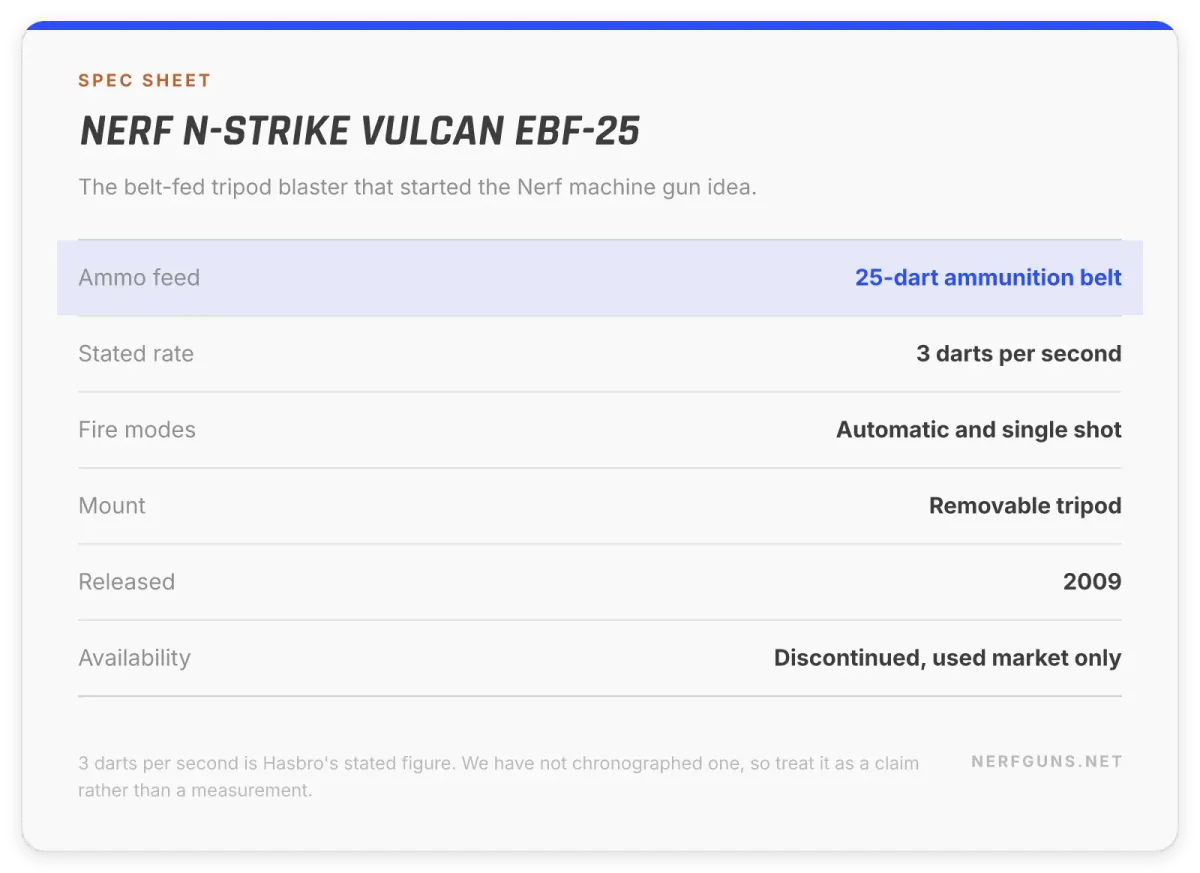
The Vulcan EBF-25 arrived in 2009 as the big motorized centrepiece of the N-Strike line. EBF stands for electronic belt fed, and the 25 is the belt capacity, so the name is unusually honest about what the blaster does.
It is battery powered, it feeds from a belt rather than a clip or a drum, and it came with a tripod in the box. Nothing else in the range worked like it. The Vulcan became the blaster every N-Strike arsenal wanted at the centre of it.
It is long out of production now, so everything below is written for someone deciding whether to buy one used.
The belt, and why it matters
The belt is the whole reason this blaster is remembered, and it is worth being specific about why.
Every other ammunition system on a Nerf blaster hides the ammunition. A clip is a box. A drum is a wheel. You know how many darts are in it because you counted, or because you are guessing.
A belt is visible. You can watch it feed. You can see how many darts are left without breaking your position or taking your hand off the grip. That is a genuine practical advantage and it is also, plainly, the coolest thing about owning a Vulcan.
The catch is that a belt is fiddly. Loading 25 darts takes longer than seating a clip. The belt can twist if you feed it carelessly. And a belt stored badly for a decade does not always run smoothly.
So the belt is the best and the worst thing about the blaster at the same time. That is usually how it goes with the feature a product is famous for.
Reloading in a real game
You are not reloading a Vulcan mid-fight. 25 darts is a lot of ammunition for a backyard game. When it runs out you are effectively out of the round, unless someone is covering you.
Plan around that rather than fighting it. Fill the belt before the game, treat the 25 darts as your budget for that engagement, and carry something small for afterwards. Any of the pocket-sized blasters work, and the Hammershot is the one we keep reaching for because it needs no batteries at all.
Automatic and single shot
The Vulcan has two fire modes and most reviews only talk about one of them.
Automatic is the headline. Hold the trigger and the belt feeds at a stated 3 darts per second. That figure is Hasbro’s, not ours, and we have not put a Vulcan in front of a chronograph, so treat it as a claim rather than a measurement.
Single shot is the mode that makes it usable. Switch over and the Vulcan fires one dart per trigger pull, which turns a suppression tool into something you can actually aim.
Here is the thing. Twenty-five darts at 3 per second is a little over 8 seconds of continuous fire. If you spend all of it in one burst you have contributed one loud moment to the game and then nothing. Single shot is how the belt lasts a whole round, and it is the mode experienced players use most.
The tripod and how it plays
The tripod detaches, which gives you two different blasters depending on how you set up.
Mounted, the Vulcan is a position. Put it at the end of a hallway. Or at the entrance to a base, or covering the one gap in a fence. It does exactly what it looks like it should do. This is the setup the blaster was designed around and it is where it is genuinely strong.
Handheld, it is heavy and awkward, and it was heavy and awkward in 2009 too. It can be done. It is not fun for a whole afternoon.
The useful way to think about it: the Vulcan is equipment you place, not a blaster you carry. Games with a base, an objective or a corridor suit it. Games built on movement and flanking do not, and no amount of enthusiasm changes that. Our war games page covers the formats where a fixed position actually earns its keep.
Batteries and the overvolting question
The Vulcan is battery powered, and like every motorized blaster its performance falls off as the cells drain. Tired batteries mean a slower feed and shorter range, and it happens gradually enough that people blame the blaster instead of the power.
Now the part this page used to get wrong. The old version of this review ended by telling readers that 3 darts per second was “just the beginning” and that much more could be achieved with a larger power source.
That advice was published without a word of context and it has been removed. Pushing more voltage through a motorized blaster is a real modification with real consequences. Heat. Melted internals. And a blaster that fires hard enough to matter at close range. It is not a casual upgrade you do because a review implied you should.
If you want to go down that road, go down it properly. Our Nerf gun mods guide covers power modifications in the order they should be done, with the safety side included rather than assumed.
Mod and paint potential
The Vulcan is a big shell with a lot of flat surface, which makes it one of the better paint projects in the N-Strike line. It also carries a strong shape on its own, so a repaint reads as a finished prop rather than a toy with colour on it.
Two honest cautions before anybody opens one up.
First, it is discontinued and parts are not replaceable. A cracked shell on a current blaster is annoying. A cracked shell on a Vulcan is permanent, because there is no spare to buy and no donor unit that is cheap. Take the extra ten minutes with the screws.
Second, the belt mechanism is the fussy part. It is the feature you bought the blaster for, and it is the system most likely to be disturbed by a teardown. If the goal is cosmetic, there is a strong argument for masking and painting without going all the way in.
For the finish itself, our paint series covers prep, primer and clear coat in order. Prep is where most people lose the job before they have started. If you want to sand the moulding lines out first, the sanding guide covers how far to take it.
Why the Vulcan is still the one people remember
Search volume tells an interesting story about this blaster. Years after it left shelves, people still type the name into Google. More than they search for plenty of blasters currently on sale.
There are three reasons for that, and only one of them is performance.
It was the first of its kind
Before 2009 there was no Nerf blaster that looked like a mounted weapon. Firsts get remembered in a way that better follow-ups do not. That is why the Vulcan is the reference point, even for people who have never held one.
The belt is genuinely unusual
Nerf has made many motorized blasters since. Almost all of them feed from clips or drums, because clips and drums are cheaper to make and less prone to jamming.
That leaves the belt as a novelty that never really came back at scale. If you want a belt-fed foam blaster, your options are narrow, and the Vulcan is at the front of the list.
It looked the part in a way Nerf later moved away from
The Vulcan’s styling was deliberately mechanical and militaristic, and Nerf’s house style has softened since. That has been a good change for a toy brand, and it also means nothing on shelves today has quite the same silhouette.
Bottom line: the Vulcan is remembered for being first, for the belt, and for its looks. None of those are reasons it will out-shoot a modern blaster, and all three are legitimate reasons to want one anyway. Buying a piece of the line’s history is a real motive, and it is worth being clear-eyed that it is the motive.
Where it sits in the N-Strike story
The Vulcan belongs to the original N-Strike era, before the Elite refresh changed the colours and pushed the ranges up. That matters for a practical reason as well as a historical one: it predates the Elite dart, so it was designed around the older foam.
Standard darts still run in it, so this is not an ammunition problem. It is a reminder that a 2009 blaster compared against an Elite-era range figure is being compared against a later standard. The full N-Strike line puts it in context alongside everything Hasbro built around it.
If the Vulcan is not it
You want more ammunition on board

The N-Strike Elite Rhino-Fire is the later answer to the same question. Two barrels, two 25-dart drums, 50 darts on board and its own tripod, with a stated range of up to 90 feet. It is the Vulcan idea with double the ammunition and double the failure points.
You want to move
A clip-fed motorized blaster gives you most of the volume and lets you play a normal game with it. That is the trade almost everyone is happier with, and the N-Strike Elite lineup covers what is worth owning at that size.
You want the category, not this specific blaster
Our machine gun style blasters page covers the motorized options, including ones still in production. The biggest Nerf guns guide ranks them by sheer size, if that is the appeal.
Buying a Vulcan secondhand
The Vulcan has been out of production for years, so every one is a used purchase. It is also a motorized blaster from 2009, which means it needs more checking than a spring blaster of the same age.
Work through these in order.
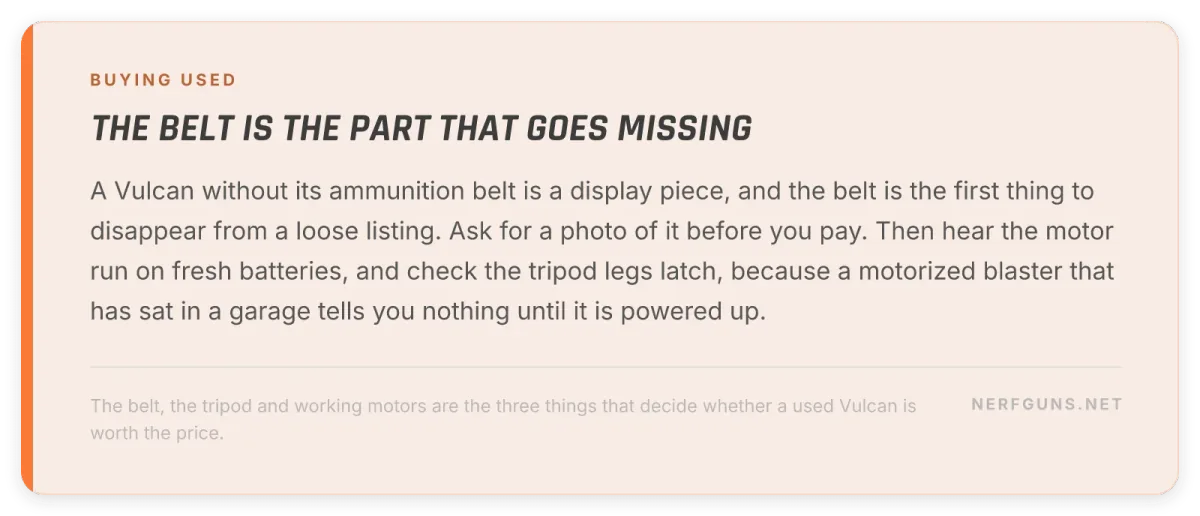
- Confirm the belt is included. This is the number one issue. A Vulcan without a belt cannot do the thing you are buying it for, and belts are hard to source separately. Ask for a photo.
- Hear the motor run. Fresh batteries, powered up, listen for it reaching speed cleanly. A motorized blaster that has sat unused for a decade is not a safe assumption.
- Check the battery tray. Leaked cells leave corrosion on the contacts. Sometimes that cleans up and sometimes it ends the blaster.
- Check the tripod. All the legs, all the latches. It folds, so it has hinges that snap.
- Feed the belt through by hand. It should run without catching. A twisted or brittle belt jams under power.
Darts are the easy part, because it takes standard N-Strike darts rather than anything proprietary. Our dart buying guide covers which refills are actually worth the money.
What the old review got wrong about price
This page used to quote a launch price as though it were current. It was a 2009 figure and it had been sitting here ever since, which is exactly the kind of number that quietly misleads a reader.
There is no useful fixed price for a Vulcan now. It is a discontinued collectible, so the price is whatever the market is doing this month. A complete example with belt and tripod sits well above an incomplete one. Judge each listing on what is in the photographs.
The Vulcan is gone, so what fills the gap?
The Vulcan has been off shelves for years. Two honest answers, and the first one is a no.
The belt is not coming back. No blaster Nerf currently sells feeds from an ammunition belt, and none of them mount on a tripod either. Those two things are the entire reason people remember the Vulcan, and nothing on a shelf today does them. If that is what you want, you want a used one.
For the sound and the volume, there is a real answer. The Nerf Loadout Galactic Commander is motorized with 3 firing modes, one of which is full auto. It comes with 48 N1 darts and two 18-dart clips, so you load one and park the spare in the stock. Hasbro rates it 8+.
Here is the trade, plainly. You lose the belt and the tripod. You gain a blaster you can actually run around with, and a reload that takes a second instead of a minute.
One thing to know before you order.
- Loadout blasters fire N1 darts, not Elite darts. Nerf’s own listings say N1 darts work only in N Series blasters, so a Vulcan belt full of old foam is no help at all.
- Plan on N1 darts alongside it. The upside: no more D batteries.
Bonus tip: nobody ever guesses the right blaster. Put the one you actually want on a free wish list, then send the link to whoever keeps asking what you want for your birthday. Start your free Nerf wish list and let them buy the right thing.
Where to buy
As an Amazon Associate and eBay Partner, we earn from qualifying purchases.
- Current Vulcan EBF-25 listings on Amazon, which is the honest link for a discontinued blaster.
- N-Strike Elite 250-dart pack, since a 25-dart belt eats foam quickly.
- Safety glasses, which matter more with a blaster that fires this fast.
- Used Vulcan EBF-25 listings on eBay, usually the better hunting ground for a belt-fed blaster that left shelves years ago.
If you would rather buy something currently in production, our guide to the new Nerf guns covers what is on shelves.
Frequently asked questions
How many darts does the Vulcan hold?
25, on the ammunition belt that feeds through the blaster. There is no clip or drum option, so the belt is the capacity.
How fast does the Vulcan fire?
Hasbro states 3 darts per second in automatic mode. That is a manufacturer figure. We have not measured one ourselves and we are not going to publish a number we did not take.
Does the Vulcan have a single shot mode?
Yes, and it is the mode that makes the blaster last a whole game. Automatic empties the belt in a little over 8 seconds if you hold the trigger down.
Is the Vulcan still made?
No. It is discontinued, so every one available now is used or old stock. The belt and the tripod are the parts most likely to be missing.
What does EBF-25 stand for?
Electronic belt fed, with 25 being the number of darts the belt carries. The name describes the blaster more literally than most Nerf model numbers do.
Can the Vulcan be used without the tripod?
Yes, the tripod is removable. It is a heavy blaster to hold for long, so most people mount it and treat it as a fixed position rather than something they carry.
Can you buy a replacement Vulcan belt?
Not reliably, and that is the single most important thing to know before bidding on an incomplete one. Belts turn up occasionally as spares, but they are not a stocked item. A Vulcan sold without its belt should be priced as a display piece, not a working blaster.
Does the Vulcan take Elite darts?
It takes standard Nerf darts, so Elite refills work in it. The blaster predates the Elite line, so its range figures belong to the older era of foam. The good news: you are not hunting a discontinued ammunition type to feed it.
Is there a modern version of the Vulcan?
No, not a real one. Nerf does not sell a belt-fed blaster any more, and nothing current mounts on a tripod. The closest motorized blaster on shelves is the Loadout Galactic Commander, which has 3 firing modes including full auto. It feeds from an 18-dart clip rather than a 25-dart belt, and it fires N1 darts, so your old foam will not load into it.
Is the Vulcan worth buying today?
As a collector piece and a base defence blaster, yes, provided the belt is included and you have heard the motor run. As your main blaster for an active game, no. Something clip-fed from the N-Strike line will serve you better.
It’s Nerf or Nothin’!


good but not so good the maverick has more power then this but i like the tripot
it is a good gun for protecting a fort
if you don’t use batteries. on my frends gun it wont cock.
my nerf guns are awesome.
why dont u put the hulk abomonation blaster aka the titan on this website coz it is coool and it is n strike plus it looks like a rocket launcher!
the titan is pretty cool and I definitely should dedicate a page to it, thanks for the input.
the vulcan is a piece of crap. without the box, youre screwed. it is heavy, jams wastes ammo is not fast enough. I appreciate Nerfs effort though.
The vulcan is sort of crap but its probably the coolest looking nerf for a while and who doesnt love massive toy guns?
True, but not cool lookin.
this gun a pile of crap that has been modeled into a box with a another box to hold the ammo. this gun sucked so much, when my friends and i tried playing with it but when we ran with it the box that holds the ammo.
Did anyone notice that the vulcan loolks like the AGS-17?
well the vulcan nearly look thesame as the ags-17,but what about it yhat look the same?
YES OF CORSE if only it fired nerf granades.
I got a New Nerf Vulcan and I got really lucky. My vulcan has no problemos. no jamming, good range, heaviness, accucary, the new nerf vulcan has it all. I one time shot my mom with this, and it flew so fast it the target a second after i fired it.
heh it’s pretty light weight for a nerf gun.
you cant kill anyone with it but it gives good cover in a fight.
agreed but gives good cover.
ohh, the Vulcan that i have never jams. Think its because i have an updated model
Mine are really good and I have the updated model too
this gun is so good because of its rate of fire and it is so easy to re-load.
Vulcan sucks. cant get more than three or four rounds out without it jamming. HUGE WASTE OF MONEY!!!!!
u must of got an unlucky 1. my friends have 2 vulcans. 1 of them was left out in the rain, and 1 had just got jams. im not saying this gun stinks
vulcan is a great defense gun, not an offense gun.
y is the rating so low?!!!?!????!
A lot of people are rating it low because they feel it jams too often.
I’ve only had it jam when trying to run and shoot it, which ends up putting way too much strain on the belt.
Other than that it’s a pretty awesome Nerf gun IMHO.
This gun is perfect for defence or slowly moving through the feild. if you have a jamming problem then do the jamming mod in gun mods for the vulcan so you can fix the jam.if anyone thinks that it wasts ammo then buy more ammo belts and modify them so theyre connected.and if you want to store it in a larger ammo box like the 7.62 military ammo box.but this mod is ireversible.you need to cut the part of the plastic ammo box that connects to the vulcan and locks on and super glue it or somehow atach it to the end of the military ammo box.
i have 2 of these guns. but the main reason y is because my first vulcan’s stand kept coming off of the gun. and now i have a vulcan at my mom’s house and 1 at my dad’s.
my first vulcan has range problems in the good way! i dont no about the other1 yet. but my first1 i got can fire like 20 – 30 ft
there is a dude who has a vulcan and his vulcan has stand, fire rate, and range problems (in the bad way)
the dude i was talking about with the vulcan, hi shoots like 10 – 15ft
Is it possible to connect both ends of the belt together? Like the buzz bee belt? If so I think I know a way to keep it from jamming while running… if not then I tried :\
this gun is good but its realy heavy so in a nerf war its not the gun id pick unles i was a fort protecter
sooner or later i will make a nerf machine gun. my dad will teach me how to mod the chains (4) togethuh
my vulcan coud nail a power line from 30 feet away.
this gun fires too slow
stock standard, this gun is sorta okay, does not shoot as fast as a magstrike or rapid fire 20 on full auto. The single shot function has good range (where you pull back and it fires like a cock gun)
But the moment you get your hands on an 18 volt nicad rechargable battery pack + aligator clips
IT BECOMES A DIFFERENT BEAST.
There is improved range + fire rate,but warning, do not over do it cuz it will burn out your electric motor.
Good points
* do not need to pump 30 times
* fires fast
bad points
* to heavy and cumbersome
* range issues in full auto mode.
My friend came over with it and i was so excited.It looked cool and it had a cool name. But its is really only for cover, when i first went against it the fact of 3 darts coming down my hallway made me not go but I realised that if you commando crawl, its easy to get past, after you realise that its easy to dodge the bullets, its not that fun. I got my sister to shoot me from about 5 feet away and I dodged every bullet.
it looks like a pretty amazing gun to me, i just ordered one today from amazon and it’ll come next week. I’m predicting great fun shooting my elder brother with 3 darts/sec 🙂
I really disaprove of buzzbee to a expirenced nerfer beacuse using nerf will set your expectations high.
I loved this gun! It was great for suppressive fire and general bullet spam. Sadly, it got jammed easily by the sand that is quite common where I live.
nice joke
i really like the vulcan. the only reason it jams, people, is because u dont have the box on the side. therefore, the belt is too heavy to be fed. its pretty good in a nerf war if u have several belts. if u have 1 or 2 belts, ur screwed unless u have a sidearm or something. i must say, it lays down an extremely impressive barrage of fire, especially with the tripod on. its good for providing covering fire as yo team advances. btw its really fun to play with.
DROOL, DROOL, DROOL. O.K enough stooging around, lets cut
‘ to the chase, this gun is 100% awseomeness,
| ‘ |or tha is to say 99%. apart from this guns
| ‘ |ability to make me drool over its body
————- design, this gun has many inherrent flaws:jamming: this is THE nerf gun that jams the most, range: PTHTHTHTHTHT, or in other words 25 feet? the cheif designer of this guns innards must have had a very small… uh, you know what, but apart from that, I give it a rating of 65.25%
P.S
LONG LIVE THE NERF EMPIRE!!!!!!!!!
SWEET GUN
its not cool to think this gun is bad you big fat jerkies
what sence does that make
I have a few of these guns, my main one is able to shoot up to 75ft, another is ranged down to 50ft for FFP a game played here in Australia.
Its easy to fix the range with removal of ars. and if u add two more batteries, youll get faster rpms. As for jamming, as long as you use the right belt feeding methods, it should be fine and not jam as much. Ho[e this helps 😉 Lee
best for defending a base
stampede or vulcan BTW im not new to nerf at all ive had nerf guns for like 2 years now the only reason im debating is the tripod and the turret like response from the vulcan
DONT LEAVE MEAN COMMENTS BECAUSE IM DEBATING BETWEEN THESE GUNS
if you modd it, it can fire extremely fast and can someone tell me if you can hook the belts together?
I only use the box if i have to shoot and move with the vulcan. If i am a fort-protector I take the box out and it helps the reload time
If you think this huge thing is for running around with, you are an idiot. Take a good look at it, huge range and accuracy. Post up in a good spot and take people out when they come around and it will one of your favorite nerf guns
Got a used one of ebay that was supposed to work but it didnt and you could tell it had been sitting for awhile.
On the bright side I am modding it into a handcrank model so I will never need batteries. It will be awesome.
They have a clear edition at target now.
P.S. almost done with the crank. Then all I’ll need to do is the handle.
Hey guys finally gonna be able work on the handle. Just waiting on the glue for last part of the crank to dry.
No comments yet? Well I’ll let you know when its done.
I think that the best nerf gun in terms of: High ammo supply, small, and easy to reload is the Alpha trooper. The Vulcan doesnt fire that fast and jams. Not to mention it takes to long to reload.
It looks pretty cool apart from the jamming thing. I don’t have any Nerf guns but my friend does. 2 mavericks and a barrel break. epic. which should I get first?
never had an issue with my original version vulcan and has bailed me out heaps of times.
Doesn’t everyone just agree all nerf guns are cool?!?!?!
EPIC GUN! The only problem with the gun is the fact that the tripod is worthless
would the nerf vulcan be better thene the stamped
no no no no no no no no no no no no no no no no no no no no no no no no no no no no no no no no no no no no no no
@Ben if your a rusher then go for the stampede but if your a defender then go for the vulcan as it’s only good for defending
how much is shipping to Australia.
Jamming only occurs when you are going “Rambo-style” and you don’t have the little box attached otherwise it will fire. Great for defending but not for much else, because if you try to use as an attacking type role youll probably be swarmed. Only get it if you plan to be doing some defending.
relly great gun ive had it for over a year and it hasnt jammed once!!!!!
i am going to get one tomorrow!! with spare belt any advice would be greatly appreciated 🙂
i work in small hit hard skirmish’s mostly
i am thinking of modding mine to fire a titan under the barrel wut u think?
i dont know what you are all talking about because i have the volcan and its the clear one with orange it is perrrrrfect it never jams its goes fast and for all the retarted people that have jams make sure the bullets are srtaight and you have a amo box cause i make sure mines are striaght
Never buy em used. I have twice now and neither has a working motor.
On the bright side i halfway through making the handle for my hand crank one.
I am*
but i forgot to tell you this my gun was a used one but the last person took good care of the gun and its realy good next im going to face my friend he has the stamped but i know im going to win becuase iv been training now the weight of the gun is no longer a problem heres a tip for you if you think that the is heavy either start lifting weights or use your gun as a weght then in your next battle the weight is now your advantage please leave a comment
you know if you want to keep your volcan in shape and at its peek.
step 1 always have your gun on the with reachargeables or brand new batteries.
step 2 make sure the bullets are straight and good
step 3 and if you think the volcan is heavy then start working out and keep training hard and never give up.its NERF or NOTHING dont forget keep training and always be fit and healthly finaly VOLCAN ROCKS CLEAR SERIES
I just bought my Vulcan today, mainly because it’ll help with the completmented Halo Armor to carry it with…the question is, jamming occurs when moving or when the box is missing? Or both? What if the belt was being fed from say a back mounted backpack?
As long as the belt is supported and not putting much wieght on the sprocket it should not jam.
The one reason the Vulcan will always be better than the Stampede is the fact that the Vulcan has a single shot action that works without batteries as where the Stampede does not.
Rule #? of Vulcan: NEVER DROP IT, ITS MASSIVE WEIGHT WILL CRUSH THE INTERNALS!!!
i havent yet got it but i think its a beast of a gun and those who think its rubbish shouldnt have bought it in the first place or should now sell it!!!!!!!!!!!!
i found the barrel break in australia i found it in toysrus and it was the only one on the shelf
Vulcan is better, and if you can’t lift it, then you can’t lift the stampede. The 6 “D” batteries in the Stampede stock are not light, and the Vulcan shoots farther and is more accurate. If you think the Vulcan jams, put the box on, that’s what it’s made for. The Vulcan is actually lighter than the Stampede and works better, so I don’t know why everybody is arguing over something that is perfectly clear: Vulcan EBF-25 is better than Stampede CS-18.
i have just brought it the Vulcan and it it awesome it is better than my raider, barricade, recon, and maverick put together
Just got one tonight, and it kicks. Hasn’t jammed once (am using box). 25-30 feet range every shot, using screamer darts (my fav). got it for 33 dollars at Target. Would definetly recommend to anyone.
I notice how all the people saying the gun is “a pile of crap” or “very horrible” have the grammar of a 10 year old and say they are getting jams. Judging by what all of you are saying about the ammo, you are probably using the wrong type of bullets, if the reason you don’t like it is because you lost the ammo box, you probably aren’t old enough to have a Nerf gun if your losing pieces to it. I think the gun is great and I have had no problems with anything on it. (Mainly because I know where the ammo box is and I know what bullets to use) 5 stars to the gun!
wish i had one of them seems like it gives good covering fire in a battle which i always have with my 3 three friends and my cousin Eric. thing is i only have 6 nerf guns and my cousin has one nitefinder so he carry’s it and sucks at shooting. also he’s alway’s the first one to get shot
i am getting the vulcan today. And i heard it jams alot. So is there anybody who knows how to make it not jam? PS. i do not like to shoot it with bullets they get lost and i have two dogs and they love to eat foam so if that is the problem i hope it is asta lavesta pudgepudge
we want to buy nerf vulcan, can we buy through internet?
i don’t have it yet but really i want to buy it.can someone tell me where are they selling vulcans in malaysia
which should i buy? The vulcun or the stampede? Please help me! I can’t decide.
I’d go with the stampede because it is much easier to carry around and fire. When you run around with the vulcan the ammo belt tends to jam.
what type of batteries?
I think it’s a little slow. I mean, when I saw “full auto”, i thought it would be, like, 5 darts per second. but it’s like boom1secondboom1secondboomchicchicJAMfixBoom. Although, i did make a 250 shot belt. I cut off the beginning blank thing and the ending blank thing on 9 belts, and the end blank on the 10th. Then i sewed them together. For more detailed instructions, call 4438057065 or email gavinhorstmann@hotmail.com.
*Ninja vanish*
i looks like a really cool gun but why does it need 6 D batteries
It’s a much strategical gun, really. If u want to move efficiently around the field, then get yourself a recon, but the Vulcan has a great capacity of ammo, if u buy the ammo chains sepparetly, making it the parfect defensive gun. Alas, the Vulcan, such as any other ‘big, bad gun’ has an interesting psychological effect on your enemies, that u can use to your favor. I mean, u can even say ‘that’s a pieace of crap’, but would u stand still in front of a incoming blast of thi gun? No way. The Vulcan is a great gun, u just need to know how to make better use of its capacities.
ugly Nerf MG but i like the belt the tripos an the full auto feature.
What is everybody complaining about.The vulcan won’t jam unless you load it incorrectly. If you think the rate of fire is too slow, get two 9.6v rc battery packs and hook it up to the vulcan. Overall the Vulcan surpasses the Stampede
I had a nerf war for my 9th birthday party. I had a Vulcan and one of my friends brought his. We only used them to defend the bases though (that’s pretty much the best use for it).
The Vulcan EBF-25 looks really good but people say it is heavy to Cary around if in battle
Do you guys know where to get a Vulcan in Asia. I live in Vietnam and I want to take revenge of my friend who ambushed me with Nite Finders
Have 8, with team amazing crossfire
Use hot glue after a little cutting to connect
the rounds, 100 bullets per belt
mod. one to have blast screen from stampede today
rock on!!!!!!!!!!!!!
We Have the Vulcan but can’t get the rotating wheel to rotate inorder for the darts to fire. anyone know why this is happening or how i can fix it??