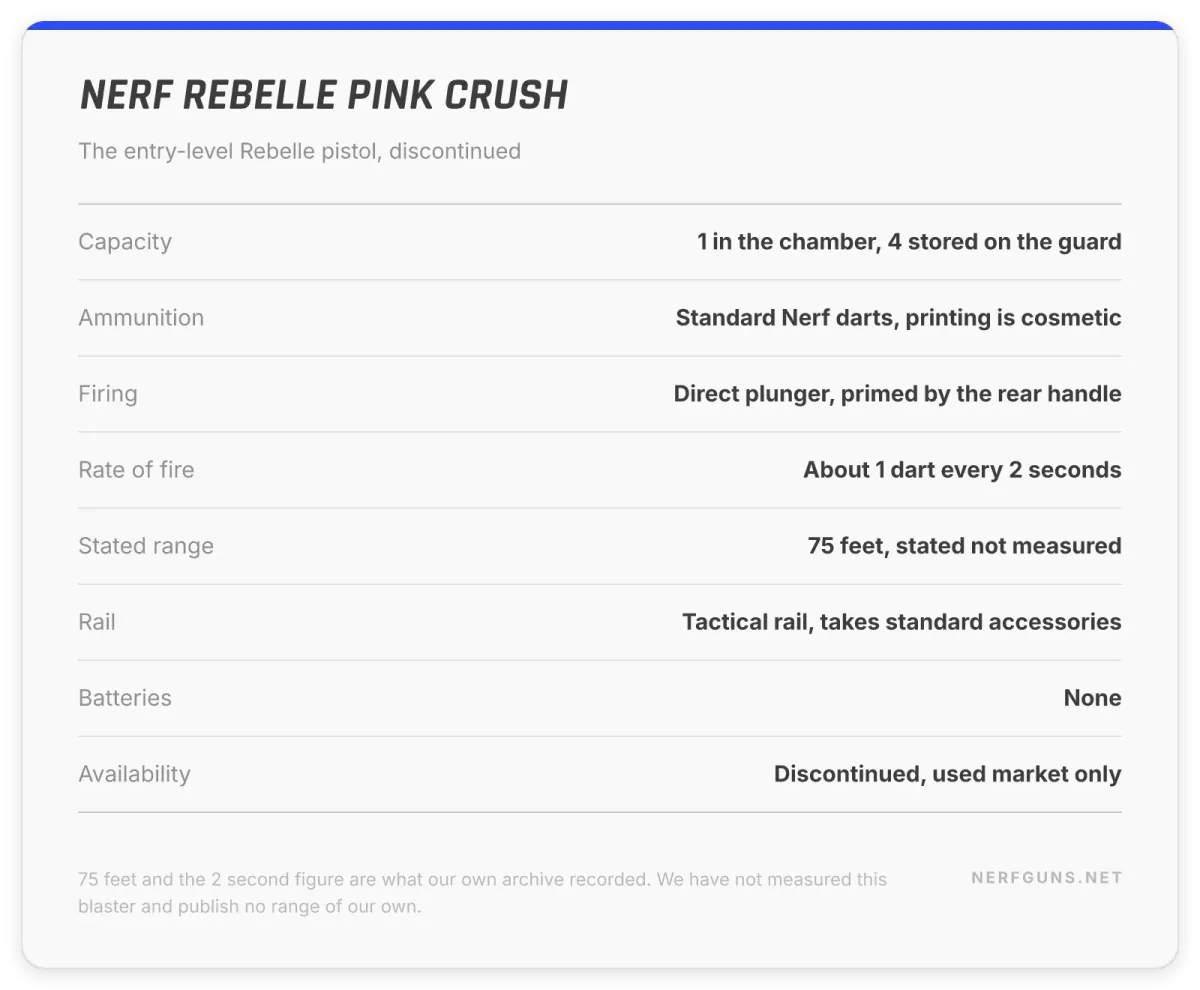
The Pink Crush is the smallest blaster Rebelle made, and the one most people actually owned. It is a direct-plunger pistol dressed up as a mini crossbow. It carries 5 darts on the blaster itself, and our archive records 75 feet as the stated range. Here is what it does well, and the one number that decides whether it belongs in your loadout.
What is on this page
- The short verdict
- What you get in the box
- How a direct plunger works
- Range and accuracy
- Rate of fire, the real limit
- The dart storage nobody mentions
- Size, grip and the rail
- Where it fits in a game
- Where it sat in the Rebelle line
- Mod potential and paint
- If this one is not it
- Buying one secondhand
- What to buy now that Rebelle is gone
- Where to buy
- Frequently asked questions
The short verdict

- Single shot, hand loaded, with a direct plunger. No clip, no barrel, no motor.
- 5 darts on board: 1 in the chamber and 4 clipped behind the bow-shaped guard.
- 75 feet is the stated figure in our archive, and it is stated rather than measured.
- Standard darts, so ammunition is never a problem.
- A tactical rail, which is unusual on a blaster this small and this cheap.
Buy it if you want a light backup that lives on a belt or in a pocket and never runs out of batteries.
Skip it if you want a primary. One dart at a time is one dart at a time. No amount of range makes up for that against somebody carrying a clip.
What you get in the box
The Pink Crush sat at the bottom of the Rebelle range, which in practice means it shipped with a blaster, some darts and nothing else.
The darts are the patterned collectible sort the whole line used. Underneath the printing they are ordinary Nerf darts, and any standard dart fires from a Pink Crush perfectly well.
That matters more than the packaging suggested. A cheap blaster that eats common ammo stays useful for years. A cheap blaster with its own private ammo becomes a paperweight the moment the refills stop.
How a direct plunger works
Under the shell, the Pink Crush is the same machine as the plain N-Strike pistols of that era. Understand the mechanism and everything else on this page follows.
You pull the handle at the back of the blaster. That drags a plunger backwards through a sealed tube and catches it against a spring.
Pull the trigger and the catch releases. The spring drives the plunger forward, the air in front of it has nowhere to go except down the barrel, and the dart leaves.
That is the entire system. No batteries, no motor, no flywheel. Nothing to spin up and nothing to run flat. It is the most reliable arrangement Nerf has ever shipped, and it is why a Pink Crush still works after a decade in a cupboard.
The cost is just as simple. One plunger stroke gives you one dart. The plunger cannot be primed while a dart is in the air. Everything slow about the Pink Crush comes from that one fact.
Range and accuracy
75 feet is the stated figure in our archive for the Pink Crush, and stated is carrying weight in that sentence. We have not measured this blaster and we do not publish numbers we did not take.
What is fair to say is this. A direct plunger with a short fixed barrel is a well-understood setup. Blasters built this way tend to be more consistent shot to shot than rotating-barrel designs, because the dart always sits in the same place.
Accuracy is therefore decent for the size. Not because anything clever is happening, but because there is almost nothing in the path between the plunger and the dart.
The honest catch is the same one that applies to every small blaster on this site. A short barrel and a light dart means wind wins. Outdoors, a stated 75 feet becomes a lot less across an open lawn.
One correction worth making to our own older copy. A previous version of this page claimed the Pink Crush had a range advantage of 40 to 45 feet over comparable blasters. That figure was never sourced or measured. It does not follow from anything else here, so it was removed rather than repeated.
Rate of fire, the real limit
Our archive records roughly 1 dart every 2 seconds for the Pink Crush, which is the ordinary pace of prime, aim, fire for a hand-loaded pistol.
That is the number that decides where the Pink Crush belongs. It is not slow because it is badly made. It is slow because every shot needs a hand off the grip to load the next dart.
Compare that with a revolver-style pistol holding 6 in a rotating barrel. Same prime, same plunger, but 6 shots before you stop to reload rather than 1.
So the Pink Crush is a sidearm, not a primary. Judged as a sidearm it is genuinely good: light, silent, always ready, and it never needs a battery.
Judged as a primary it is a handicap. Anybody with a clip-fed blaster gets 12 shots to your 1. No amount of aiming closes that gap.
The dart storage nobody mentions
This is the most useful feature on the blaster and the one the packaging said the least about.
The bow-shaped guard wrapped around the barrel is not just decoration. It holds 4 spare darts, clipped in place. So the Pink Crush carries its own reloads on its body.
With 1 loaded, that is 5 darts on the blaster, in your hand, nothing in a pocket. For a pistol that is genuinely useful. It is the difference between a backup you can use and a backup that fires once.
The technique: load the chamber, then reload from the guard with your off hand while the blaster stays pointed. It takes practice. Once you have it, it roughly halves the time between shots.
The catch is holding on to them. Darts clipped to the outside of a blaster fall off when you run. Check the guard is still full before you commit to a position, not after.
Size, grip and the rail
It is small and light. The shell is thin, there is nothing heavy inside it, and it disappears in an adult hand.
The grip is sized for a smaller hand, on purpose rather than by accident. A larger hand can still work the prime comfortably, because a short plunger stroke does not need much leverage.
The prime is light. That is the single best thing about handing this blaster to somebody new, because a stiff prime is what makes a beginner give up on a blaster inside 10 minutes.
There is a tactical rail on top, which is genuinely unusual at this size and price. Standard Nerf rail accessories fit it, so a sight or a light from another blaster goes straight on. Our attachments guide covers what helps and what is just decoration.
Be realistic about the rail though. Hanging a scope on a blaster this small mostly adds weight to something whose main virtue is being light.
Where it fits in a game
The Pink Crush has one job and it does it well: it is the thing on your belt for when your primary runs dry.
That moment is the weakest point in any Nerf game. You are standing still, both hands busy, and everybody knows it. A single-shot pistol that is already loaded changes it completely.
It is also the right blaster for close quarters. Indoors, around furniture, in a hallway, a small blaster that swings fast beats a big one that catches on the doorframe.
And it is a good first blaster. Light prime, no batteries, standard darts, nothing to jam. Nothing about it will put a new player off.
Where it fails is open ground. Out in a yard against clip-fed blasters, one dart at a time is not a contest. Carry the Pink Crush alongside something bigger, never instead of one.
Setting up a game for a group? Our Nerf war game modes page has formats built around limited ammo, where a single-shot sidearm is a design choice instead of a handicap.
Where it sat in the Rebelle line

Rebelle was a small range built around a look. The Pink Crush was its entry point: the cheapest thing on the peg, and the one most likely to be bought as an extra rather than the main present.
That position explains the design exactly. Simple mechanism, low part count, no batteries, and the one clever idea being onboard dart storage rather than anything expensive.
The line was marketed as being for girls, and that framing is worth naming rather than repeating. It described a shelf, not a mechanism. A direct-plunger pistol with a rail and 5 darts on board suits whoever is holding it. Our older copy on this page leaned on that marketing in a way it should not have.
The whole range is discontinued now. Our guide to the Rebelle blasters lays all of them out with their stated figures and honest limits.
Mod potential and paint
Limited, and for a good reason: there is not much in there.
A direct-plunger pistol responds in principle to the usual work: better seal, stronger spring. On a shell this small the payoff is modest. The trigger and catch are not built for much more load than they already carry.
If you want a plunger platform worth opening up, the larger N-Strike pistols of the same generation have more room and far more parts available. The mods hub points at the ones that reward the effort.
Paint is the sensible route here, and the Pink Crush is an unusually good candidate for it. The bow guard and flat slab sides are easy shapes. It is also cheap enough that a first attempt going wrong is not a disaster.
Our painting guide covers the prep. Sanding first is what stops a finish flaking off a small blaster that gets handled constantly.
If this one is not it
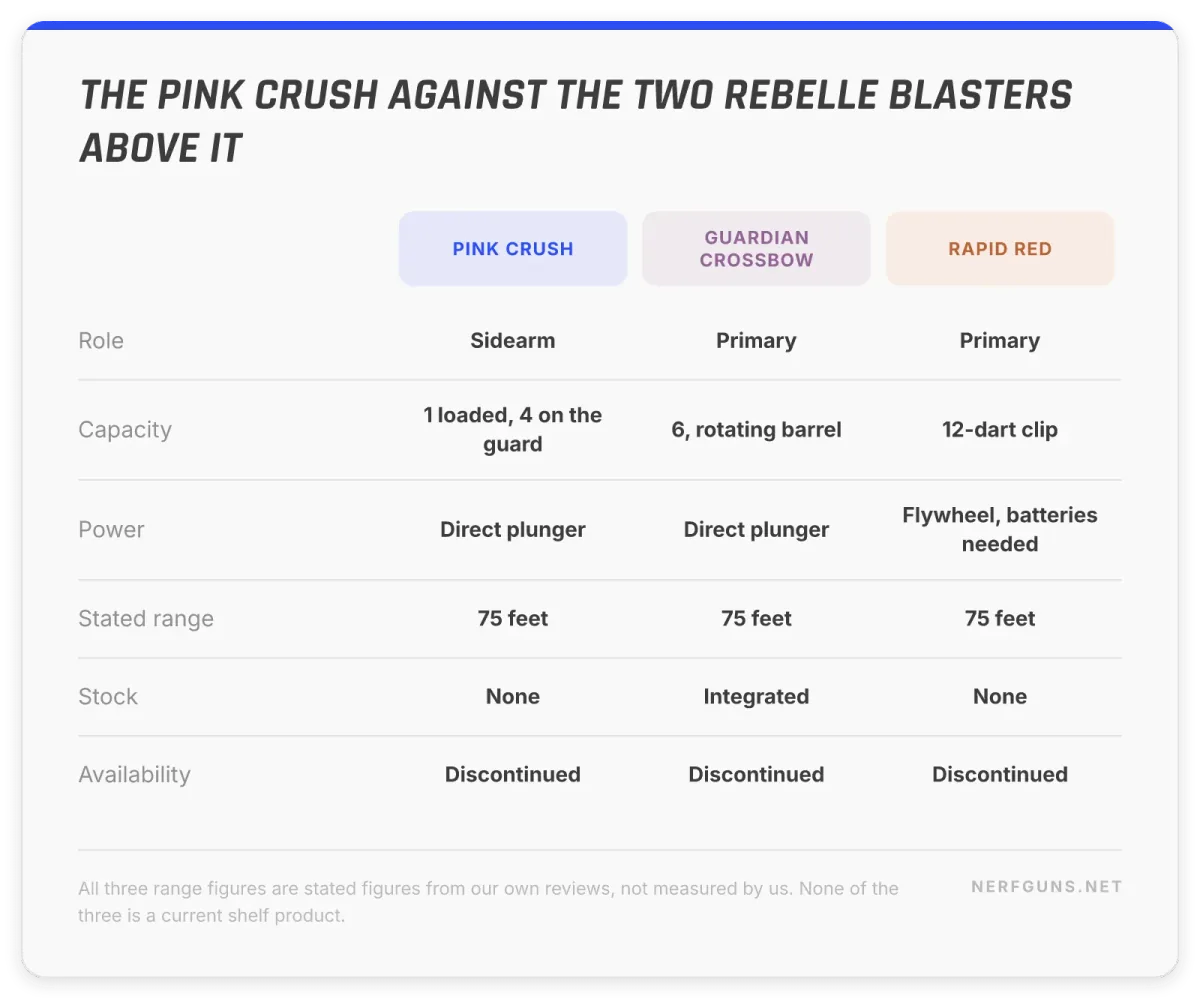
You want the same size with more shots. A revolver-style pistol gives you 6 in a rotating barrel with the same prime and the same plunger. That is the single most useful upgrade from a Pink Crush and it changes nothing else about how you carry it.
You want a Rebelle blaster you can lead with. The Guardian Crossbow holds 6 and has a shoulder stock, and the Rapid Red runs a 12-dart clip off a flywheel.
You want the bow shape for real. Our roundup of the best crossbow Nerf guns compares the proper bows and crossbows, including which ones to avoid.
Buying one secondhand
Rebelle is discontinued, so every Pink Crush on the market is used and there is no current-shelf equivalent. Anything sold as new in box is old stock rather than new production.
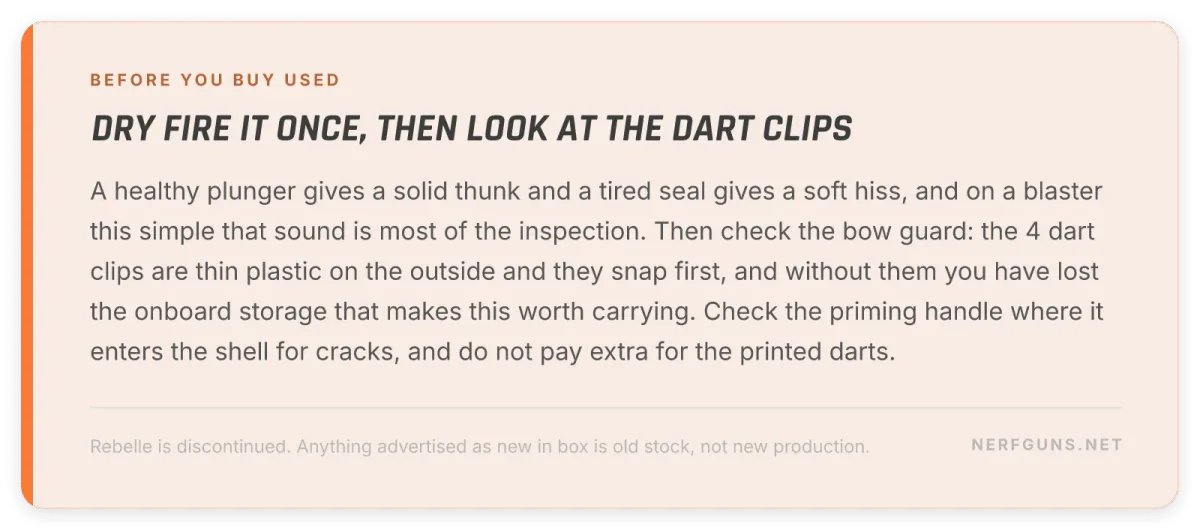
Prime it and dry fire it before anything else. A healthy plunger gives a solid thunk. A tired seal gives a soft hiss. On a blaster this simple, that one sound tells you almost everything.
Check the bow guard for the dart clips. They are thin plastic, they sit on the outside, and they are the first thing to snap. A Pink Crush with broken clips has lost its onboard storage, which is most of the reason to own one.
Look at the priming handle where it enters the shell. Cracks there mean the catch has been fighting something, and that is not worth fixing on a blaster this cheap.
Do not pay a premium for the printed darts. They are cosmetic, they are usually lost, and ordinary darts work identically.
What to buy now that Rebelle is gone
Rebelle is finished as a line. Every Pink Crush out there is a used one.
The good news is that this is the easiest bridge on the whole site. The Pink Crush was never really a Rebelle mechanism. It was a plain direct-plunger pistol in a bow-shaped shell, and Nerf still makes plain direct-plunger pistols.
Better still, they still fire ordinary Elite darts. So the foam you already own keeps working, which is not true of the newer N1 blasters.
Further up this page we said the single most useful upgrade from a Pink Crush is a revolver-style pistol: 6 in a rotating barrel, same prime, same plunger. Here is that blaster.
- The Nerf Elite Disruptor has a 6-dart rotating drum and slam fire, and it ships with 6 Elite darts. Six shots before you stop, instead of one. That is the Pink Crush problem solved without giving up a single thing you liked.
- If you want to stay closer to the original, the Nerf Elite 2.0 Prospect QS-4 is still pull-back priming with a built-in targeting scope, and it comes with 8 Elite darts.
One thing neither of them does. Nothing current carries spare darts clipped to the outside of the blaster the way that bow guard did. That little idea was the best thing about the Pink Crush and nobody copied it.
Amazon states no age rating on either of those two listings, so this page does not print one. Read the listing yourself if you are buying for a younger player.
Bonus tip: nobody ever guesses the right blaster. Put the one you actually want on a free wish list, then send the link to whoever keeps asking what you want for your birthday. Start your free Nerf wish list and let them buy the right thing.
Where to buy
As an Amazon Associate and eBay Partner, we earn from qualifying purchases.
The Pink Crush is discontinued, so these point at the used and third-party market, not a current shelf item. Prices there move constantly. Treat anything you see as a snapshot.
- Nerf Rebelle Pink Crush on Amazon , the blaster itself, and it still has a live buy box.
- Standard dart refills on Amazon, which work in this blaster
- Used Pink Crush listings on eBay, usually the better hunting ground for a discontinued blaster, and the place to find one with its dart clips unbroken.
If chasing a discontinued blaster is not appealing, our guide to the new Nerf guns covers what is on shelves now, and the full blaster list has everything we have written up.
Frequently asked questions
How many darts does the Pink Crush hold?
1 in the chamber and 4 clipped behind the bow-shaped guard, so 5 on the blaster in total. There is no clip and no rotating barrel, so each shot is loaded by hand.
How far does it shoot?
Our archive records 75 feet as the stated figure. We did not measure it. Treat it as a manufacturer ceiling in ideal conditions, not what you will see outdoors.
Does it need batteries?
No. It is a direct plunger driven by a spring, so there is nothing electrical in it at all. That is the main reason a Pink Crush bought used still works.
Does it take normal Nerf darts?
Yes. The patterned darts in the box are cosmetic and any standard dart works. Ammunition is never a problem with this blaster, which is not something you can say about everything from its era.
Is it any good as a main blaster?
No, and it was not built to be. One dart at a time at roughly 1 shot every 2 seconds is a sidearm rate of fire. Carry it alongside something bigger rather than instead of one.
Is the Pink Crush a real crossbow?
No. The bow shape around the barrel is a shield and a dart holder, not a mechanism. Underneath it is the same direct-plunger pistol as the plain N-Strike models of the same period.
Is it suitable for a younger or first-time player?
It is one of the better choices for that. The prime is light, there is nothing to jam, there are no batteries, and it is small enough to hold comfortably. Simplicity is the whole point of it.
Can you put a scope or a light on it?
Yes, the tactical rail takes standard Nerf accessories. Whether you should is another matter, because a Pink Crush weighs almost nothing and a scope on top undoes the one advantage it has over every bigger blaster.
How does the Pink Crush compare to the Guardian Crossbow?
Same line, opposite ends of it. The Guardian holds 6 in a rotating barrel and has a shoulder stock, and it is a primary. The Pink Crush holds 1 with 4 stored on the body, and it is a backup. Both state 75 feet and both fire ordinary darts.
Do the spare darts really stay on the guard?
They stay put while you walk and they come loose when you run. Push each one fully home, and get into the habit of checking the guard when you take cover rather than discovering the problem when you reach for a reload.
Is there a modern version of the Pink Crush?
Yes, and it is a straight upgrade. The Pink Crush is a plain direct-plunger pistol underneath, and Nerf still makes those. The Elite Disruptor gives you a 6-dart rotating drum and slam fire for the same prime, and the Elite 2.0 Prospect QS-4 keeps pull-back priming with a built-in scope. Both fire ordinary Elite darts, so your existing foam still works. The one thing neither has is the spare darts clipped to the outside of the blaster.
Is the Pink Crush worth buying now?
At sidearm money, yes. It is reliable, it takes common darts and it carries its own reloads. If a seller is pricing it as a collectible because the line is discontinued, that is a different question, and the answer there is usually no.
It’s Nerf or Nothin’!