
The Retaliator is the blaster I hand people who ask what one blaster does everything. Clip fed, pump primed, four configurations, and not a single battery. Here is what it does well. Here is what to check before you buy a used one. And here is the one thing that turns a cheap listing into a bad deal.
What is on this page
The short verdict

- Four blasters in one box, and the four configurations are genuinely different rather than cosmetic.
- No batteries at all. Nothing to die mid-game, nothing to corrode in storage, no motor noise giving your position away.
- A 12-dart clip that shares with every other N-Strike and Elite clip blaster you own.
- Fast reloads for a pump blaster, with a translucent clip so you can see what is left.
- Discontinued, but one of the safest used blasters on the market precisely because it has no electronics.
Buy it if you want one blaster that adapts to whatever the game turns out to be. Skip it if you want the fastest rate of fire, because a flywheel blaster will always beat a pump.
What the Retaliator is
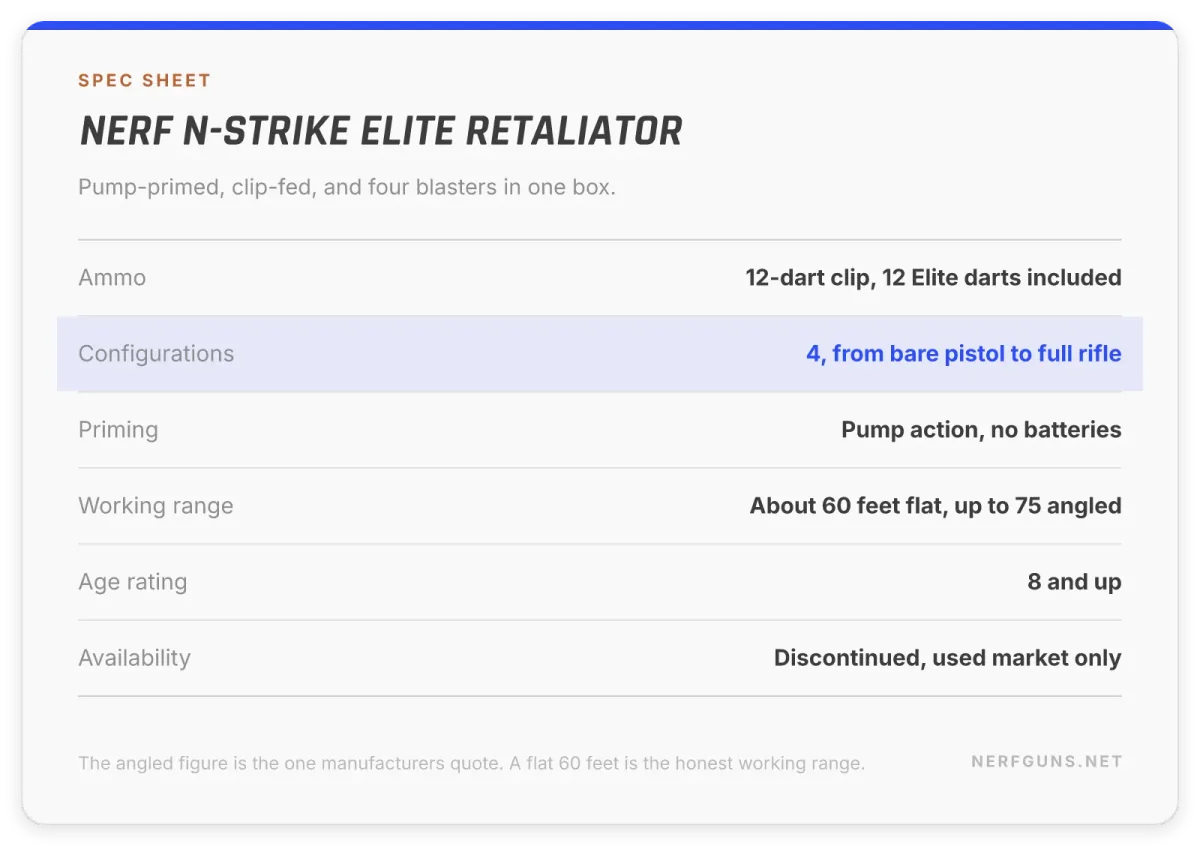
The Nerf N-Strike Elite Retaliator is a pump-action, clip-fed dart blaster in the Elite blue and white colour scheme. It ships with a 12-dart clip and 12 Elite darts, and it comes apart into four pieces you can run in any combination.
Those four pieces are the core blaster, a barrel extension, a shoulder stock, and an assault grip that mounts underneath the front.
It is rated for ages 8 and up, and the reason it works at that age is the priming. There is no motor to spin up, no batteries to die halfway through a fight, and no acceleration trigger to remember. Pull the slide back, push it forward, pull the trigger. A younger player figures it out in one demonstration.
The four configurations
That is where the “4 in 1” tag comes from, and it is not marketing fluff.
- Bare blaster. Strip everything off and you have a chunky pistol. Fast to bring up, easy to carry, fine indoors.
- Carbine. Add the stock and you have something you can shoulder, which steadies every shot you take.
- Long barrel. Add the barrel extension and you have something you can aim across a yard.
- Full rifle. Run all of it and you have a full-size blaster with a grip up front for the second hand.
Four blasters for one purchase, and you decide which one you are carrying on the walk out the door.
Here is the part people underrate. You are not choosing once. You can reconfigure between rounds, or mid-game if you have somewhere to put the parts down. A game that turns out to be indoors and close gets the bare blaster. A game across a field gets the barrel and stock.
That is a genuinely useful property, and it is the reason this blaster stays in an armoury long after flashier ones have been sold on.
Range and accuracy
With Elite darts, expect around 60 feet on a flat straight shot. Angle it up and let the dart arc, and you get about 75 feet.
That angled figure is the one manufacturers like to quote, so know which number you are reading when you compare blasters. A flat 60 feet is the honest working range, and it is what you will actually get shooting at somebody across a garden.
You may see a higher figure quoted for the Retaliator elsewhere, including on one of our own older pages. Where our numbers disagree, trust the flat and angled pair above. It keeps the two measurements apart instead of blending them into one big number.
Elite darts are lighter than the older Streamlines. That is where the extra distance comes from. They also run in most N-Strike blasters, so you are not buying a special kind of ammunition. Our dart buying guide covers which refills are worth the money.
Accuracy in practice
Pump blasters are more consistent than flywheel blasters, shot to shot, because there is no motor speed to vary. What you get from a Retaliator is a predictable arc you can learn.
The stock is what turns that consistency into hits. Shouldering the blaster removes most of the wobble that a one-handed grip introduces, and it costs you nothing but the time to clip it on.
Reloading and handling
Reloads are about as fast as a pump blaster gets. Pull the priming slide back, hit the clip release, drop the empty, seat a fresh clip, run the slide forward, and shoot.
The clip is translucent down one side, so a glance tells you what you have left instead of counting shots in your head. That sounds minor until the first time you dry-fire at somebody because you miscounted.
Two details that get overlooked.
First, it will run smaller clips, not just the 12, so any N-Strike clips already in your kit work here. Buying two spare clips does more for your game than buying a second blaster.
Second, there is a clip point on the handle for a sling, which matters more than it sounds like it does. A sling is the difference between reconfiguring the blaster mid-game and dropping half of it in the grass.
The tactical rail is compatible with most N-Strike blasters, so sights, lights and scopes move between them. If you are building out that side of things, the attachments guide covers what is worth bolting on and what is not.
How it compares to its siblings
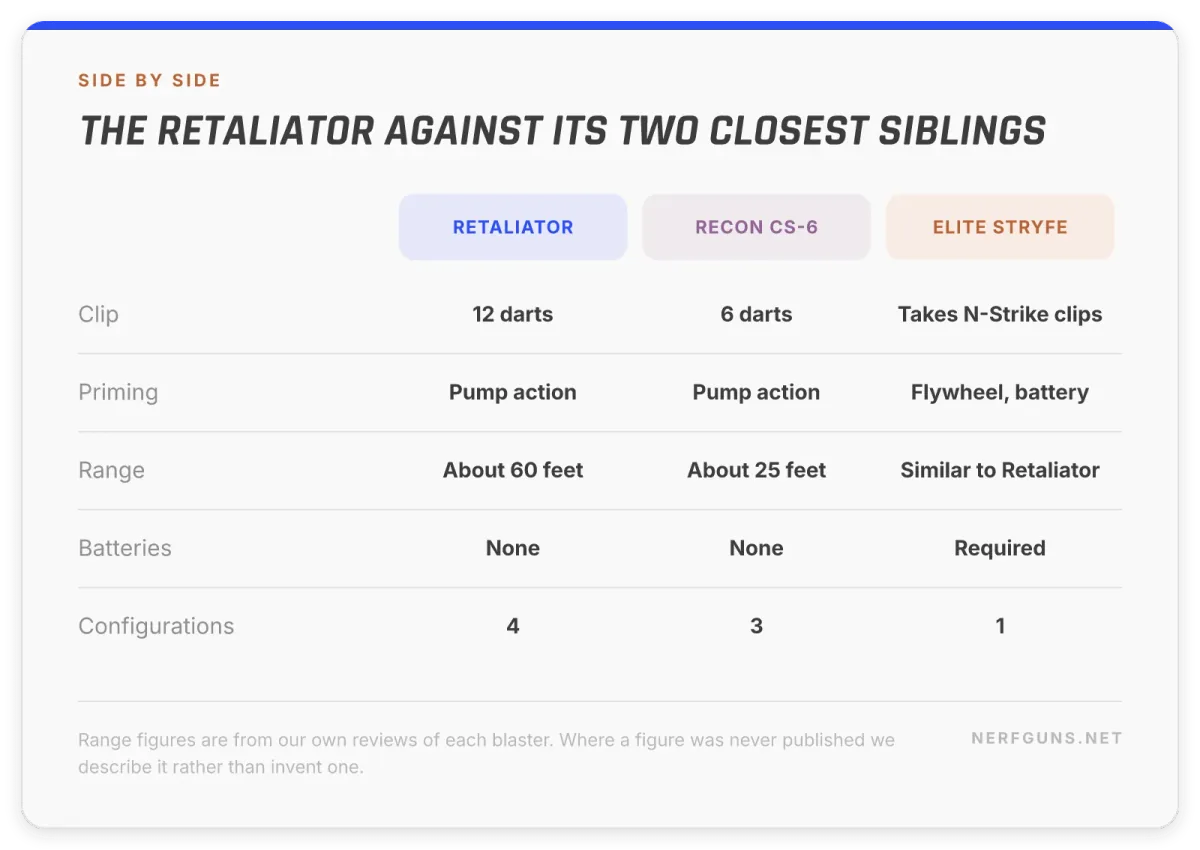
Versus the Recon CS-6
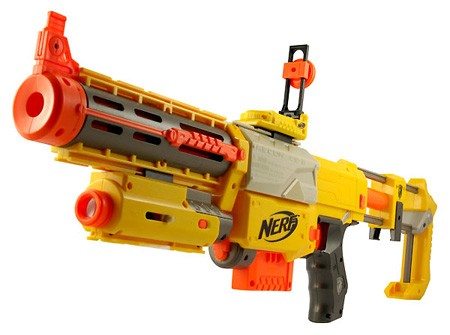
The Retaliator is the Recon’s big brother. The family resemblance is obvious: same look, same priming, same swap-the-parts idea. The difference is capacity and reach.
The Recon runs a 6-dart clip and lands around 25 feet per shot. The Retaliator runs 12 and reaches roughly 60. If you already know and like the Recon CS-6, the Retaliator is the same idea with the numbers turned up.
Versus the Elite Stryfe
The Elite Stryfe is the closest match in size and range, and the two land in similar territory on distance. The split is how they fire.
The Stryfe uses a battery-powered flywheel, so there is no pumping between shots, which is genuinely faster. The Retaliator needs no batteries at all, which means it never dies on you and it never gives your position away with motor noise.
Pick your side of that trade honestly, because both answers are defensible.
Versus the Elite Rampage
The Rampage is the drum-fed answer in the same family if raw ammunition capacity is what you are short of. The Retaliator gives that up in exchange for being far easier to carry and reconfigure. Both sit in the N-Strike Elite lineup.
Versus the heavy motorized blasters
If what you actually want is volume rather than versatility, that is a different blaster entirely. The Rhino-Fire holds 50 darts on two drums and mounts on a tripod, and the Vulcan EBF-25 feeds 25 from a belt. Both are equipment you place rather than blasters you carry, and both need batteries.
Which games it suits
The Retaliator is unusual in that there is no format it is bad at. That is the whole pitch, and it is worth spelling out rather than leaving as a claim.
Indoor and close quarters
Strip it to the bare blaster. No barrel to catch on a doorframe, no stock to snag, and a pump prime that works fine one-handed once you have the knack. Twelve darts is plenty for a room.
Backyard and open ground
Barrel and stock on. The shoulder contact is what makes 60 feet usable rather than theoretical, and the front grip steadies the blaster while you prime it.
Humans versus Zombies and long games
This is where no batteries stops being a nice detail and starts being the reason you win. A long game punishes anything with a runtime, and the Retaliator has none. It also stays quiet, which matters in a format built around ambush. Our war games page covers the formats worth running.
Games with a chrono limit
Stock, it sits comfortably inside most club limits, which is not true of a heavily modified blaster. If you play anywhere with rules, an unmodified Retaliator is the blaster you do not have to think about.
Where it is the wrong pick
Pure rate-of-fire games. Does the format reward putting the most foam in the air in the shortest time? Then a pump blaster loses to a flywheel blaster. No amount of practice closes that gap. Buy for the game you actually play.
Mod potential
The Retaliator is one of the most modified blasters in the line. The reason is simple. It runs on a spring and a plunger, and spring blasters answer to work in a way that is predictable and easy to undo.
The usual first steps are removing the air restrictor and fitting a stronger spring. Both change how hard the blaster hits. That changes which games it is safe in, so check the rules of whatever you play before you start.
The honest warning: a modified spring blaster is harder to prime. Push the spring far enough and you end up with a blaster a younger player cannot cock. That is a strange result for a blaster whose whole virtue is that anybody can use it.
Our Nerf gun mods guide covers the order to do things in and what each step actually buys you. The Retaliator is also a great paint project, because the shell is large and mostly flat. Our paint series walks through prep, primer and clear coat.
Why the Retaliator outlasted flashier blasters
Plenty of Elite-era blasters were more exciting on a shelf. Most of them are gone from people’s collections and this one is not, and the reason is worth naming.
A blaster earns its place by being the one you reach for without thinking. That means no setup, no runtime, no ammunition you have to buy specially, and no situation where it is the wrong tool. The Retaliator clears all four.
Excitement is a shelf quality. Reliability is a game quality. This blaster has very little of the first and almost all of the second. That is backwards from how it was marketed. It is also exactly why it survived.
Buying a Retaliator secondhand
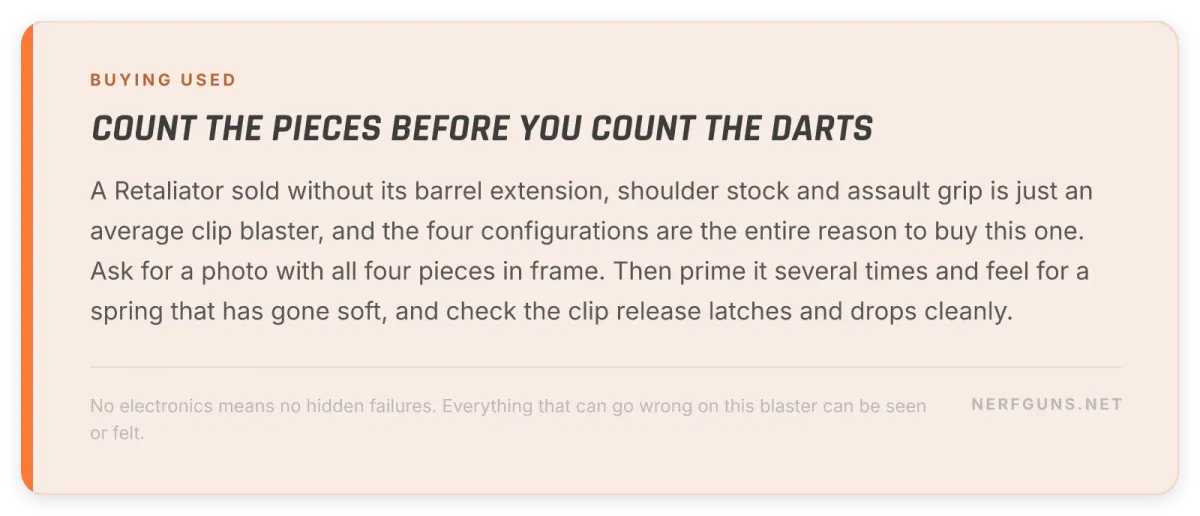
Here is the straight version: this blaster is not a current shelf product, and Elite as a line has moved on. What you are looking at is the used and old-stock market.
That is less of a problem here than it is for most discontinued blasters, for one specific reason. The Retaliator has no electronics. There is no motor to burn out, no battery contacts to corrode, no wiring to fail.
A used one fails in two ways: a tired plunger spring, or cracked plastic. You can see and feel both before you buy. A used pump blaster is a much safer secondhand purchase than a used flywheel blaster, and that is worth real money in your favour.
What to check, in order:
- All four pieces. This is where people get burned. A Retaliator sold without the barrel extension and stock is just an average blaster. The four configurations are the whole reason to buy this one.
- The spring. Prime it several times and feel for a spring that has gone soft. A tired plunger is the one thing that quietly costs you range.
- The clip release. It should latch and drop cleanly. A sticky release turns a fast reload into a fumble.
- The slide. It should run the full stroke without grinding or catching at either end.
- Cracks around the priming grip. That is where the force goes, so that is where a hard-used blaster shows it.
Darts and clips are the easy part, because both are standard across the line. A missing clip is a small purchase, not a reason to walk away from an otherwise complete blaster.
The Retaliator is gone, so what do you buy now?
The Retaliator is discontinued. Every one you see today is used or old stock.
Here is the good news. Its best idea did not die. The whole point of this blaster was parts you swap. Nerf sells that idea again, and the current line is called Loadout.
Two blasters on shelves get you close. They miss in different ways, so here is the honest split.
- Want the pump prime and no batteries? The Nerf Loadout Shadowspeed Recon primes with a pump, same as the Retaliator. It holds 6 darts in a revolving cylinder instead of a clip, and it comes with a 14-dart storage attachment. Hasbro rates it 8+.
- Want the stock, barrel and sight? The Nerf N Series Shadow Storm ships with all three in the box, which is the Retaliator’s four-in-one trick in current plastic. It feeds from an 8-dart internal clip, so you cannot drop the clip out. Hasbro rates it 8+ as well.
Nothing on shelves does the Retaliator’s exact trick. That trick is a clip you can pop out and replace in about a second. If that is the part you loved, the used market is where it still lives.
One more catch, and it gets everybody. Both blasters above fire N1 darts. Nerf’s own listings say N1 darts work only in N Series blasters. So the pile of Elite foam sitting next to your Retaliator will not feed either one. Budget for N1 darts on day one.
Bonus tip: nobody ever guesses the right blaster. Put the one you actually want on a free wish list, then send the link to whoever keeps asking what you want for your birthday. Start your free Nerf wish list and let them buy the right thing.
Where to buy
As an Amazon Associate and eBay Partner, we earn from qualifying purchases.
- Nerf N-Strike Elite Retaliator on Amazon , the blaster itself.
- Current Retaliator listings, which is the more reliable link for a discontinued blaster.
- N-Strike Flip Clip refill listings, because spare clips do more for your game than a second blaster.
- N-Strike Elite 250-dart pack, the ammunition it runs on.
- Used Retaliator listings on eBay, usually the better hunting ground for a blaster that left shelves years ago.
If you would rather buy something current instead, our guide to the new Nerf guns covers what is on shelves now.
Frequently asked questions
How many darts does the Retaliator hold?
12, in the clip that comes with it, and 12 Elite darts are in the box. It also accepts smaller N-Strike clips, so a 6-dart clip works if that is what you have.
Does the Retaliator need batteries?
No. It is pump primed and fully mechanical. That is a big reason it is still worth owning, and a big reason a used one is a safe buy.
How far does the Retaliator shoot?
Around 60 feet on a flat shot with Elite darts, and up to about 75 feet angled up so the dart arcs. The flat figure is the one that matters in a game.
What are the 4 configurations?
Bare blaster, blaster plus stock, blaster plus barrel extension, and everything together with the assault grip fitted. All four use the same 12-dart clip.
Is the Retaliator automatic?
No. It is a pump-action blaster, so one prime and one trigger pull per dart. If you want a faster rate of fire from the same family, the flywheel-powered Elite Stryfe is the closest equivalent.
Is the Retaliator still made?
No, it is discontinued, so every one available now is used or old stock. Because it has no electronics, that matters far less than it would on a motorized blaster.
Does the Retaliator take drum magazines?
It takes N-Strike clips, and the drums from the same system physically share that interface, so a drum will seat in it. The blaster balances badly with a big drum hanging off it, which is why the Rampage exists as the drum-fed member of the family.
Can you use Retaliator parts on other blasters?
Yes, and this is one of the quiet reasons to own one. The barrel extension, the stock and the assault grip all use standard N-Strike fittings, so they move onto any blaster with the matching mounts. Buying a Retaliator is partly buying a parts kit for everything else you own.
Is there a modern version of the Retaliator?
Not an exact one. The closest blasters on shelves are in the Nerf Loadout line, and the nearest match is the Loadout Shadowspeed Recon, which primes with a pump and holds 6 darts in a revolving cylinder. The N Series Shadow Storm ships with a stock, a barrel and a sight, which is the four-in-one idea. Neither one takes a drop-out clip, and both fire N1 darts, so your Elite foam will not work in them.
Is the Retaliator worth buying today?
Yes, if the listing has all four pieces. It is still the most versatile blaster per dollar in the N-Strike line. It adapts to the fight, instead of making you pick the fight in advance. For everything else in the family, browse every blaster we have covered.
It’s Nerf or Nothin’!


Here i am, sitting in my chair, looking at this review and thinking: ‘why don’t i have one of these yet?’ I seriously look foward into having this little baby in my arsenal soon enougth!