Nerf baseball gear turns a backyard into a batting cage for about the price of a pizza. It will not build a swing on its own. What it does is remove every excuse, and below are the 7 Nerf baseball picks worth owning plus the 8 drills that actually use them.
What is on this page
- Why Nerf baseball gear earns its space
- What you need to set this up
- The Nerf baseballs, and what each one is for
- Bats, tees and the glove
- 8 backyard drills that build real skills
- Where the blasters come in
- Safety rules worth saying out loud
- When a player starts taking baseball seriously
- Mistakes that waste a backyard session
- Where to buy Nerf baseball gear
- Frequently asked questions
Why Nerf baseball gear earns its space
I am not going to hand you a study. Nobody has run a controlled trial on foam balls in a driveway, and if anyone tells you they have, ask to see it.
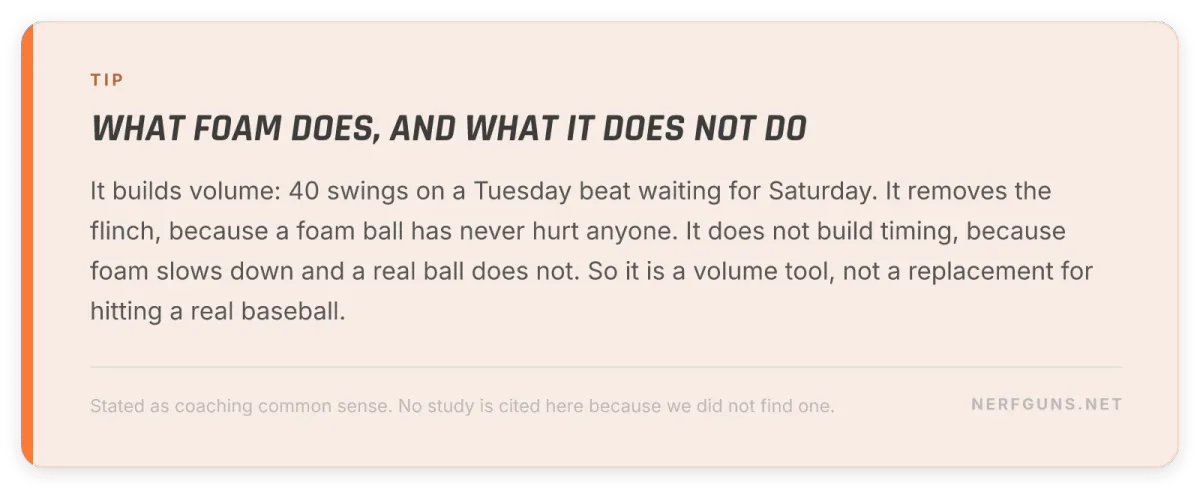
What I will hand you is the coaching math, and it is not complicated. A player who takes 40 swings in the yard on a Tuesday has taken 40 more than the player who waited for Saturday practice.
Volume is the whole argument. Nerf baseball gear removes the 3 things that normally cap volume at home: the cost of the ball, the damage a real ball does to a window, and the flinch a young player gets when a hard ball comes at his face.
That last one matters more than people admit. A 7 year old who has been hit once by a real baseball will bail out of the box for a season, and you cannot coach that out with words.
You can coach it out with reps he is not afraid of. That is the honest case for Nerf baseball equipment, and it is common sense rather than science.
The second honest point: foam does not behave like leather. Nerf baseballs slow down faster, they will not carry, and a swing that gets away with being late on foam gets caught late on a real ball.
So treat Nerf baseball gear as a volume tool, not a replacement for hitting a real baseball. Both things can be true, and pretending otherwise is how a player arrives at tryouts surprised.
What you need to set this up
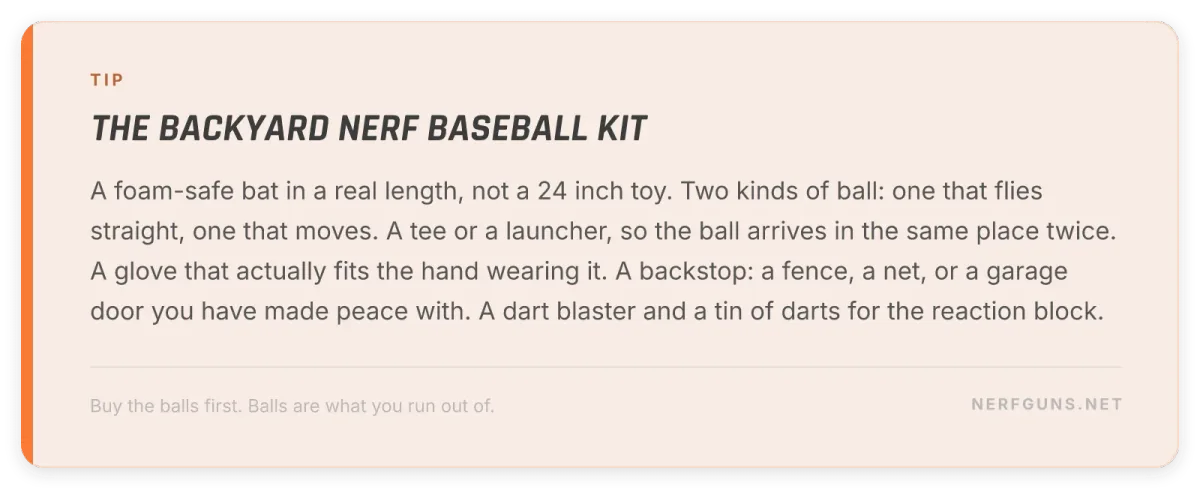
A working Nerf baseball setup is 6 items. You do not need all of them on day one, and you do not need the expensive version of any of them.
- A foam-safe bat. Plastic barrel, real length, something a player can actually swing without cheating his hands.
- Two kinds of ball. One that flies straight for timing, one that moves for tracking.
- A tee or a launcher. Anything that puts the ball in the same place twice.
- A glove that fits. An oversized glove teaches a player to catch with the wrong part of the hand.
- A backstop. A fence, a net, a garage door you have made peace with.
- A dart blaster and a tin of darts for the reaction work further down this page.
That last one is the part people raise an eyebrow at. Stay with me, because it is the reason this article exists on a Nerf site.
Buy the balls first. Balls are what you run out of, balls are what the dog eats, and a bucket of Nerf baseballs is what turns 10 swings into 40.
Everything else in the kit can wait a paycheck. The bucket cannot.
The Nerf baseballs, and what each one is for
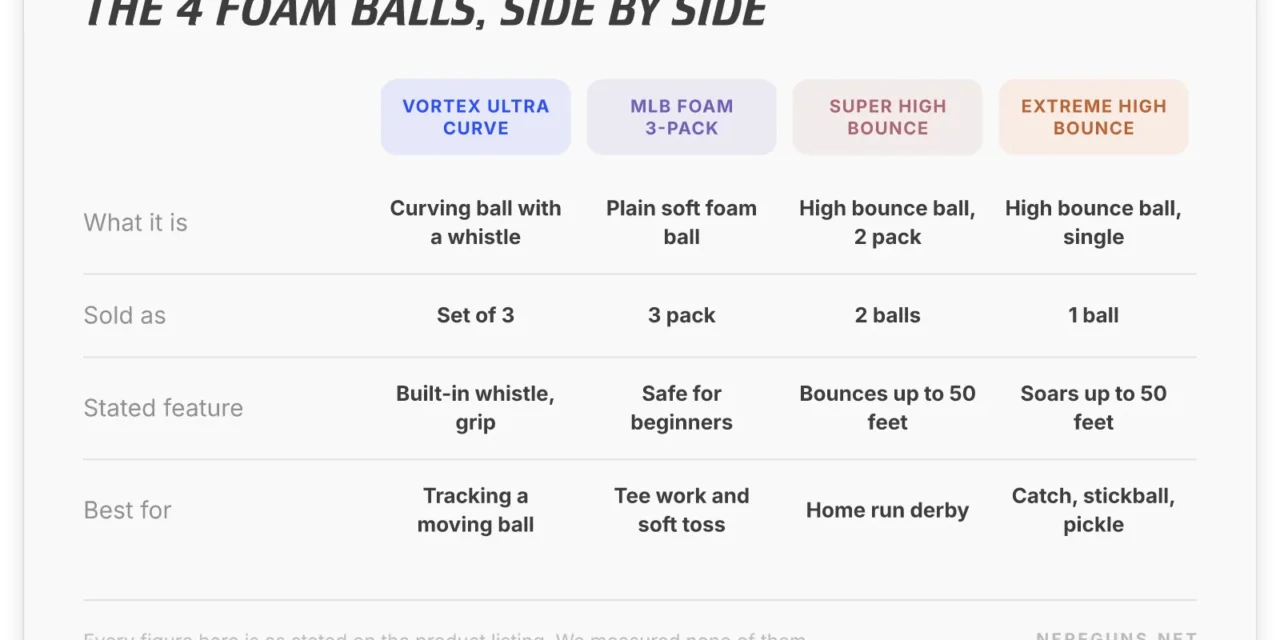
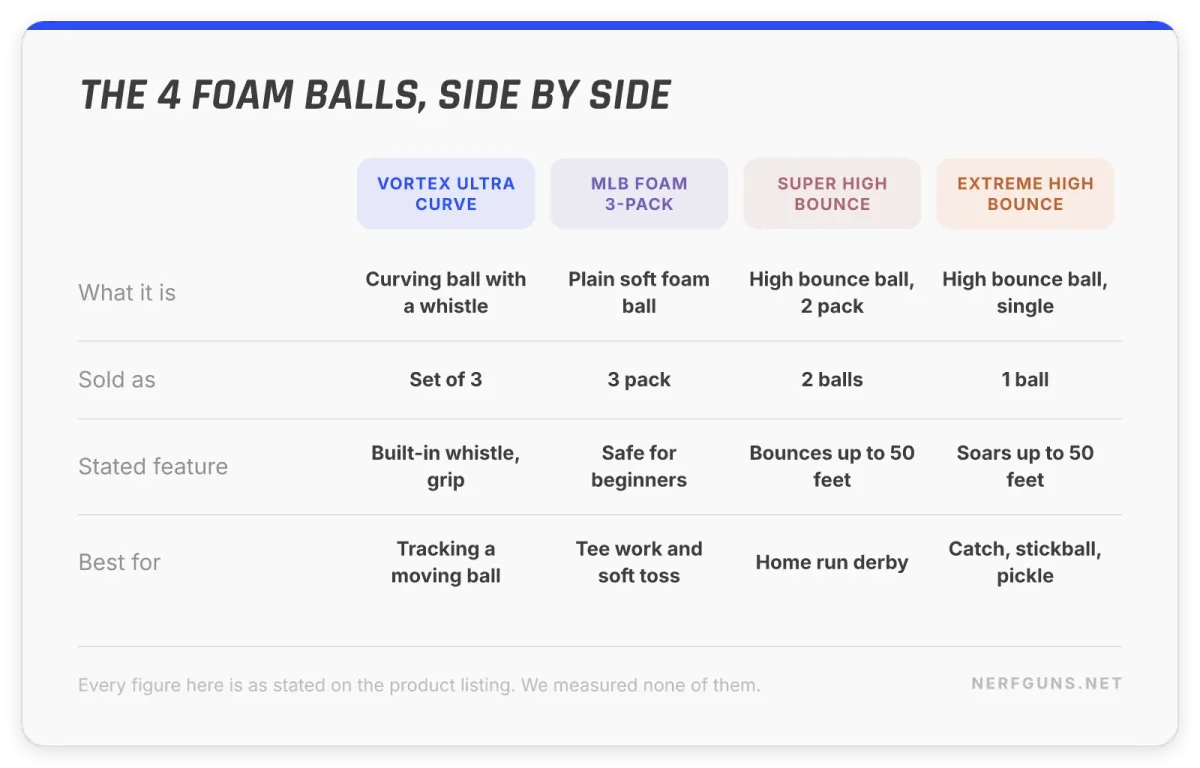
There are 4 Nerf baseballs in this lineup and they do 4 different jobs. Buying all 4 is not overkill if more than one player uses the yard.
Nerf Vortex Ultra Curve baseballs, the movement ball
These are sold as a set of 3 with a built-in whistle and a dual-injected grip, and the listing is explicit that they are meant for backyard batting practice.
The whistle is not a gimmick. This is the loudest Nerf baseball in the lineup, and a ball that makes noise as it moves gives a young hitter a second channel of information.
The curve does the rest. A ball that moves forces him to track it all the way in instead of guessing early off the release.
Best for: tracking, and for the parent who cannot throw a curveball on purpose.
Nerf Vortex Ultra Curve baseballs on Amazon
Franklin Sports MLB foam baseballs, the workhorse
A 3 pack of plain soft foam baseballs, listed as safe for beginners and made for batting practice anywhere. There is nothing clever about them and that is the point.
This is the Nerf baseball you use when you want a straight, repeatable flight so the only variable is the swing. It is also the one you hand a 5 year old without thinking about it.
Best for: soft toss, tee work and first catches.
Franklin Sports MLB foam baseballs, 3 pack
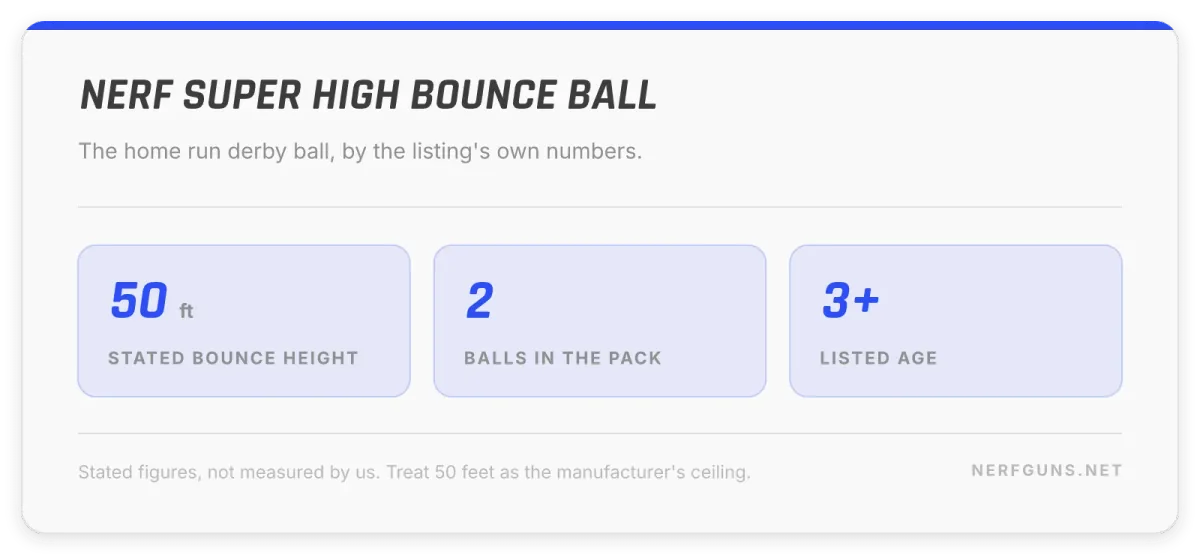
Nerf Super High Bounce Ball, the home run derby ball
Sold as a 2 pack, rated for ages 3 and up, and the listing states it bounces up to 50 feet. Treat that number as the manufacturer’s ceiling rather than what your driveway will produce.
It is the wrong Nerf baseball for hitting mechanics and the right one for a home run derby, because it goes a long way off a mediocre swing and the players lose their minds about it.
Best for: ending a session on a high note.
Nerf Super High Bounce Ball 2 pack
Franklin Sports Nerf Extreme High Bounce Ball, the pickle ball
Same 50 foot claim, single ball, and the listing points this Nerf baseball at catch, stickball and pickle rather than hitting. Pickle is the old rundown game, and it is the best conditioning drill nobody calls conditioning.
Best for: games that keep 3 or more players moving without an adult umpiring.
Franklin Sports Nerf Extreme High Bounce Ball
Bats, tees and the glove
The balls do most of the work. These 3 items are what turn a pile of Nerf baseballs into a session with a shape to it.
Franklin Sports Nerf Power Blast bat and ball set
A 32 inch plastic bat with a pro-style barrel, an extra grip handle and air-flow holes through the barrel, sold with 2 balls. The 32 inch length is the part that matters.
Undersized bats are the quiet problem with backyard hitting. A player who spends all summer swinging a 24 inch toy learns a swing that does not transfer, because the barrel arrives somewhere his real bat never will.
So buy the Nerf baseball bat in a real length, even if it looks big in his hands the first week. He grows into it inside a season.
Best for: being the only bat in the yard, which is what it will end up being.
One thing to check before you order. The older single ball listing for this set went out of stock. The link below is the current 2 ball version, and it is the same 32 inch bat.
Franklin Sports Nerf Power Blast bat and ball set
Franklin Sports Nerf AirTee stomp launcher set
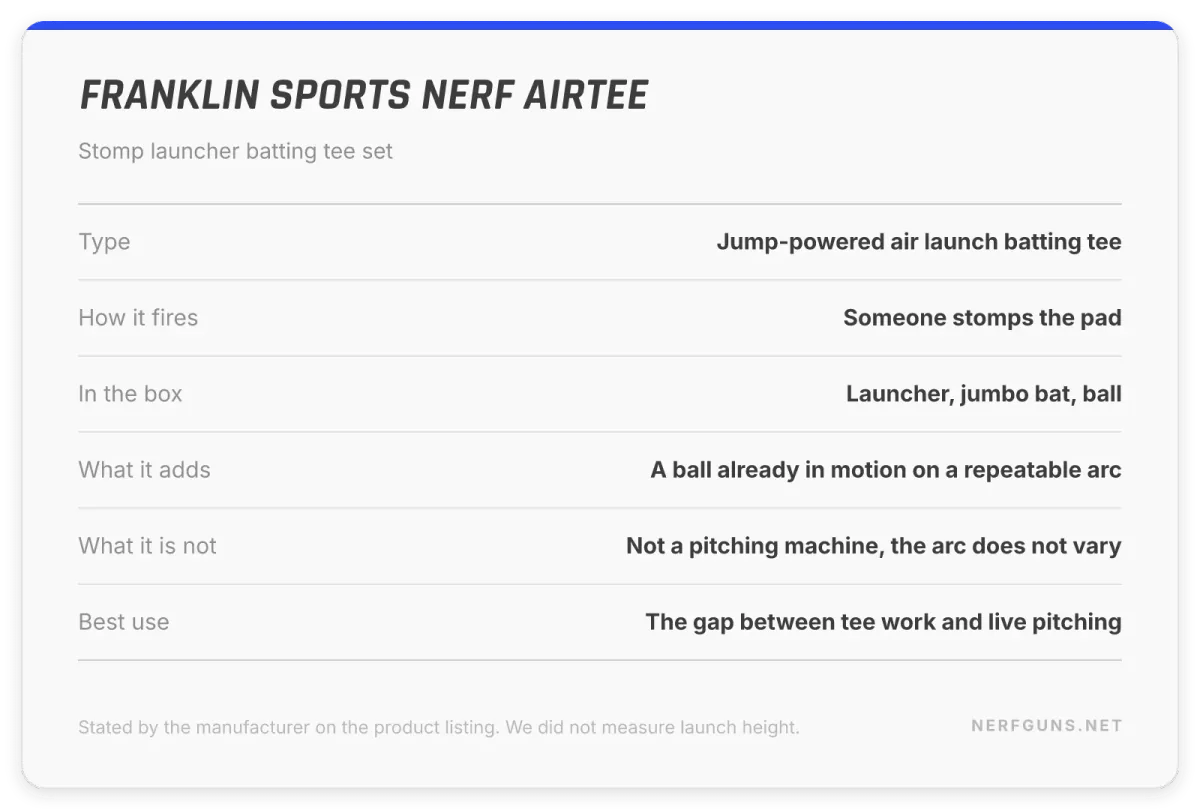
This is the one that surprised me. It is a batting tee that launches the ball into the air when someone stomps the pad, and it ships with a jumbo bat and a ball.
A standing tee teaches a swing path with no timing in it. This Nerf baseball tee puts the ball in motion on a repeatable arc instead, which means a player has to start his hands at the right moment.
That is the one skill a stationary tee can never teach, and it is the reason this thing is worth more than its price suggests.
Best for: the gap between tee work and live pitching, and for solo practice when nobody is around to toss.
Franklin Sports Nerf AirTee stomp launcher set
Nerf Proshot teeball glove and ball set
An 8.5 inch youth mitt with a foam ball, listed as adjustable and as a right hand throw model, which means it goes on the left hand. Check that before you order, because it catches people out every year.
An 8.5 inch glove is small on purpose. A 4 or 5 year old in an adult-sized mitt cannot close it, so he learns to trap the ball against his body instead of catching it in the pocket.
Pair this one with the plain foam balls above. A soft Nerf baseball and a glove that shuts is the entire recipe for a first catch that does not hurt.
Nerf Proshot teeball glove and ball set
8 backyard drills that build real skills
Every one of these Nerf baseball drills runs in a normal yard with the gear above. Keep each drill under 10 minutes. Attention is the limiting resource, not the swing.
- Tee to launcher ladder. 10 swings off a stationary tee, then 10 off the stomp launcher. The second block feels harder and it should.
- Whistle tracking. Toss the curve balls underhand and have the player call “in” out loud the moment he hears the whistle change. It forces him to watch the whole flight.
- Two ball soft toss. Hold a Nerf baseball in each hand, toss one, and call the color as it leaves your hand. He has to identify before he swings.
- One knee hitting. Same soft toss, hitter on his back knee. It strips out the stride and shows you what the hands are really doing.
- Wall bounce quick hands. Throw a high bounce ball at a wall from 6 feet and catch it barehanded. Start slow, move closer, stop before it stings.
- Pickle. Two fielders, 2 bases, one runner, one Nerf baseball. Run it for 5 minutes and everyone is out of breath.
- Home run derby. 10 swings each with the high bounce ball, a fence or a tree as the wall, and a running score. This is the reward drill.
- Blind toss. Player stands with his back turned, you call “go”, he turns and finds the ball already in the air. This is the drill that bridges into the blaster work below.
Rotate 3 of the 8 per session. Running all 8 turns a good hour into a long one, and a bored player is not learning anything.
Where the blasters come in
Here is the part I actually got asked about, and the reason a Nerf site is writing about baseball at all.
Reaction and tracking are trainable in a way a swing is not. A dart in the air is a small object moving fast on a curve, which is the same visual problem as a pitched ball, minus the fear.
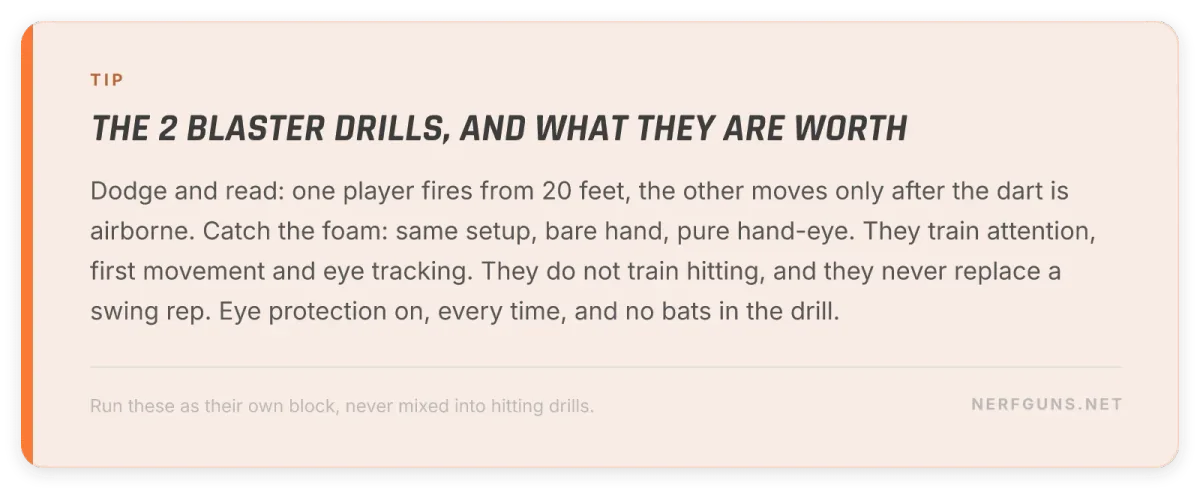
Two drills, and I will be straight about what they are worth. They train attention, first movement and eye tracking. They do not train hitting, and no amount of dart dodging will fix a bad load.
Run them as their own block, before or after the hitting drills, never mixed in with them.
- Dodge and read. One player fires darts from 20 feet, the other moves only after the dart is in the air. Call a direction out loud before moving.
- Catch the foam. Same setup, but the goal is to catch the dart with a bare hand. It is harder than it sounds and it is pure hand-eye.
Any low-power dart blaster works. A Nerf Elite Strongarm is the one I keep in the yard because it is single-shot, cheap and hard to break.
Your darts decide how well this works. Worn foam wobbles and flies short, so read how to bring old darts back into shape before you blame the blaster.
If the crossover session turns into a full blown yard war, which it will, the Nerf war game modes page has the rules already written up.
Safety rules worth saying out loud
Foam is forgiving. It is not harmless, and the two halves of a Nerf baseball session fail in different ways.
Eye protection during blaster drills, every time. A dart to the eye is the one injury this hobby actually produces, and it is 100% preventable with $8 of safety glasses.
Never fire darts at a player holding a bat. Obvious written down, not obvious at 6pm with 5 excited kids in the yard. Bats and blasters do not share a drill.
Keep the hitting zone pointed away from windows and cars even with foam. The high bounce Nerf baseballs are the ones that reach a neighbour’s yard, and they reach it fast.
Set the batting line before the first swing and make everyone stand behind it. A backyard has no dugout and no umpire, so the line is the only thing you have.
When a player starts taking baseball seriously
At some point the foam stops being the point. He starts asking about travel ball, or a coach mentions high school tryouts, and the questions get bigger than anything a bucket of Nerf baseballs can answer.
That is well outside what this site knows, so I will point you at people who do know it. Uncommitted U is a college baseball recruiting site, and the two pages worth reading first are both free.
The first is their guide to working out which college baseball level a player actually fits, which is the honest version of a conversation most families have far too late.
The second is their breakdown of NCAA baseball eligibility and the recruiting clock, because the rules about when a coach can talk to a player surprise almost everyone the first time they read them.
Neither of those is a Nerf problem. But the 9 year old swinging at foam in your driveway is the same kid who will be reading those pages in 5 years, and it costs nothing to know where they live.
Mistakes that waste a backyard session
- Buying one ball. Chasing a single ball around the yard turns a 40 swing session into 12. Buy the multi packs.
- A bat that is too short. It feels easier and it teaches a swing that does not survive contact with a real bat.
- Coaching every swing. One cue per session. A player thinking about 4 things is thinking about none of them.
- Running it too long. 20 focused minutes beats an hour of dragging. Stop while he still wants one more.
- Treating foam results as real results. Foam flatters a late swing. Do not build confidence on a ball that forgives.
- Mixing blaster drills into hitting drills. Separate blocks, separate gear, no exceptions.
Where to buy Nerf baseball gear
As an Amazon Associate I earn from qualifying purchases.
Every Nerf baseball item on this page was a live Amazon listing at the time of writing. Prices move, so check before you commit.
- Vortex Ultra Curve baseballs, set of 3
- MLB foam baseballs, 3 pack
- Super High Bounce Ball, 2 pack
- Extreme High Bounce Ball, single
- Power Blast 32 inch bat and ball set
- AirTee stomp launcher set
- Proshot 8.5 inch glove and ball set
- Elite 2.0 dart refill, 80 darts
If Amazon is out of something, our guide to the best places to buy Nerf gear covers which sources are worth the shipping.
Frequently asked questions
What age is Nerf baseball gear for?
The balls in this lineup are listed from ages 3 and up, and the glove set is aimed at teeball players. The hitting drills start working around 5, once a player can track a moving object and hold a bat with both hands in the same place twice.
Does Nerf baseball practice actually transfer to the real game?
Partly, and it is worth being precise. Repetition, tracking and confidence in the box transfer well. Timing does not transfer cleanly, because foam slows down and a real ball does not, so a player who only ever hits foam will be early on live pitching.
Are Nerf baseballs safe to use indoors?
The plain foam balls are, in a room with nothing breakable in the swing path. The high bounce balls are not, because that is the whole feature. Keep those two categories in different rooms and you will not lose a lamp.
Can you use a real bat with foam balls?
You can, and plenty of families do. A metal bat sends a high bounce ball a long way, so if you go that route, move the whole setup away from anything with glass in it and shorten the swing space.
What is the single best first purchase?
A multi pack of plain foam baseballs and a full length plastic bat. That combination alone runs 5 of the 8 drills on this page, and it costs less than one dinner out.
Why is a Nerf site writing about baseball?
Because Hasbro licenses the Nerf name onto baseball gear, so a large share of what is sold as Nerf baseball equipment is genuinely foam blaster adjacent. The reaction drills sit in both worlds, and plenty of readers here have a player in the house.
Where do the rest of the guides live?
The full index of Nerf guides and articles covers buying, modding, ammunition and the wider hobby.
It’s Nerf or Nothin’!