
This Nerf LiPo battery calculator answers the two questions that decide whether a pack is right for your build: can it actually supply what your motors pull, and how long does it last once it can. Capacity and C rating do different jobs, and buying on capacity alone is the most common mistake in the hobby. Put your setup in below, then read on for what the verdict means.
What is on this page
- How to use the Nerf LiPo battery calculator
- C rating and mAh do different jobs
- The math behind the verdict
- What good margin, tight and over actually mean
- Draw by setup, and the C rating it needs
- Startup surge, and why headroom is not padding
- Choosing between two packs
- Packs get weaker as they age
- 2S or 3S, and why it is not a volume knob
- When the pack is not the bottleneck
- Before you click buy
- Five ways to buy the wrong pack
- Frequently asked questions
LiPo Battery Calculator
Checks whether a pack can actually feed your motors, and how long it lasts once it can.
Your setup
Approximate continuous draw under load, gathered from published motor specs and community bench numbers. Real draw depends on your cage, wiring and how hard the wheels bite. Measure yours with a clamp meter if you want the true figure.
Startup surge runs far higher than this for a moment.
The continuous number on the label, not the burst number.
Verdict
Good marginEstimate only. Motor draw varies with cage tension, dart type, wire gauge and pack age, and C ratings on cheap packs are often optimistic. Treat this as a starting point, then measure. LiPo packs need correct charging, storage voltage and a fire safe bag.
As an Amazon Associate I earn from qualifying purchases.
How to use the Nerf LiPo battery calculator
Four inputs, one verdict. The Nerf LiPo battery calculator does the rest, and the presets cover you if you do not own a clamp meter.
- Pick your motor setup, or enter a custom draw. The presets run from stock flywheel motors up to flywheels plus a pusher on full auto.
- Enter the pack capacity in mAh. Straight off the label.
- Enter the C rating. Use the continuous number, never the burst number.
- Read the verdict, then the headroom figure underneath it.
The preset draws are approximations, not measurements of your blaster. Real draw depends on your cage, your wiring and how hard the wheels bite. A clamp meter is the only way to get your true number.
C rating and mAh do different jobs
Get this one distinction and the rest of the Nerf LiPo battery calculator is arithmetic.
- mAh is how much fuel is in the tank. It sets how long you run before recharging.
- C rating is how fast the tank can pour. It sets whether the pack can feed the motors at all.
- They multiply together. Continuous amps available = capacity in amp hours, multiplied by the C rating.
So a big pack with a low C rating and a small pack with a high C rating can deliver identical current, and last completely different lengths of time.
A pack that cannot supply the draw will get hot, swell, and fail early. That is not a slow decline, it is the failure path described in the LiPo safety checklist.
The math behind the verdict
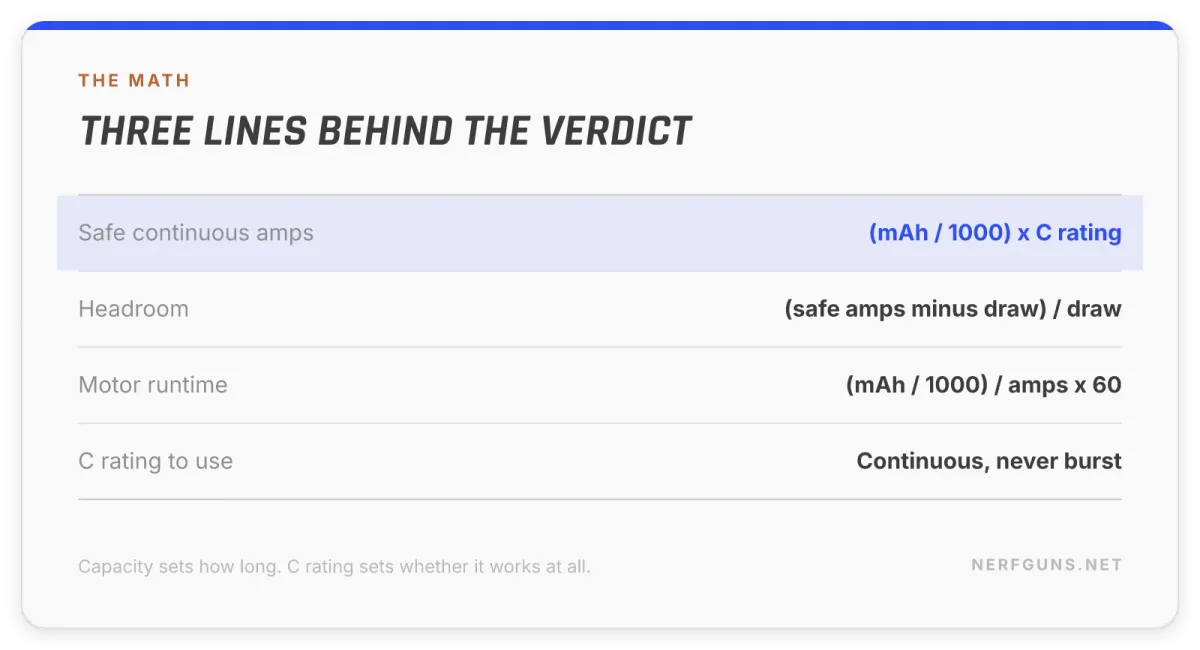
The Nerf LiPo battery calculator runs 3 lines, all of which you can check by hand.
- Safe continuous amps = (mAh / 1000) x C rating.
- Headroom = (safe amps minus your draw), divided by your draw.
- Motor runtime in minutes = (mAh / 1000) divided by amps, times 60.
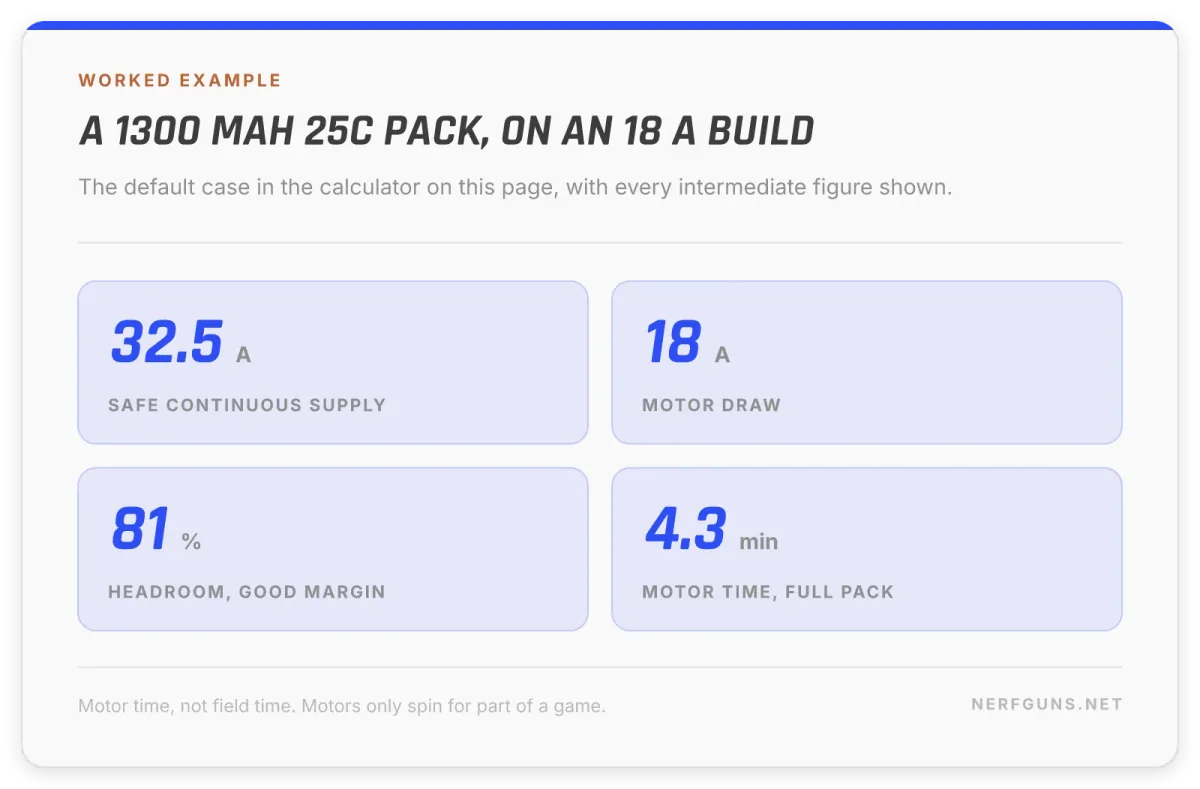
Take the default case, a 1300 mAh pack rated 25C against an 18 A draw.
Safe continuous amps is 1.3 x 25, which is 32.5 A. Against an 18 A draw that leaves 14.5 A spare, or about 81% headroom, which the Nerf LiPo battery calculator reports as good margin.
Runtime is 1.3 divided by 18, times 60, which is about 4.3 minutes of actual motor spin. That sounds alarming until you realise motors only run for a fraction of field time, which is what the battery runtime calculator works out.
What good margin, tight and over actually mean
The Nerf LiPo battery calculator gives you one of 3 verdicts, and the boundaries are fixed.
- Good margin, 25% headroom or better. The pack supplies the draw with room to spare. This is where you want to be.
- Tight, above zero but under 25%. It works on paper and it has nothing left for surge, heat, or a pack that has aged. Playable, not comfortable.
- Over, headroom below zero. The pack cannot supply what the motors want. Do not run it.
Tight is the verdict worth taking seriously, because it is the one that looks like a pass. A pack sitting at 10% headroom on paper is a pack running at its limit every time you pull the trigger.
Draw by setup, and the C rating it needs
Every figure below assumes a 1300 mAh pack, which is a common size for blaster builds, and asks what C rating clears 25% headroom in the Nerf LiPo battery calculator.
| Setup | Approx draw | Min C on 1300 mAh | Headroom on a 25C pack |
|---|---|---|---|
| Stock flywheel motors, 2S | 4 A | 3.8 C | 713% |
| Rebuilt 130 size motors, 2S | 8 A | 7.7 C | 306% |
| Mid torque flywheel pair, 2S | 12 A | 11.5 C | 171% |
| High speed flywheel pair, 3S | 18 A | 17.3 C | 81% |
| Full send flywheel pair, 3S | 22 A | 21.2 C | 48% |
| Top tier flywheel pair, 3S | 28 A | 26.9 C | 16% |
| Flywheels plus pusher, full auto, 3S | 32 A | 30.8 C | 2% |
Look at the bottom two rows. A 1300 mAh 25C pack is comfortable up to about 22 A and out of its depth by 32 A, on the same shelf, at the same price.
That is the entire argument for running the Nerf LiPo battery calculator before you buy rather than after.
Startup surge, and why headroom is not padding
Every number in the Nerf LiPo battery calculator is continuous draw. It is not what happens in the first fraction of a second.
When flywheels spin up from stationary they pull far more than their running figure, briefly. That spike is short enough not to appear on the continuous math and real enough to matter.
- Headroom absorbs the spike. A pack at 80% headroom shrugs it off.
- A tight pack sags instead. Voltage drops, spin up gets slower, and your first shot is your weakest.
- Rev on trigger makes it constant. If your blaster spins up per shot rather than staying on, you pay the surge every single shot.
So headroom is not a safety cushion you are wasting. It is the part of the pack doing the work every time the wheels start.
Choosing between two packs
Once the Nerf LiPo battery calculator says both packs clear the draw, the decision moves to everything else.
Here are two packs that both feed the same 18 A build comfortably.
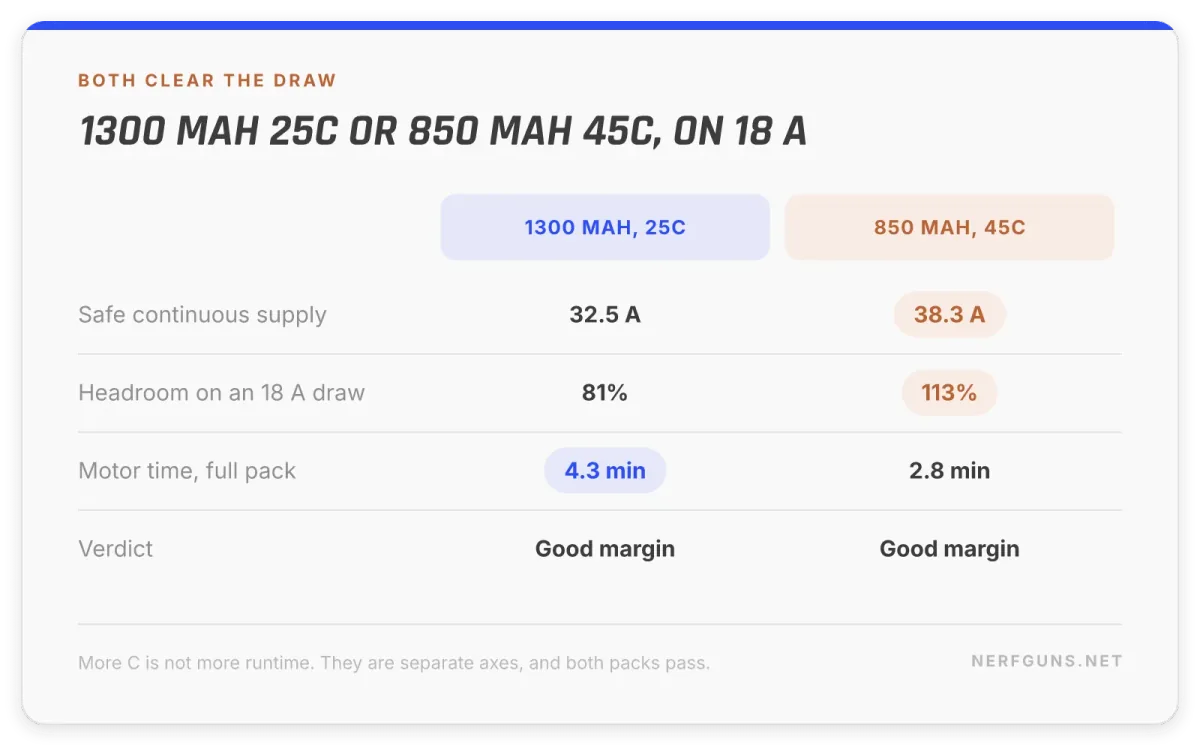
The 1300 mAh pack at 25C supplies 32.5 A and runs about 4.3 minutes of motor time. The 850 mAh pack at 45C supplies 38.3 A, so it is actually the stronger of the two on current, and it runs about 2.8 minutes.
More C does not mean more runtime. It is a different axis entirely, and a smaller high C pack can out deliver a bigger one while lasting a good deal less.
Physical size decides plenty of this too. A pack that does not fit the shell is not a candidate no matter what its numbers say.
Packs get weaker as they age
Every figure the Nerf LiPo battery calculator produces describes a healthy pack.
- Internal resistance rises with age and use. The same pack delivers less current later in its life than it did new.
- Capacity falls too. The mAh on the label is what it held when it was made.
- Heat accelerates both. Which is why a pack that runs tight ages faster, and then runs tighter.
- A puffed pack is finished. No calculation applies to it, and it does not get one more charge.
That is the real argument for buying headroom. A pack bought at 25% headroom is a pack running at zero headroom a season later.
2S or 3S, and why it is not a volume knob
Cell count sets voltage, and voltage sets how hard the motors spin. It is the most tempting number to change and the one with the widest blast radius.
- Your build was designed around a cell count. Motors, switch and wiring were all chosen for it.
- Going up a cell raises current through everything. The switch, the wire and the motors all see more, not just the flywheels.
- Stock switches are the usual casualty. They were specified for the original voltage and they weld or burn.
- It moves your muzzle velocity too. Which means re-chronographing, and possibly a new legal ceiling. That is what the joules to FPS calculator is for.
Changing cell count is a rebuild decision, not a battery swap. The Nerf LiPo battery calculator will happily tell you a 3S pack feeds your motors, and it cannot tell you whether the rest of the blaster survives it.
When the pack is not the bottleneck
A pack with plenty of headroom can still deliver a disappointing blaster, because current has to get from the pack to the motors.
- Stock wiring is thin. It was specified for stock motors. Leave it in place behind upgraded motors and the wire becomes the restriction, and it gets hot.
- The trigger switch is a common choke point. Stock switches were never intended to carry 20 or 30 amps.
- Connectors matter. Small connectors have real resistance at these currents, which is why builds move to something like XT60.
- Every solder joint is a potential resistance. A cold joint behaves exactly like a weaker pack.
If the numbers say the pack is comfortable and the blaster still feels soft, stop blaming the battery. Measure voltage at the motors under load and you will usually find it somewhere in the wiring.
A multimeter settles this in a couple of minutes, and it is in group 3 of the modder's toolkit.
Before you click buy
Five minutes with the Nerf LiPo battery calculator and a tape measure saves a return.
- Measure the battery space in the shell, in all 3 dimensions, including room for the leads to bend.
- Confirm the cell count your build expects. Not the one you would like.
- Get a draw figure, from a clamp meter if you have one, from the presets if you do not.
- Run the candidate pack's mAh and continuous C through the tool and check the verdict.
- Aim past 25% headroom, so the pack is still comfortable after a season of ageing.
- Buy the charger at the same time if you do not have one. A balance charger is half the purchase, per the LiPo safety checklist.
Five ways to buy the wrong pack
Every one of these produces a pack that looks fine on a listing and fails in the Nerf LiPo battery calculator.
- Buying on mAh alone. Capacity says nothing about whether the pack can feed the motors.
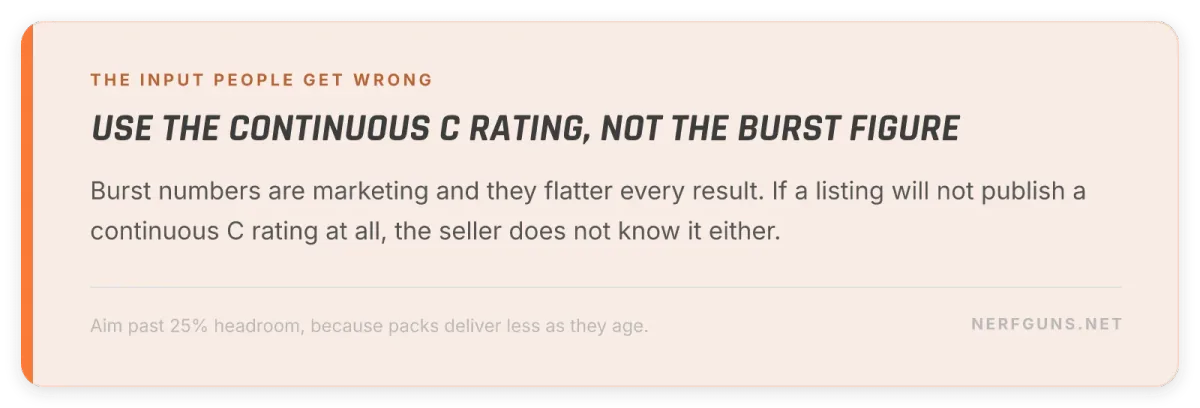
- Entering the burst C rating. Burst figures are marketing. Use the continuous number.
- Trusting a listing with no C rating at all. If the seller will not publish it, they do not know it.
- Ignoring cell count. A 2S and a 3S are different voltages, and your build was designed around one.
- Not measuring the shell. Capacity, C rating and voltage are all irrelevant if the pack does not physically fit.
The wiring gear for fitting one is in the modder's toolkit, and the handling rules are in the checklists.
Frequently asked questions
Does the Nerf LiPo battery calculator account for startup surge?
No, and nothing that works from published figures can. The numbers are continuous draw, which is why the tool treats 25% headroom as the floor for a comfortable pack rather than as optional padding.
What headroom should I aim for?
25% is the boundary the tool treats as good margin, and more is better given packs weaken with age.
If you are choosing between two packs, the one with more headroom will still be usable in a year.
Is a higher C rating always better?
Not always. Higher C packs are often heavier or physically larger for the same capacity, and past the point where the Nerf LiPo battery calculator reports comfortable headroom the extra buys you nothing.
Why does the Nerf LiPo battery calculator show such short runtimes?
Because it reports motor time, not field time. Motors only spin for a fraction of a game, so a few minutes of motor time covers a long stretch of play.
How do I find my real current draw?
A clamp meter on the battery lead while the motors run under load, then put that figure into the Nerf LiPo battery calculator. The presets are a starting point, not a substitute.
Can I use this for NiMH packs?
The runtime math applies, but NiMH cells are not rated in C the same way, so the Nerf LiPo battery calculator headroom verdict does not translate directly.
My pack gets warm after a game. Is that bad?
Slightly warm is normal. Hot is information, and it usually means the pack is running tighter than the numbers suggested, or that it is ageing.
Does a bigger pack make my blaster shoot harder?
Not by itself. Capacity changes how long you run, not how hard the motors spin.
What changes velocity is voltage, motors and how well the wiring delivers current. A larger pack of the same cell count and adequate C rating shoots identically and simply lasts longer.
Why does my headroom look fine but the blaster still sags?
Usually wiring, a stock switch, or a tired pack rather than the specification on the label.
Measure voltage at the motors while they are running. That single reading separates a pack problem from a delivery problem in about a minute.
Two packs have the same continuous amps. Which do I buy?
The one that fits your shell, then the one with more capacity, then the lighter one.
Once current is comfortably covered, the Nerf LiPo battery calculator has nothing left to say and the decision is physical.
Can I fit a bigger pack than the blaster was designed for?
Sometimes, and it is a shell modification rather than a battery choice. Do not force a pack into a space that compresses it, because pressure on a LiPo is exactly what you are trying to avoid.
Related pages: the LiPo safety checklist, the battery runtime calculator, the kinetic energy calculator, the joules to FPS calculator, the modder's toolkit, the mod guides, and every Nerf gun ever made.
It's Nerf or Nothin'!
Want the next tool?
These calculators are free and there are more coming. Leave your email and we will tell you when the next one is ready. That is all it is for.
More Nerf calculators
Every tool here is free and runs in your browser. The full set is on the Nerf calculators page.
- Dart compatibility checker, which darts fit your blaster
- Kinetic energy calculator, dart weight and velocity into joules
- Joules to FPS calculator, your maximum legal velocity
- Spring FPS estimator, what a spring swap will chrono
- Battery runtime estimator, how many packs a war needs