
This Nerf kinetic energy calculator turns dart weight and muzzle velocity into joules, which is the number a growing share of events actually cap. FPS on its own does not tell you whether you are legal. Put your numbers in below, then read on for the math, worked examples and the mistakes that produce a wrong answer.
What is on this page
- How to use the Nerf kinetic energy calculator
- Why events are moving to joules
- The formula, and why velocity is squared
- Why dart weight changes the answer
- Worked examples you can check by hand
- Getting a velocity number worth trusting
- FPS caps, joule caps, and why fields differ
- Cap reference: what each limit allows
- Muzzle energy is not impact energy
- What actually raises your number
- Five ways to get a wrong number
- What joules do not tell you
- A five minute routine before an event
- Frequently asked questions
Kinetic Energy Calculator
Dart weight plus muzzle velocity gives you joules, then checks that number against example field caps.
Your setup
Typical values. Weigh your own darts for a real number, batches vary.
A 0.01 g scale costs less than a spring kit.
Average several chrono shots, not your best one.
Result
130 FPS is 39.6 m/s
Field legality readout
| Example cap | Limit | Your dart at that cap | Verdict |
|---|
Estimate only. Caps and the way they are measured vary by event, and plenty of fields chrono in joules rather than FPS. Check the rules your organizer publishes and chrono on site.
As an Amazon Associate I earn from qualifying purchases.
How to use the Nerf kinetic energy calculator
Three inputs, one answer. The Nerf kinetic energy calculator needs about 20 seconds once you have your numbers in front of you.
- Pick your dart type, or enter a custom weight. The presets cover Elite full length, half length, Rival and Mega. They are typical figures, not guarantees, because batches genuinely vary.
- Enter your muzzle velocity in FPS. Use an average across several shots, never your best single reading.
- Read the joules figure, then the legality table underneath it. The table shows what your dart would carry at 3 example caps, and whether your current velocity is over or under each one.
Weigh your own darts if you can. A cheap 0.01 g scale costs less than a spring kit and it is the difference between a real number and a guess.
Why events are moving to joules
For years everything in this hobby was quoted in FPS, and plenty of events still work that way.
The shift to energy is happening for one reason: FPS treats a feather and a brick as the same thing.
- An FPS cap punishes light darts. A player on half length darts is held to the same speed as a player throwing 4.5 g of foam, despite carrying a fraction of the energy.
- An energy cap measures what actually lands. That is closer to what a safety limit is trying to control.
- It also closes the heavy dart loophole. Under an FPS cap, switching to a heavier dart raises your energy while keeping you technically legal.
That last point is why a Nerf kinetic energy calculator is worth having open before you change ammo, not after somebody at the chrono table asks you what your darts weigh.
The formula, and why velocity is squared
The maths is one line of physics, and it is the same line used for every projectile on earth.
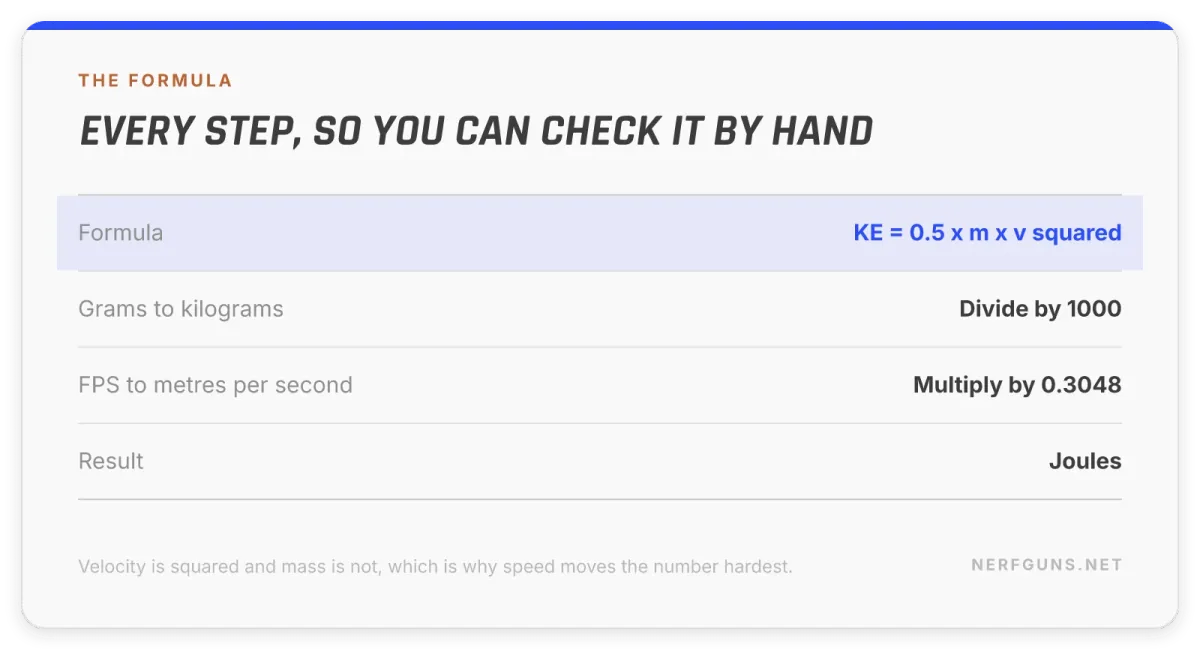
KE = 0.5 x m x v squared, where m is mass in kilograms and v is velocity in metres per second.
Two unit conversions get you there from the numbers a Nerf player actually has.
- Grams to kilograms: divide by 1000. A 1.0 g dart is 0.001 kg.
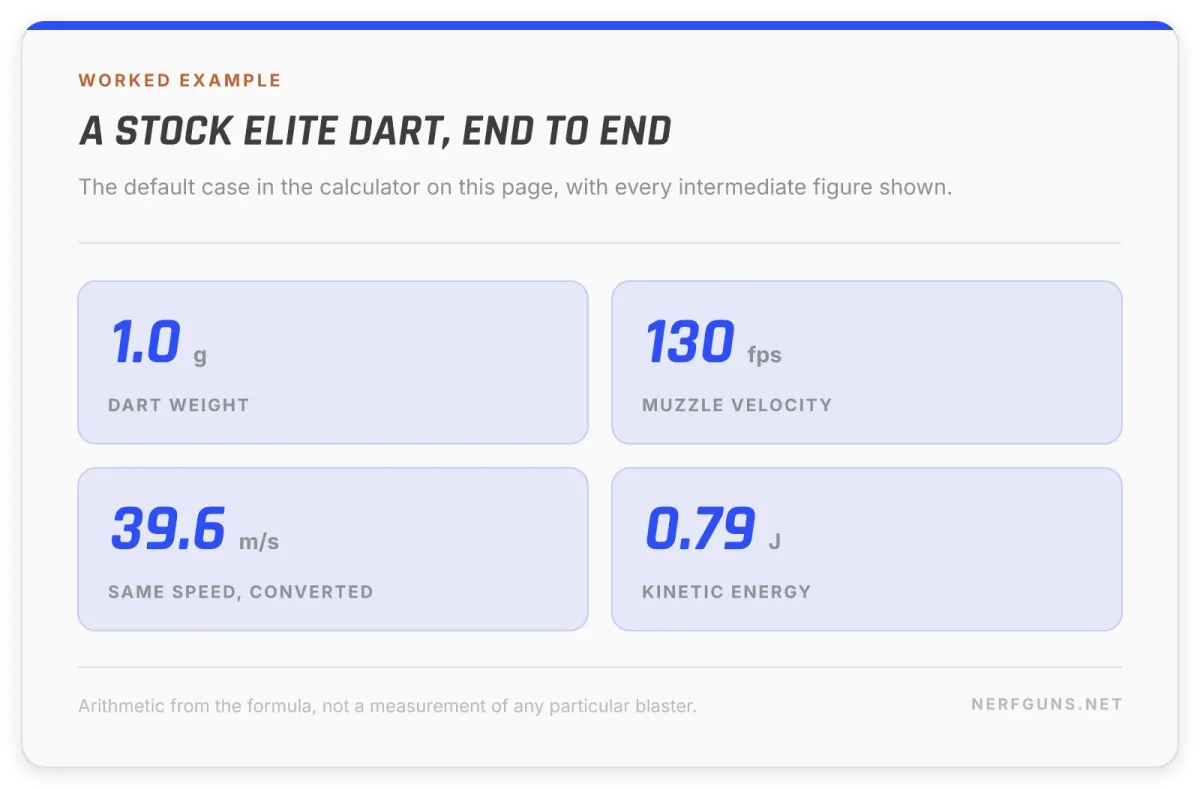
- FPS to metres per second: multiply by 0.3048. So 130 FPS is 39.6 m/s.
Put those into the formula and a 1.0 g dart at 130 FPS works out at 0.79 joules. That is the figure the Nerf kinetic energy calculator shows by default, and you can check it on any scientific calculator in under a minute.
Here is the part that catches people. Velocity is squared and mass is not.
Double the weight and you double the energy. Double the velocity and you quadruple it.
Why dart weight changes the answer
This is the single most useful thing the Nerf kinetic energy calculator will teach you, and it surprises almost everybody the first time.
A heavier dart at the same FPS carries far more energy.
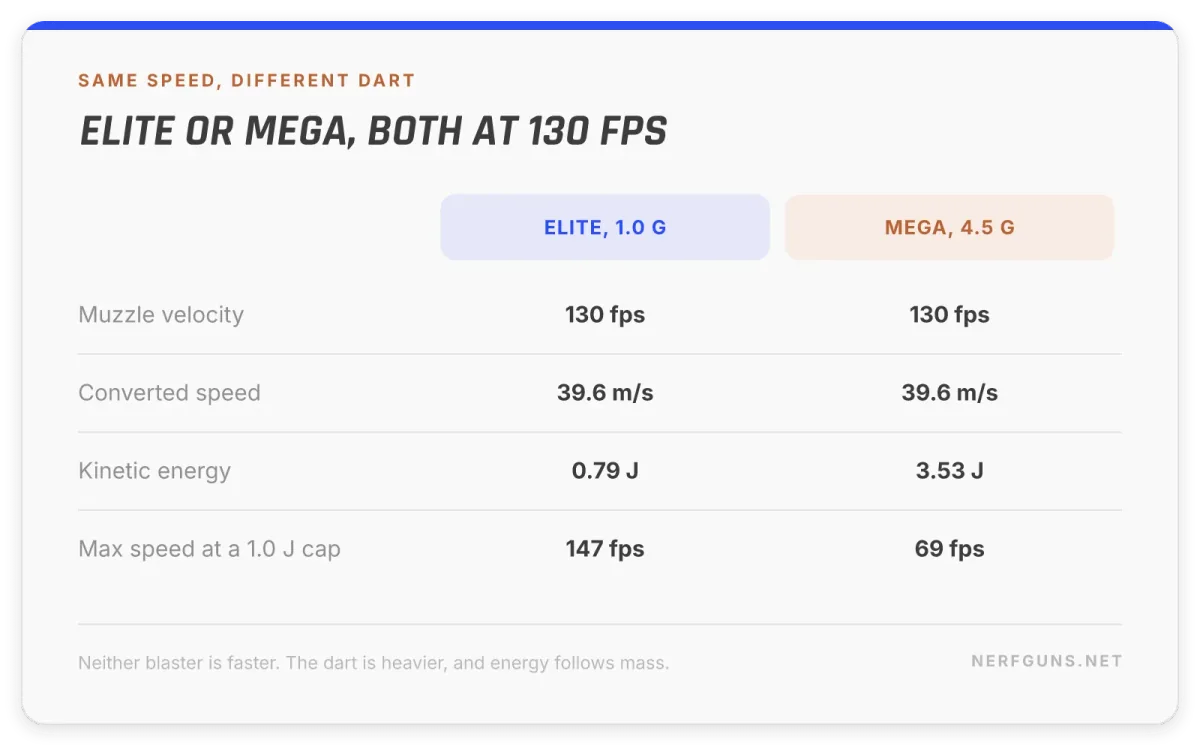
At 130 FPS, a 1.0 g Elite dart carries 0.79 joules. A 4.5 g Mega dart at exactly the same 130 FPS carries 3.53 joules, which is more than four times as much.
Neither blaster is shooting faster. The dart is simply heavier.
That is why a field running a joule cap will let a light dart travel much faster than a heavy one. Run the numbers both ways in the Nerf kinetic energy calculator and the gap is obvious.
Worked examples you can check by hand
Every figure below comes straight out of the formula above. Nothing here is measured on a specific blaster, it is arithmetic, so you can reproduce all of it in the Nerf kinetic energy calculator or on paper.
| Dart | Weight | Velocity | Energy |
|---|---|---|---|
| Elite full length | 1.0 g | 100 FPS | 0.46 J |
| Elite full length | 1.0 g | 130 FPS | 0.79 J |
| Elite full length | 1.0 g | 150 FPS | 1.05 J |
| Half length | 0.85 g | 130 FPS | 0.67 J |
| Half length | 0.85 g | 150 FPS | 0.89 J |
| Rival round | 2.5 g | 100 FPS | 1.16 J |
| Mega dart | 4.5 g | 100 FPS | 2.09 J |
| Mega dart | 4.5 g | 130 FPS | 3.53 J |
Read down the Elite rows and watch what the squared term does. Going from 100 to 150 FPS is a 50% increase in speed and well over double the energy.
Now read the two 100 FPS rows for Rival and Mega. Same velocity, and the Mega dart carries nearly double.
Getting a velocity number worth trusting
The Nerf kinetic energy calculator is only as good as the FPS you feed it, and that is where most wrong answers start.
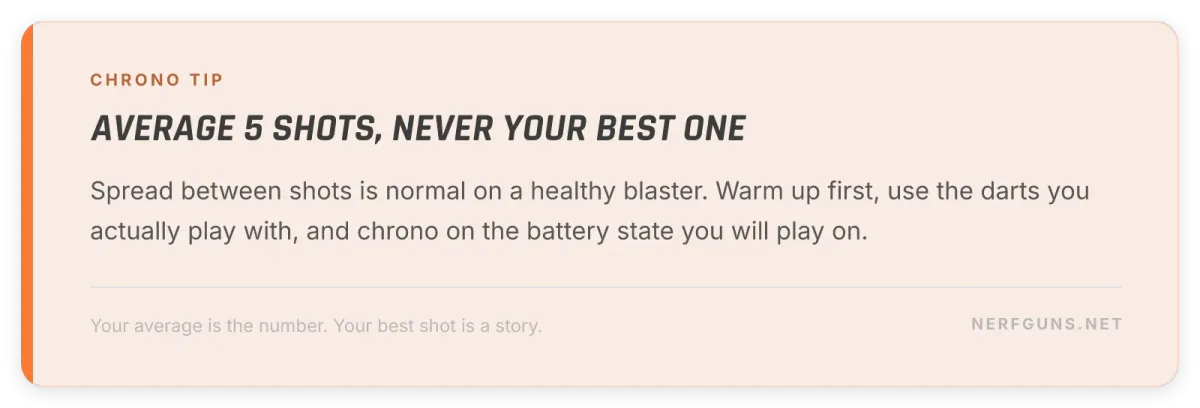
- Average at least 5 shots. A single reading tells you almost nothing, because spread between shots is normal even on a healthy blaster.
- Use the darts you will actually play with. Not a fresh dart from a sealed bag if you play with a worn bag of mixed brands.
- Chrono at a realistic battery state. A flywheel blaster on a freshly charged pack reads higher than the same blaster in hour 3 of a game.
- Fire a few warm up shots first. Springers and flywheels both settle after the first couple.
- Write the number down with the date. Blasters drift as springs take a set and motors wear.
Your average is the number. Your best shot is a story.
FPS caps, joule caps, and why fields differ
Two events can publish completely different looking limits and be asking for almost the same thing.
- An FPS cap is simple to marshal. Point a chronograph, read a number, done. It is also unfair between dart weights, because a heavy dart at the cap carries far more energy.
- A joule cap is fairer and slower. It accounts for weight, which is exactly what the squared formula shows you matters.
- Some events publish both. Usually an FPS ceiling plus an energy ceiling, and you have to clear each one.
If your event publishes a joule limit and you only know your FPS, this page is the conversion. If it works the other way round, the joules to FPS calculator starts from the limit and tells you your maximum legal velocity.
Whatever the number is, the event’s own published rules are the only authority. The three caps shown in the tool are examples of what you will run into, not a standard.
Cap reference: what each limit allows
If your event publishes an energy limit, this is the velocity it buys you. Same formula as the Nerf kinetic energy calculator, rearranged to solve for FPS.
| Dart | Weight | Max FPS at 1.0 J | Max FPS at 1.5 J |
|---|---|---|---|
| Half length | 0.85 g | 159 FPS | 195 FPS |
| Elite full length | 1.0 g | 147 FPS | 180 FPS |
| Rival round | 2.5 g | 93 FPS | 114 FPS |
| Mega dart | 4.5 g | 69 FPS | 85 FPS |
Look at the spread. At a 1 joule cap, a half length dart may travel more than twice as fast as a Mega dart and both are equally legal.
That is not a loophole, it is the entire point of capping energy rather than speed. The Nerf kinetic energy calculator above lets you check your own combination rather than reading off this table.
Muzzle energy is not impact energy
Everything on this page describes the dart as it leaves the barrel. That is what a chronograph measures and what an event caps.
It is not what arrives at the far end of the field.
- Darts shed speed quickly. Foam is light and draggy, which is exactly why it is safe to play with.
- Energy falls faster than speed does. The squared term works in both directions, so a dart that has lost a third of its velocity has lost well over half its energy.
- Heavier darts hold speed better. More mass carrying the same drag, so Mega and Rival lose proportionally less over distance.
- Nobody caps impact energy. It depends on range, which nobody can marshal, so muzzle energy is the number everyone uses.
So treat your joule figure as the worst case, measured at the muzzle. A hit at 40 feet carries a good deal less than the number the Nerf kinetic energy calculator gives you.
What actually raises your number
If you are chasing a legal maximum, it helps to know which changes move energy and which only move the feel of the blaster.
- A stronger spring, on a springer. The most direct route, and the one most likely to need the shell reinforced before the spring goes in.
- More voltage or better motors, on a flywheel blaster. This is where a LiPo pack enters the conversation, and with it the LiPo safety checklist.
- Removing air restrictors, on many springers. Frees the air path that the stock design deliberately choked.
- A better barrel or breech fit. Less blow by, more of the air behind the dart.
- A heavier dart, which raises energy without raising speed. Worth remembering when your event caps FPS rather than joules.
The bench gear for all 5 of those is in the modder’s toolkit.
Re-chrono after every one of these changes. A mod that felt like nothing can move you over a cap, and a mod that felt enormous sometimes moves the number barely at all.
Five ways to get a wrong number
- Using the advertised dart weight instead of weighing. Batches vary, and third party darts vary more.
- Entering your best shot. Covered above, and still the most common one.
- Mixing units. Grams and kilograms, or FPS and metres per second. The tool handles the conversion, so enter grams and FPS exactly as labelled.
- Chronographing with a different dart than you play with. The weight in the formula has to be the weight in the magazine.
- Assuming the number holds all day. On a flywheel blaster it does not, which is what the battery runtime calculator is about.
What joules do not tell you
Energy is one number and it does not describe everything about a hit. The Nerf kinetic energy calculator answers a legality question, not a safety question.
Dart construction matters, and so does what the dart hits. A soft foam tip and a hard printed tip at the same energy are not the same experience.
Eye protection is not optional at any energy level on this page. No joule figure makes an unprotected eye safe, which is why every event requires it and why it is on the HvZ loadout checklist.
Treat the output here as a legality and comparison tool, not a safety rating.
Frequently asked questions
Is a Nerf kinetic energy calculator worth using if my event caps FPS?
Yes, because it tells you how much headroom a change in ammo will cost you. Swapping to a heavier dart keeps your FPS legal and raises your energy every time.
What is a normal joule figure for a stock Nerf blaster?
Most stock blasters land well under 1 joule. A 1.0 g Elite dart at 130 FPS is 0.79 J in the Nerf kinetic energy calculator, and plenty of stock blasters are slower than that.
Is the Nerf kinetic energy calculator accurate?
The arithmetic in the Nerf kinetic energy calculator is exact, because it is one formula with two unit conversions. The accuracy of the answer depends entirely on your two inputs.
Weigh the dart, average the chrono, and the output is as good as your scale.
Why does my heavy dart fail a joule cap when it passes the FPS cap?
Because energy scales with mass. At the same velocity a 4.5 g Mega dart carries over four times what a 1.0 g Elite dart does, so it can clear an FPS limit and still fail an energy limit.
Do I need to weigh every dart?
No. Weigh 10 from the bag you play with, take the average, and put that figure into the Nerf kinetic energy calculator.
What velocity does a 1 joule cap allow?
It depends on the dart. Roughly 147 FPS for a 1.0 g Elite dart, about 159 FPS for a 0.85 g half length, and only about 69 FPS for a 4.5 g Mega dart.
Why do two chronographs give me different readings?
Placement, lighting and how far the muzzle sits from the sensor all shift the reading, and cheap units vary more than expensive ones.
Chrono on the event’s own unit where you can, because that is the number that will be enforced.
Does a longer barrel raise kinetic energy?
Sometimes, up to a point, and then it starts costing you. It depends on the air volume behind the dart, which is why barrel length is a whole topic rather than a single answer.
Should I aim to sit right on the cap?
No. Leave yourself headroom, because blasters drift and the event’s chronograph is not yours.
Sitting 10 FPS under the limit costs you nothing you will notice and saves you being turned away.
Can I use this for Rival rounds?
Yes. Rival rounds are heavier, around 2.5 g, and the same formula applies without any change.
Does the Nerf kinetic energy calculator store anything I enter?
No. It runs entirely in your browser, the numbers never leave your device, and nothing is saved between visits.
A five minute routine before an event
Do this the week before rather than in the queue at the chrono table.
- Weigh 10 darts from the bag you are actually taking. Average them.
- Chrono 5 shots per blaster, warmed up, on the battery state you will play on. Average those too.
- Put both averages into the Nerf kinetic energy calculator. Write the joule figure on a bit of tape on the blaster.
- Compare it against the event’s published limit, and leave yourself headroom rather than sitting on the line.
- Repeat for every blaster you are bringing, including the secondary nobody ever chronographs until the day.
Five minutes at home beats being turned away at the door. It also means you can answer the marshal’s question with a number instead of a shrug.
Related pages: the joules to FPS calculator, the LiPo battery calculator, the battery runtime calculator, all the checklists, the modder’s toolkit, the mod guides, and every Nerf gun ever made.
It’s Nerf or Nothin’!
Want the next tool?
These calculators are free and there are more coming. Leave your email and we will tell you when the next one is ready. That is all it is for.
More Nerf calculators
Every tool here is free and runs in your browser. The full set is on the Nerf calculators page.
- Dart compatibility checker, which darts fit your blaster
- Joules to FPS calculator, your maximum legal velocity
- Spring FPS estimator, what a spring swap will chrono
- LiPo battery calculator, whether a pack can feed your motors
- Battery runtime estimator, how many packs a war needs