
Nerf war games are the half of this hobby that a pile of blasters cannot solve on its own. This page pulls every mode we have written up into one place. The classics. The objective games. Humans vs Zombies. The party formats. Plus the organizing that keeps a battle from turning into an argument. It is for anyone hosting a backyard war, a birthday, an office battle or a full campus game, whether that is 4 players or 40.
What is on this page
- Set the ground rules first
- The classic modes
- Objective modes for bigger groups
- Humans vs Zombies
- Party and target formats
- Pick a mode in 10 seconds
- The full library of Nerf war games
- Tactics: hitting what you aimed at
- Safety, and keeping your gear alive
- Running the war: hosting, teams and roles
- Organizing a war people come back for
- Ammo and batteries
- The 2026 host kit for Nerf war games
- Frequently asked questions
Set the ground rules first
Every one of the Nerf war games below assumes you did this part. Agree on these three before anyone loads a dart:
- What is allowed. Blaster types, ammo limits, and whether melee weapons count. Some groups run darts only, others let foam swords in, see the Nerf N-Force sword range for that side of the armory.
- Safety. No shots to the face is the standard line, and eye protection is cheap insurance. No hitting, no tackling.
- The technical stuff. Most Nerf war games run on the honour system, so decide what counts as out, whether teammates can revive you, where each team’s base and respawn point sits. Most games run on the honor system, so make the rules simple enough to self-referee.
The classic modes
The quick version, and the five Nerf war games almost every group starts with. Full rules, player counts and battlefield notes for each are in the game format library further down the page:
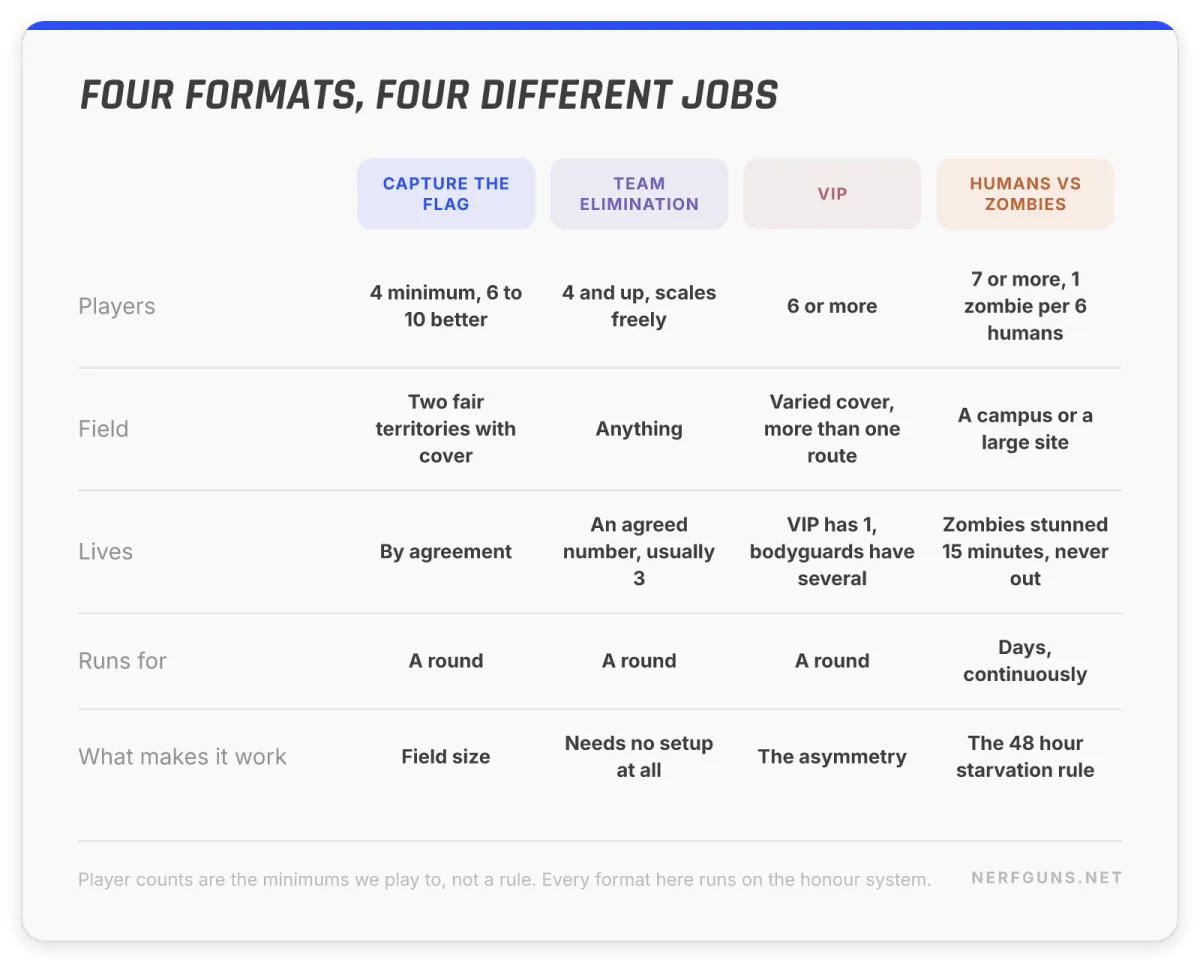
- Capture the Flag. Two teams, two territories, one flag each, and the flag can be a ball, a stuffed animal, or a special dart. Steal theirs, keep yours. Four players minimum, 6 to 10 is better.
- Team Elimination. The most basic game there is. Two teams, an agreed number of lives each, last team standing wins.
- Freeze Tag. Get shot, freeze in place. Teammates unfreeze you with a tag or a shot. Freeze the whole other team to win.
- Offend the Core. Each team defends a container. The goal is to land as much ammo in the other team’s core as possible; the team with the least ammo in their core when time runs out wins.
- Meatgrinder. The warm-up game while stragglers arrive. Shoot as many people as possible in a set time, teams optional.
Objective modes for bigger groups
Same quick version. These are the Nerf war games that need bodies on the field, and again the full rules for each one are in the library:
- VIP, also called Protect the President. Six or more players. One VIP with a single life, one team guarding them, one team hunting them.
- Hostage. Two teams, each hiding and guarding a hostage from the other team. Rescuers get one life; captors respawn. First team to recover their hostage wins.
- Gunslinger Heaven. Fast rounds with a flag mechanic: get hit, wear the flag for 10 to 15 seconds. Hit again while wearing it and you are out for good, but land a hit and you earn your life back.
- Dodging Duelers. Every player defends a marked circle they cannot leave. Dodge however you like inside it. Last player in their circle wins.
Humans vs Zombies
The biggest of all Nerf war games deserves its own section. Humans vs Zombies started at Goucher College in 2005, invented by Brad Sappington and Chris Weed, and spread to hundreds of campuses, plus high schools, summer camps and military bases. The short version of the rules. One player starts as the original zombie. Zombies tag humans to infect them. Humans stun zombies for 15 minutes with a dart or a thrown sock. Marked bandannas show who is on which side. The game runs continuously for days, which is what makes it different from everything else on this page.
If you are gearing up for an HvZ style game, this is exactly what the Nerf Zombie Strike line was built for, and our hub covers every blaster in it.

The HvZ rules, in full
Two teams, played like tag. Unlike every other format here, this one never stops for a round break, and that single difference is what separates it from the rest of the Nerf war games on this page. The zombie team starts with one lone original zombie whose only job is to infect as many humans as possible. Every zombie wears a bandanna or some other agreed marking so everyone can tell which side they are on.
Humans defend themselves with blasters or balled up socks. A zombie hit by a dart or a sock is not eliminated, only stunned, for fifteen minutes. A human tagged by a zombie becomes a zombie.
The rule that makes the whole thing work is starvation: a zombie has to tag a human every forty eight hours or it dies of hunger. That is the only way a zombie leaves the game, and it is how humans win, by surviving until every zombie has starved. It is also why the game runs for days rather than rounds, and why an HvZ game has a real narrative arc that no single afternoon format can match.
Setting up an HvZ game
You can throw most Nerf war games together in a day. A game on a campus needs groundwork. Expect some resistance from staff the first time they see players running past a classroom with blasters. Talk to them before they find out on their own. Settle these five things before anybody starts:
- Safe zones. Nobody should get infected in a bathroom, in a lecture, or during a varsity basketball game. Name the places the game does not reach.
- Boundaries. Where the map ends. A human who can simply keep running is not playing the same game as everyone else.
- Modified blasters. People will bring modded blasters, so decide in advance how powerful is too powerful. The rule some groups use is that the owner has to be willing to take a hit from their own blaster.
- What marks a zombie. Headbands, armbands, custom shirts, whatever you like, but pick one and make it unmistakable at a distance.
- How you keep track. Over a multi day game somebody has to know how many humans and how many zombies are left, or the ending never arrives.
A game this long wants more than rules. Set a calendar of missions and an agreed total length. Pick somewhere online to run registrations and announcements. Add a plot if you enjoy that side of it. A plot is optional and it does make the game better.
What players carry matters more here than in any other format, because a multi day game gives you nowhere to go and restock. We keep the HvZ loadout checklist for exactly that, covering what goes in a bag before the first tag.
Party and target formats

Not every gathering wants a war, and some of the best Nerf war games are not battles at all. We have collected formats that work for a birthday or a rainy afternoon. There is a blindfolded Shoot the Dart on the Donkey. There is a helium balloon target shoot. There is an obstacle course with targets at each checkpoint. And there is a night war with glow in the dark darts. Two of them, paint darts and dart art, involve dipping darts in paint, so use a blaster you are willing to ruin and clothes you do not care about.
Pick a mode in 10 seconds
Scan the table, pick a row, scroll to its rules. That is the fastest way to start.
| Mode | Players | Field | Round length | Best for |
|---|---|---|---|---|
| Team Elimination | 6 or more | Any | Short | First-timers |
| Capture the Flag | 8 or more | Wide | Medium | Teamwork |
| Freeze Tag | 6 or more | Small | Short | Younger players |
| Offend the Core | 10 or more | Wide | Medium | Attack and defend fans |
| Humans vs Zombies | 12 or more | Large | Long | All-day events |
| Standoff | Any | Small | Seconds | Resetting the mood |
| Sole Survivor | 8 or more | Any | Medium | Free-for-all players |
| Party formats | 4 or more | Backyard | Short | Birthdays |
Running a birthday rather than a war? The Nerf party guide covers food, favors and timing, and the printable checklists cover what to pack. Both pair well with the Nerf war games modes below.
The full library of Nerf war games
The lists above are the quick version. These are all the Nerf war games we have written up, with the player counts, the field it needs, and the one thing that actually makes it work. Most of these run on the honor system, so the rules are deliberately simple enough that players can referee themselves.
Capture the Flag
Players: four minimum, two per team. Six to ten, three to five a side, plays much better. Field: indoor or outdoor, but it has to split into two clear territories that are roughly fair, each with enough cover for defenders and more than one route in.
Capture the Flag is where most groups graduate from casual Nerf war games to organised ones. Each team has a flag on their own side. It can be a ball, a stuffed animal, or a special dart, it just has to be obvious and grabbable. You win by carrying the enemy flag back to your side without losing your own.
Two hit rules are in circulation and you need to pick one before the whistle. We usually play that you can only shoot an opponent who is on your side of the field, which pushes people to actually raid. The other common variation lets you shoot anyone anywhere.
What makes it work: the field size. Capture the Flag is the most physical of the Nerf war games here, so too much ground turns it into a hike and too little turns it into a scrum. Mark the teams clearly with different colored clothing, because at a sprint nobody is checking armbands.
Team Elimination
Players: four, two per team, and it scales as far as you like. Field: anything.
The most basic of all Nerf war games, and the one to fall back on. Two teams, an agreed number of lives each, three is the usual number. Take a hit, lose a life. Lose them all and you are out. Wipe out the other team and you win.
What makes it work: it needs no props, no setup and no explanation, so it is the format everybody already knows. The endless variations people argue about are all just this game with one rule changed.
Freeze Tag
Players: two teams, any size. Field: an open area, ideally one where a frozen player is easy to spot.
The playground game with blasters, and the friendliest of these Nerf war games for a mixed age group. Take a hit and you freeze where you stand. A teammate can unfreeze you with a tag or a shot. Freeze every player on the other team at once to win.
What makes it work: nobody sits out. A frozen player is still in the game and still worth defending, which keeps the whole group playing instead of drifting to the snack table.
Offend the Core
Players: two teams of five or more. Field: open ground plus one large, sturdy container per team as its core.
Of all the Nerf war games here, this one alone inverts the scoring. Instead of counting hits, you count ammo. The goal is to land as much of your ammunition as possible inside the other team’s core. When time is up, the team with the least ammo sitting in their own core wins.
What makes it work: it turns wasted darts into a resource decision. Every shot you take at a player is a shot you did not put in their core, so the game rewards a completely different instinct from every other mode on this page.
Meatgrinder
Players: any number, teams optional. Field: whatever you are standing on.
The warm-up before the real Nerf war games start. Somebody is always late, and rather than have the early arrivals stand around, you run this: shoot as many people as possible inside a set time. No objective, no lives, no teams unless you want them.
What makes it work: low stakes and a hard stop. It exists to burn ten minutes and warm up trigger fingers, and it is honestly a bit of a throwaway game, which is exactly the job.
VIP, also called Protect the President or Assassins
Players: six or more. One VIP, two bodyguards, the rest assassins. Field: a decent sized indoor or outdoor area with varied cover and more than one path to the destination.
The VIP has a single life and is either unarmed or carrying something light. The bodyguards have multiple lives, can carry whatever they like, and can take hits meant for the VIP. The assassins have to reach the VIP before the VIP reaches the end point, or before the clock runs out if you are playing the survival version.
Two restrictions on the assassins keep it fair: no physical contact attacks, and no rapid fire automatic blasters. A full auto blaster shredding a one life target from across the field ends the round before it starts.
What makes it work: the asymmetry, which none of the other Nerf war games here produce. One player has everything to lose and the other side only has to be lucky once, which produces the kind of nervous, careful movement no elimination game ever gets out of people.
Hostage
Players: six minimum, more is better, split into two armed teams. Field: decent sized, indoor or outdoor, with multiple routes between the two sides, real hiding places, and a marked respawn spot for each team.
At the start each team hands a player over to the other side as their hostage. Both teams then get a short setup window, around two minutes, to disarm, hide and guard the hostage they were given. After that, recovery begins.
Rescuers have one life. Captors have unlimited lives but have to walk back to respawn every time they are hit. A rescuer frees their hostage by tapping them, which also rearms them. First team to get their own hostage back to their base wins.
What makes it work: the life economy is deliberately lopsided, where most Nerf war games try to keep both sides even. Attacking with one life against defenders who respawn forces real planning, and it stops the game collapsing into a running gunfight. If your group is small, skip the simultaneous version and alternate: one team captures, the other rescues, then swap.
Gunslinger Heaven
Players: five or six at least. Two player teams or every player for themselves. Field: small to medium with a good amount of cover, but not so much that camping is comfortable. You also need one hat, bandanna or similar wearable flag per player.
This is one of the few Nerf war games that punishes hiding by design. Get hit and you step out of bounds for ten to fifteen seconds, then come back wearing your flag. Wearing the flag, a second hit puts you out permanently. But land a hit on somebody else while wearing it and you take the flag off and get your life back.
Loadout is your call, which is rarer across Nerf war games than you would think. Some groups run no restrictions, others insist on single shot pistols only to keep it in the gunslinger spirit.
What makes it work: rounds stay short and the flag mechanic punishes hiding. A player wearing a flag has to take a risk to survive, so the moment somebody gets tagged the whole field speeds up.
Dodging Duelers, also called Circle Dueling
Players: two or more, all carrying the same blaster type or the same fixed number of darts. Field: indoor or outdoor, big enough to space everyone out, with a clearly marked circle for each player.
You cannot leave your circle, which makes this the most compact of all the Nerf war games here. Inside it you can jump, duck, bend and twist however you like. You are out if you take a hit, step outside your circle, or run out of darts. Last player standing wins. Keep the circles the same size relative to the player inside them.
What makes it work: it strips the game down to pure aim and reaction, with no cover and nowhere to run. It is also the only one of these Nerf war games that works in a space too small for anything else.
Sole Survivor, also called the Hunger Games
Players: eight or more, two teams of four minimum, each player bringing a primary and a secondary. Field: outdoors, with room to run.
Unlike most Nerf war games, nobody brings their own loadout to this one. Every weapon and every dart goes into one pile in the middle. Players spread out an equal distance from it. On a signal, an air horn or a whistle works, everyone sprints for the pile and grabs whatever they can reach. Players who are hit lie down prone where they fall. Last player standing wins.
What makes it work: nobody starts with an advantage, and the opening ten seconds decide the whole round. It also solves the problem that quietly spoils a lot of Nerf war games, unequal collections, since the pile belongs to everybody.
Infection, the short round version
Players: at least seven, and more is better. Start with roughly one zombie per six humans. Field: outdoors is better. Pick something reasonably large with obstacles like trees and enough hiding places for the humans once the horde gets big.
Infection is the gateway to the zombie Nerf war games. Humans carry blasters, zombies usually infect by hand though you can arm them. A shot zombie is stunned temporarily rather than eliminated. A tagged human becomes a zombie. Humans are trying to be the last one standing; zombies are trying to infect everybody.
This is the short cousin of Humans vs Zombies, and the way into zombie Nerf war games for a group that only has an afternoon. It runs back to back rounds or a set time limit rather than for days, which makes it the version that fits an afternoon.
What makes it work: the balance shifts continuously. It starts as a horror movie for the zombie and ends as one for the last human, and nobody who gets tagged has to stop playing.
Zombie round with respawn
Players: any large group. Field: anything you are already playing on.
A lighter variation on the elimination Nerf war games, used at large public events. Play a normal round. A player who is hit comes back to life after a set time instead of sitting out. It is the same idea as Gunslinger Heaven’s timer without the flag bookkeeping.
What makes it work: at a big event, people came to shoot, not to spectate. A respawn timer means the field stays full for the whole session.
Attack and Defend
Players: two teams, any size. Field: anything with one obvious location worth holding.
Attack and Defend is the most symmetrical of these Nerf war games. One team has a time limit to capture a location. The other team has the same time limit to hold it. Then you swap and see who did it faster or held it longer.
What makes it work: the clock. Few Nerf war games get their tension this cheaply. Attackers cannot wait, defenders cannot chase, and both restrictions come free with the format instead of needing a rule.
Standoff
Players: any number. Field: small.
Fast and furious, used as a palate cleanser between longer Nerf war games at large events. Everybody in range of everybody, and it is over in seconds.
What makes it work: it takes no setup and it resets the mood of a group that has been grinding out objective games for an hour.
Party and target games in full
These are the Nerf war games for a birthday, a mixed age group, or a rainy afternoon when nobody wants a battle. No teams, no elimination, nobody goes home upset.
- Trampoline fights. Add a trampoline to a game of Nerf tag and it becomes proper target practice, because now you are shooting at something that will not hold still. Use a trampoline with a safety net, and if you do not own one, check whether your town has a gymnastics center open to the public.
- Shoot the dart on the donkey. Pin the tail on the donkey with a blaster. Blindfold, a few spins, then try to hit the target. It is much harder than it sounds.
- Helium balloon shoot. Weight the balloons down so they do not float off, then shoot them. Leftover party balloons are the cheapest target set you will ever assemble.
- Obstacle course. Set targets at checkpoints along a course that makes players climb and crawl to reach the next one. Each player carries a blaster through and stops to hit the target at each stop. Score on accuracy and speed together, so rushing costs you.
- Night war. Glow in the dark darts and glowsticks, and any of the games above. Be careful where you run this one, because a field where people can get lost in the dark is the wrong field.
- Paint darts. Somewhere between paintball and a Nerf war: dip the darts in paint and fire away. Wear clothes you do not care about and use a blaster you are genuinely willing to ruin.
- Dart art. Same paint, no people. Set up a big sheet of paper or cardboard, dip the darts, and shoot at it. Outdoors only, and again, a blaster you can afford to lose.
Two of those, paint darts and dart art, are one way trips for the blaster. That warning is not decoration.
Tactics: hitting what you actually aimed at
Spraying foam is fun. Hitting the thing you were aiming at is a skill, and on this hardware it is far more about familiarity than about talent. A blaster with a low capacity or a single shot punishes a miss the hardest, because a miss buys the other player the whole time it takes you to reload. Every one of the Nerf war games above rewards the player who can actually land a dart.
Know your own blaster before anything else
This is the single most useful thing on this page, whichever of the Nerf war games you end up playing. Two blasters off the same production line will handle slightly differently, which is exactly why players get attached to one particular lucky blaster and refuse to swap. Yours has its own quirks and you find them by shooting it, not by reading about it.
Take a pile of darts into the yard and shoot at pop cans, well before your first Nerf war games of the season. Learn where your sights actually put a dart rather than where they claim to. You can do the low effort version indoors, firing at something across the room while the television is on. The goal is not a score, it is being comfortable enough that aiming stops being a decision.
How to practice so it counts
Start with a stationary target at close range, close enough that the blaster’s range is not the variable. Experiment with aiming slightly high and slightly low and watch which one lands where you meant. Make small adjustments until your shots are consistent, then move the target back and do it again. Work outward until you can hit anything inside that blaster’s range.
Practice makes permanent rather than perfect, so it is worth building the right habits before you take them into real Nerf war games. Learn to shoot from several positions too: prone, standing, and down on one knee. Field layout and how much of a hurry you are in will decide which one you get.
If you run accuracy accessories like a sight or a foregrip, practice with them fitted. They change the weight and balance of the blaster, and getting used to them mid battle is not a plan.
Stance, stability and breathing
Movies have taught a lot of people to shoot badly, and none of it survives contact with actual Nerf war games. Firing upside down, with arms crossed, or sideways around a corner looks great and lands nothing. Hold the blaster in both hands, keep your elbows straight, and plant both feet when you are shooting standing up.
Everything after that is about removing shake, and it is what separates players who win Nerf war games from players who spray foam. Kneeling or lying down steadies your aim, and as a bonus both positions make you much harder to see, which is why they are the sniper’s default. A shoulder stock steadies the blaster against your body, and a bipod takes your hands out of the equation entirely.
Breathing moves the blaster up and down and adds body shake on top. The fix is to control it deliberately: get the target in your sights, take a breath, let it out slowly, then squeeze rather than pull. Some players fully exhale before firing, others take a breath and hold it. Both work, and the point is that you chose one.
Distance shooting and reading the field
At range, and in the bigger Nerf war games especially, two things stop being optional. First, watch where your shots are landing during the battle, not after it. If they consistently drift right, aim left. If they sail high, come down. Adjusting on the fly is the difference between one wasted dart and thirty.
Second, and outdoor Nerf war games punish this hardest, adjust for weather. Wind, rain and snow all change where a light foam dart ends up. Turn up early and put a few darts downrange before the game starts, so you learn what the day is doing to your aim while it still costs you nothing.
Against a moving target you have to lead it, aiming slightly ahead of where the player is now to account for the time your dart spends in the air. And take your time on a long shot. A hurried long range shot is a wasted dart, so you may as well not have taken it.
Sights and scopes help you line a shot up, but they are not accurate until you know how to compensate, which usually means holding a little high. An unadjusted scope is a confidence problem, not an accuracy solution.
Your darts decide your accuracy more than your blaster does
These are toys, and they were never engineered to be precision instruments in the first place. Given that, most of the accuracy you can still claw back lives in the ammunition, which is why darts decide more Nerf war games than blasters do.
- Consistency is the whole game. Accuracy is repeatability, so anything that varies shot to shot is your enemy, including your own aim.
- Uniform darts fly uniformly. If you make your own darts, get them as close to identical as you can in weight, shape and size. Mixed ammunition means every shot is a new experiment.
- Light darts are unstable darts. Foam darts are often light enough to overturn or flip in flight, and once a dart is tumbling a slight breeze will send it somewhere new every time. Adding weight, either at the front of the dart or overall, is the usual fix.
- Barrel length is a lever. Depending on the blaster, lengthening or shortening the barrel can improve accuracy. That is modding territory, and our mods guide covers the barrel work in detail.
Team roles, and what to hand each one

Once you are past one on one duels, Nerf war games get won by the team that knows who is doing what. Some players are simply better at one job than another, and a good team builds around both the group’s needs and the individual’s strengths. If you do not know what kind of player you are yet, try a few roles out in casual games.
Almost every role in Nerf war games works best with a primary and a secondary blaster. Make sure both take the same darts. Then you carry one type of ammunition instead of two.
- Commander or general. Directs the team. Wants experience, the nerve to lead from the front, and the ability to read a situation and the other side’s behavior quickly. Carry something multi purpose that is fine in any situation, with a pistol as backup.
- Scout. Goes out, gathers information, comes back. Needs speed, agility and the stamina to keep running. Arms light, stealthy and close range, because a scout who has to win a firefight has already failed.
- Defender or heavy. Holds the base or the flag. This is the firepower role: high capacity automatic or semi automatic blasters that can hold a lane on their own.
- Assault, infantry or commando. The front line that raids and takes bases. Needs to be fearless and tactful in equal measure, which mostly means knowing when to push and when to fall back. Close to mid range blasters.
- Sniper. The long range specialist who stays out of sight and picks people off. Needs precision, patience, a good hiding spot and, just as importantly, a planned escape route out of it. Pair the long blaster with a close range pistol for when somebody finds them.
Our original write-up named specific blasters for each role and they were all from the N-Strike era, so treat them as descriptions of a class rather than a shopping list. What matters is the pattern: multi purpose for the commander, light for the scout, high capacity for the defender, mid range for assault, long range for the sniper. Pick today’s equivalent from every Nerf gun ever made.
Safety, and keeping your gear alive
Two things end Nerf war games badly: an eye injury, and a neighbour who called the police. Both are avoidable, and neither costs money to avoid.
The third thing that ends them quietly is a bin full of dead darts, so that is here too.
The safety rules worth saying out loud
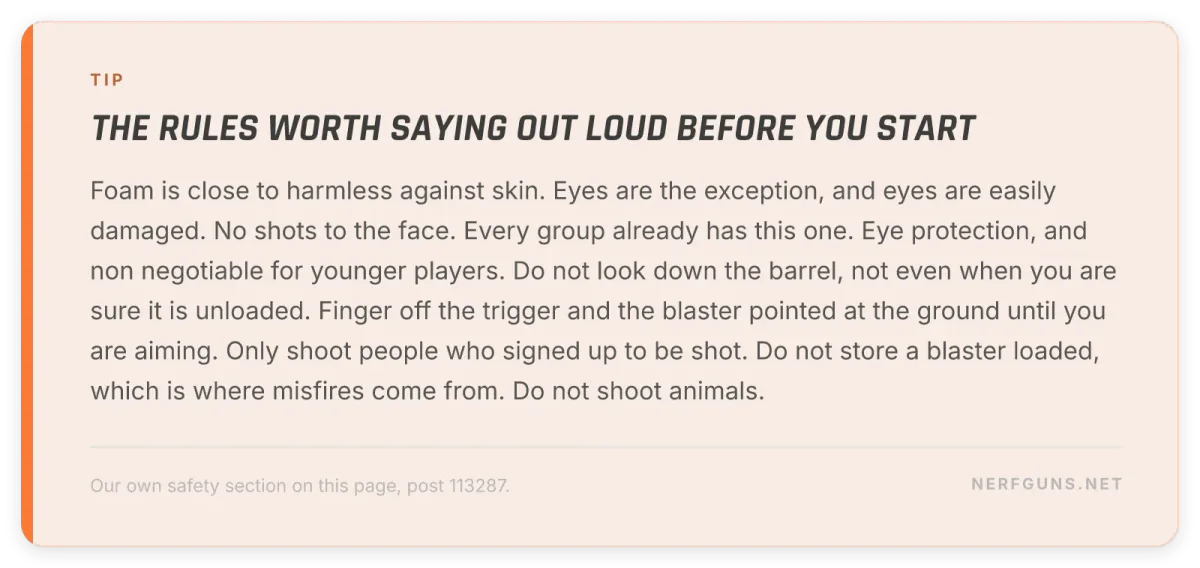
Nerf blasters are not inherently dangerous. Nerf war games go wrong through carelessness, not through foam. Like any toy they can be used carefully or recklessly, and essentially all of the trouble comes from the second one. Foam darts are close to harmless against skin. Eyes are the exception, and eyes are easily damaged.
- No shots to the face. This is the one rule every group already has, and it is worth restating anyway.
- Eye protection. Safety glasses are cheap insurance, and they should be non negotiable for younger players and for anybody in an organized war.
- Do not look down the barrel. Not even when you are sure it is not loaded. Especially then.
- Finger off the trigger, blaster pointed at the ground until you are actually aiming at something.
- Only shoot people who signed up to be shot. Players in the game, nobody else.
- Do not store a blaster loaded. That is where misfires come from.
- Do not shoot animals. It is mean and it costs you their trust.
There is a genuinely good argument that a blaster is a useful teaching tool for exactly these habits. A child who learns muzzle discipline and trigger discipline on foam is a child who has those instincts if they ever encounter a real firearm. Target shooting also builds motor control, and shooting down numbered cups turns arithmetic practice into something a player will do voluntarily.
Playing in public without ending up in a police report
Senior shoot-out style games, where students hunt each other across a town for weeks, are where this hobby generates its worst headlines. Students have been cited for disorderly conduct after neighbors saw blasters being pointed and called the police, and school districts have sent letters home warning parents about exactly this. The citations in that case were eventually dropped, but the point stands.
The behavior that causes real harm is not the darts. It is breaking into homes, trespassing on private property, and above all anything involving cars. Shooting at a vehicle, or out of a moving one, has caused a head-on collision in at least one case we covered. Some regions fine you several hundred dollars for throwing or shooting objects at cars. A driver swerving because a dart hit the windscreen is a serious accident, not a prank.
If your Nerf war games run anywhere the public can see them, tell people first, mark your boundaries, and keep the whole thing off the road.
Keeping your darts alive
Darts are the consumable that decides how long Nerf war games last. Foam is deliberately soft so it is harmless, which is the same reason it is not durable, and no matter how careful you are a couple always vanish.
Use the right ammunition. There are four general dart types and mixing them causes problems. Streamlined darts are the classic shape, a short tip plug on a foam body. Whistler darts look similar but carry a harder tip with a slit that makes the whistling noise. Suction darts, also sold as sticky or micro darts, have a plastic suction cup head. Tagger darts have a velcro patch on the tip so they stick to fabric, which is what Dart Tag was built around.
Shape is everything. A crushed, squashed or bent dart does not fly straight. Do not leave darts where they will be stepped on, do not let a pet chew them, and stop stuffing them in your trouser pockets where they get bent and sat on. Carry spares in a magazine if your blaster takes one, otherwise use a pouch or an ammo holster.
Know when to retire one. Every shot compresses a dart slightly, because the dart has to fit tightly in the barrel for pressure to build behind it. Eventually a dart that still looks perfectly fine has lost the thickness it needs, and the only symptom is that it no longer performs like it used to. When a dart stops flying like its siblings, bin it.
Keep them dry. Foam absorbs water and goes soft, and a limp dart does not shoot. Store them somewhere dry, which also means not leaving the ammo box out overnight after a war.
Running the war: hosting, teams and roles
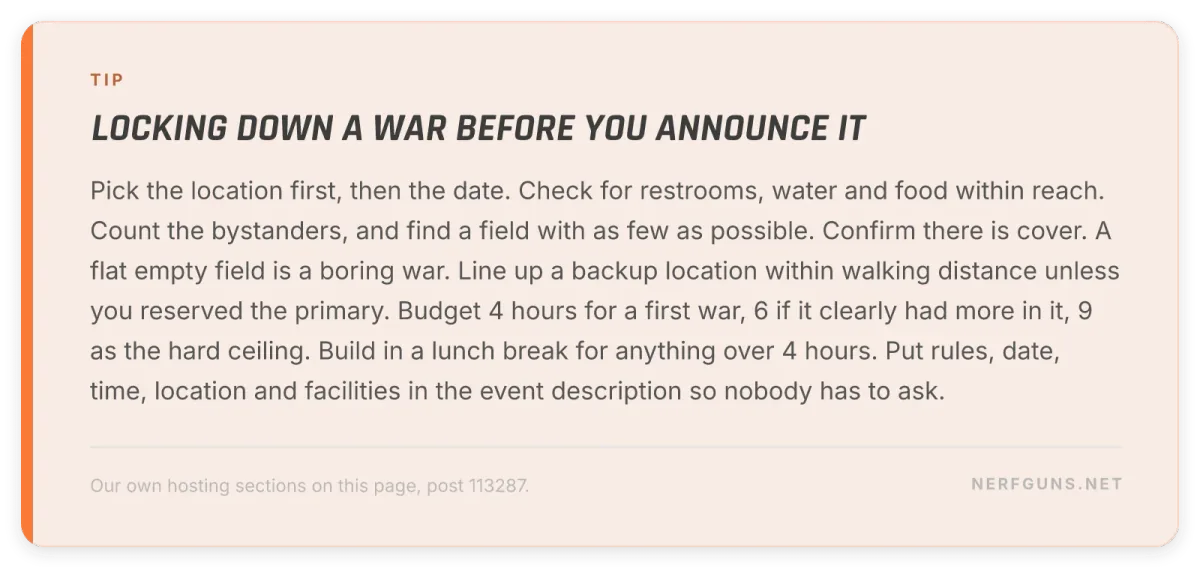
Organizing Nerf war games is its own skill. It starts with picking a battlefield. You want some cover and as few bystanders as possible. You want restrooms and water nearby. You want a backup spot within walking distance. Lock the details down before you announce the event, not after.
For bigger teams, assign jobs. Our team roles section runs through the common ones, starting with a commander who directs the team, and pairs each role with a sensible primary and secondary blaster. And if you want proof of how far this hobby scales, read about some of the biggest Nerf wars ever held.
Organizing a war people come back for
Running Nerf war games takes practice, and the first one will not be your best one. That is fine and it is not a reason to skip it. Groups that keep at it end up running super wars of thirty or more players, and everybody running those started by getting a handful of friends into a field.
Location
Finalize everything before you announce anything, because Nerf war games live or die on the venue. The location comes first, and there are four things a good battlefield has:
- Restrooms, water and food within reach.
- As few bystanders as possible.
- Some cover. A flat empty field is a boring war.
- A backup location within walking distance, unless you actually reserved the primary.
If you have a little budget, renting a public park is often cheaper than people expect, and a local school is worth asking about. You will not find a perfect location, so do not stall the whole event hunting for one.
Date, time and how long to run it
Pick the location first, then the date. If you already know who is coming, ask them what works; if you do not, choose a date yourself and let people fit around it.
Four hours is the right length for a first war, and most Nerf war games fill it easily with three or four formats. If it goes well and clearly had more in it, try six next time. Anything over four hours needs a lunch break built into the schedule, and nine hours is the ceiling. Past that, people are tired, careless and no longer having fun.
Getting people there
Once the details are locked, Nerf war games promote themselves more easily than you expect. A Facebook event is the easiest way to keep everyone in one conversation. Put the rules, the date, the time, the location, and whether there is food, water and restrooms directly in the event description, so nobody has to ask.
Then share it wider than your own circle, because Nerf war games draw people from further away than you would guess. Local classified listings work, and it is worth posting to the boards for nearby towns as well, because people will happily drive for a good war.
Rules worth stealing from established groups
Groups that have been running Nerf war games for years have already solved problems you have not hit yet.
- The modded blaster rule. A church group in Ohio that runs monthly wars allows modified blasters on one condition: the owner has to be willing to take a shot from it. If it hurts too much for them, it does not play. That single sentence settles the whole modding argument without anyone having to measure a velocity.
- Charge in food, not money. The same group’s entry fee is two cans of food, donated to a local food bank. It costs players almost nothing, it does not feel like a ticket price, and it gives the event a reason to exist beyond the game.
- Ask a church, a rec center or a community group about their grounds. Venues like these are used to hosting, they already have restrooms and parking, and they are often glad of an event that gets people outside and moving. One of that group’s wars ran from seven in the evening until four in the morning with twenty four players.
- Limb rules for large events. A large annual gathering in Los Angeles, the NerfWar TurfWar, plays with location based damage. A hit to an arm or a leg costs you the use of that limb. A hit to the head or the chest puts you prone for the round. The organizer’s own description of the result is that it has led to situations where armless, legless players are the only survivors and have to crawl a quarter mile to reach each other. It is slower, it is funnier, and it makes hits feel like they mattered.
- Mark your boundaries and be a good neighbor. That same event runs in a public park on a holiday weekend, so the players rope off the battlefield themselves and keep the game inside it. The organizer’s rule for the whole thing is worth repeating: the most important part is to act like adults and not like children.
Scale is not the hard part with Nerf war games. That LA event started as a small battle between a few friends. Once it was made public it grew into a hundred-plus player afternoon, split into four color coded teams and run over about three hours. Its worst injury across an afternoon that size was a broken collarbone from a bad slip, not from a dart.

The biggest Nerf wars ever held
Airsoft leagues need dedicated zones and real commitment, and paintball gets expensive fast once you are loaded out. Nerf war games can happen anywhere, any time, and the ceiling on that is higher than most people assume.
- The flash mob war. A group organized an impromptu battle in Chicago’s Millennium Park, in front of the Bean. Attendance was expected to run to a couple of hundred; a handful actually turned up, drew their lines, and had a few gloriously chaotic minutes before park security arrived. Both halves of that are instructive.
- The rec center war. A recreation department in New York ran a war for players aged five to eleven and had over sixty children and parents turn up. They ran escape challenges, speed rounds and capture the flag alongside the main free-for-all, and designated every adult a zombie for an apocalypse themed session. No child survived. The organizer’s stated goal afterward was a bigger event and a regular community group.
- The office war. Plenty of workplaces keep a blaster in a desk drawer. One Australian tech company built the habit into its culture. It runs regular office wars when management decides everyone is taking the job too seriously.
- The first world record. A university set out to claim a Guinness World Record for the largest Nerf war, running freshmen and seniors against sophomores and juniors. Faculty did not expect the whole student body to show up. With Guinness officials counting, 468 players were recorded.
- The record it lost to. Another university, in Des Moines, Iowa, set out specifically to break that number. They raised funds, worked with charities, handed out 600 blasters, and held the whole thing at night under stadium lights.
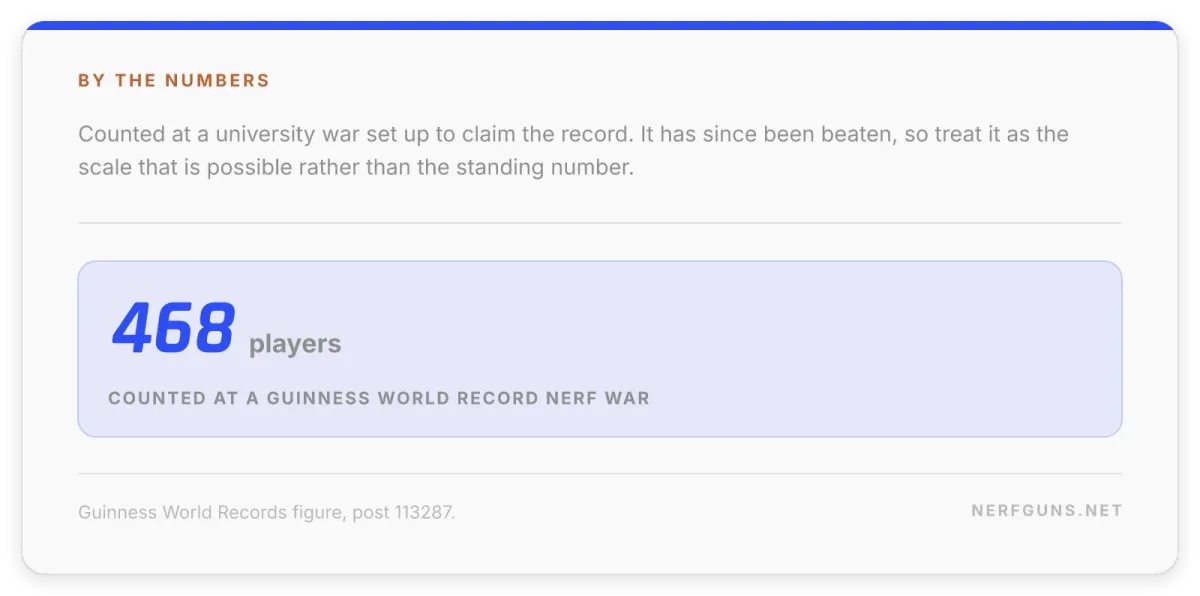
Both record figures are compiled from the published record attempts. Records move, so treat them as a sense of the scale that is possible rather than as today’s standing number.
Ammo and batteries: the two things that end a war early
Nerf war games eat darts. Count on players losing a chunk of whatever they bring, so a shared refill box is the single best piece of host equipment. The full 2026 kit for Nerf war games, darts and cover and all, is further down this page.
As an Amazon Associate and eBay Partner, we earn from qualifying purchases.
- Nerf Elite 2.0 50-dart refill, the ammo box standard that feeds most dart firing blasters

If your group runs flywheel or motorized blasters, dead batteries are the other war ender. Our battery runtime calculator estimates how many packs a war of a given length actually takes, and the LiPo battery calculator covers the modded side of the hobby.
The 2026 host kit for Nerf war games
Nerf war games do not need much gear. You need enough darts, enough eye protection, and something to hide behind. That is the whole list.
Darts, and lots of them
Buy in bulk. Nerf war games chew through ammo, and a shared refill box beats every player bringing their own handful.
- N Series N1 Dart Refill Pack, 200 darts , listed at ages 8 and up. These fit N Series blasters only, so check what your group runs first.
- N Series N1 Darts, 100 darts , also listed at ages 8 and up. Same N Series-only rule.
- N-Strike Elite Dart Pack, 250 darts , the bulk box for the Elite darts most older blasters fire.
- AMOSTING 100PCS Refill Darts . Not made by Hasbro, Nerf compatible, and the cheap way to fill a host box.
Note: N1 darts and Elite darts are not the same dart. Sort them into two boxes on the day or you will spend the afternoon untangling jams.
Eye protection, every single time
This is the one thing nobody gets to skip. YSCare protective goggles are not made by Hasbro either, just Nerf compatible, and a stack of spares by the door means no player ever has an excuse.
Cover, which is what turns a yard into an arena
A flat lawn makes for short, dull Nerf war games. The BUNKR Battle Zones Nerf Stadium Pack is an 8-piece inflatable cover set, and it is the fastest way to build a field with corners to fight over. That exact pack is hard to find new now, so the link above shows the BUNKR sets Amazon still stocks and eBay is where the Stadium Pack turns up secondhand.
Cheaper route: cardboard boxes, laundry baskets, patio chairs and a couple of pool noodles taped upright. Cover is cover.
Arming the players who turn up empty-handed
Somebody always does. These box sets exist for exactly that moment.
- N Series Party Pack , 5 Flex blasters and 15 N1 darts in one box, listed at ages 8 and up.
- N Series Backyard Triple Pack , 3 Flex blasters, 3 targets and 30 N1 darts, listed at ages 8 and up.
- N Series Gear Up Pack , 3 blasters and 18 N1 darts, listed at ages 8 and up.
- 12 Pack Blaster Guns party favors . Third party, Nerf compatible, and 12 of them is a whole team.
- 16-set party accessories bulk pack . Third party again, with darts, glasses, masks and wristbands for 16 players.
The N Series boxes are current stock rather than retired, but Amazon sells out of them often. When those links come up empty, the Party Pack on eBay and the Gear Up Pack on eBay are the fallback.
Want to look the part? POKONBOY tactical vest kits come 2 to a set. Third party, Nerf compatible, and they hold spare darts where you can reach them.
Two things that turn up in this search and do not belong here
Search for Nerf war games and two other things turn up. You will meet a World’s Smallest Official Nerf Basketball , listed at ages 6 and up, and a Nerf Fencing Duel Swords Set with soft-tip blades and light-up targets.
Both are real Nerf products and both are fun. Neither is a blaster. They are Nerf Sports items, so they match the words on this page and not the subject, which is why they are not in the kit above. If you want a head-to-head duel game rather than a dart war, the swords are the honest pick.
Buying blasters in bulk for a big war
Big Nerf war games get expensive fast at retail prices, and 20 players is a lot of blasters. Retired blasters are where hosts actually shop, because a used job lot costs a fraction of a shelf price and nobody minds when a loaner gets scuffed. These searches are the route for the discontinued stuff Amazon no longer stocks: Nerf blaster job lots on eBay | Stryfe | RapidStrike | bulk used darts.
Bonus tip: the gear you want for your next Nerf war games day is never the gear you remember when you are standing in the shop. Write it down while the game is fresh.
Frequently asked questions
The questions we get asked most about running Nerf war games, answered from the formats above.
How many players do you need for Nerf war games?
Two can duel, four can play Capture the Flag, and the objective modes want six or more. Humans vs Zombies is the big group format: it wants at least 7, at roughly one starting zombie per six humans.
What are the best Nerf war games for a birthday party?
Target formats over war formats: balloon shoots, Shoot the Dart on the Donkey, or an obstacle course. They work for mixed ages, need no teams, and nobody goes home upset.
What should the host bring?
A dart refill box, spare batteries for anyone running motorized blasters, something to mark teams, and the rules agreed in advance. Nerf war games stall when the host has to improvise any of those on the day. Location scouting notes are in the location section.
Rather than work from memory, run the printable version. We keep all the checklists in one place, and the host list is the one to open the night before.
How long should Nerf war games last?
Four hours for a first one. Six if that clearly had more in it. Build in a lunch break for anything over four hours, and treat nine hours as the hard ceiling, because past that people are tired and careless rather than having fun.
Are Nerf guns safe?
Yes, and Nerf war games have a good safety record for a contact hobby. The darts are foam and close to harmless against skin. Eyes are the exception, which is why no shots to the face is the universal rule and why safety glasses are worth the small cost. Almost every genuine injury story attached to this hobby comes from the behavior around the game, trespassing or anything involving a car, rather than from the blasters. Full rules are in the safety section.
Related pages: the Zombie Strike lineup is the range built for the zombie formats, Nerf swords and melee weapons cover the melee rule, and every Nerf gun ever made is where to pick a loadout.
If you are running a water version in summer, the Super Soaker hub has the soakers worth buying. Licensed blasters are the ones people bring to show off rather than to win, and the history of Nerf explains how a foam ball turned into all of this.