
The Swarmfire shows 20 darts to your opponent before anybody pulls a trigger. That alone changes how people play against you. It is the battery-powered heavy of the Dart Tag line, built for volume, not precision. Here is what it does well, and the one weakness you have to plan your whole game around.
What is on this page
- The short verdict
- What you get in the box
- The 20 barrels, and why it never jams
- The reload, and how to survive it
- Handling, the stock and the grip
- Range and accuracy
- The one thing it is missing
- The battery question
- How it compares to the Hyperfire
- Where it wins on a field
- Who should get one
- Buying one secondhand
- If this one is not it
- What to buy now that Dart Tag is gone
- Where to buy
- Frequently asked questions
The short verdict

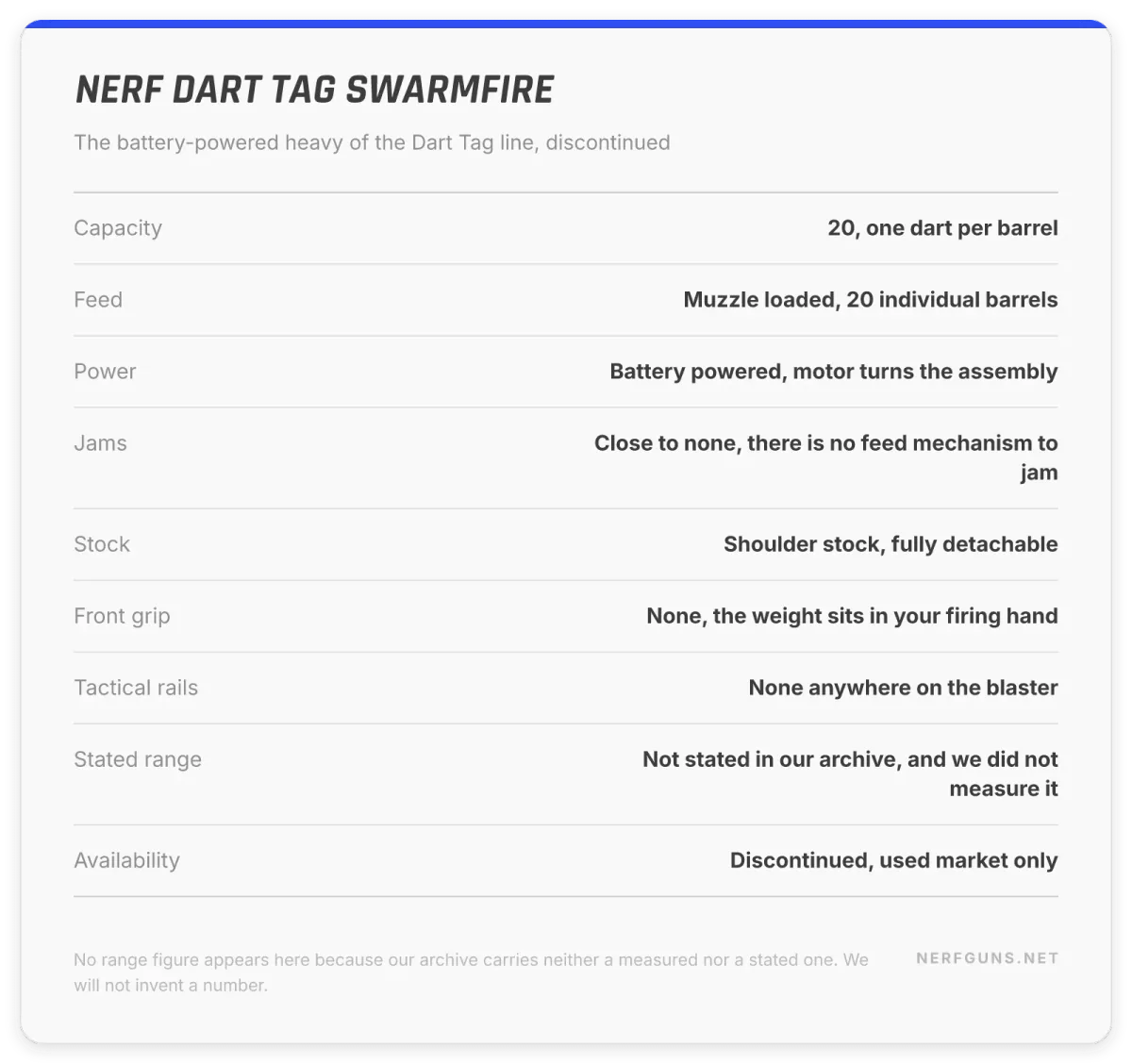
- 20 darts on board, in a rotating assembly that shows every muzzle at once.
- Battery powered, so you hold the trigger and it works through the load without priming.
- Muzzle loaded, which makes it close to immune to the jams that plague clip-fed and drum-fed blasters.
- A detachable shoulder stock, and most people never try it without.
- No tactical rails at all, so nothing bolts on. What you see is what you get.
Buy it if you want to bring a lot of darts to a game and you value reliability over reconfigurability.
Skip it if you need to reload in a hurry, or you like bolting sights and lights onto a blaster. The Swarmfire does neither.
What you get in the box
This was the top of the Dart Tag range, so it shipped as a single large blaster with its stock and a set of darts.
The yellow and black styling is not subtle. It was never meant to be. The blaster looks like a hornet that is about to sting you 20 times, and that look does real work before a shot is fired.
What is not in the box is anywhere to keep your spare darts. With 20 in the blaster and a game to play, a vest or a pouch is the accessory you actually need. Our guide to Nerf gun vests covers the options.
The 20 barrels, and why it never jams
The Swarmfire does not have a magazine. It has 20 individual barrels arranged in a rotating assembly, and each one holds exactly 1 dart.
Pull the trigger and the motor turns the assembly, firing each barrel as it comes round. There is no feeding, no stripping a dart off a stack, and no lifting anything into position.
That is why it is so reliable. Almost every Nerf jam happens at the feed: a clip lip deformed, a dart seated crooked, a drum that will not index. The Swarmfire has none of those parts, because the dart is already in the barrel it will be fired from.
Dart Tag was built around scoring, and a blaster that never stops mid-game is worth a lot in that format. Our archive calls that reliability the single best thing about the Swarmfire. That still holds up.
Then there is the scare factor. Every barrel is visible from the front, loaded, all the time. Nobody has to guess how much ammo you are holding. Knowing it is 20 changes how they come at you.
The reload, and how to survive it
Here is the catch, and it is a large one.
Every one of those 20 darts goes in by hand, one at a time, into its own barrel. That is not an annoying reload. It is a genuinely long one, and no version of the Swarmfire reloads quickly.
Three habits make it survivable, and they are the whole skill of running this blaster.
- Take cover first. Not cover you are hoping holds. Real cover. You are going to be there a while, and both hands will be busy.
- Empty it rather than conserving. Half a load does not save you if you get caught reloading anyway, so spend the darts when they are useful.
- Carry a backup. Something like the Strikefire on a belt covers the gap while you feed barrels. That is the difference between a long reload and being out of the game.
One more practical point: where your darts live while you reload. Fishing them out of a deep pocket one at a time doubles an already slow job. A chest pouch or a vest with loops is worth more on the Swarmfire than on any other blaster on this site.
Handling, the stock and the grip
Two design decisions define how the Swarmfire feels, and both are unusual.
There is no front handle. All the weight rests in your firing hand. So it carries like an oversized pistol rather than a two-handed rifle, and that gets tiring over a long game in a way nobody expects.
The grip is textured. That sounds like a tiny detail, right up until a game has been going 20 minutes and your hands are damp. It is one of the small things the Swarmfire gets right.
The shoulder stock is completely detachable, and most people never test it. Leave it on for weight and stability, or pull it off and you have a noticeably more compact blaster that comes onto a target faster.
Try both before you decide. Most people leave the stock on simply because it came that way. For close-quarters play, no stock is often the better call.
The overall size is large but not unmanageable. It is the barrel assembly that takes up the room, and it is wide rather than long, so doorways are more of a problem than corridors.
Range and accuracy
Our archive carries no measured range figure for the Swarmfire and no stated one either, so this page publishes no number. We do not print figures we did not take.
What can be said honestly is that accuracy is not really the point of this blaster, and the design agrees.
Twenty short barrels will never produce tight groups. Each one sits a fraction differently against the mechanism. And a dart fired from a short barrel has less length to straighten it out than one from a long fixed barrel.
Volume is its own kind of aiming. Miss with the first dart and there is a fair chance the second or third lands. That is the trade the Swarmfire makes on purpose.
Outdoors, the same rule applies as to every dart blaster. Wind pushes light foam around. A spread of darts in a breeze turns into a wide spread of darts you have to go and collect.
The one thing it is missing
The Swarmfire has no tactical rails. None, anywhere on the blaster.
If you like building a blaster out with sights, scopes and lights, the Swarmfire has nothing for you. There is no workaround short of drilling into it.
In fairness it does not need most of them. A sight on a blaster that fires a spread is decoration. A scope on something with this much barrel-to-barrel variation would just lie to you.
The real loss is a light. Playing after dark with 20 ready darts would suit this blaster perfectly, and there is nowhere to mount anything to see by. That is a genuine gap rather than a stylistic one.
Our attachments guide covers what fits blasters that do have rails. Worth reading before you buy anything expecting to kit it out.
The battery question
A motorised blaster is a running cost, and it is worth being plain about that before you buy.
The Swarmfire needs cells to do anything at all. Not to boost performance, not to add a feature: without power the barrel assembly does not turn and no dart leaves the blaster.
Rechargeables are the obvious answer. They kill the running cost completely. They also hold voltage more steadily under load than cheap alkalines, which matters on a motor spinning a heavy loaded assembly.
The symptom of tired cells is worth recognising. The assembly slows, the firing rhythm drags, and it feels like the blaster is wearing out. It is not. Change the batteries before you conclude anything.
And take them out for storage. Every corroded Swarmfire on the used market got that way because somebody shut it in a cupboard with the cells still in it. Corroded contacts are the number one reason one of these turns up dead.
One habit worth forming: keep a spare set in whatever bag the blaster travels in. A motorised blaster that dies mid-game is worse than a manual one that was always slow. With a manual blaster you can still fall back on your arm.
How it compares to the Hyperfire

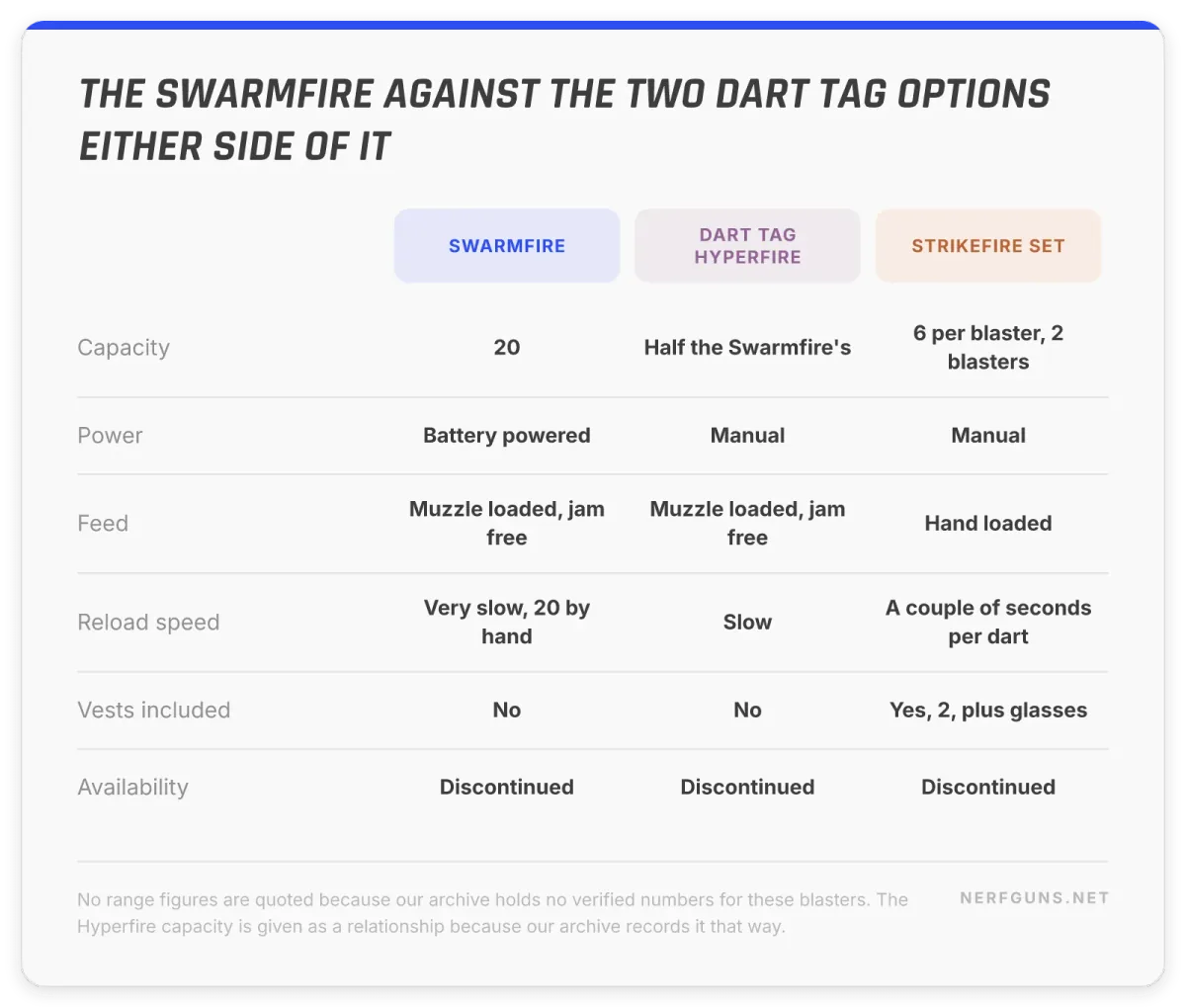
Anyone who has been playing a while will spot the family resemblance to the Hyperfire above, the earlier blaster working the same idea.
Both present their full firepower at the front rather than hiding it in a magazine, and both are muzzle loaded with the same jam-free consequence.
The Swarmfire improves on it in two specific ways. It doubles the capacity, and it backs the whole thing with a battery-powered mechanism instead of relying on your arm.
What it gives up is exactly what you would expect. Batteries to buy, batteries to go flat, and a motor that announces you the moment you pull the trigger.
If you liked the Hyperfire concept, the Swarmfire is that concept with the volume turned up and a power bill attached.
Where it wins on a field
Play it as an opener and it is excellent. Twenty ready darts is enough to take a position, break up a push, or cover somebody else moving across open ground.
It is also a genuinely good defensive blaster. Set up behind cover with a full load, and the Swarmfire holds a doorway in a way no 6-shot blaster can.
Where it fails is the long game. Once the first 20 are gone, you are a slow-moving target holding a big empty blaster. That phase lasts a while.
So the honest framing is this: bring it, empty it, and have something else ready for the 90 seconds afterwards. Play it that way and it is hard to beat for pure volume.
In group formats, a heavy blaster with a slow reload becomes a role instead of a weakness. Our Nerf war game modes page has rule sets worth borrowing. Objective games suit the Swarmfire far better than a free-for-all does.
Who should get one
This is a straightforward call.
Want to bring plenty of darts to a game, and fire them without priming between shots? The Swarmfire does exactly that, and it looks the part doing it.
If you value fast reloads, attachment options, or a blaster you can reconfigure, look elsewhere in the Dart Tag line or at clip-fed blasters instead.
The Swarmfire does one thing. It does it well, and it does not pretend to do anything else.
It also suits one specific kind of player. Somebody who would rather own a blaster that never lets them down than one with more features and more ways to fail. Reliability is an underrated thing to buy.
Buying one secondhand
Dart Tag is no longer a current line, so this is a used purchase, and the Swarmfire needs more care than most because it has a motor.
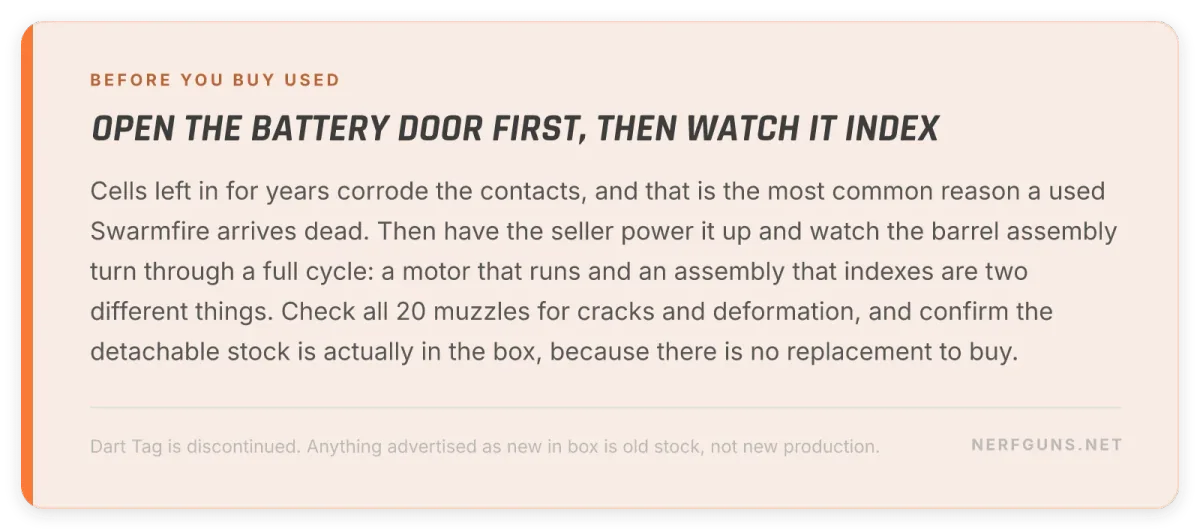
Open the battery compartment before anything else. Batteries left in a toy for years corrode the contacts, and corroded terminals on a motorised blaster can mean it simply will not run.
Then have the seller power it up. Watch the barrel assembly turn through a full cycle, do not just listen for the motor. A motor that runs and an assembly that indexes are two different things.
Check the barrels themselves. Twenty muzzles is twenty things that can be cracked or bent. A damaged barrel is one dart that does not go where the other 19 went.
Confirm the detachable stock is actually included. Detachable parts are exactly what goes missing on a used blaster, and there is no replacement to buy.
If this one is not it
You want the capacity without the reload. A clip-fed blaster trades jam-free reliability for a 2-second magazine swap. That is the opposite bargain to the Swarmfire, and the right one for most people.
You want big and motorised generally. Our roundup of Nerf machine guns covers the high-capacity motorised blasters across every line.
You want something on shelves now. Our guide to the new Nerf guns covers current products, and the full blaster list has everything we have written up.
What to buy now that Dart Tag is gone
Dart Tag is finished. Not just the Swarmfire, the whole line and the scoring game that went with it.
Start with the honest part. Nothing Nerf sells today has 20 loaded barrels pointing at you. That rotating wall of muzzles is gone, and no current blaster replaces the look of it. If that is what you want, the used market is where it lives.
The volume is easy to replace. The velcro scoring game is not. Nerf does not make a scoring line any more, so the vests-and-sticky-darts version of Dart Tag has no 2026 equivalent at all. Say it plainly rather than sell you something close.
What you can get is the sustained fire, without the 20-dart hand reload:
- The Nerf Loadout Galactic Commander is motorized with 3 firing modes, including full auto. It ships with 48 N1 darts and two 18-dart clips, so you load one and keep the spare in the stock. Hasbro rates it 8+.
- Want the team game instead? The Nerf N Series Party Pack is 5 blasters and 15 darts in one box, which is the closest thing still in production to buying Dart Tag for a group. No vests, no scoring, just five people armed. Also rated 8+. Amazon runs out of it regularly, so that link shows what is stocked today and eBay has it as well.
Here is the swap that actually stings. The Galactic Commander empties an 18-dart clip in seconds and you swap in the spare. The Swarmfire made you feed 20 barrels by hand. That is the whole trade, and for most players it is the right way round.
One catch, and it catches everybody. These fire N1 darts. Nerf’s own listings say N1 darts are compatible only with N Series blasters, so your Dart Tag foam will not feed one. Budget for N1 darts alongside the blaster.
Bonus tip: nobody ever guesses the right blaster. Put the one you actually want on a free wish list, then send the link to whoever keeps asking what you want for your birthday. Start your free Nerf wish list and let them buy the right thing.
Where to buy
As an Amazon Associate and eBay Partner, we earn from qualifying purchases.
The Swarmfire is discontinued, so these point at the used and third-party market, not a current shelf item. Prices move around constantly. Treat anything you see as a snapshot.
- Nerf Dart Tag Swarmfire on Amazon, the blaster itself, used or old stock.
- Velcro-tipped Dart Tag darts on Amazon, if you are playing the scoring game rather than a plain war
- Used Swarmfire listings on eBay, usually the better hunting ground for a blaster that left shelves years ago.
Frequently asked questions
How many darts does the Swarmfire hold?
20, one in each of 20 individual barrels. There is no magazine, no clip and no drum, which is exactly why it does not jam.
How far does it shoot?
We do not publish a figure. Our archive carries neither a measured range nor a stated one for this blaster, and inventing a number would be worse than saying so.
Does the Swarmfire need batteries?
Yes. The motor turns the barrel assembly and fires each barrel in turn, so with dead batteries it does nothing at all. Rechargeables are the sensible choice.
How long does it take to reload?
Long. Twenty darts loaded one at a time, by hand, into separate barrels. Plan for it, take cover before you start, and carry a sidearm for the gap.
Can you put a scope or a light on it?
No. The Swarmfire has no tactical rails anywhere, so nothing standard mounts to it. The lack of a light is the part worth minding, because it rules out night play.
Does it fire ordinary Nerf darts?
It fires standard darts fine. If you are playing the Dart Tag scoring game with vests you want the velcro-tipped darts instead, because ordinary ones will not stick.
Is the stock worth using?
Try it both ways. On, you get stability and weight; off, you get a more compact blaster that swings faster. Most owners never take it off, which means most owners never find out which they prefer.
Is there a modern version of the Swarmfire?
Not really. Nothing Nerf makes today carries 20 loaded barrels on the front, and the Dart Tag scoring game is gone with the line. The closest blaster for pure volume is the Loadout Galactic Commander, which is motorized with 3 firing modes and reloads from an 18-dart clip instead of by hand. It fires N1 darts, so your Dart Tag foam will not work in it.
Is the Swarmfire worth buying now?
If the motor runs, the assembly indexes cleanly and the stock is included, yes. It is one of the most reliable blasters we have covered and 20 ready darts is still 20 ready darts. Just buy it knowing the reload is the price.
It’s Nerf or Nothin’!


loks funny
and its new right???
Is it good??
second response
gun looks cool i might get it but it’s hard to get dart tag guns in australia so thats why i’ve been collecting n-strike
looks cool when will it be out in australia
Did you hear about the new Quick 16? It looks like a super scope with a big clip on the side
looks cool but i don’t have $19.99.
its 29.99
what a shame
when is it comin out in the uk
i know it’s a silly question but i know som mahine guns can shoot quite far is thiz 1 of them or is it a close assault kinda gun
swarmfire shoots 5 darts per second
When does it come out in australia
When does it come out in australia oh and it aint the gun that makes people think twice to shoot first it makes them instantly shoot cos they don’t want to lose