
Nerf Dart Tag is the only line Hasbro ever built as a scoring sport, with velcro headed darts, scoring vests and an official championship behind it. The whole line is retired, so every blaster here is a secondhand find, and that is worth knowing before you go hunting. This page covers all 8 blasters we have written up, the league that made the line matter, and what to check before you buy.
What is on this page
What made a blaster a Dart Tag blaster
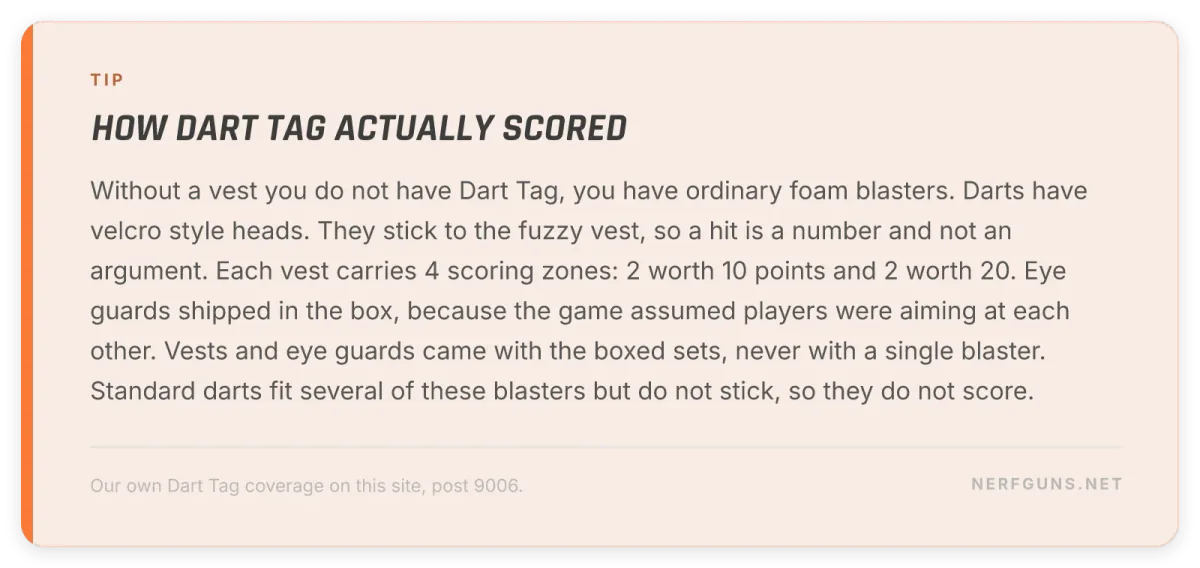
Dart Tag was built around scoring, not just shooting. The darts have velcro-style heads, and the sets shipped with vests made of a fuzzy material those heads stick to. A vest carries four scoring zones, two worth 10 points and two worth 20, so a hit is not something to argue about, it is a number. Eye guards came in the box for the same reason. The game was designed to be played fast, competitively, by people aiming at each other on purpose.
The blasters run on tagger micro darts, and several of them will also feed the standard darts already in your bin. That compatibility cuts both ways: a Dart Tag blaster will happily fire ammunition that cannot score.
That scoring vest is the part people forget. Without it you have a set of ordinary foam blasters, because the velcro dart only means anything if there is something for it to stick to.
Three things separated Dart Tag from every other Nerf line:
- Hits were scored, not argued. Four zones per vest, two worth 10 points and two worth 20.
- Eye guards shipped in the box. The game assumed people were aiming at each other, so the protection was not an afterthought.
- The darts were the whole system. Tagger micro darts with velcro heads, not a variant of the standard dart.
The Dart Tag league, and why the line existed
Nerf ran Dart Tag as a real competitive circuit, the only sanctioned league in the brand’s history. It is the reason the hardware was built the way it was.
How it worked, as we reported it at the time:
- Teams of four.
- Two age divisions, 8 to 12 and 13 to 17, so nobody faced a player more than four years older.
- Timed capture the flag elimination as the game format.
- Round robin, every team playing every team, with the two highest scoring teams advancing to the finals.
- A $25,000 grand prize.
- The Furyfire was the blaster of record in 2009.
The 2009 tour ran alongside the Dew Action Sports Tour, stopping in Chicago, Boston, Portland and Salt Lake City, with regional qualifiers feeding the World Dart Tag Championship that opened in Orlando on October 17th, 2009.
The league is covered in more detail in our history of Nerf, alongside the rest of the community era.
Why it matters to a buyer: the blasters were designed for four-player teams playing short scored rounds, which is why capacity and reload speed dominate this line and raw range does not.
The Dart Tag lineup, blaster by blaster

Two blasters in the line have full reviews of their own: the Swarmfire, the twenty-dart battery-powered heavy of the line, and the Strikefire. Everything else the line shipped is covered below.
Quick 16

As an Amazon Associate and eBay Partner, we earn from qualifying purchases.
Darts: tagger micro sticky darts, and most standard darts. Capacity: 16, in a magazine. Mechanism: magazine fed, no batteries. Check the Quick 16 listing on Amazon.
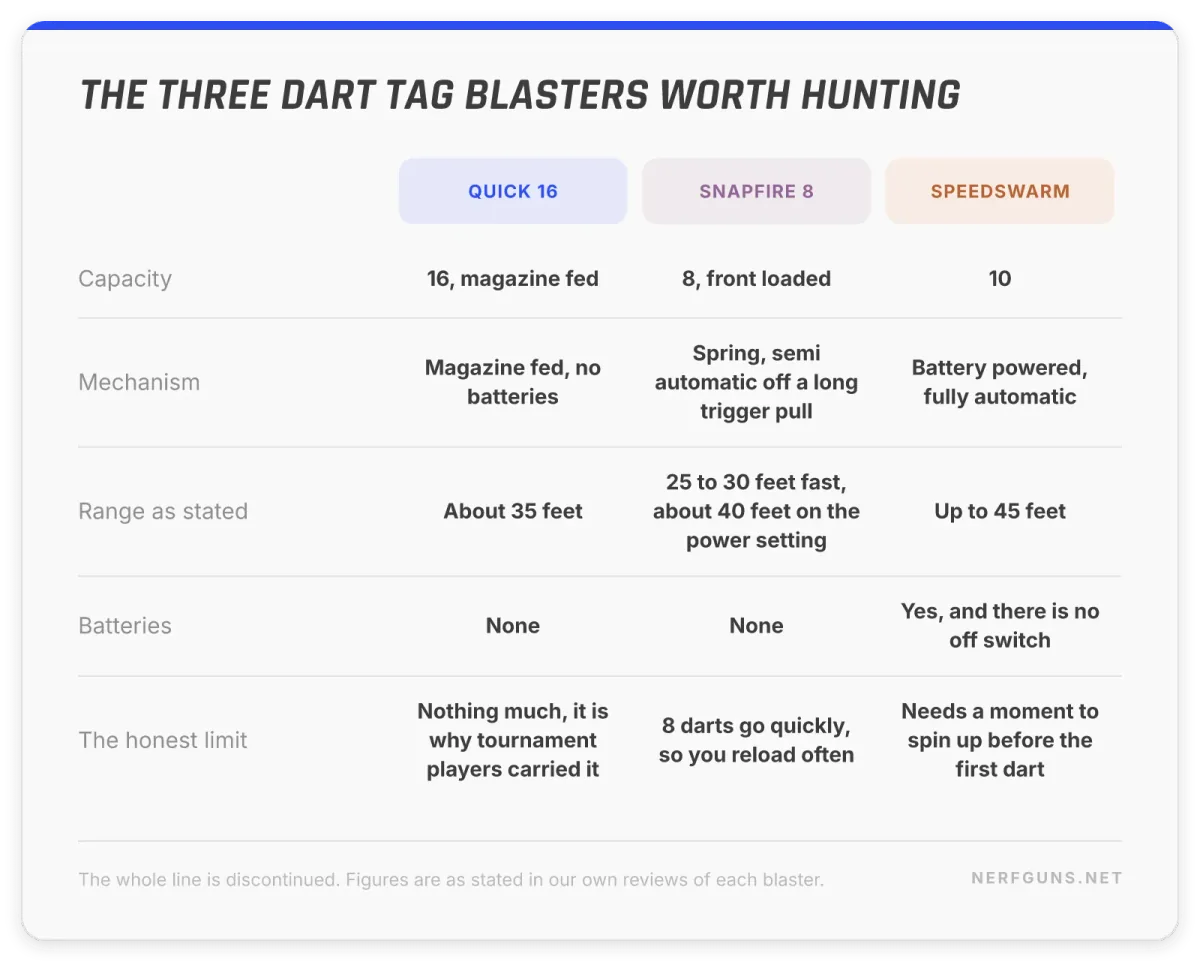
The Quick 16 is named for exactly what it holds, and 16 is the largest capacity in the line short of the Swarmfire. It reaches about 35 feet, the magazine drops out and slides back in without fuss, and the magazine itself refills through a depression bar rather than one dart at a time. A side loader opens to clear a jam.
The honest standout: it is the only clip-fed blaster Dart Tag made, which is why tournament players carried it. Ammo capacity and reload speed in a frame light enough to run with.
Speedswarm

Darts: tagger micro darts, the line standard. Capacity: 10. Mechanism: battery powered, fully automatic. Search the Speedswarm on Amazon, or find one on eBay
Roughly the size of a Maverick, the Speedswarm is the panic button of the line. It dumps 10 darts in about 7 seconds, and a pair of them dual-wielded puts 20 downrange in the same 7 seconds, pointed in two directions. The round yellow body with the blue trigger is odd to aim until you get a feel for it, and then it turns out to be surprisingly accurate at up to 45 feet. By design it cannot jam.
The honest standout, and it is a flaw: there is no off switch. Pull the batteries when you are done or you will find it flat next time. It also needs a moment to spin up before the first dart, so switch it on before the round starts, not during it.
Snapfire 8

Darts: tagger micro whistler darts and Elite darts. Capacity: 8, front loaded. Mechanism: spring, semi-automatic off a long trigger pull, no batteries.
Darts slide in from the front, and a long pull of the trigger draws the plunger and fires, so you get semi-auto behaviour with nothing to charge. It takes no barrel extensions and no shoulder stock. In the box: the blaster, 8 darts, a manual.
The honest standout: a knob on the underside changes the spring length, and an indicator on the handle shows where you have it set. Dial it toward speed and you get about 25 to 30 feet with a fast trigger. Dial it toward power and it reaches about 40 feet. Nothing else in the line lets you trade range for rate of fire between rounds. The catch is the obvious one. Eight darts go quickly, so you reload often.
Speed Load 6

Darts: standard, air, glow, and whistler darts. Capacity: 6. Mechanism: depression-bar loading, fired shot by shot or slam fired.
Bigger than a Maverick or a Sharp Shot, smaller than a Swarmfire or a Raider, and heavier hitting than the pistol shape suggests. It reaches about 35 feet, and you can either prime between shots or slam fire the whole six as a volley.
The honest standout: the depression-bar system, the same idea as the Raider’s drum, makes this the quickest reload in the line. It behaves less like a Nerf pistol and more like a revolver, which is what makes it a good second blaster when a bigger one becomes impractical.
Sharp Shot

Darts: standard ammunition, including sticky darts and tactical camo darts. Capacity: 1 in the barrel, 4 more held on the blaster. Mechanism: single fire.
The cheapest blaster in the line and the easiest to carry. A belt clip on the underside snaps free when you pull it into your hand, the grip suits small and large hands alike, and with no automatic fire there are fewer darts to pick up afterwards. It is accurate for the money, which is the whole argument for it.
The honest standout: it comes apart with a few screws, so it is the line’s modding platform. Spring swaps and other bench work go in easily, which is why it kept a following long after the shelves cleared.
Stinger

Darts: tagger micro darts, loaded one at a time. Capacity: 3, the stock capacity. Mechanism: single shot, primed by pulling the plunger handle down.
A small pistol-grip blaster, easy to conceal, easy to run with. It came in blue with the Target Tag Set, and in red and green with the Dart Duel Set, so a matched pair was the normal way to own one.
The honest standout cuts both ways: it is the smallest and quietest thing in the line to carry, and it is the slowest to get back into a fight, because every dart goes in by hand and every shot needs a prime. The flat modern shell also takes paint well, which is why so many of them ended up green, black, or camo.
Spider-Man vs Venom Set

Darts: 12 velcro-headed tagger darts included. Capacity: two blasters in the set. Mechanism: rapid-fire action for repeat shots.
This one is a complete game rather than a single blaster: two Dart Tag blasters, 12 darts, two eye guards, and two scoring vests. One vest wears Spider-Man red and blue, the other wears Venom black and white. Both are front-only with an open back, and both carry the standard four scoring zones. The blasters reach about 35 feet.
The honest standout: the blasters strap to your wrist. That frees your hands, so you can carry something full sized and still have two of these ready. The honest drawback is that the darts do not always stick to the vests. Shoot from closer in and the problem mostly goes away.
The rest of the line
Dart Tag shipped more than the blasters above. The Furyfire, the Hyperfire and the Crossfire all carried the branding, and we never put them on the bench.
So this page quotes no specifications for them. They are named here so the list is complete, not so you can shop from it. If we get one on the bench, its numbers will appear here and not before.
The Furyfire is the one worth knowing about anyway, because it was the blaster of record at the 2009 championship. That makes it the closest thing the line has to a competition standard, whatever its specifications turn out to be.
Picking one up secondhand
Since no Dart Tag blaster is on a shelf any more, buy for the job rather than for the name.
The line splits cleanly by job, and there is no single best answer.
Want volume: the Swarmfire at 20 darts, or the Quick 16 for the same idea in a lighter frame. Want a backup that reloads fast: the Speed Load 6, or the Speedswarm if you like a panic button. Want one blaster that does two jobs: the Snapfire 8, for the power knob. Want a project: the Sharp Shot.
One thing worth checking before you buy any Dart Tag blaster. The scoring vests and eye guards came with the boxed sets, not with single blasters. If you want to play Dart Tag as the scoring game it was built to be, and not just shoot foam, look for a set.
Only the Speedswarm and the Swarmfire need batteries. Everything else in the line runs on your trigger finger.
Where these actually turn up. Amazon rarely has a retired Dart Tag blaster in stock, so eBay is usually the better hunting ground. These searches are live, so what you see is what is genuinely for sale today.
| If you want | Dart Tag blaster | Look here |
|---|---|---|
| Volume | Swarmfire, 20 darts | Swarmfire on eBay |
| Volume, lighter | Quick 16 | Quick 16 on Amazon |
| A fast-reloading backup | Speed Load 6 | Speed Load 6 on eBay |
| A panic button | Speedswarm | Speedswarm on eBay |
| Two jobs from one blaster | Snapfire 8, the power knob | Snapfire 8 on eBay |
| The full scoring game | A boxed set with vests | Dart Tag sets on eBay |
Buy the set if you can find one. The vests and eye guards never came with single blasters, and they are the half that makes Dart Tag a sport instead of a blaster.
What to check before you pay
A retired line fails in predictable places, and Dart Tag fails in four.
- The velcro on the darts. This is the one that matters. Tagger heads go bald with use, and a bald dart is just a dart, so it will not score. Ask for a photo of the dart tips, not the blaster.
- The fuzzy side of the vest. The vests matt down over time in exactly the spots that get hit most, which are the 20 point zones. A matted vest reads as a miss.
- The Speedswarm battery bay. It has no off switch, so these were routinely put away still running and left flat for years. Check the contacts for corrosion before you pay.
- The Snapfire 8 spring knob. Turn it through its full travel and watch the indicator on the handle move with it. That knob is the only reason to buy this blaster over any other single shot.
One honest warning about the format itself. Our own review of the Spider-Man set found the darts did not always stick to the vests, and the same complaint runs through the line. Shooting from closer in mostly solves it, and it is worth knowing that going in rather than discovering it on the first round.
None of that makes Dart Tag a bad buy. It makes it a buy where the ammunition and the vests matter more than the blaster, which is the opposite of how people usually shop for Nerf.
What to buy if you want the game, not the line
Here is the thing about Dart Tag: the scoring game did not die with the line.
What died was the boxed format. You can still run the exact same game with any current blaster, a set of velcro-headed tagger darts and a vest, and you will not be fighting 15 year old foam to do it.
For the blaster half, the current 8 and up shelf is where to look. Our best Nerf guns guide covers what is on shelves now, and the new Nerf guns page covers the 2026 lines. For the game half, our Nerf war games guide has the scoring modes that do the same job as a Dart Tag vest.
Bonus tip: if you only want the scoring, official Dart Tag darts on eBay plus any blaster you already own is by far the cheapest route into it. The velcro heads were only ever made for this line, so eBay is where they still turn up.
Note: hunting a retired line takes patience. Save the blasters you are looking for to a wishlist so you remember what you still need when a set finally shows up.
Where to buy
As an Amazon Associate and eBay Partner, we earn from qualifying purchases.
Every Dart Tag blaster is discontinued, so there is no current shelf equivalent to send you to. The links below are searches rather than product pages, because a listing for a retired blaster goes stale faster than we can check it.
- Search Nerf Dart Tag sets, which is what to look for if you want the vests and eye guards
- Search tagger micro darts, the velcro headed ammunition the line runs on
- Safety glasses, if the set you find has lost its eye guards
If you want the scoring game rather than these specific blasters, any blaster plus a set of tagger darts and a vest gets you most of the way there. That is genuinely the cheaper route now, and it sidesteps the two things most likely to be worn out on a secondhand Dart Tag set.
Frequently asked questions
The Nerf Dart Tag questions we get asked most, answered from the blasters above.
Is Nerf Dart Tag discontinued?
Yes. Hasbro retired the entire line, blasters, darts and sets. Everything on this page is a used market find, and there is no current Nerf range that replaces it.
What darts does Dart Tag use?
Tagger micro darts with velcro style heads, which is what makes them stick to a scoring vest. Several blasters in the line will also fire standard darts, but standard darts do not stick and so they do not score.
Which Dart Tag blaster is best?
The Quick 16 for capacity and reload speed, which is why tournament players carried it. The Snapfire 8 if you want to trade range against rate of fire with its spring knob, and the Sharp Shot if you want something to take apart.
Do you need the vests to play Dart Tag?
To play it as the scoring game it was designed as, yes. The vests and eye guards came with the boxed sets and not with single blasters, so buy a set rather than a loose blaster if the scoring matters to you.
Do Dart Tag blasters need batteries?
Only the Speedswarm and the Swarmfire. Everything else in the line runs on your trigger finger, which is one of the better reasons to buy into it now.
Can you still play Dart Tag today?
Yes, and you do not need the original hardware for it. Any blaster plus tagger darts and something the darts stick to reproduces the format, and the rules sit alongside every other mode on our Nerf war games page.
More Dart Tag reading
Start with the ammo: which Nerf darts fit which blaster, fix bent Nerf darts.
Full reviews: Nerf Dart Tag Swarmfire, Nerf Strikefire Dart Tag Blaster. Gear to go with them: Nerf accessories and attachments.
For the other retired lines, Vortex and Zombie Strike are both worth reading before a secondhand purchase, and licensed blasters covers the Spider-Man Dart Tag set from the franchise side. The whole catalogue is every Nerf gun ever made.
Looking for Zombie Strike darts? They are Elite darts in a different colour.

Nerf Dart Tag Swarmfire
The Swarmfire shows 20 darts to your opponent before anybody pulls a trigger. That alone changes how people play against you. It is the...
Nerf Strikefire Dart Tag Blaster
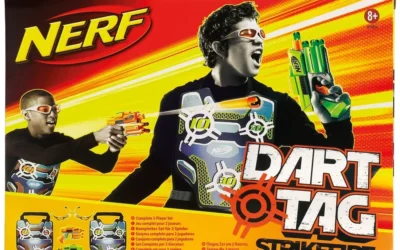
The Strikefire is not a blaster. It is a boxed game. Two pistols, two scoring vests, two pairs of safety glasses and 12 velcro-tipped darts. That...