
Vortex is the one time Nerf abandoned darts completely and shipped a whole line firing discs instead. Seven blasters, one ammunition type, and a flight profile nothing else in the range could match. Here is what the discs actually changed, which blasters were worth owning, and the most honest answer we can give to why the line ended.
What is on this page
What Vortex was
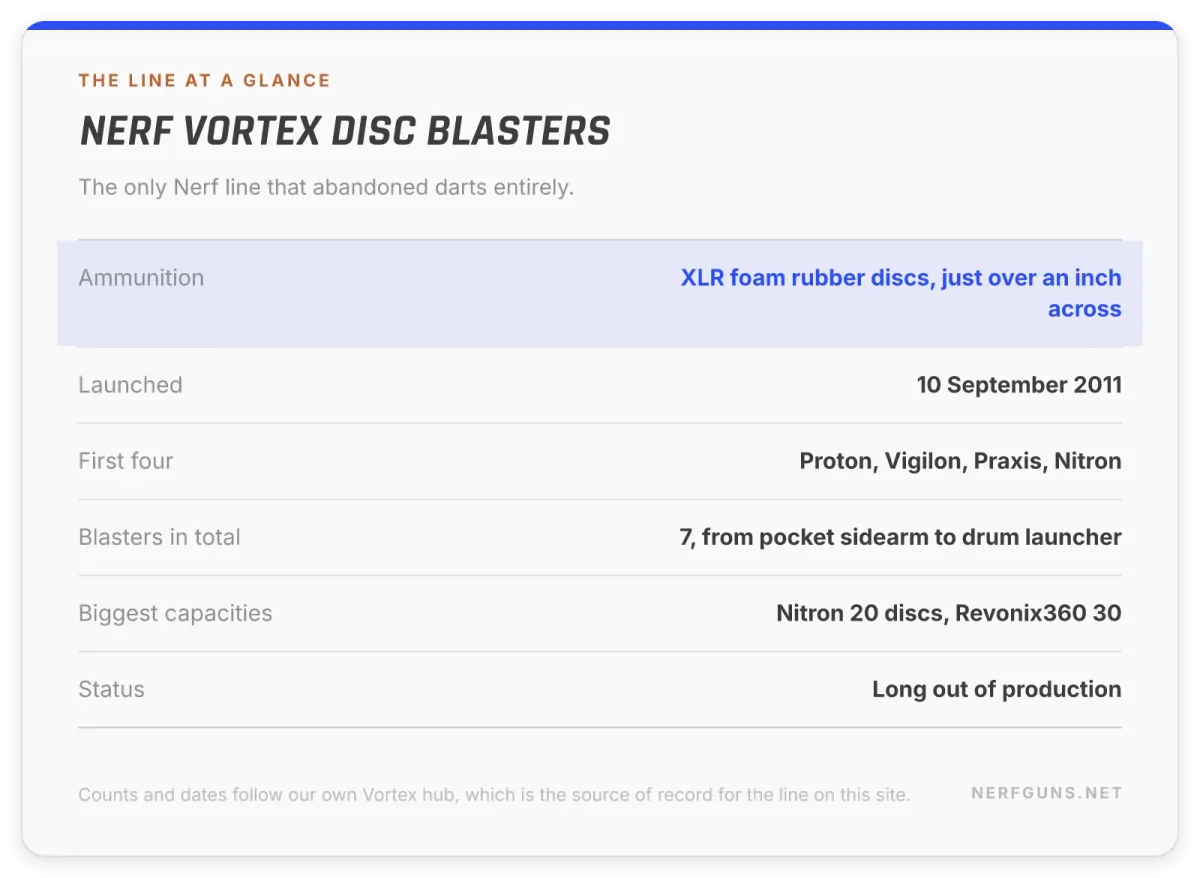
Hasbro released the Vortex line on 10 September 2011 with four blasters: the Proton, the Vigilon, the Praxis and the Nitron. Three more followed, making seven in total, from a pocket sidearm up to a drum launcher holding 30 discs.
The blasters do not use darts at all. They fire semi-hard foam rubber discs called XLR discs, a little over an inch across, which behave like miniature frisbees rather than like projectiles.
Visually the line set itself apart too. A green accent instead of the usual orange, and a more angular, science-fiction look than the N-Strike blasters sitting beside it on the shelf.
The whole line is long out of production. Everything below is written for someone deciding whether to buy one secondhand, or trying to work out what happened to it.
What the disc changes
A disc flies differently from a dart, and the difference is not marginal.
A dart is a tube with a weighted head, and the hole in that head makes it swerve. It arcs, it drops, and past a certain distance you are aiming somewhere other than the target.
A spinning disc generates lift. It flies flatter, it holds its line, and it stays airborne longer. Where a one-shot dart pistol frequently misses at longer range, a disc sidearm is far more likely to hit.
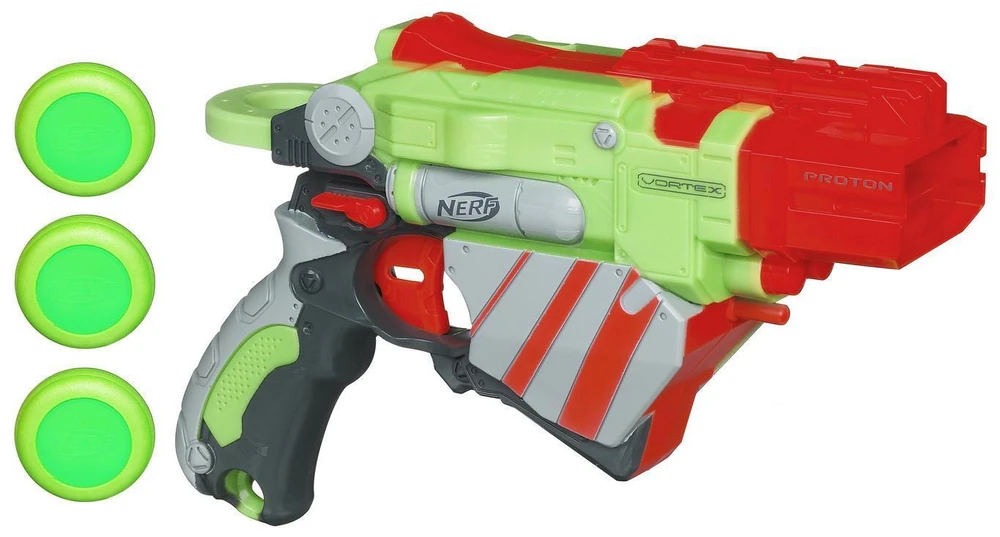
That is the genuine achievement of the line, and it is why the small blasters were the surprise. A Vortex sidearm has real range and accuracy. You could not say that about most dart pistols of the same era.
The two problems that came with it
Both are physical consequences of the disc and neither is fixable.
Wind. A disc is a lifting surface, so any breeze pushes it around outdoors. The same property that gives it a flat, long flight in still air makes it unpredictable on a windy afternoon.
Losing them. Discs are small, they are flat, and the green ones disappear into a lawn instantly. Anybody who owned a Vortex blaster spent time crawling around looking for ammunition.
The blasters, briefly
Seven blasters shipped, and our Vortex hub covers every one of them properly. The short version:
- Proton, the pocket sidearm, and the blaster that best demonstrates what a disc does for a small blaster.
- Vigilon, a compact magazine-fed blaster that fits in a pocket with a spare magazine.
- Praxis, the mid-size clip blaster of the line.
- Lumitron, the glow one, with a charge mechanism that makes discs far easier to find afterwards. Genuinely good for night games.
- Diatron, which fires two discs at once.
- Revonix360, the 30-disc drum launcher, though the drum does not come off, so a fast reload is not possible.
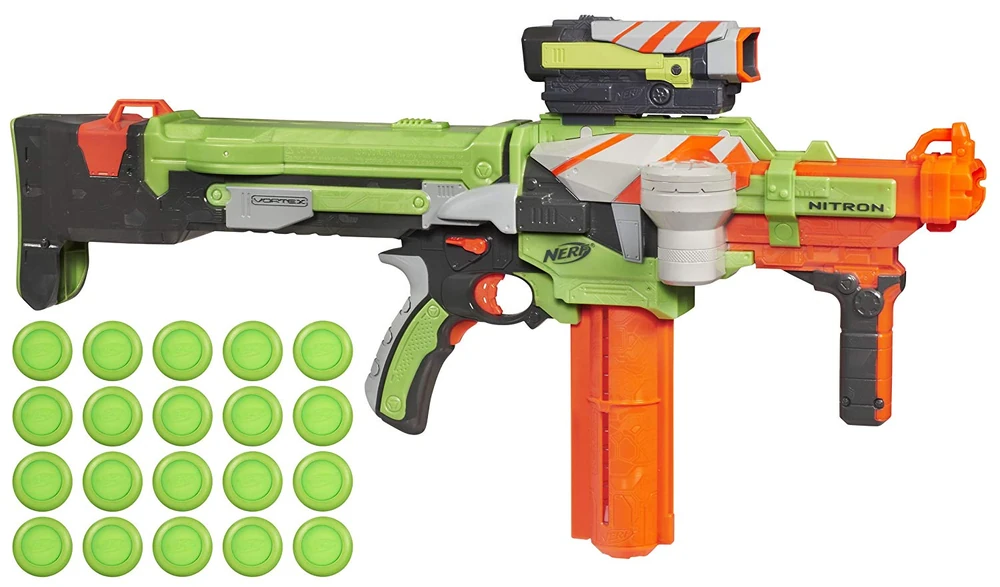
- Nitron, the flagship: battery powered, a 20-disc clip, a scope, and close to 50 feet on a still day.
The Nitron is the one people remember, and the Pyragon is covered separately as the capacity king, doubling the Nitron’s 20 discs.
The line also carried the same tactical rail system as the rest of the range, so N-Strike scopes and accessories fit, which was a sensible decision that the ammunition undercut.
Why Vortex was discontinued
This is the question people actually arrive at this page asking, so here is a straight answer.
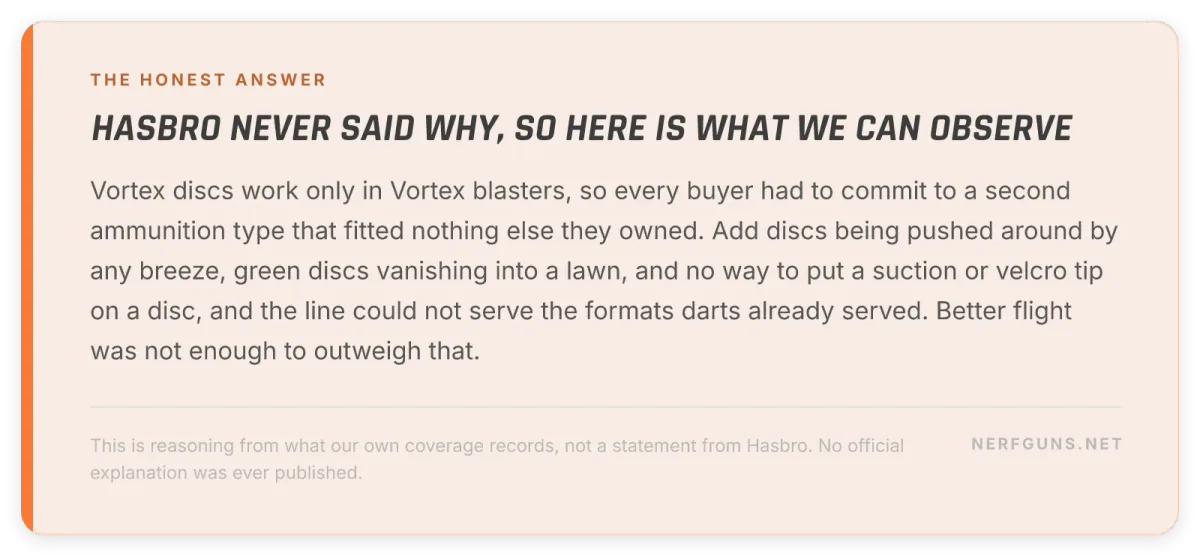
Hasbro never published a reason. Anybody telling you the official explanation is making it up. What we can do is set out the factors our own coverage records, and they are consistent enough to be useful.
1. The ammunition fitted nothing else
This is the big one. A disc works in a Vortex blaster and in nothing else, and a dart does not work in a Vortex blaster at all.
Every other line Hasbro ran shared the dart standard, so buying a second N-Strike blaster cost you nothing in new ammunition. Buying into Vortex meant committing to a parallel ammunition type, a parallel stock of it, and a parallel set of blasters. That is a much larger ask than the price tag suggests.
2. You cannot put a tip on a disc
A dart takes a suction cup or a velcro head without losing any real aerodynamics. A disc cannot, because anything stuck to it ruins the flight that is the entire point.
That closed off whole formats. Target games, scoring games and the tag formats that ran on velcro all needed darts, so Vortex could not replace darts even where it flew better.
3. The practical annoyances compounded
Wind outdoors, discs vanishing in grass, and a drum you could not swap on the biggest blaster. None of those alone would end a line. Together they made owning one more work than owning a dart blaster.
The summary
Vortex was not a failure of engineering. The discs did exactly what they promised, which was fly further and straighter than foam darts.
It was a failure of fit. A better projectile that only works in its own blasters, cannot take a tip, and misbehaves in a breeze is a harder sell than a worse projectile that works with everything you already own. The line existed alongside N-Strike for a few years and then stopped, and every reason we can observe points the same way.
What this page used to predict, and what happened
The original version of this article, written when the line launched, suggested that discs might be the future of foam and that darts could go the way of the ping pong balls Nerf’s earliest blasters used.
That prediction was reasonable at the time and it turned out to be wrong, so it has been removed rather than quietly softened. Darts did not go anywhere. Vortex did.
The reason it is worth recording rather than deleting is that the prediction failed for an instructive reason. It judged the disc on how it flew, which is the thing a reviewer can see in an afternoon. It never asked whether the disc fitted into the range, which is the thing that actually decided the outcome.
Three things called Vortex that are not blasters
Search this topic and Nerf hands you a pile of sports gear, because the name gets reused across the catalogue. None of it fires anything.
- Nerf Vortex Dual Power Pack Foam Footballs. Footballs. You throw them.
- Nerf Vortex Ultra Curve Baseballs. Also a throwing toy, and it belongs on our Nerf baseball drills page rather than this one.
- Franklin Sports Nerf Vortex Mini Aero Howler. A whistling foam rocket for the garden.
They are all Nerf Sports products, and they match the words on this page rather than the subject of it. So none of them are on the list. If it does not fire an XLR disc, it is not one of these blasters.
Discs against darts, honestly
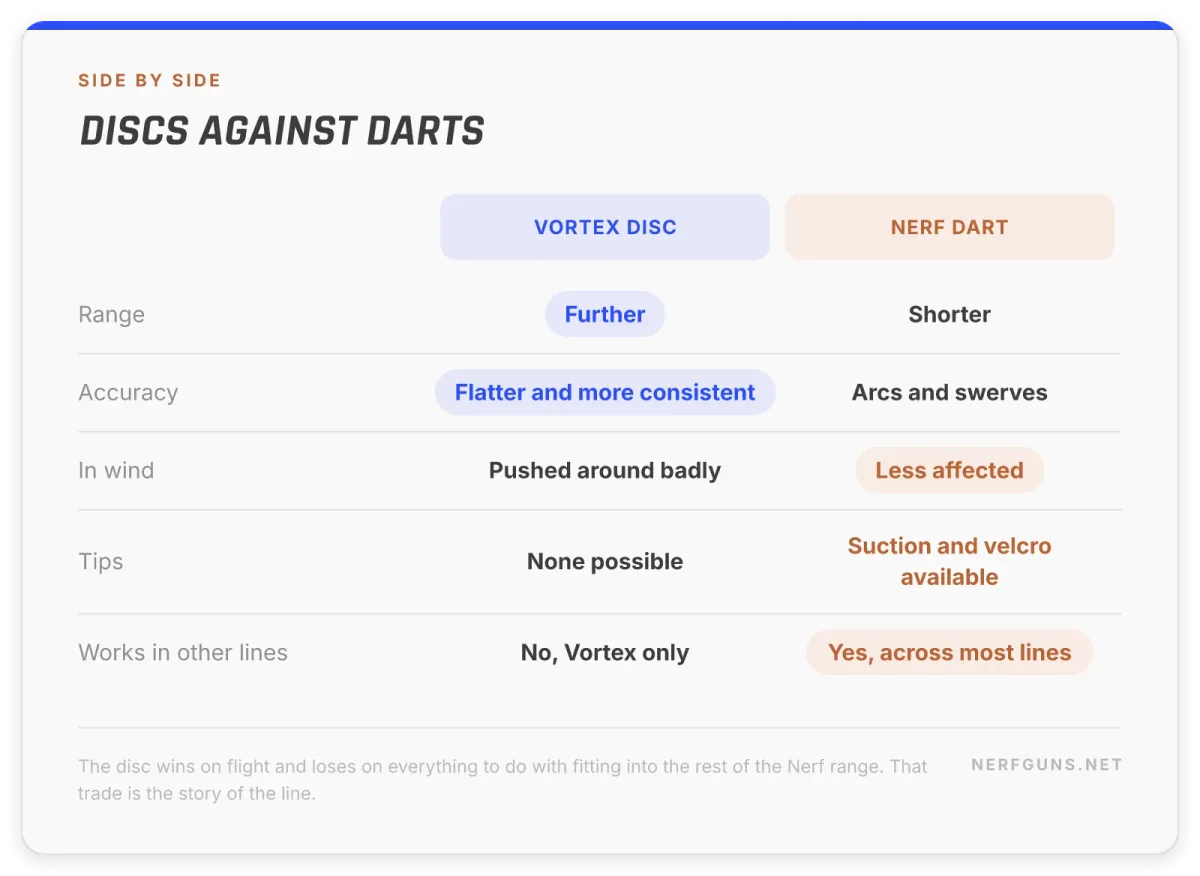
Both sides of this have a real case, and the older version of this page only argued one of them.
Where the disc wins: range and accuracy, and it is not close. A disc flies flatter, holds its line, and gives a small blaster reach that a dart pistol cannot approach.
Where the dart wins: everything to do with fitting in. Darts work across most Nerf lines, they take suction and velcro tips, they are easier to find on the ground, and a breeze barely troubles them.
Plenty of players genuinely preferred the discs, and that preference was never irrational. It just was not enough, and this page originally suggested discs might replace darts entirely. They did not, and it is worth saying so plainly rather than leaving a decade-old prediction standing.
What Vortex left behind
A discontinued line usually leaves nothing. Vortex left three things worth noting, and they explain why people still search for it.
It proved a small blaster could be accurate
Before Vortex, the trade in foam was simple: if you wanted range and accuracy you carried something big. The Proton put both into a pocket blaster, and it did it with physics rather than with a bigger plunger.
Nothing in the dart lines has repeated that, because a dart cannot be made to fly like a disc. It remains the one genuinely distinctive thing the line achieved.
It gave the prop and cosplay crowd a silhouette nobody recognises
Vortex blasters do not look like Nerf blasters. The angular bodies and the green accents read as science fiction rather than as toys, and that makes them a shortcut for anyone building a prop that should not be identifiable.
They also paint well, because the shapes are flat and panelled rather than curved and busy. Our paint series covers prep, primer and clear coat, and the mods guide is the place to start if a costume is the goal.
It is a lesson in why compatibility beats performance
This is the part worth taking to any buying decision, not just this one. The Vortex disc was measurably better at flying than the dart it competed with, and the dart won comprehensively because it fitted into everything.
The same logic decides which blaster you should buy today. A blaster that shares ammunition, clips and accessories with what you already own is worth more to you than a slightly better blaster that shares nothing.
The same bet is on the table again
Here is why this is worth reading in 2026 and not just as history.
Nerf’s N Series blasters, launched in 2024, fire N1 darts. The Nerf Wiki lists N1 as the N Series ammunition, and Amazon’s own listings for those blasters say the darts work only in N1 blasters. The Loadout line runs them too.
That is the same bet, made with a dart instead of a disc. A projectile that flies its own way, in blasters that share ammunition with nothing else on the shelf.
The difference is scale, and it cuts both ways. This line was one family beside a whole range that took the same dart. N1 now sits across two current families. But Blaster Hub’s coverage of the 2026 New York Toy Fair reports that the newer Rebel Ops blasters go back to Elite darts, so the format is not spreading unopposed.
Nobody can tell you yet whether it ends the same way, and anybody who says otherwise is guessing. What this whole story does say is that the question worth asking about any new ammunition is not how well it flies. It is what else it fits.
Playing with discs
If you do end up with a Vortex blaster, a few things make the difference between enjoying it and putting it in a cupboard.
Play indoors, or on a still day
This is the single biggest one. The wind problem is not a minor annoyance, it is the difference between the discs doing what they are supposed to and behaving unpredictably. Indoors, a Vortex blaster is at its best and comfortably out-shoots a dart blaster of the same size.
Do not play on long grass
Green discs on a lawn is the worst combination there is, and you will lose ammunition you cannot replace. A hard surface, a short lawn, or indoors keeps your discs recoverable.
If you have a choice of disc colour, take anything but green for exactly this reason.
Count your discs before and after
It sounds fussy and it is the practical reality of owning a blaster whose ammunition is out of production. Treat discs like a consumable you cannot restock, because that is what they are now.
Expect the curve
Discs curve, and which way depends on the spin the blaster imparts. It is consistent per blaster, so it is learnable, but it is not something you can correct out. Aim off, the same way you would with any projectile that does not fly straight.
Is a Vortex blaster worth buying now
For the right person, yes, with one condition attached.
Buy discs at the same time as the blaster. This is not optional advice. Discs are line-specific, they are no longer in production, and a Vortex blaster with three discs is not a usable blaster. If you cannot source spare discs, do not buy the blaster.
With that settled, the case for owning one is real:
- The sidearms are genuinely good. A disc pistol with real accuracy is a thing no dart blaster of that size manages.
- Nothing has replaced it. There is no current line firing discs, so if you want this experience, the used market is the only route.
- Prices are reasonable for most of the line, because the ammunition problem suppresses demand. The exception is the flagship blasters, which collectors chase.
- Indoor play suits it. The wind problem disappears entirely indoors, which is where the discs are at their best.
If you want a blaster that slots into a kit you already own, this is the wrong line and the N-Strike blasters are the right one.
What to check on a used one
- How many discs come with it. The single most important line in the listing. Count them in the photograph.
- Disc condition. Bent, split or compressed discs fly badly and jam. Discs are consumable and these ones cannot be replaced easily.
- The magazine or clip. Line-specific and not interchangeable with dart clips, so a missing one is a real problem.
- Motors, on the powered blasters. The Nitron is battery powered, so hear it run before paying, exactly as with any motorised blaster from this era.
- The drum, on a Revonix360. It does not detach, so any damage to it is damage to the blaster.
For the full model-by-model detail and the line’s own secondhand checklist, the Vortex hub is the deeper page.
Where to buy
As an Amazon Associate and eBay Partner, we earn from qualifying purchases.
- Vortex disc refills on Amazon, and buy these first, before the blaster. The one that still had a live listing when we checked is the Nerf Vortex VTX Disc Refill , so start there and fall back to the search.
- Vortex Proton listings, the pocket sidearm. It has no Amazon buy box any more, so the eBay search is usually the better route.
- Vortex Praxis listings, the mid-size clip blaster. Same story, no buy box, so try eBay as well.
- Current Vortex Nitron listings, the flagship.
- Safety glasses, which matter here as much as anywhere.
If you would rather buy something in production, our new Nerf guns guide covers what is on shelves, and every blaster we have covered is the full reference.
Bonus tip: put the discs on a list before the blaster. The one rule on this page is that ammunition comes first, and discs are exactly the thing nobody thinks to buy as a present. A free Nerf wish list lets you point family at the refills instead of another blaster you cannot feed.
Frequently asked questions
Why was Nerf Vortex discontinued?
Hasbro never gave a reason. The observable factors are that discs work only in Vortex blasters, cannot take suction or velcro tips, get pushed around by wind, and are easily lost in grass. A better-flying projectile that fits nothing else you own is a hard sell.
Do Vortex discs go further than darts?
Yes. A spinning disc generates lift, so it flies flatter and holds its line where a dart arcs and swerves. That advantage is real and it is the reason the line existed.
How many Vortex blasters were there?
Seven shipped between 2011 and the line’s retirement, starting with the Proton, Vigilon, Praxis and Nitron on 10 September 2011.
Can you still buy Vortex discs?
Only on the secondhand and old-stock market, since the line is out of production. Buy discs at the same time as any blaster, because a Vortex blaster without ammunition cannot be fed from anything else.
Do Vortex blasters take N-Strike attachments?
The line used the same tactical rail system, so N-Strike scopes and accessories fit. The ammunition is the part that does not cross over.
What is the best Vortex blaster?
The Nitron is the flagship, with a 20-disc clip and close to 50 feet on a still day. The Proton is the better demonstration of what the discs do, because a genuinely accurate pocket blaster is more unusual than a big powerful one.
Do Vortex discs hurt more than darts?
The discs are semi-hard foam rubber rather than the soft foam of a dart, and they carry more speed at distance because they hold their flight better. Treat them as firmer than a dart rather than dangerous, and wear eye protection as you would with anything else. The safety rules do not change between the two.
Is Vortex the same as Nerf Rival?
No, and they get confused because both broke away from darts. Rival fires round high-impact rounds and is a separate, much later line. Vortex fired flat discs and predates it. Nothing crosses over between them.
Which Vortex blaster holds the most discs?
Of the seven in the main line, the Revonix360 with its 30-disc drum, though the drum does not detach so you cannot swap it for a fast reload. The Pyragon, covered separately, carries more still at double the Nitron’s 20.
Are Vortex blasters worth buying today?
Yes, if you can get discs with them and you play mostly indoors. No, if you want something that shares ammunition with the rest of your kit, because nothing else takes a disc.

I don’t think they’ll take over the dominant blaster system but they’ll stay for a few years.
There’s not much you can do with disc firing. You can sling it (Proton, Vigilon and Praxis internals) or you can spin it (Nitron) but other than that, there isn’t any unique firing mechanisms like with N-strike.
With that being said, there is a limited range with what can be achieved design wise. Sure you can have rear loading, inbuilt clip and clip system but after that Nerf will be pushed for practical blasters.
With Nerf starting to run out of ideas for the N-Strike line, the vortex system would be a nice tie in if they got rid of the alien asthetics and decided to go N-strike colours. Disagree with me all you like but the vortex ammo in a N-strike gun would be gold. Rethink the sling mechanism, make an accurate disc rifle and Nerf have a true longshot. Find a slam fire catch for the sling mechanism, make a large clip and Nerf have a raider disc style.
Vortex is not the end of foam darts but it might make a nice stable mate like the Dart Tag and Super Soaker line.
Discs will never take on darts. NEVER.
I have founed that discs tend to veer off course, after about 20 feet. Discs also go very slow, and can be blown of course by a wind that would not deter a sstandard dart. It comes down really to wether you prefer range or accuracy, not if you prefer the aesthetics of the darts or the discs. I for one prefer ccuracy. I hope hasbro does not ever convert fully to discs.
Aalso, on a diffrent topic, nerf should bring back the longshot (awesome gun!) and give it a double spring, and a good scope.d
I have been using the praxis for some time now, it has a nearly fifty foot range, and is surprisingly accurate. Also, it DOES NOT JAM. Almost all of the N-strike nerf weapons with a clip or belt jams, this does not, and in the highly rare event that it does it includes a effective way of unjamming, it also can shoot all ten rounds very quickly (slam fire!), and is easy to ricochet off walls to hit your opponent. Darts are to Vortex like paintball is to real bullets. (darts)Unaccurate<Accurate(disks). And BTW, the longshot shoots 35, praxis shoots 50.—-Ben
You forgot the new vortex guns=lumitron, also the new very new one
I think i’ll still use my maverick but with the praxis aswell
cool
I tested a few Vortex blasters and i have to say, that i dont really like all of them! The original blasters with the arrow are a lot better, but thats just my opinion. 😉
I think darts are best, it is easier to retrieve