

Old Nerf darts do not die, they go thin. The foam compresses a little every time you fire it, the seal gets worse, and one day your shots are landing 15 feet short for no reason you can see. You can bring most of them back in about 10 minutes.
This is the heat and moisture method we use at the bench, the test that tells you which darts are worth saving, and the honest limit on how many times it works.
What is on this page
- Why old Nerf darts stop performing
- The 10-second test for a worn dart
- What you need
- The boiling water method, step by step
- Doing a whole tin without ruining it
- A gentler method if you are nervous
- Which Nerf darts respond best
- How many times this works
- Nerf darts that are beyond saving
- How to stop it happening again
- Mistakes that ruin a batch
- Where to buy replacements
- Frequently asked questions
Why old Nerf darts stop performing

A Nerf dart is a foam tube with a weighted tip, and it works by sealing against the inside of the barrel. Air pushes on the back, the seal holds, and the dart goes.
Every shot squeezes that foam a little. Every landing squashes it a bit more. Do that a few hundred times and the tube is measurably thinner than it was.
A thin dart is a bad seal. Air leaks past instead of pushing, so less of what your blaster produces reaches the dart.
Here is the part that matters: range goes first. Old Nerf darts will still fire and still feel fine in your hand while quietly costing you a third of your distance. Nothing about the dart looks broken.
The good news is that the foam has not lost anything. It has been compressed, and compressed foam can be persuaded to expand again.
The 10-second test for a worn dart
Do not guess, and do not reshape a whole box on principle. Test first.
Load the Nerf dart into the muzzle of a front-loading blaster. A Maverick or any blaster you load through the front works. Push it in with a finger.
A healthy dart resists. It should go in with a light, definite push and feel snug the whole way, like it is doing something.
A worn dart drops. If it slides in with no resistance, or falls in under its own weight, the foam is thin and that dart is your candidate.
Sort your Nerf darts into 2 piles as you go. The snug pile goes back in the tin. The loose pile is what you are about to fix.
Test 5 or 6 from a batch rather than all of them. Nerf darts from the same pack wear at about the same rate, so a sample tells you what the batch is doing.
What you need
- A pot of water and a stovetop.
- Metal tongs. Not your fingers, and not plastic tongs that will soften.
- A colander or a paper bag to dry the darts in without squashing them.
- A towel under everything, because wet darts roll.
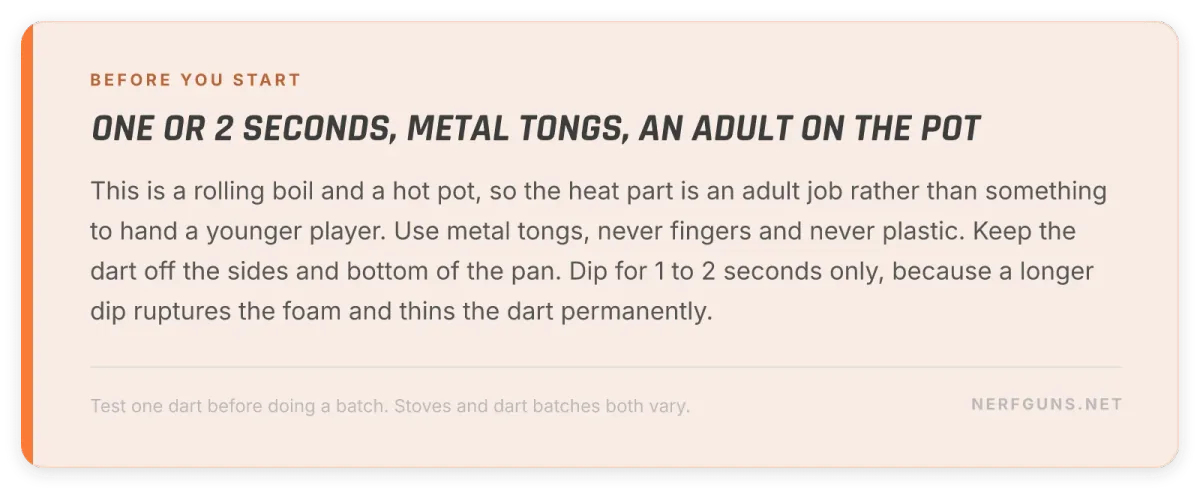
- An adult doing the hot water part. This is a boiling pot and a job worth 10 minutes of supervision, not a task to hand a younger player.
Reshaping Nerf darts needs no thermometer, no mould, or anything sold specifically for this. Every attachment marketed as a dart restorer is doing what a pot of water does.
The boiling water method, step by step
The whole thing rests on one behaviour: the foam expands when it is heated and holds the new shape as it cools. That is it. Everything below is about not overdoing it.
Step 1. Separate the worn Nerf darts. Use the test above. Reshaping a dart that did not need it wastes one of its remaining lives.
Step 2. Bring the water to a boil. A full rolling boil, not a simmer. You want the dart in and out quickly rather than soaking at a lower temperature.
Step 3. Dip one of the Nerf darts, for 1 or 2 seconds only. This is the whole technique and the only place it goes wrong. Hold it with the tongs, in, out. Count it out loud if that helps.
Longer is not better and it is not neutral. Leave a dart in and the foam expands past its structure, the cells rupture, and you get a dart that is permanently thin and useless. That failure is not reversible.
Step 4. Keep it off the pot. Do not let the dart touch the side or the bottom. Direct contact with hot metal melts the foam.
Step 5. Dry it without squeezing it. Straight into the colander or paper bag. Do not grip a hot dart, do not stack them, and do not roll them in a towel. Warm foam takes the shape of whatever you press it into.
Step 6. Wait until they are completely dry. Damp foam swells and swollen darts jam, so a dart that feels perfect and is still wet will misbehave in a clip.
Step 7. Retest. The same muzzle test you used to sort the Nerf darts. A reshaped dart should feel snug again. If it does not, that one is finished.
Do one dart before you do 30 Nerf darts. Batches vary and this costs you a single dart to find out.
Doing a whole tin without ruining it
Once the single-dart test has worked, the batch is a production line rather than a craft project. Set it up before you turn the heat on.
Lay out 3 stations. The worn pile on the left, the pot in the middle, the colander on the right. Every dart moves one way and you never have to think about which pile it came from.
Work in tens. Ten Nerf darts in, ten drying, then stop and check that batch before starting the next. If the timing has drifted you have lost 10 darts rather than 60.
Keep the count out loud. One and out. The moment you start chatting is the moment a dart spends 6 seconds in the water.
Give them longer to dry than you think. An hour in a colander in a warm room is a reasonable minimum, and overnight is better. This is where people undo good work, because a batch that feels dry on the outside can still be damp in the core.
A gentler method if you are nervous
If a boiling pot is not something you want in the room, there is a slower version that trades speed for margin.
Hot tap water, several minutes, in a bowl. Fill a bowl from the hot tap, drop the Nerf darts in, leave them a few minutes, then dry exactly as above. It recovers less than the boil and it is much harder to overdo.
Steam over a pan. Hold the Nerf darts in a colander over simmering water for a minute or 2. Slower again, and the foam never touches liquid water, so drying is quicker.
Neither gets a badly compressed dart back the way a proper dip does. Both are a reasonable first attempt when the batch is only slightly soft, and neither will destroy anything.
Which Nerf darts respond best
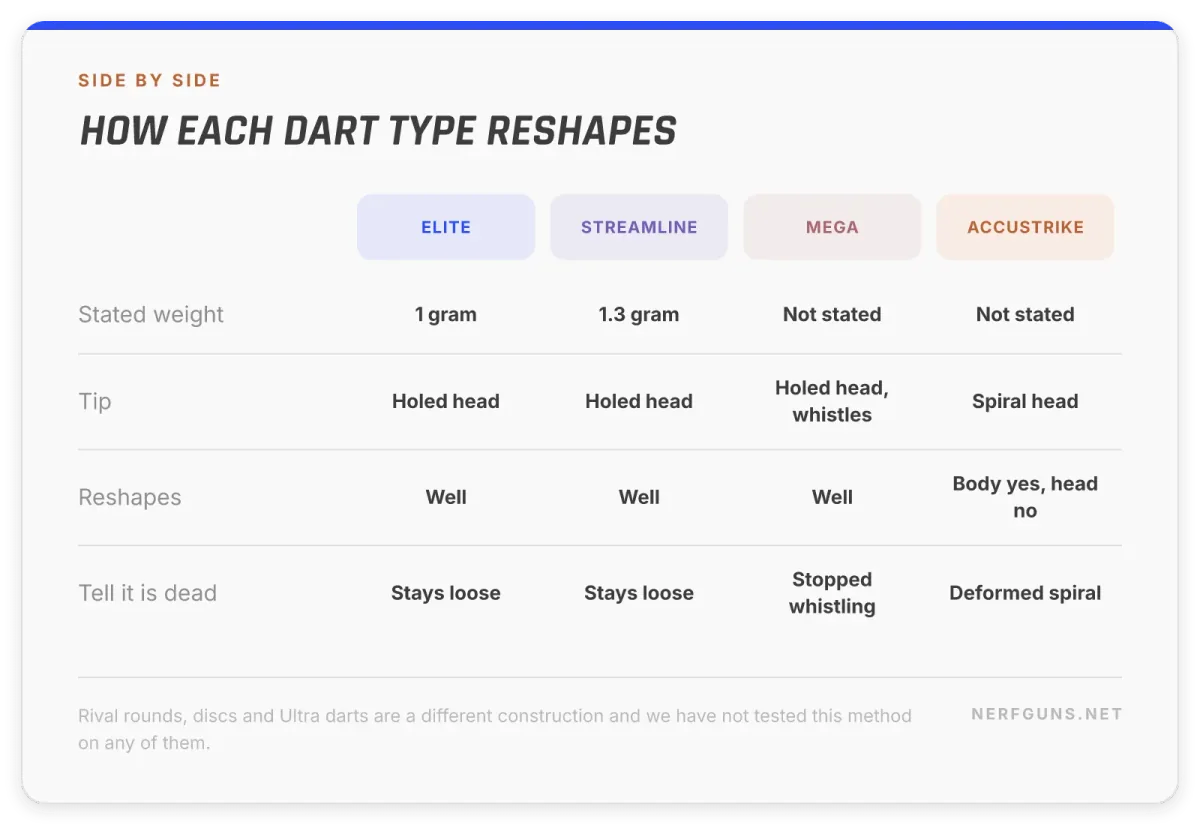
Not every dart in your tin is the same object, and the differences matter here.
Elite darts are the default, orange and blue, 1 gram, with a short tip plug. They are what most of this hobby fires and they reshape well, which is convenient because they are also the ones you own most of.
Streamline darts are the older type at 1.3 grams. That extra 0.3 of a gram is most of the reason Elite darts fly further from the same blaster. Old Streamlines reshape fine. They are still slower afterwards.
Mega darts are the big whistling ones. More foam means more to compress and more to recover. The whistle is a free diagnostic too: a Mega dart that has stopped whistling has a damaged body, not a soft one.
AccuStrike darts have a spiral head and lean on drag rather than balance. The body reshapes like any other foam, but a deformed spiral head is a dead dart, because the head is doing the work.
Suction darts have a solid tip and no hole, which is why they fly straighter than a standard Elite. They reshape normally. Check the suction cup has not perished, because that is the part that fails first.
N1 darts are the newest type and the one we get asked about. They are the ammunition for Nerf’s N Series and Loadout blasters, and Amazon’s own refill listing says they are compatible only with N Series blasters, so an N1 blaster cannot fall back on the Elite darts in your cupboard.
? Does the method work on them? We do not know, and we are not going to guess. The N1 head is a different shape from an Elite tip, flatter and wider, which is exactly the kind of difference that could matter. We went looking for somebody who had actually tested it and found nothing worth citing: the searches returned this page, some listings, and a general “it should work on any foam” from a site that never mentions N1.
“Should work” is not a test. So the honest position is that everything on this page is documented on Elite-style foam, we have not confirmed it on N1, and if you try it, try it on one dart you can afford to lose.
Rival rounds, discs and Ultra darts are a different construction and we have not put any of them through this, so we are not going to tell you what happens.
How many times this works
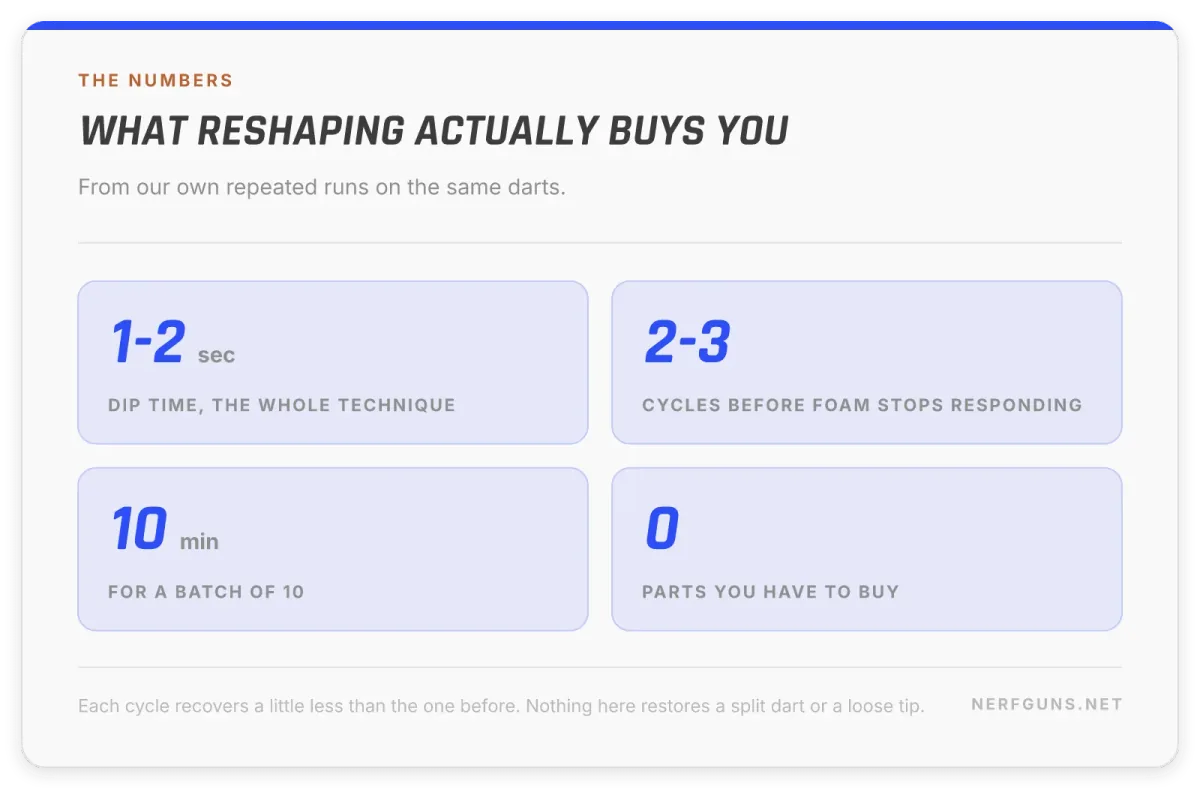
Two or 3 times per dart, in our experience, and then the foam stops responding. That is the realistic ceiling on reviving old Nerf darts.
Each cycle recovers slightly less than the one before. The first reshape on a well-worn dart is dramatic, the second is useful, and the third is usually the last one worth the water.
What you are buying is time, not immortality. Roughly speaking you are getting 2 or 3 extra lifespans out of a set of Nerf darts, which turns one refill pack into the equivalent of several.
That is the honest pitch. Anybody telling you a dart can be restored indefinitely has not run the same dart through it 4 times.
Nerf darts that are beyond saving
Some Nerf darts are damaged rather than compressed, and heat does nothing for any of it.
- A split down the side. The seal is gone permanently. Bin it.
- A loose or missing tip. The weight is what makes the dart fly nose first. Glue is a temporary fix that usually ends up in a blaster’s mechanism.
- A permanent bend. A dart bent in storage may straighten, but one creased by a mechanism has a damaged internal structure.
- A dart already reshaped 3 times. Track this if you can. A dart that comes out of the water still loose is finished.
- Anything that has been chewed. Dogs love foam darts. Whatever the dog gives back is not a dart.
Throw the dead ones out rather than leaving them mixed in. One thin dart in a clip is a jam, and a jam mid game is worse than being 4 darts short.
How to stop it happening again
Most of the wear on old Nerf darts was avoidable, and 5 habits prevent nearly all of it.
Do not store Nerf darts compressed. Foam takes a set. Darts left loaded in a clip for a month come out with a flat spot that no amount of hot water fully removes.
Unload clips and drums after a game. This is the single biggest thing you can do, and it costs 30 seconds.
Store them dry. Damp foam swells and swollen darts jam. A garage in winter is a worse home for darts than a cupboard indoors.
Keep your Nerf darts out of direct sun. The same heat response that lets you reshape a dart also works slowly on a windowsill, without the control.
Rotate your stock. Fire from the whole pile rather than the same handful, so wear spreads evenly instead of destroying your 20 favourites.
Our dart and ammo guide covers the 7 ammunition types and how to spot counterfeit foam, which wears out faster than the real thing and takes your priming mechanism with it.
Mistakes that ruin a batch
Dipping for 5 seconds instead of 2. The single most common way people destroy a batch of Nerf darts. There is no benefit to a longer dip and the damage is permanent.
Doing 30 Nerf darts at once on the first attempt. Test one. Batches differ, and so does your stove.
Squeezing them while hot. Warm foam deforms under any pressure at all, which is the whole reason this works, and the reason a towel-dry undoes the job.
Loading them wet. Damp Nerf darts swell and jam. Wait for completely dry, not nearly dry.
Reshaping Nerf darts that did not need it. Each dart only has a couple of cycles in it, so spending one on a healthy dart is a waste.
Trying it on foam that is not a dart. Rival rounds, discs and Ultra darts are built differently, and we have not tested this method on any of them.
Where to buy replacements
As an Amazon Associate I earn from qualifying purchases.
Reshaping buys you time. Eventually you buy new Nerf darts, and buying official refills matters more than people think, because counterfeit foam jams and wears out priming mechanisms.
- Nerf Elite dart refills on Amazon, the default ammunition for most blasters.
- Mega dart refills, for the oversized whistling darts.
- AccuStrike refills, the spiral-head darts from 2017.
Check for the Nerf logo on the dart itself, and remember that a Mega dart that does not whistle is not a Mega dart. Our guide to where to buy covers which sources are worth using for bulk foam.
Bonus tip: foam is the gift nobody thinks of. A tin of fresh darts beats another blaster for almost everybody, and it is the one thing every player runs out of. Put a big refill on a free Nerf wish list alongside whatever else you want, because reshaping old Nerf darts buys you time and not an infinite supply.
Frequently asked questions
How do you fix old Nerf darts?
Dip each one in boiling water for 1 to 2 seconds using metal tongs, then dry it in a colander without squeezing it. The heat expands the compressed foam and it holds the recovered shape once cool.
How many times can you reshape the same dart?
Two or 3 times, and each cycle recovers a little less than the last. A dart that comes out of the water still loose in the barrel has reached the end of its life.
Does this make old Nerf darts more accurate?
It restores the seal, which mostly returns lost range. Accuracy improves as a side effect, because a dart that leaves the barrel properly is more consistent than one that wobbles out on leaking air.
Will boiling water damage the tip?
Not in 2 seconds. What damages tips is a long soak, contact with the pot, or an already loose tip that the water finishes off. If a tip is loose before you start, that dart is finished anyway.
Can I use a microwave or a hair dryer instead?
We would not. Both heat unevenly, and uneven heating is exactly what ruptures the foam cells and thins a dart permanently. Water spreads heat evenly, which is the whole reason it works.
Does this work on Mega, AccuStrike and Suction darts?
It works on standard foam darts, which covers Elite, Streamline, Mega, AccuStrike and Suction. We have not tested it on Rival rounds, discs or Ultra darts, and we are not going to claim results we have not seen.
How do I know if a dart is worn?
Push it into the muzzle of a front-loading blaster. A good dart feels snug the whole way. A worn one slides in loose or drops in under its own weight, and that looseness is the leak costing you range.
Why do my Nerf darts keep going soft so fast?
Usually storage. Darts left loaded in a clip take a set in the foam, and damp storage swells them. Unload your clips after every game and keep the foam somewhere dry and out of the sun.
Is it cheaper to just buy new darts?
Reshaping costs a pot of water and 10 minutes, so it wins on cost every time. The real reason to buy new is that reshaped foam has a ceiling, and a serious game wants darts that have not been through the cycle 3 times.
What else should I read?
Our dart buying guide for which refills to buy, and the mods hub if you want to know why better darts are the first upgrade any modder should make.
It’s Nerf or Nothin’!


Any tip that saves me money is welcome, thank you. I would not have thought about reshaping them by placing in boiling water.
I’ll always have to replace the ones that go missing in the garden so being able to mend the ones we do keep hold of helps very much.
I would put them in a bag that you would give to somebody for their B-Day! I would find any darts that I find need to be revived and stick them in the bag. You want to take a hairdryer and put your darts and the hairdryer into the bag, but make sure there’s room for air to escape! Then go ahead to about a medium/hotish heat for about 45 seconds! They should expand, and operate better!