

The Rayven CS-18 is the flywheel blaster that got the balance right: 18 darts, a compact body, glow-in-the-dark everything, and four AA batteries doing all the work. We have run one for years. Here is what it is genuinely good at, and the one thing that will annoy you.
What is on this page
- The short verdict
- What comes in the box
- Where the Rayven came from
- How the flywheel works
- The glow, and night games
- The 18-dart clip and the reload
- Batteries, and what they cost you
- Range and accuracy, honestly
- Barrel extensions, and the one that works
- Size, jams and build
- Who this blaster is for
- Mod potential
- Buying one used
- What to buy now that it is gone
- Where to buy
- Frequently asked questions
The short verdict
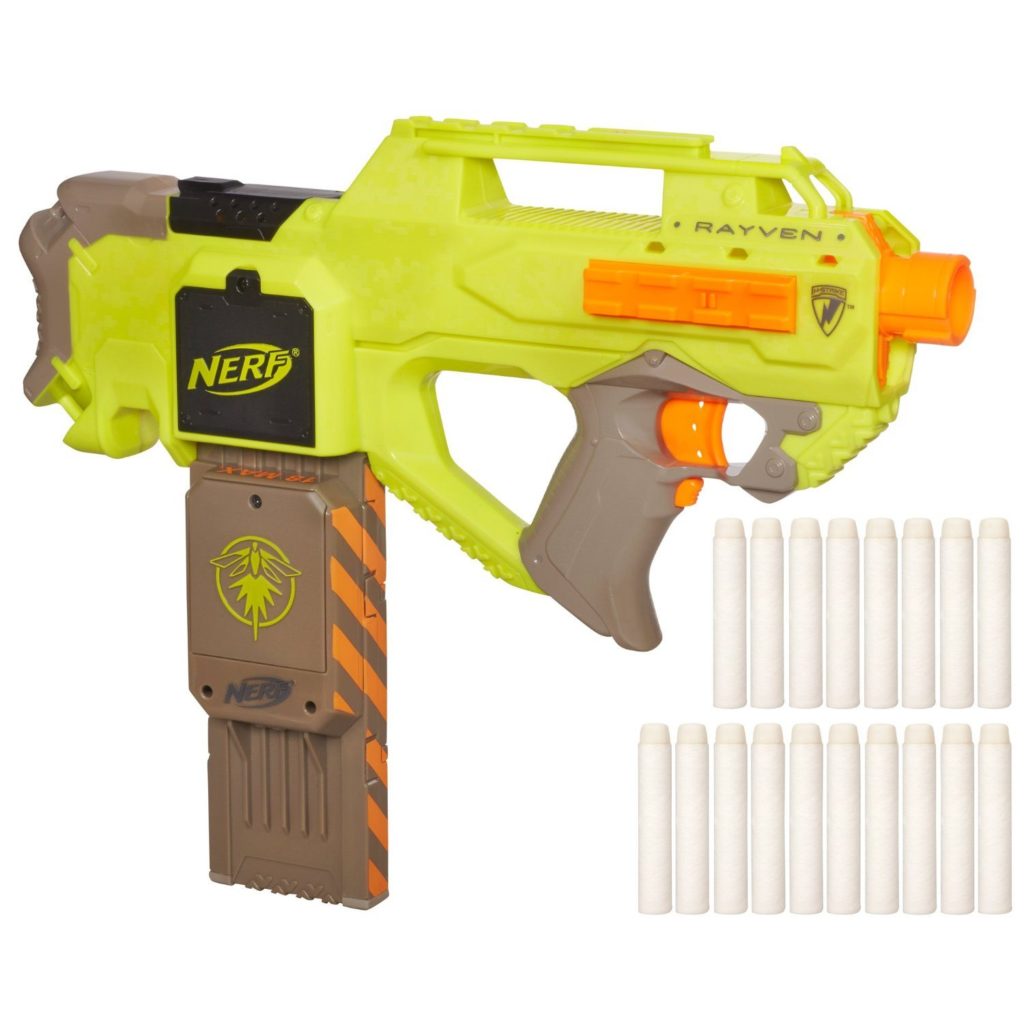
- It is small for what it holds. Eighteen darts in a body you can carry all day is the whole argument for this blaster.
- The clip sits behind the grip, which is why it is compact, and it is the design decision that makes the Rayven what it is.
- It glows. Shell, clip and darts, and it is not a gimmick if you play after dark.
- Semi-automatic on a flywheel. Rate of fire is your trigger finger, once the motors are up.
- Four AA batteries, and no batteries means no blaster. This is the trade.
Buy it if you want a fast, light, high-capacity primary and you do not mind feeding it cells. Skip it if you want something that always works with nothing in it, because a flat Rayven does nothing at all.
What comes in the box
The Rayven shipped with the blaster, an 18-dart curved clip, and a set of glow-in-the-dark darts.
The shell is the glow-in-the-dark green that the blaster is known for, with an integrated stock, two tactical rails and sling points top and bottom.
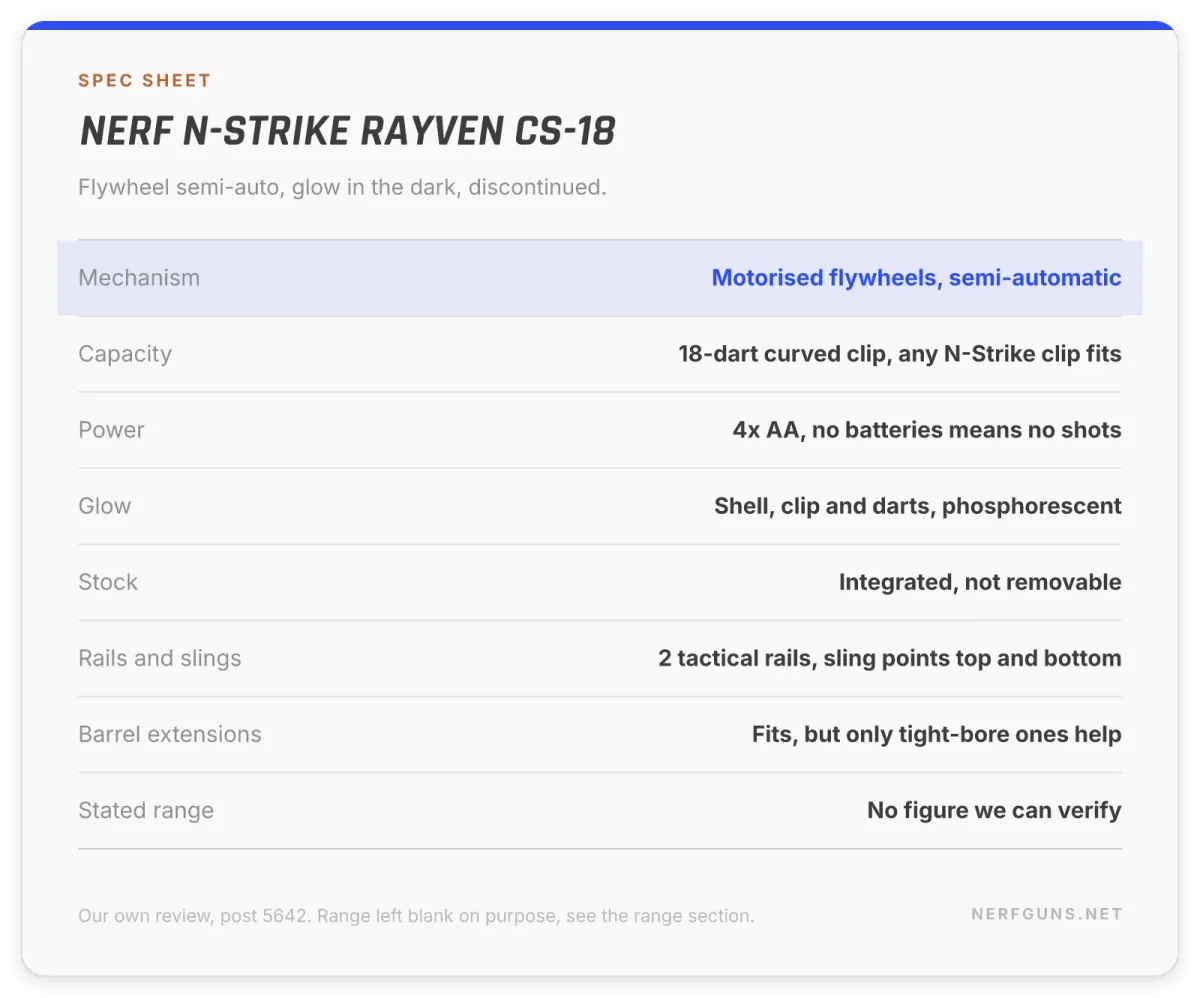
The clip and the darts glow too, which matters more than it sounds. A dropped clip in a dark garden is findable and a dropped clip in a dark garden that glows is trivially findable.
It takes any N-Strike clip. The 6 and 12 dart clips fit, and the drum magazines from other blasters seat correctly, so anything you already own works here.
Where the Rayven came from
The Rayven belongs to the stretch when Hasbro was still working out what a motorised blaster should be. It is one of the few designs that got it right first time.
Flywheel blasters were still new then. The line had spent years on springs, plungers and pump grips. A blaster that fired as fast as you could pull the trigger was a real change, not a variation.
What made the Rayven stand out was restraint. It did not try to be the biggest thing on the shelf. It took the new mechanism, wrapped it in the smallest sensible body, and moved the clip behind the grip so the body could stay small.
Our old copy called it “perhaps the pinnacle of Nerf dart blasters right now”. That was a big claim in its year, and a stale one every year since. It is gone.
The old page also compared the Rayven to two named real handguns. That framing does not belong on a site about foam blasters and it has been removed rather than reworded.
What survives the decade is the shape of the idea. Compact, high capacity, semi-automatic, and light enough to carry all game. Every good flywheel blaster since has been some version of that sentence.
How the flywheel works
Pull the acceleration trigger and two motorised wheels spin up. Pull the main trigger and a pusher shoves a dart between them, and the wheels throw it out of the barrel.
That is the whole mechanism and it has two consequences worth understanding before you buy.
The first is that there is no priming. Once the wheels are spinning, every trigger pull is a shot. You are not working a bolt, a pump or a slide, and your rate of fire is limited only by your finger.
The second is spin-up time. There is a short delay between squeezing the acceleration trigger and the wheels reaching speed, and firing before then throws a dart out slowly and badly.
The practical habit is to rev before you need to shoot rather than at the moment you decide to. That is a learned reflex and it takes about one game to acquire.
The glow, and night games

The glow is the Rayven’s signature and it is genuinely functional rather than decorative.
Charge the shell and the darts under a bright light for a minute or two and they will glow for a useful stretch afterwards. It is phosphorescence, not electronics, so there is nothing to switch on and nothing extra to power.
Firing a dozen glowing darts in the dark is the single best thing this blaster does. It is why the Rayven turns up in every conversation about night games.
There is a tactical cost and it is obvious once you say it. A blaster that glows is a blaster that shows the other team where you are.
So it cuts both ways: brilliant for a garden game with friends, a liability in anything competitive after dark. Our stealth blaster roundup covers the other end of that trade.
The 18-dart clip and the reload
The clip loads into the rear of the blaster, behind the pistol grip, rather than in front of the trigger.
That is unusual and it is the reason the Rayven is as short as it is. The magazine occupies space inside the stock instead of hanging under the middle of the blaster.
The 18-dart curved clip is the sweet spot. Eighteen darts is enough to fight with and the clip is still short enough not to foul on anything when you go prone.
Reloading is a clip swap and it is fast. The release is under the rear of the blaster and it is reachable without changing your grip much.
Here is the catch. Because the clip is behind the grip, a fresh clip goes in behind your own hand, which is a slightly awkward motion the first few times. It becomes automatic quickly.
Batteries, and what they cost you
The Rayven takes four AA batteries and they run the flywheels.
This is the honest cost of the whole design. A spring blaster works forever and works cold. A flywheel blaster works brilliantly until it does not.
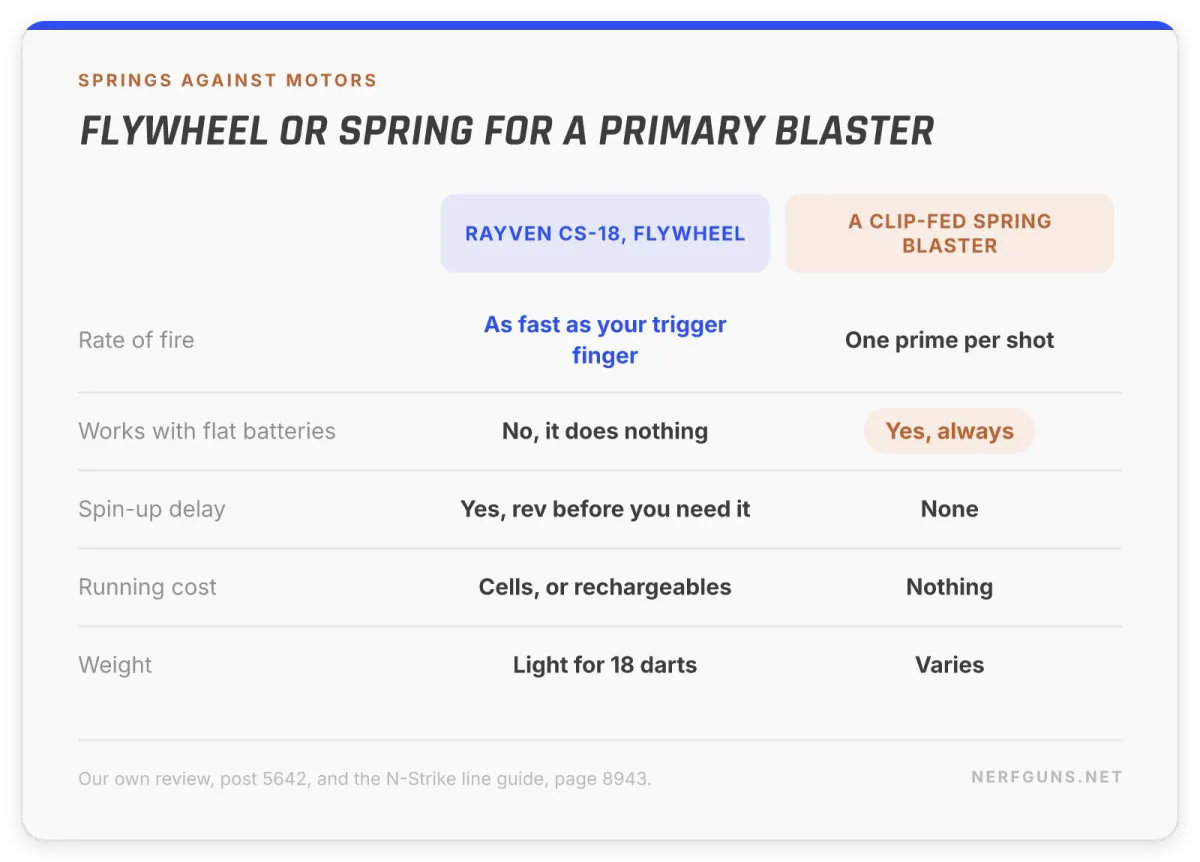
Tired cells do not stop the blaster, they slow the wheels. That is worse than a clean failure, because performance drops off gradually and you will blame the darts before you blame the batteries.
Rechargeable AA cells are the sensible answer and they suit this blaster particularly well, because a flywheel draws hard in short bursts.
Our battery runtime calculator will tell you how many packs a game actually needs. That beats guessing, and it beats hauling a bag of spares you never open.
Range and accuracy, honestly
Our old copy for this page claimed “accuracy up to forty feed, but closer to twenty five or thirty on most days”.
Beyond the typo, that number was never a measurement. We have no chronograph run on file for the Rayven, so we are not going to restate it as though it were.
What we can tell you honestly is comparative and it is useful. The Rayven is a pre-Elite N-Strike flywheel blaster, so it belongs in the same conversation as its own generation rather than against a current blaster.
Flywheel accuracy is also its own subject. A dart fired between two wheels picks up spin from whichever wheel grips it harder, and small differences there matter more than anything about the barrel.
The practical version: the Rayven is a mid-range blaster that puts a lot of darts into a general area quickly. It is not a precision instrument and it was never sold as one.
Barrel extensions, and the one that works
The Rayven takes standard N-Strike barrel extensions. This next bit is the one piece of advice from our old page worth keeping.
Most extensions are wider inside than the dart. So the dart bounces down the tube on the way out, and it comes out slower and less straight than it went in.
The extensions that work are the ones whose bore actually fits the dart. On this blaster the Spectre barrel and the Longstrike barrel are the two our archive has always pointed at.
Test yours both ways in a garden. Ten minutes of that beats any number anybody can quote you, including us.
And remember what an extension is for. It adds length and mounting points, not power, and a flywheel blaster gets none of its speed from the barrel.
Size, jams and build
The Rayven is compact for an 18-dart blaster and that is the headline. The rear-mounted clip buys you a body that handles like something much smaller.
The stock is integrated rather than removable, so the length you see is the length you get, and it is short enough to swing indoors.
Jams are rare and clearing them is easy. There is a hinged jam door on top, the same arrangement as the Recon CS-6, and it opens without tools.
What causes jams on any flywheel blaster is tired darts. A dart with a soft, deformed head does not get gripped cleanly, and that is a dart problem rather than a blaster problem.
Sling points top and bottom mean it hangs properly on a strap, which suits a blaster you are meant to keep with you.
Who this blaster is for
This is a good first serious blaster. It is also a good permanent primary. Those are two different recommendations that happen to land on the same object.
For a beginner: no priming to learn, high capacity so mistakes are cheap, and light enough not to become a chore. That combination is rare.
For an experienced player: it is the compact high-capacity option, and it pairs naturally with something spring powered that keeps working when the cells die.
Our old page called it “probably the very best gun to pickup if you’re a beginner”. That is close to right, and we would soften it slightly. The Rayven is one of the best. The batteries are the only reason it is not simply the best.
For where it sits in the wider family, see the N-Strike Elite guide and the rest of the N-Strike line.
There is one group it does not suit, and it is worth naming. If you play in the cold, outdoors, for hours, a flywheel blaster is the wrong tool. Alkaline cells lose output as the temperature drops and you will spend the game wondering why your blaster got worse.
The same goes for anybody who plays rarely. Leave a blaster in a cupboard for 6 months with cells in it and you get corroded contacts. That is how most dead Rayvens died.
Take the cells out between games. It is the single habit that keeps one of these working for a decade, and almost nobody does it.
Mod potential
Flywheel blasters are a different modding world from spring blasters and the Rayven sits at the friendly end of it.
The usual work is electrical rather than mechanical: better cells, better wiring, better switches. None of that requires cutting anything.
The warning that belongs here is a real one. Push more voltage through motors built for 4 AA cells and you burn motors out. You also get hot batteries. Lithium packs in particular deserve respect rather than enthusiasm.
Our LiPo safety checklist exists precisely for that, and the mod guide covers the sensible progression.
Buying one used
The Rayven is discontinued, so this is a used purchase, and an electronic blaster carries risks a spring blaster does not.
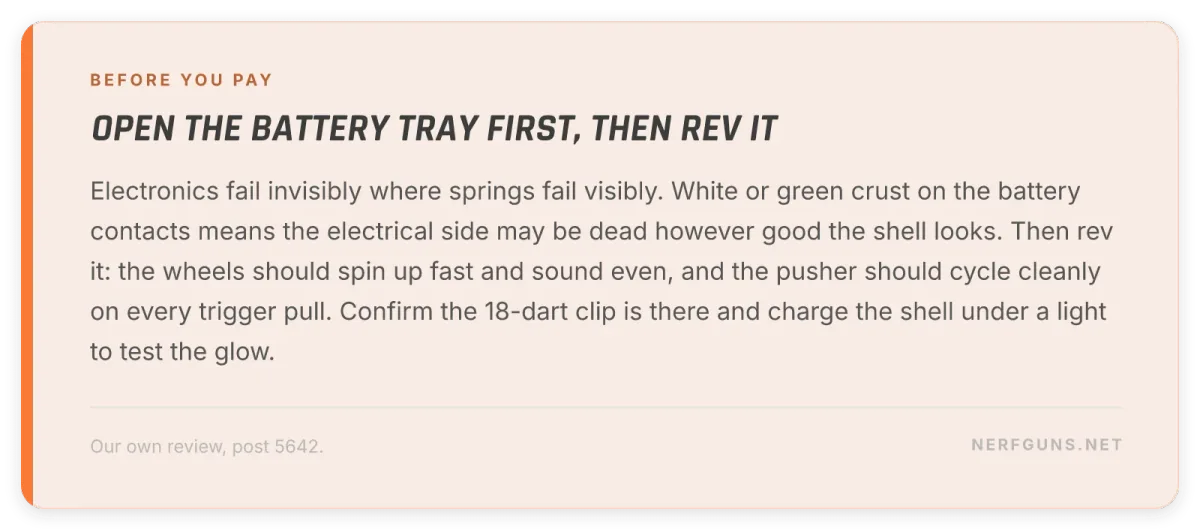
Open the battery tray first, before anything else. Old toys sat in garages with cells left in them, and leaked batteries corrode the contacts. White or green crust means the electrical side may be dead however good the shell looks.
Then rev it. The wheels should spin up fast and sound even. A rattle or a wobble is a motor or a wheel, and neither is a quick fix.
Confirm the 18-dart clip is included, and check the glow still works by charging it under a light for a minute.
The glow is worth testing rather than assuming. Phosphorescent plastic fades after years of sunlight. A Rayven that has lived on a windowsill will not light up the way a boxed one does.
Ask whether it has been rewired. This is one of the most modified blasters of its generation. A rewired Rayven with an unknown battery setup is a different purchase from a stock one.
Finally, listen to the pusher as well as the wheels. It should cycle cleanly on each trigger pull, and a pusher that hesitates is a jam waiting for a game.
What is not worth worrying about
Scuffs and a faded orange tip affect nothing. Neither does a missing sling, which is not something that came in the box anyway.
The Rayven is gone, so what do you buy now?
The Rayven CS-18 is discontinued. Every one is used or old stock.
This is the easiest swap on the whole site. The Rayven is a motorized blaster that feeds from an 18-dart clip. The Nerf Loadout Galactic Commander  is a motorized blaster that feeds from an 18-dart clip. Same number, same idea, 15 years apart.
It goes further than the Rayven did in two places:
- Two clips in the box, not one. Nerf’s listing says to load your primary clip and keep the spare in the stock. That is the reload the Rayven always made you buy separately.
- 3 firing modes, one of which is full auto. A Rayven is semi-auto only, so your rate of fire was always your trigger finger.
It also ships with 48 darts, and Hasbro rates it 8+.
Now the two things you lose, and one of them will sting.
- The glow. Nerf’s listings do not mention glow-in-the-dark plastic anywhere in this line, so do not count on it. If night games are the reason you loved a Rayven, that reason has no current replacement, and a used Rayven is still the answer.
- Your clips and darts. The Galactic Commander fires N1 darts, and Nerf says N1 works only in N Series blasters. Your N-Strike 18-dart clips will not seat and your foam will not feed, so budget for N1 darts
 .
.
One thing does carry over, and it is the important one. A motor still needs power, and tired cells still slow the wheels without stopping them. Buy rechargeables and take them out between games, exactly as you should have been doing with the Rayven.
Bonus tip: nobody ever guesses the right blaster. Put the one you actually want on a free wish list, then send the link to whoever keeps asking what you want for your birthday. Start your free Nerf wish list and let them buy the right thing.
Where to buy
As an Amazon Associate and eBay Partner, we earn from qualifying purchases.
The Rayven CS-18 has been discontinued, so listings are the used market. We have not verified stock at the time of writing, so treat the links below as searches. For a blaster on shelves that does the same job, see the section above: the Loadout Galactic Commander is motorized and feeds from an 18-dart clip, the same as this one.
- Nerf N-Strike Rayven CS-18 listings on Amazon
- N-Strike 18-dart clips on Amazon
- Glow in the dark Nerf darts on Amazon
- Used Rayven CS-18 listings on eBay, usually the better hunting ground for a discontinued blaster, and the photos show whether the glow clip is included.
Frequently asked questions
Does the Nerf Rayven need batteries?
Yes, four AA cells, and it does nothing without them. The flywheels are the entire firing mechanism, so a flat Rayven will not fire at all.
How many darts does the Rayven hold?
Eighteen, in the curved clip it ships with. Any N-Strike clip fits, including 6 and 12 dart clips and drum magazines.
Does the Rayven really glow in the dark?
Yes. The shell, the clip and the included darts are phosphorescent, so they charge under a bright light and glow afterwards. There is nothing to switch on and nothing extra to power.
Is the Rayven fully automatic?
No, it is semi-automatic. Hold the acceleration trigger to spin the wheels, then one dart leaves per pull of the main trigger.
Why does my Rayven shoot weakly?
Check the batteries first, because tired cells slow the flywheels without stopping them. After that, check your darts, since a deformed head does not get gripped cleanly.
What barrel extension should I use on a Rayven?
The Spectre or the Longstrike barrel, which is the advice this site has carried for years. Wider extensions let the dart bounce down the inside and cost you both range and accuracy.
Is there a modern version of the Rayven?
Yes, and it is a close one. The Loadout Galactic Commander is motorized and feeds from an 18-dart clip, the same as the Rayven, and it comes with two clips plus 3 firing modes including full auto. What it does not do is glow. Nerf’s listings say nothing about glow-in-the-dark plastic, so a used Rayven is still the answer for night games. It also fires N1 darts, so your old clips will not fit it.
Is the Rayven good for a Nerf war?
Yes, and it is one of the better primaries of its generation. Carry something spring powered as a backup so that a dead battery does not end your game.
Rayven or Stryfe?
Both are compact flywheel blasters and both are good. The Rayven glows and has the rear-mounted clip that keeps it short. Choose on which body suits your hands, because the mechanism is the same idea either way.
It’s Nerf or Nothin’!


looks cool!!!!!!!!!!!!!!!!!!
Do you know when it is in stores? i cant find it on the internet or stores
it is in stores overseas, australia and singapore I believe. Hasn’t reached the U.S. yet, but should this spring.
I am holding one in my hands, right now, in a target in california. Found this site checking for a review.
hope it will reach the UK soon realy want to get it and does not look 2 expensive. i have been looking for a aasault rifle sort of gun for ages and this is it it’s perfect 🙂
looks cool !!!!!!!!!!!!!!!!!!!!!!!!!!!!!!!!!!!!!!!!!
how many
ATTN: NERF! WTF is up with all the vomit green guns?! at least the “caution sign” yellow had a kind of industrial look to it, but green? You mess up a really good looking gun like the vortex lineup, and then continue it here? Seriously, wth is up? If a cop is stupid enough to mistake a nerf gun for an automatic rifle, odds are it’s color isn’t going to matter.
I mean, heck. With the internet how it is today, why not just give us a choice to go online @nerf and order our gear in the color cocktail we want, from gear up’s black and orange, to white out. Charge more for it, don’t care, it’s cheaper and easier then having to dismantle it and get spray paint to fix your color blindness. Heck, you can even make a business model off of it.
I know, I know.. shutting up now. Still Nice looking gun, bum ugly color. *marches off*…. *marches back* NERF! ALSO!. Learn how to use compressed air canisters! If you can fire BBs and paint balls with compressed air, you can sure as heck fire foam darts. And it won’t have to make electrical whines from compressors, spinning wheels, or electric pump actions that fire most of your semi/full autos. Also. Firefly vortex blasters. Make it happen. SRSLY. Now I’m done.
I was just wondering how loud it is. I have the barricade, and it’s fairly noisy.
love the color pretty sweet looking does the clip really make the darts glow? i want the gun so bad!
is the rayven better than the alpha trooper?
how loud is compared to the
baricade?
how loud is it compared to the
baricade?
It’s quiter then the Barricade!
I think the raider is better
it looks sorta like a mini bullpup style stampede, am i right?
@padsta,
you could think that
i finally got the gun love it except 4 the trigger it seems a little stiff but great rate of fire nerfsniperwillkilya was correct it is quieter than the barricade.im a fan of the tactical rail on the side of the rayven and the bullpup design
I think the rayven’s mag can be used in any cs (clip system) nerf guns etc stampede, raider, longshot, longstrike, recon because of the g-I-t-d (glow in the dark) mag. I only found out about it today. The rayven is awesome I’ m going to get one
I totally agree!!!! I AM LIVID!! Because they only allow you to sell 2 of their FUSION razors on ebay each month.. they are stepping on our rights as citizens to do what we will with the money we used to purchase their products. It is a shame, really. Since I will not go out of my way to purchase their products and many will do the same leading to a huge drop in their sales.. oh pity.
Love this gun cuz it shoots far. only problem is its only good in accuracy if you add a barrel at the end.
O_O WOW looks like a mini version of the stampede im buying it definatly i have got the stampede but now rayven here i come
finnally a bullpup style!!! took you forever nerf
it works gr8 with the longstrike barrel
i agree it is about time on the bullpup design a rather good design
Looks like a P90 to me.
“Hi, so I’m just starting out moding and I want to mod my rayven to give it the 35 drum and increase the voltage to 24v. But I can’t seem to find anywhere to buy just the drum and I also don’t know if it is possible to get the voltage up that high. any suggestions?”
Dude just buy the 35 dart drum with the Raider… Its the ONLY way to get the 35 dart drum
@lj. The nerf firefly was made Back in 2005 an it is a bullpup gun
penis
dill dow
I hope they make a yellow version. This gun has good features (clip-system with motor) but the green color is just disgusting.
the nerf p90 semi-auto sub-machine gun
Umm… one problem… To those who have it how much does it cost? O_o
At Walmart of course
I’m Canadian so I don’t have Target. I have Zellers instead but they didn’t have it.
I really want this gun, i love its size, and how the clip goes behind the grip, but there are a few things I wanted to know first. 1) How many clips are included with the gun? 2) What clips from other guns are compatible with the rayven? And 3) what other darts work with the rayven? (other than the streamlined ones)
1) One clip is included
2) All clips can be used in the Rayven, except the Dart tag clip.
3) Sorry, glow streamlines and normal streamlines are all that work.
Well, the Rayven is indeed one of the better foamers out now, but it does seem to suffer when used in dirtier conditions. I’ve found mine is incapable of withstanding even the slightest dirt ingress as the wiring is not very well soldered to the machinery. However, this may just be a result of being and Australian version. I’ve had to clean it out after every game in order to keep it functioning properly for te next one. It also drains the batteries fairly quickly if the flywheels are left spinning, which is the preffered thing to do in proper engangements. To peak the performance of the Rayven, try using Trustfire or Eneloop battereis. They are the right size and their voltage output/capacity is outstanding. These are expensive, RC class batteries but in a stock fight I’d invest in them, otherwise replace the power supply as soon as possible and install your own motors. Outrunners are the best for flywheels as they are extremely efficient and do not run your battereis dry very quickly for superb performance. All rtings considered, the Rayven is a great foamer to start with and performs admirably. I’ve found it is best used in conjunction with a Maverick for quick combat swaps. It’s really fun and performs better than many of its contemporaries but through a number of minor faults, it can be outclassed by nearly every other foamer around. it is the best all-rounder out now but it cannot be uesd as a successful suplement to other classes of foamer. It’s still darn fine for its price though!