The Rapid Red was the first Rebelle blaster with a clip. That one change took the line from novelty to something you could actually carry into a game. It is motorised, it runs a 12-dart clip, and the clip doubles as a decoder for the message darts. Here is what it does well, and the two things that will annoy you inside the first afternoon.
What is on this page
- The short verdict
- What you get in the box
- The clip, and why it mattered
- The decoder darts, honestly
- Range and how the flywheel behaves
- Handling, size and the rail
- Where the Rapid Red sat in the line
- Where it fits in a game
- Mod potential and paint
- If this one is not it
- Buying one secondhand
- What to buy now that Rebelle is gone
- Where to buy
- Frequently asked questions
The short verdict

- 12-dart clip, the first in the Rebelle line. It also takes standard clips from the rest of the Nerf shelf.
- Flywheel powered, so there is no priming between shots. Spin up, then pull the trigger for each dart.
- 75 feet is the stated figure in our archive, and it is stated rather than measured.
- The clip is a red filter that reveals the printing on the message darts. That is a genuinely clever piece of design.
- Discontinued. Rebelle is gone as a shelf line, so this is a used purchase.
Buy it if you want a light clip-fed flywheel blaster and you like the idea of ammunition that carries a message.
Skip it if you need range you can count on outdoors. Or if you hate feeding batteries into a blaster that still fires one dart per trigger pull.
What you get in the box
The Rapid Red shipped as part of the Secrets and Spies sub-series. That was the Rebelle run built around hidden messages instead of straight blasting.
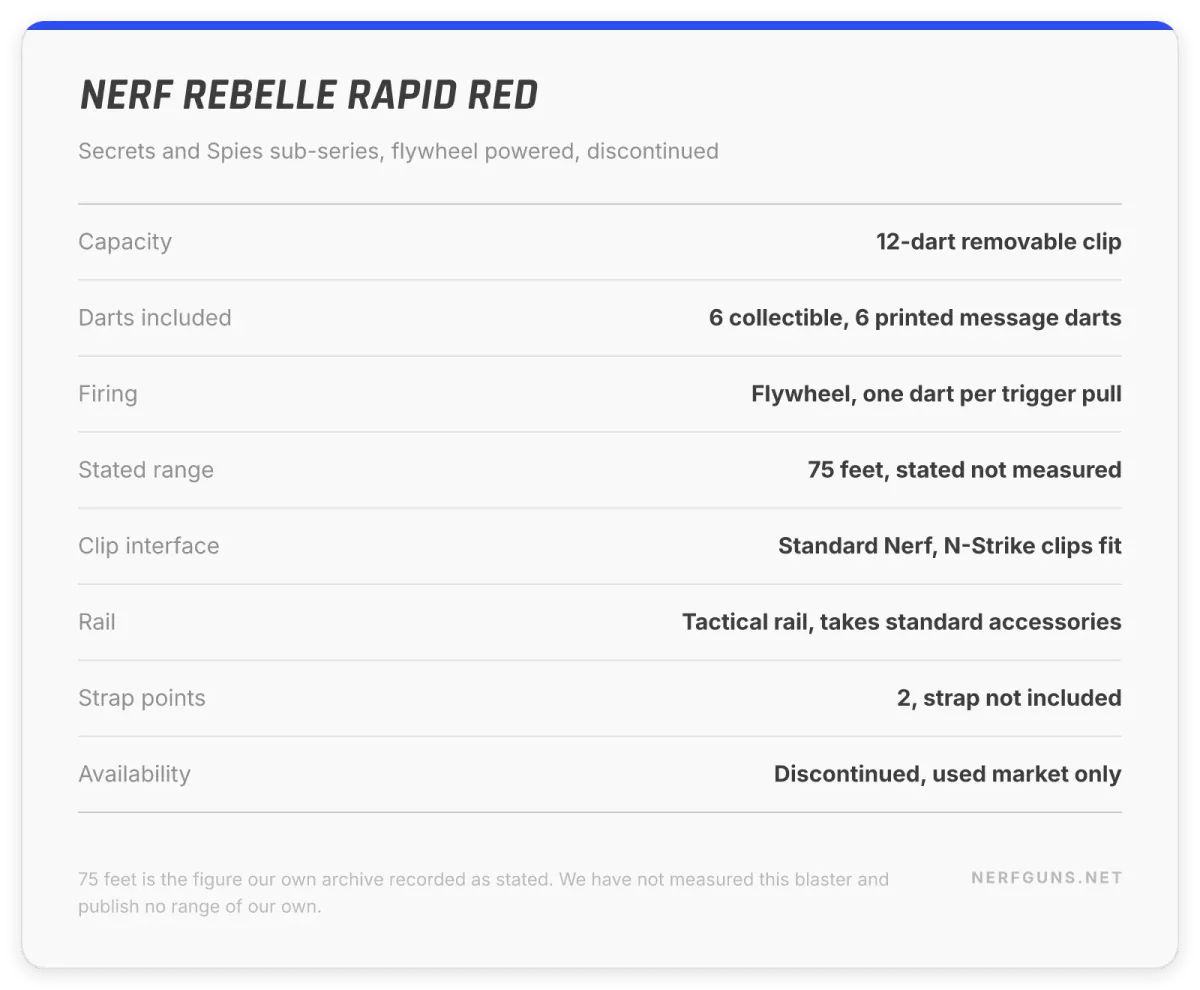
The dart split is worth reading twice. 6 of the 12 are ordinary collectible darts. The other 6 are message darts. So half your load is ammunition with a job beyond hitting somebody.
There is a tactical rail on top and 2 strap points on the body. The strap itself was not in the box. That is the kind of gap you only notice when you go looking for the strap.
The clip, and why it mattered
Before the Rapid Red, every Rebelle blaster loaded by hand, one dart at a time, into a barrel or a chamber. That is fine for 5 shots and hopeless for a real game.
A clip changes everything. Carry a spare, drop the empty, seat the full one. You are back in the fight in about 2 seconds instead of 30.
The clip is also standard. It is the same interface the N-Strike line uses, so clips move between blasters freely. If somebody in the house already owns a clip-fed Nerf blaster, their spares fit the Rapid Red and vice versa.
That is the single most useful thing about the Rapid Red, and the packaging barely mentioned it. A Rebelle blaster that shares magazines with the rest of the Nerf shelf is a Rebelle blaster you can actually use.
One catch worth stating plainly. A 12-dart clip is a curved stick magazine, and it sticks out below the grip. So the Rapid Red will not lie flat, and it will not sit neatly in a bag with the clip in. Carry the clip separately, or live with the shape.
The decoder darts, honestly
This is the gimmick and it is a good one, so it deserves a fair hearing rather than a shrug.
The message darts carry printing that is invisible, or close to it, under normal light. The clip is moulded in translucent ruby red. Look at a dart through that red plastic and it filters out the printing’s own colour. The message appears.
It is a red filter decoder, the same trick as a puzzle book from 40 years ago, built into a blaster. It works. It is genuinely satisfying the first time. And it is the reason the Rapid Red is remembered at all.
Now the honest part. In an actual game, nobody is reading darts. The message darts get fired, they land somewhere, and the decoding happens later or never.
Where it does work is play that is not a firefight. Treasure hunts, team codes, a message fired across a room to somebody who has to go and get it. That is a real use and it is the use the Secrets and Spies name was pointing at.
The practical warning: message darts are the ones you will lose. They are the ones that get fired at odd angles into hedges. They are also the ones you cannot replace, because nothing on the market prints them any more.
Range and how the flywheel behaves
75 feet is the stated figure our archive carries for the Rapid Red. The word “stated” is doing real work there. We have not measured it, and we do not publish numbers we have not taken.
What is worth understanding is how a flywheel blaster gets to its number, because it is not automatic.
The motor drives a pair of wheels that grip the dart and throw it. Pull the trigger before those wheels hit full speed and the dart leaves slow, then drops early. Hold the rev until the motor stops climbing in pitch. Then fire.
That single habit is the difference between a Rapid Red that feels weak and one that feels fine. Most complaints about flywheel blasters underperforming are really complaints about firing too early.
Battery condition is the other half of it. Flywheels are sensitive to voltage in a way that spring blasters are not, so tired cells produce a visibly slower dart. If it suddenly feels flat, change the batteries before you conclude anything about the blaster.
Accuracy is ordinary. It fires standard darts, so it inherits standard dart behaviour: fine indoors, pushed around by any real wind outdoors.
Handling, size and the rail
It is a light blaster and it feels like one. The shell is thin, the motor is small, and there is nothing heavy in it other than the batteries.
The grip is sized for a smaller hand, on purpose rather than by accident. It is still comfortable in a bigger hand, as long as you are not expecting a rifle stock. There is no stock at all.
The colours are violet, lavender, teal and orange, with the ruby clip. Whether you like that is your call. Worth knowing either way: this scheme hides in long grass far better than the white and pink used elsewhere in the line.
The tactical rail takes standard Nerf rail accessories, so sights and lights from other blasters go straight on. Our attachments guide covers what actually fits and what is decoration.
The 2 strap points are the underused feature. A sling turns a blaster you have to hold into one you can let go of. That matters when you are also carrying a spare clip and a handful of darts.
Where the Rapid Red sat in the line

Rebelle started as a small range of hand-loaded blasters and bows. The early ones were built around looks and a low price, not performance.
The Rapid Red is where that changed. A motor and a standard clip are the two things that make a blaster competitive against the rest of the Nerf shelf. The Rapid Red brought both to the line at once.
It is worth being clear about what that does and does not mean. The Rapid Red was not the most powerful blaster Nerf made that year and it was never trying to be. What it was is the first one in this line you could hand somebody without apologising for the reload.
The sub-series matters to the design. Secrets and Spies was built around concealment and messages, so the whole run leans on hidden compartments, decoders and printed darts rather than raw output. The Rapid Red is the one that took that theme and put a working blaster underneath it.
The line as a whole is discontinued now, and that is the honest context for every buying decision on this page. Nothing here is a current product, prices are set by whoever is selling rather than by a shelf, and condition varies enormously.
Want the whole range compared side by side instead of one model at a time? Our Rebelle blaster guide lays them all out, with the stated figures and the honest limits of each.
Where it fits in a game
The Rapid Red is a primary for a lighter loadout, not a heavy. One dart per trigger pull means you are aiming rather than spraying, and 12 in the clip means you can afford to miss a few.
Against a clip-fed N-Strike blaster of the same era, the Rapid Red matches it on capacity and trails slightly on feel. That is mostly because there is no stock to brace against.
Where it is genuinely strong is a mixed-age game. It is light, it needs no priming strength, and the reload is a clip swap rather than a wrestling match. Anyone who can hold it can run it.
Pair it with something that does not need batteries as a backup. A dead motor mid-game is a dead blaster, and a simple spring pistol on a belt covers that hole completely.
Building a game around a group rather than a duel? Our Nerf war game modes page has formats where a message-dart blaster is genuinely useful instead of a novelty.
Mod potential and paint
Modest, and the reasons are structural.
Flywheel blasters do respond to work: better cells, better wheels, a rewire. But the Rapid Red is a small light shell with a small motor. The popular flywheel platforms of the same era have more room inside, and far more parts made for them.
Realistically the useful upgrade is rechargeable batteries, which costs nothing in effort and fixes the most common complaint.
Paint is the other direction and the shell takes it well. A large flat side panel and simple curves make it a friendly first repaint. Our painting guide covers prep. Sanding first is what separates a finish that lasts from one that chips off the first time it hits the floor.
Do not paint the clip. It is a working optical filter, and paint on translucent red plastic ends the decoder feature permanently.
If this one is not it
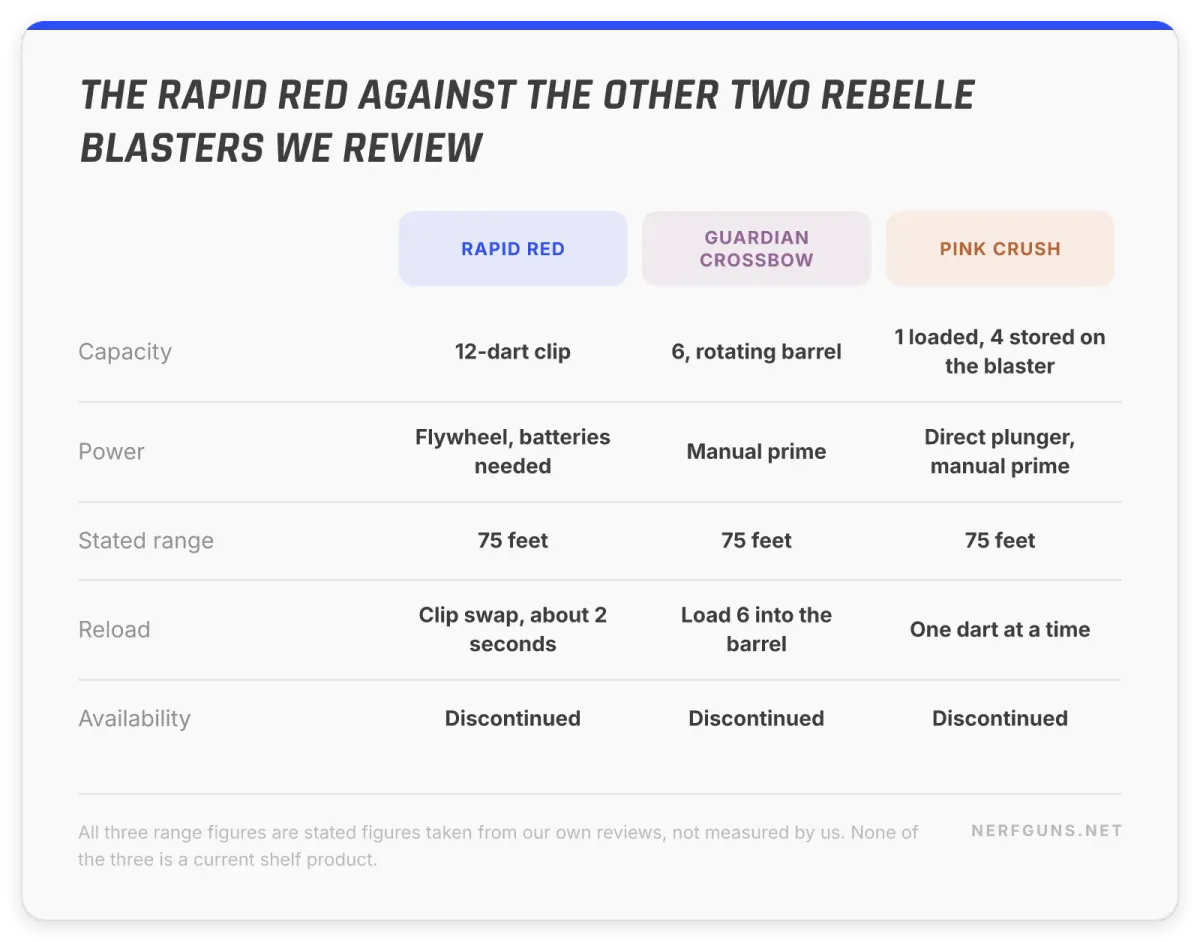
You want the same idea with more capacity. The clip interface is standard, so a larger clip from any N-Strike blaster fits the Rapid Red directly. That is the cheapest upgrade available to it and it needs no tools.
You want a Rebelle blaster with no batteries. The Pink Crush is the simple direct-plunger pistol at the other end of the line. The Guardian Crossbow holds 6 in a rotating barrel with no motor at all.
You want the whole line laid out. Our guide to the Rebelle blasters compares all of them, and says plainly which ones are worth the used-market prices they now command.
Buying one secondhand
Rebelle is discontinued, so every Rapid Red on the market is used and there is no current-shelf version of it. Anything sold as new in box is old stock rather than new production.
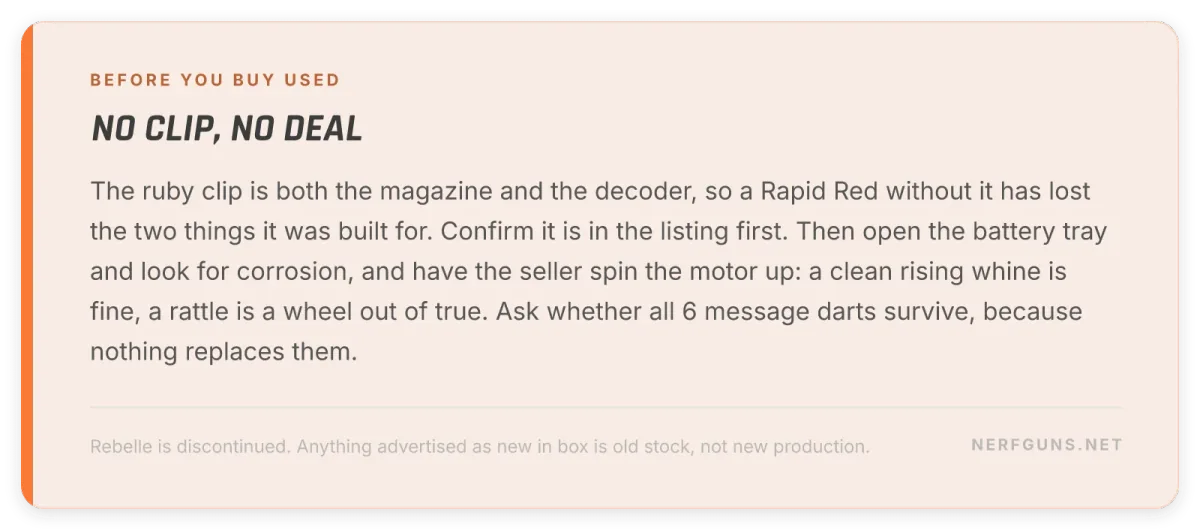
Open the battery tray first, before anything else. Cells left in a toy for a decade corrode the contacts. Green crust on the terminals is the difference between a working blaster and a shelf ornament.
Then make the seller spin the motor up and fire it. A flywheel blaster tells you almost everything in 3 seconds. A clean rising whine is fine. A rattle or a grind is a wheel out of true.
Confirm the clip is included. It is the whole point of the blaster, and it is exactly the part that goes missing. A Rapid Red without its ruby clip has lost the decoder as well as the magazine.
Ask about the message darts specifically. Ordinary darts are easy to replace. The printed ones are not, so a listing with all 6 present is worth paying a little more for.
What to buy now that Rebelle is gone
Rebelle is finished. Not just the Rapid Red, the whole line.
Here is the good news hiding in that. Nerf no longer sells a separate line aimed at girls. There is one shelf now, and the blasters on it are the blasters on it. Nobody has to shop in a special aisle to get a clip and a motor.
What has no 2026 replacement: the decoder. No current blaster ships with message darts or a filter clip, and nothing on the market prints those darts. If the codes were the reason you wanted a Rapid Red, the used market is the only place that still has them.
What is easy to replace: everything else. The Rapid Red’s real pitch was a motor plus a standard clip, and that is now the default rather than the exception.
- The Nerf Loadout Galactic Commander is the same idea grown up. Motorized, 3 firing modes, and it feeds from an 18-dart clip instead of 12. It ships with two clips and 48 darts, so you load one and stash the spare in the stock. Hasbro rates it 8+.
- It also takes 3 swappable attachments, which is where the tactical rail on your Rapid Red was always pointing. Same instinct, more to bolt on.
One catch, and it catches everybody. Loadout blasters fire N1 darts. Nerf’s own listings say N1 darts are compatible only with N Series blasters, so your Rebelle darts will not feed one, message darts included. Budget for N1 darts alongside the blaster.
Keep the Rapid Red for the codes. Buy something current for the games.
Bonus tip: nobody ever guesses the right blaster. Put the one you actually want on a free wish list, then send the link to whoever keeps asking what you want for your birthday. Start your free Nerf wish list and let them buy the right thing.
Where to buy
As an Amazon Associate and eBay Partner, we earn from qualifying purchases.
These are searches rather than fixed product links. The Rapid Red is discontinued, so listings for it come and go. Prices on the used market move constantly, so treat anything you see as a snapshot.
- Nerf Rebelle Rapid Red on Amazon
- Standard 12-dart clips on Amazon, which fit this blaster directly
- Used Rapid Red listings on eBay, usually the better hunting ground for a discontinued blaster, and the place complete sets with the message darts turn up.
If chasing a discontinued blaster is not appealing, our guide to the new Nerf guns covers what is on shelves now, and the full blaster list is the place to browse everything we have written up.
Frequently asked questions
How many darts does the Rapid Red hold?
12, in a removable clip. 6 of the darts in the box are ordinary collectible darts and the other 6 are printed message darts.
How far does it shoot?
Our archive records 75 feet as the stated figure. We have not measured it, and we will not publish a number we did not take. Treat 75 feet as a best-case ceiling, with a fully spun flywheel and fresh batteries.
Does the Rapid Red need batteries?
Yes. It is flywheel driven, so the motor does the work of throwing the dart. With dead batteries it does not fire at all, which is worth planning around in a way that a spring blaster never requires.
How does the decoder clip work?
The clip is moulded in translucent ruby red and acts as a colour filter. Looking at a printed message dart through it removes the camouflage colour and the message becomes readable. It is a simple optical trick and it works exactly as advertised.
Do standard Nerf clips fit it?
Yes. The clip interface is the ordinary Nerf one, so clips and magazines from N-Strike blasters fit, including larger ones. That is the easiest way to raise the capacity without touching the blaster itself.
Can you still buy message darts?
Not new. They were made for this sub-series, and nothing on the market prints them any more. The 6 that came in the box are the 6 that exist for your blaster. Ordinary darts work fine in the clip.
Is it a good first blaster?
It is a reasonable one. It is light, needs no priming strength, and reloads with a clip swap rather than a fiddly hand load. The battery dependence is the only real drawback for a first blaster.
Is it semi-automatic?
One dart per trigger pull, with the motor already running. That is what semi-automatic means on a flywheel blaster: the motor removes the priming step, but it does not fire a stream while you hold the trigger. The Rapid Red will not empty its clip on its own.
What batteries does it take?
Ordinary alkaline cells in a tray in the grip. Rechargeables are the sensible choice, because a flywheel blaster on tired cells throws a visibly slower dart long before the batteries are actually flat.
Is there a modern version of the Rapid Red?
Partly. Rebelle is gone as a line, and no current blaster has the decoder clip or the message darts, so that half of the Rapid Red has no replacement. For the motor and the clip, the closest thing on shelves is the Loadout Galactic Commander: motorized, 3 firing modes, and an 18-dart clip instead of 12. It fires N1 darts, so nothing from your Rebelle box will feed it.
Is the Rapid Red worth buying now?
If the clip is included and the price is sensible, yes, as a light clip-fed blaster that still plays perfectly well. If the clip is missing, walk away. Without it you have a flywheel blaster with no magazine and no decoder, which is neither of the two things it was for.
It’s Nerf or Nothin’!