
The Rapid Fire AS-20 holds 20 darts and throws them in a burst. No batteries at all. It runs on air you pump in by hand. That combination has never quite been repeated. Here is how it works, what to check on a used one, and what to buy instead now it is gone.
What is on this page
- The short verdict
- What the Rapid Fire AS-20 is
- How the air system works
- Burst or accuracy
- The rate of fire claim, and why it is gone
- How it compares to the heavies
- Running a Rapid Fire in a game
- Why the air blasters disappeared
- Buying a Rapid Fire secondhand
- What to buy instead
- What to buy now that it is gone
- Where to buy
- Frequently asked questions
The short verdict

- 20 darts in the chamber, ready to go without a clip or a drum.
- Air powered. You pump it by hand, so there are no batteries and nothing to go flat.
- Two speeds. Let it run for a burst, or slow down and place shots.
- Light enough for a small player to hold, which is unusual at this capacity.
- Long out of production, and air blasters age differently from spring and motor blasters.
Buy it if you want volume with no batteries and you can test the seals first. Skip it if you want something you can buy new, because the modern equivalent is motorized.
What the Rapid Fire AS-20 is
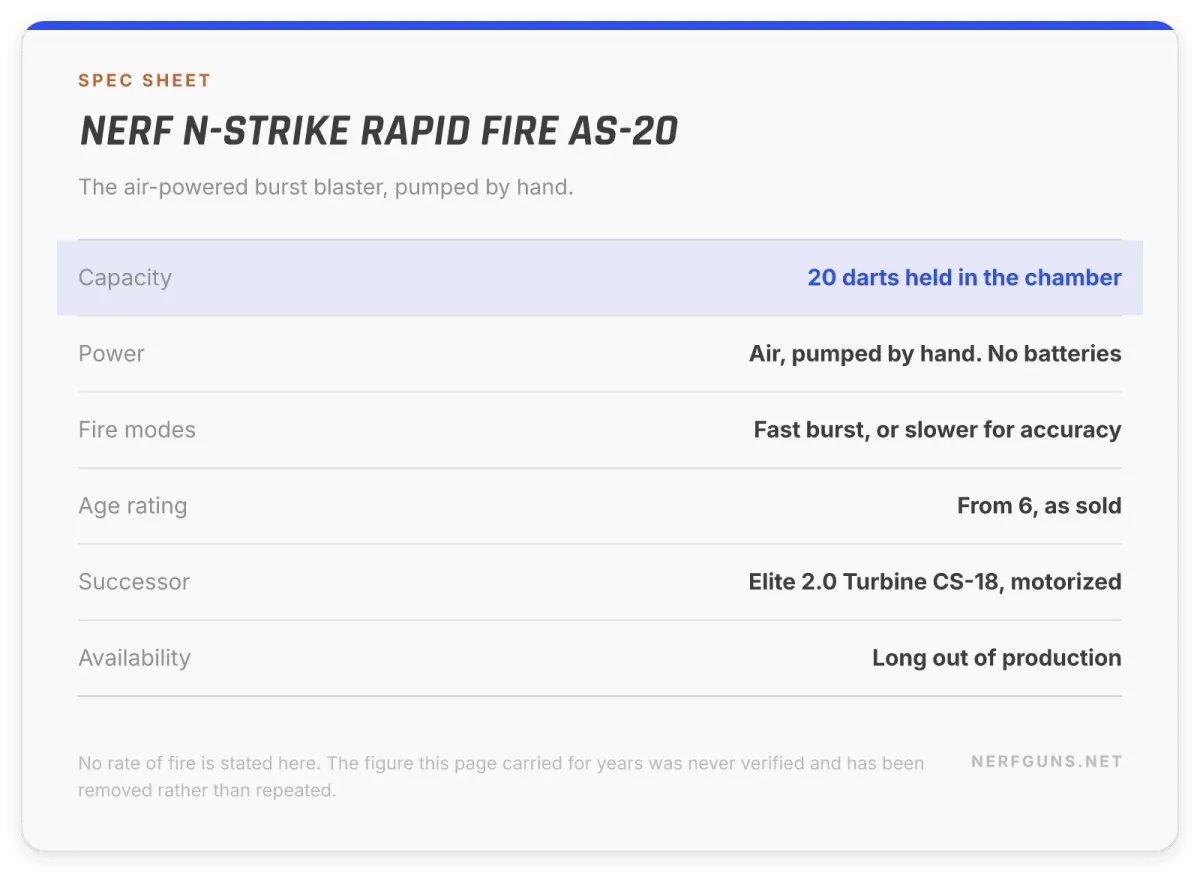
The Rapid Fire AS-20 is one of the more interesting blasters Hasbro built in the original N-Strike era. It solves the volume problem in a way nothing since has copied.
The AS in the name is the air system. You pump air into the blaster, and that stored air is what launches the darts. It holds up to 20 rounds in the chamber at once. That was a lot for its day. It is still a lot for a blaster with no clip and no motor.
When you let it run, it gives you a genuine burst rather than one dart at a time. The sound of the air releasing from the chamber is a large part of why people who owned one remember it.
How the air system works
This is the part worth understanding, because it explains both the appeal and the failure mode.
A spring blaster stores energy in a spring, and you compress that spring once per shot. A flywheel blaster stores no energy at all and spins motors up on demand. An air blaster stores energy as pressure in a tank, and that tank feeds multiple shots.
That is why the Rapid Fire can produce a burst without a motor. You are doing the work up front with the pump, and the blaster spends it quickly afterwards.
It also means the blaster has a rhythm the others do not. Pump, fire, pump, fire. You are managing a reservoir rather than priming a mechanism, and running it well means learning how much you have left.
Why nothing modern works this way
Air systems went out of fashion in mainstream Nerf blasters, and the reasons are practical rather than mysterious. They need seals, seals perish, and a blaster that loses pressure feels broken even when nothing has snapped.
Flywheels are cheaper to build, more consistent shot to shot, and they fail in obvious ways. That is a better product decision and a worse experience for anybody who liked the pump.
Burst or accuracy
The blaster gives you both and the choice matters more than it does on most Nerf blasters.
Run it fast and it does what the name says. The stored air empties fast and you put a lot of foam into a small area. That is exactly what you want when somebody is close, or when you are covering a doorway.
Slow down and the same blaster becomes accurate. Taking your time gives each dart the full pressure behind it, and lets you aim. That is a genuine second mode, not just firing less.
If being stealthy is what is called for, the slower speed gives you accuracy wherever you point it. That flexibility, in a blaster with no batteries, is the reason the AS-20 stayed in people’s collections.
The rate of fire claim, and why it is gone
This page used to state that the Rapid Fire AS-20 fired at about eight rounds per second.
That figure has been removed. We did not measure it, we cannot find a manufacturer source that states it, and it had been sitting on this page as a bare assertion for years.
It may well have been roughly right. That is not the same as verified. Repeating a number because it has always been there is how bad figures spread across a whole category of websites.
Here is what we can tell you honestly. It fires a burst fast enough that the mode really is different from single shots. The limit is the air in the tank, not the mechanism. If you want a number, measure your own, because a used air blaster’s performance depends entirely on the condition of its seals anyway.
How it compares to the heavies
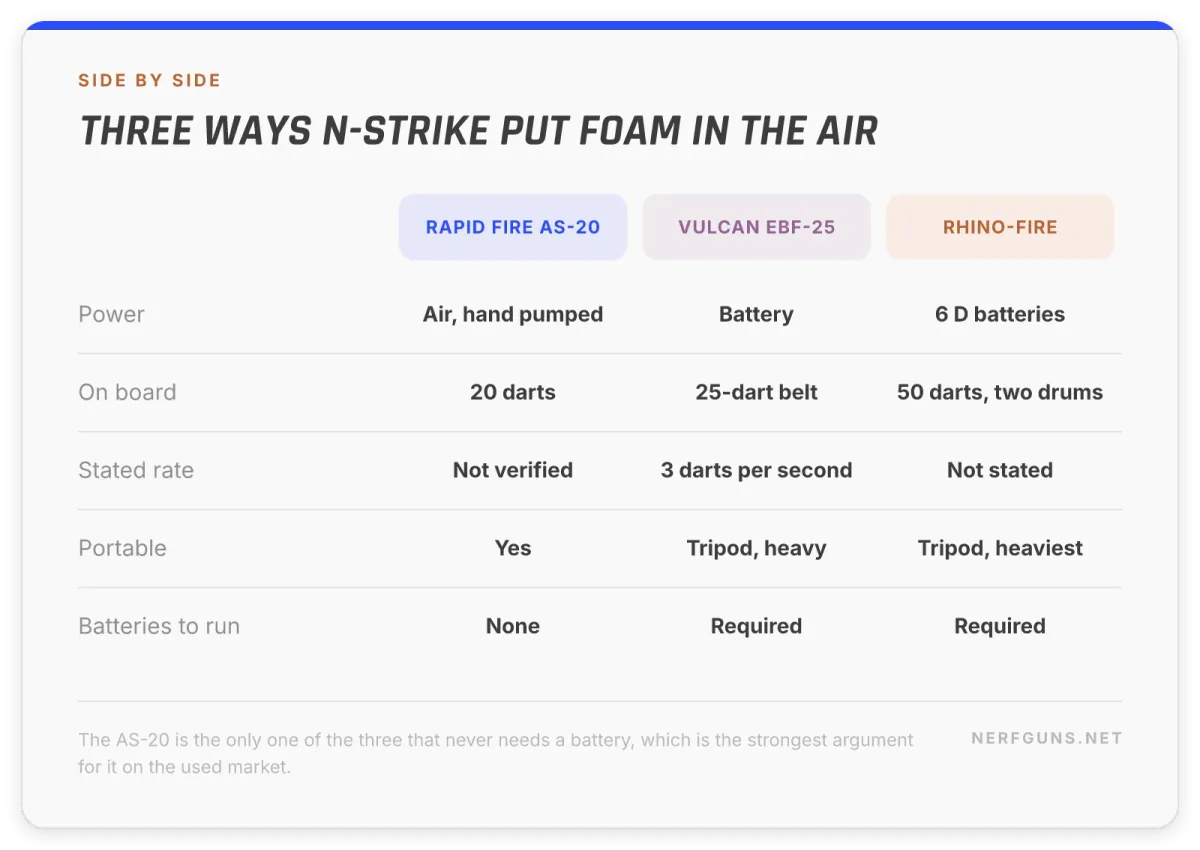
Three N-Strike blasters were built to put a lot of foam in the air, and they went about it three different ways.
Against the Vulcan EBF-25
The Vulcan feeds 25 darts from a belt at a stated 3 darts per second, and it needs batteries and a tripod. It is the more impressive object and the less practical one.
The AS-20 gives up the belt and the spectacle, and in exchange you can carry it and it never needs a battery.
Against the Rhino-Fire
The Rhino-Fire holds 50 darts on two drums and runs on 6 D batteries. It is equipment you place rather than a blaster you carry.
Different category entirely. If the AS-20 is a blaster for a person, the Rhino-Fire is a blaster for a position.
Against a clip-fed blaster
A clip blaster like the Retaliator gives you faster reloads and shared ammunition with the rest of the line, at the cost of the burst. For most players that is the better trade, and it is why clips won.
The rest of the family sits in the N-Strike hub.
Running a Rapid Fire in a game
The Rapid Fire AS-20 rewards a different habit from every other blaster in a normal kit. Getting that habit right is the whole difference between enjoying one and finding it frustrating.
Pump before you need it, not when you need it
The reservoir is the thing to manage. A Rapid Fire with a full tank and a full chamber is a strong blaster. The same blaster caught half-pumped is worse than a pistol.
So the rule is the same one that applies to reloading: top it up in every lull, automatically, without thinking about it. Players who treat pumping as something you do when the blaster feels weak are always behind.
Decide your burst length before the fight
Twenty darts sounds like a lot and it empties fast if you let it run. Two or three short bursts covers more situations than one long one, and it leaves you pressure in reserve.
The Rapid Fire is at its best when you are disciplined with it. Which is an odd thing to say about a blaster named for volume.
It is a group blaster
Nothing about it needs batteries. So a Rapid Fire is the blaster you can leave in a cupboard for a year, then hand to somebody at a party. That reliability is genuinely useful, and it is the reason these turn up at family games long after the motorized blasters have died.
Where it struggles
Long games without breaks, because the pumping adds up. And any format where you need to reload fast, since refilling a 20-dart chamber by hand is slower than swapping a clip. Pair it with a clip-fed primary if the game is going to run.
Why the air blasters disappeared
The Rapid Fire AS-20 belongs to a small group of Nerf blasters that stored energy as air, and none of them have modern successors. That is worth explaining, because people assume the design was bad and it was not.
Seals are a manufacturing problem
An air system depends on seals holding pressure. Seals are more expensive to make well than a spring, they perish over time, and they fail gradually rather than obviously. From a manufacturer’s point of view that is a warranty problem and a reputation problem at once.
Consistency sells better than character
A flywheel blaster fires the same way on shot one and shot twenty. A Rapid Fire fires according to how much air is left, which means the experience varies within a single chamber. Players who like the blaster find that engaging. Buyers comparing two blasters in a shop do not.
Pumping is work
This is the plain one. Motorized blasters removed the physical effort, and most buyers preferred that. The Rapid Fire asks you to earn your burst, and a large part of the market did not want to.
What was lost
One thing, and it is the reason this page still gets read: a high-capacity blaster that never needs a battery. Every modern equivalent has a runtime. The Rapid Fire AS-20 does not, and nothing on shelves has replaced that property.
What the AS-20 name actually means
Worth spelling out, because N-Strike model numbers are more literal than they look. The AS is the air system that powers it, and the 20 is the number of darts the chamber holds.
That naming convention runs through the era. The Vulcan is the EBF-25 for electronic belt fed with a 25-dart belt, and the clip blasters carry CS numbers for their clip systems. Once you know the pattern you can read most of an original N-Strike blaster’s specification off the box before you open it.
Buying a Rapid Fire secondhand
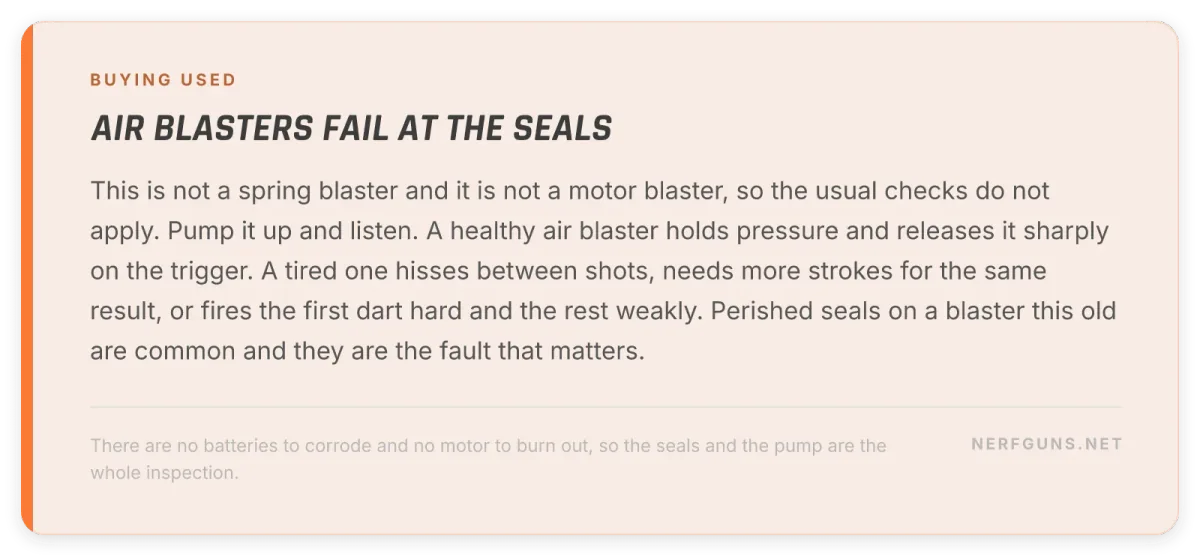
The AS-20 is long out of production, so treat any listing as a used-market find. It also needs a different inspection from anything else on this site, because it is neither a spring blaster nor a motor blaster.
- Pump it and listen. A healthy air blaster holds pressure. A tired one hisses between shots, which is a perished seal and the most common fault on a blaster this old.
- Count the strokes. If it needs noticeably more pumping than it should for the same result, it is leaking somewhere you cannot see.
- Fire a full chamber. The first dart hitting hard and the rest trailing off is the classic sign of a system that cannot hold what it is given.
- Work the pump handle. It should move smoothly through the whole stroke. Grinding means wear in the pump itself.
- Check the chamber. Twenty dart positions, all clear, nothing cracked.
The good news is that there are no batteries to have leaked and no motor to have burned out. If the seals are sound, an air blaster from this era can be in excellent working order.
What to buy instead
The AS-20 itself is out of production. Want the same spray-everything thrill in a blaster you can actually buy? The closest match is motorized rather than air powered.
The Elite 2.0 Turbine CS-18 is the honest recommendation. It is a flywheel blaster with an 18-dart clip, so it covers the same job with modern ammunition and current availability. What you give up is the pump, and with it the no-batteries advantage that made the AS-20 distinctive.
There is no current-shelf air blaster that fills this gap, which is worth saying plainly rather than pretending a substitute exists. If the air system is specifically what you want, the used market is the only route.
For what is actually in production, our new Nerf guns guide covers the current lines. The machine gun style blasters page covers the high-volume options.
The Rapid Fire AS-20 is gone, so what sprays foam now?
The AS-20 is long out of production. Two honest answers, starting with the one nobody wants.
Nothing Nerf sells today runs on hand-pumped air. That whole idea, pump it up and dump 20 darts in a burst, left with the original N-Strike era and has not come back. If the air tank is what you loved, this is a used-market hunt.
For the burst itself, motorized is where it went. The Nerf Loadout Galactic Commander has 3 firing modes, one of them full auto, and it ships with 48 N1 darts and two 18-dart clips. Hasbro rates it 8+.
The trade is honest both ways. You gain a trigger you can hold down and a clip you can swap in a second. You lose the thing that made the AS-20 special: no batteries, ever, and a blaster that works after a year in a cupboard.
One catch before you order. Loadout blasters fire N1 darts, not Elite darts. Nerf’s own listings say N1 darts work only in N Series blasters, so the 20 darts an AS-20 holds will not load one. Budget for N1 darts alongside it.
Bonus tip: nobody ever guesses the right blaster. Put the one you actually want on a free wish list, then send the link to whoever keeps asking what you want for your birthday. Start your free Nerf wish list and let them buy the right thing.
Where to buy
As an Amazon Associate and eBay Partner, we earn from qualifying purchases.
- Current Rapid Fire AS-20 listings on Amazon, the honest link for a discontinued blaster.
- Nerf Elite 2.0 Turbine CS-18, the motorized equivalent you can buy new.
- N-Strike Elite 250-dart pack, because a 20-dart chamber empties quickly.
- Safety glasses.
- Used Rapid Fire AS-20 listings on eBay, usually the better hunting ground for an air-powered blaster that left shelves years ago.
For everything else in the line, browse every blaster we have covered, or our dart buying guide for what to feed it.
Frequently asked questions
How many darts does the Rapid Fire AS-20 hold?
Up to 20, held in the chamber at one time. There is no clip or drum to swap, so a reload means refilling the chamber.
Does the Rapid Fire AS-20 need batteries?
No. It is air powered, pumped by hand, which is its main advantage over the motorized blasters that replaced it.
How fast does the Rapid Fire AS-20 shoot?
We do not publish a figure. This page previously carried one that was never verified, and it has been removed rather than repeated. It fires a genuine burst, and how fast depends on the condition of the seals in the specific blaster.
Is the Rapid Fire AS-20 automatic?
It fires a burst from stored air rather than one dart per trigger pull, and it also has a slower mode for placing shots. There is no motor involved in either.
What age is the Rapid Fire AS-20 for?
It is quick and accurate enough to keep an adult interested, and light enough for a smaller player to hold. That combination is rarer than it sounds at this capacity.
Is the Rapid Fire AS-20 still made?
No, it is long out of production. The closest thing you can buy new is the motorized Elite 2.0 Turbine CS-18, which trades the pump for a battery.
Can you repair a leaking Rapid Fire?
Sometimes, and it is one of the few repairs on a discontinued blaster that is genuinely worth attempting. A Rapid Fire that will not hold pressure has usually lost a seal, not broken anything structural. Seals are generic parts, not Hasbro-specific ones. It is fiddly work and it is not a first teardown, but a leaking air blaster is not automatically scrap.
Does the Rapid Fire AS-20 take Elite darts?
It takes standard Nerf darts, so Elite refills feed it. Like every blaster from the original N-Strike era it was designed around the older foam, and the modern darts run in it without trouble.
Is the Rapid Fire AS-20 good for younger players?
It is one of the friendlier high-capacity blasters for a smaller player. No motor noise, no batteries to manage, no clip to seat. The pumping is the only physical demand, and it is a whole-arm motion rather than a strong one.
Is there a modern version of the Rapid Fire AS-20?
Not an air-powered one. Nerf stopped making hand-pumped blasters after the original N-Strike era and has not gone back. For the same burst-of-foam feeling the closest thing on shelves is the Loadout Galactic Commander, which is motorized and has a full auto mode. It fires N1 darts, so your Elite foam will not load into it, and it does need batteries where the AS-20 never did.
Is the Rapid Fire AS-20 worth buying today?
Yes, if you can test it first and the seals hold. It is the only easy route to high-volume fire with no batteries, and nothing currently on shelves offers that. If you cannot test it, buy the Turbine instead and accept the batteries.
It’s Nerf or Nothin’!


uses up ammo 2 quickly
but its good
I have this gun and let me tell you it evens the odds
you wouldn’t even believe how good it is fully modded
new barrels alone makes it shoot incredibly far
Some guy hooked up a co2 tank to 1 of these
wat do u guys think is better rapid mode or single mode
leave a response below
how far does it shoot
very far, and this gun is very very very good, can spray at people.
hmm my only real gripe of this weapon is the unecessary
black plastic that covers the gun,but once removed, it feels less cumbersome. I have test fired both that and the older nerf wildfire, ranges the same un modded,but I wish the pump of the rapid fire was part of the main body rather than far below the gun, a more compact form factor would have made the gun much better.
Cheap in nerf battles. the chicken boy in battle made up a rule of no as20
this gun takes a while to re load but once your out of bullets no one is going to be allowed.
This is a truly epic nerf gun! If I could have any nerf gun I wanted for free, I would definitely choose this one, even over the vulcan!
this nerf gun is good in the open but if some one ducks behind somthing it is just going to fly over them
awesome but dont talk as much u gave me a headache try to remember that for ur next video.
no fair ur cat took it all the way king nerf nerd
this gun is a beast and will rip apart your opponents in a nerf war!!! its accuracy is not bad and its range is real good, too. like the magstrike, it has a rediculously high rate of fire, plus it holds 20 darts, so its nothing but instant death for the enenmy. it seems to work best with velcro darts. it really only has one drawback, however it is a very big one. it takes forever to reload, so it is highly suggested that u keep a sidearm with u at all times in conjuction with this gun.
i mean really, ambushing someone with this gun is just downright cruel…but funny as hell for the berson on the attacking end
the gun is inaccurate, but good for close range combat
Slow to reload. If you can surrive all the darts this thing puts out. Then you can take them out because of the horrible reload time. I acually had a friend make a loader that hoald all 20 darts and you push it in and pull it out and all 20 darts are reloaded. It saves so much time and it makes this weapon a killer.
I love this gun. Got it for my 10 year old son but it was too hard for him to pump it up. Great rate of fire, but now my oldest son broke the pump handle. It is a flimsy handle but gonna try and fix it, if possible.
hmp you never seen a gun that is as good as the stampeed automatic rifle it is at it best moded and with the 35 bullet barral
Reload time is terrible, and the ammo is depleted in a second. But then again, once your out of ammo, proooobably no one is going to be left alive. If your assaulting a base, this weapon is perfect as a primary…..but make sure to have a secondary with you.
i got this gun awsome modded and hooked it to a massive air compressor omfg it shoots super fast and super far
love this gun. i’ve been looking for a good gun for about 4 months and this is the one as most of my friends have either heavy guns like vucan or stampede or raiders and recons. i hav a recon and this it the 1 thing i need to boost my arsenal. i lov the retro design
I really want a new nerf gun and i don’t know which 1 2 get. the Rapid Fire or the Barrel Break
aweorsome