
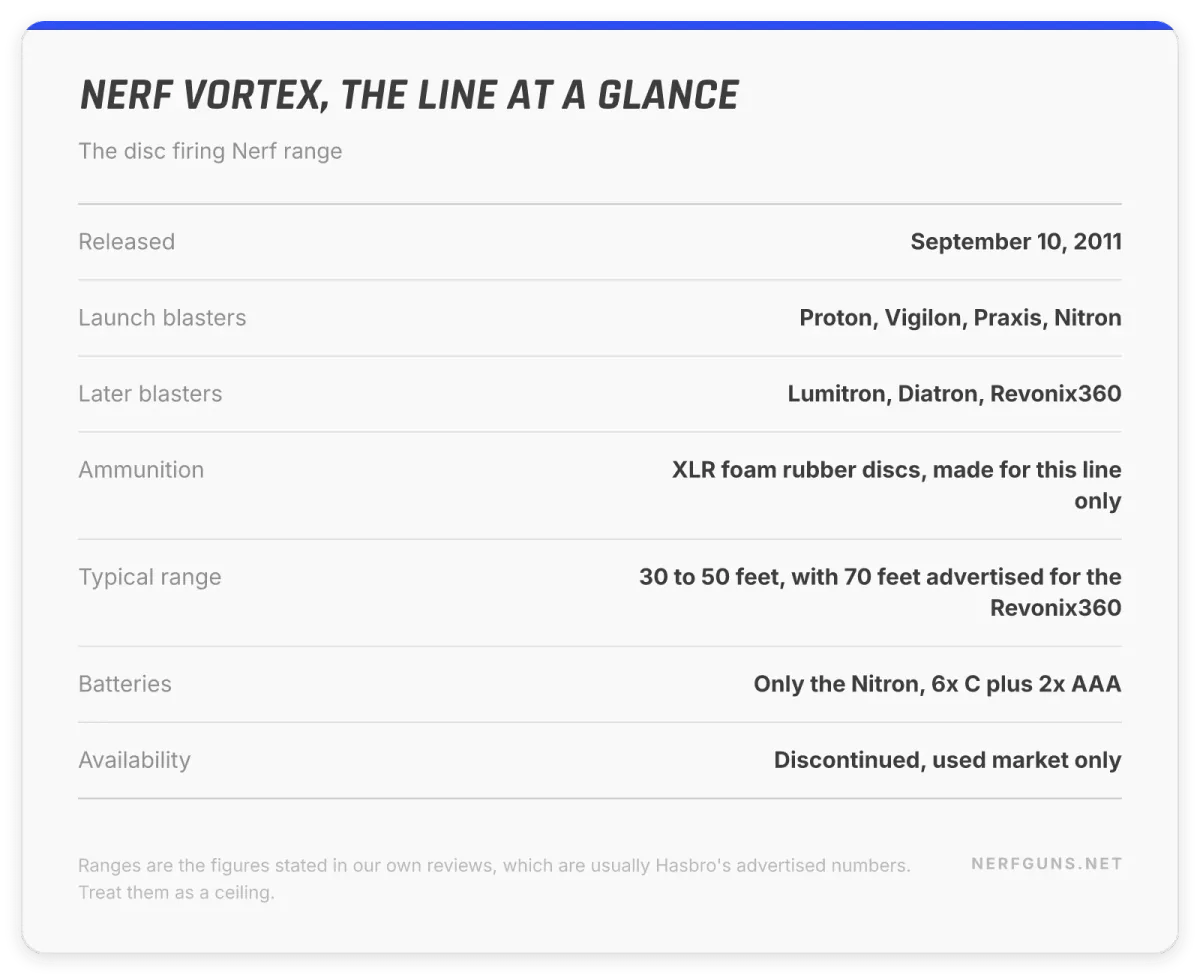
Vortex is the Nerf line that fired discs instead of darts, and it out-ranged every dart blaster Hasbro was making at the time. Seven blasters shipped between 2011 and the line’s retirement, from a pocket sidearm to a 30 disc drum launcher. This page covers all of them, what the disc actually changes, and the honest state of buying one now.
What is on this page
As an Amazon Associate and eBay Partner, we earn from qualifying purchases. The Amazon links on this page are affiliate links. They cost you nothing extra. See our affiliate disclosure.
What a disc blaster does differently
Vortex blasters fire semi-hard foam rubber discs, called XLR discs, in place of darts. The blaster puts a spin on each one and it leaves the barrel like a little frisbee, and that spin is where all of the line’s strengths and all of its quirks come from.
Range. Vortex discs go further than darts. Expect somewhere in the 30 to 50 foot band from the launch blasters, and the bigger models in the line can hit a target at roughly twice the practical range of a traditional dart blaster. That is the reason the line existed.
Ammo that survives the day. Vortex discs are much less likely to be crushed in a clip or damaged in a pocket than darts are, and they have no rubber suction cups to fail. They also load into spring loaded clips that work like a semi-automatic pistol magazine, so instead of feeding one dart at a time or hauling an ammo belt around, you drop the empty and slap a fresh one in. Three or four Vortex clips fit in a pocket.
The quirks, and every Vortex blaster has them. Because the disc is fired by spinning it, Vortex shots curve consistently to the left or the right. The curve is the same on every shot, so once you have adapted to it the blaster is remarkably accurate, but the first magazine will go wide. Any breeze outdoors makes it worse. Discs also sting slightly more than a dart on impact, though they are completely harmless, and they are green, which means they vanish into grass and are lost far more easily than an orange dart.
The Vortex line, blaster by blaster
Nerf Vortex Proton
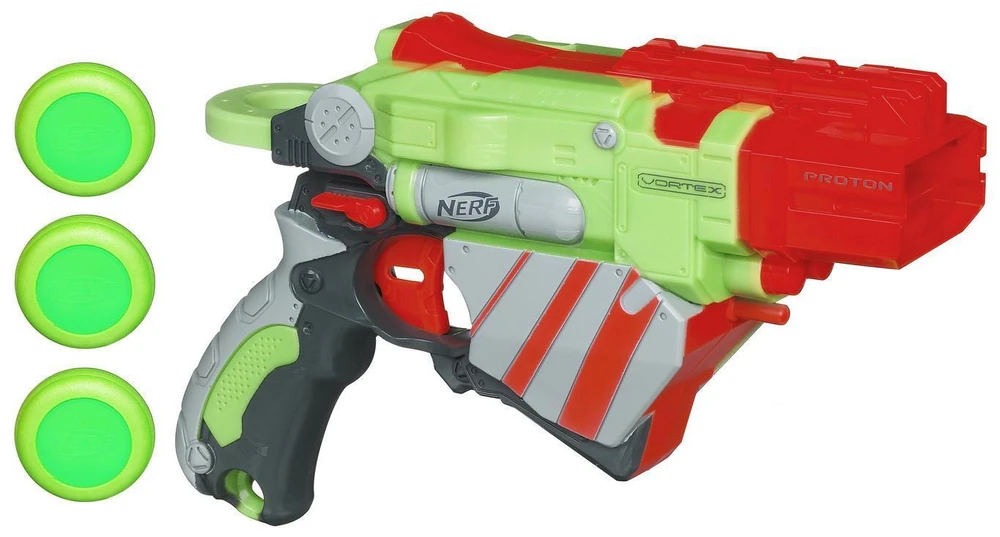
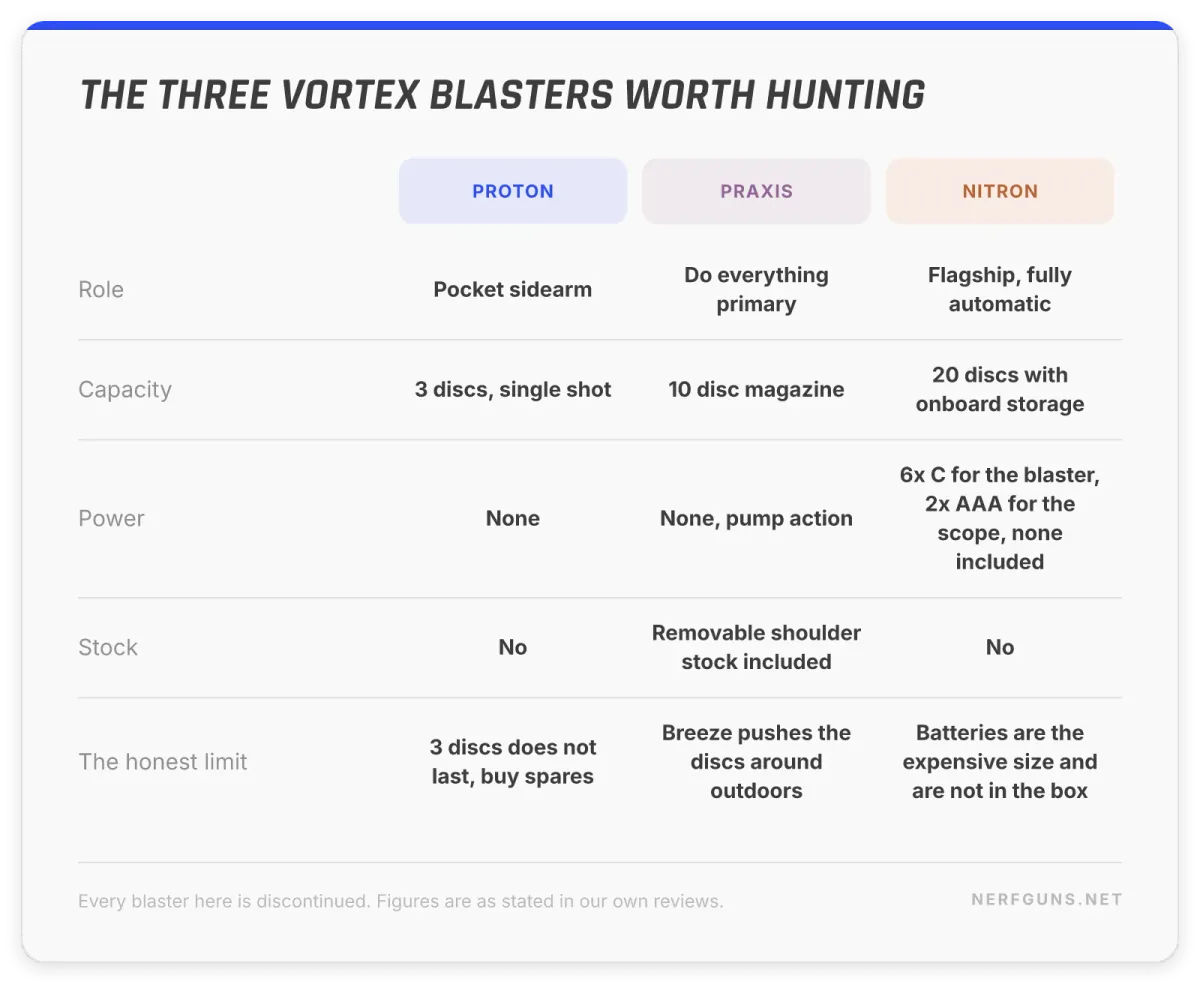
The Proton is the pocket blaster of the line, and it is the one that stays on you no matter what else you carry. It ships with three discs and instructions, fires single shots, and reloads fast enough to matter when your back is against the wall. Compared with a Maverick or another dart sidearm it is genuinely small and light, and the spare discs tuck into a vest pocket or a shirt pocket without getting smashed. Try firing a dart that has spent an afternoon folded into your back pocket and the advantage becomes obvious.
What makes it more than a novelty is that the discs give a sidearm real range and accuracy. Most one-shot backups only work at conversational distance, which is exactly the wrong trait when you are cornered and out of ammo. The Proton is effective from several yards, which also makes it a stealth weapon: you do not have to close all the way in to take the shot. Buy extra discs at the same time, because three does not last.
Nerf Vortex Vigilon
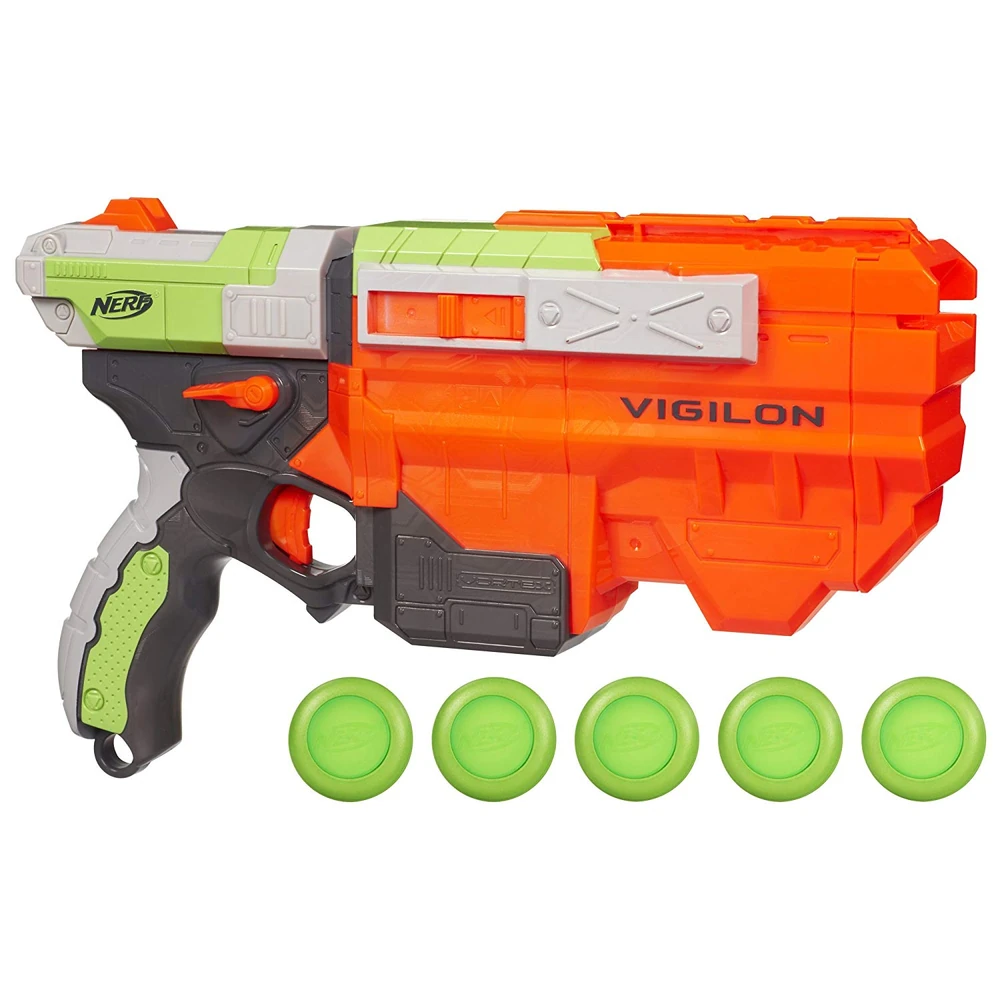
The Vigilon is the Proton’s answer to running dry. It carries five discs in a built in drop-down clip, so you rearm in seconds rather than fumbling, and with a couple of spare clips in a pocket you are carrying twenty rounds on a cheap sidearm. Think of it as the equivalent of the one-shot N-Strike pistol, with two extra rounds, more accuracy and more range.
The pump action is fast and smooth, which is not a given in this price bracket. Plenty of cheaper foam blasters ship with a clunky pump that jams or starts leaking air within a week, and the Vigilon does not. Its drop-down clip is the feature owners rate highest, and it is reputed to have a noticeable kick.
One maintenance tip that applies to every clip in the line. Store your clips empty between games. A magazine spring that is kept compressed all week takes that shape permanently, loses its push, and starts failing to feed the next round. Keep them unloaded and they stay like new for years.
Nerf Vortex Praxis
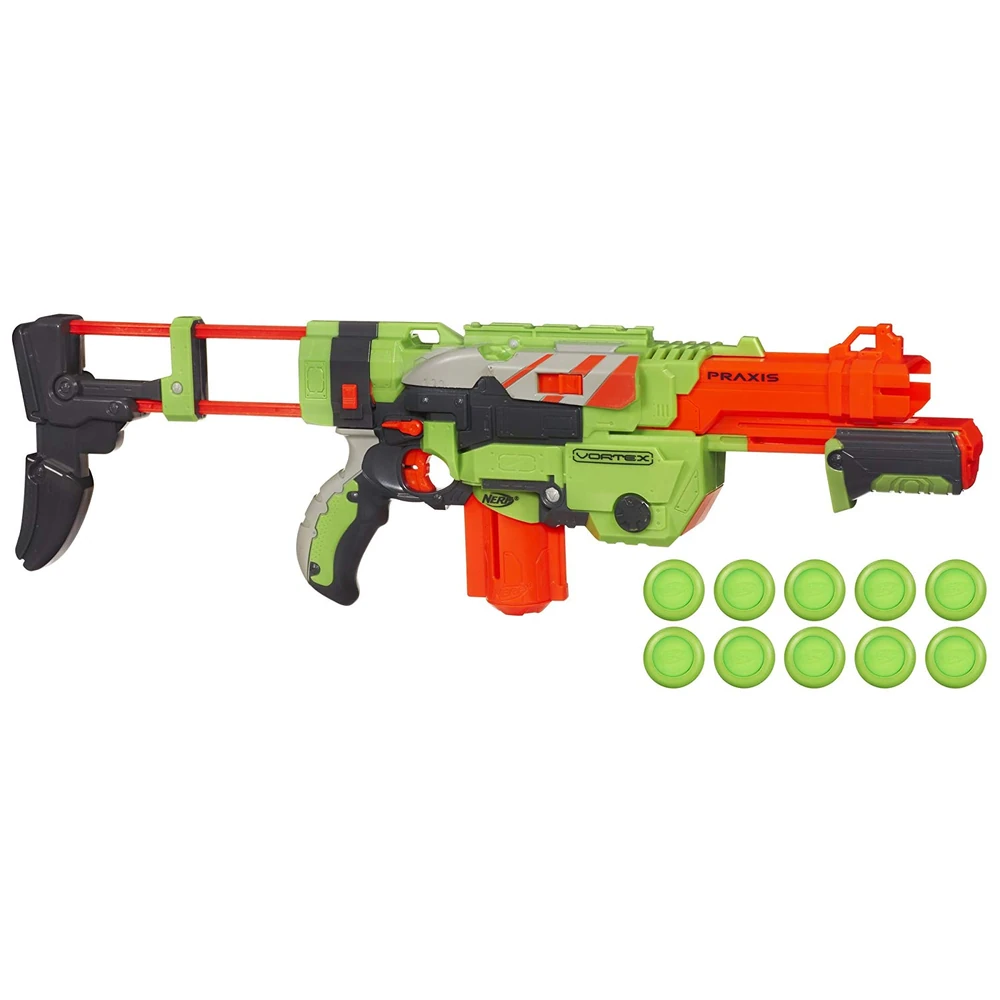
The Praxis is the one to buy if you want a single blaster that can play any position. It comes with a ten disc ultra-distance magazine and a removable shoulder stock, so you choose between a two-handed setup for accuracy and a one-handed setup for speed without owning two blasters. The pump action is easy to work and it does not jam the way a lot of foam blasters do.
The discs are a little over an inch across and they fly a long way, comfortably far enough to tag someone at 40 feet. The magazine fits in a pocket, and a second magazine plus a pack of spare discs turns it into a fast-reloading blaster. Compared with the Nitron it looks similar but is much lighter and much quieter, and it shares most of its interchangeable-parts approach with the N-Strike Recon while shooting considerably further. The honest downsides are the ones the whole line shares: any breeze pushes the discs around outdoors, and green discs disappear into a lawn. You may end up leaving the stock at home, but you will not regret the ammo capacity.
Nerf Vortex Lumitron
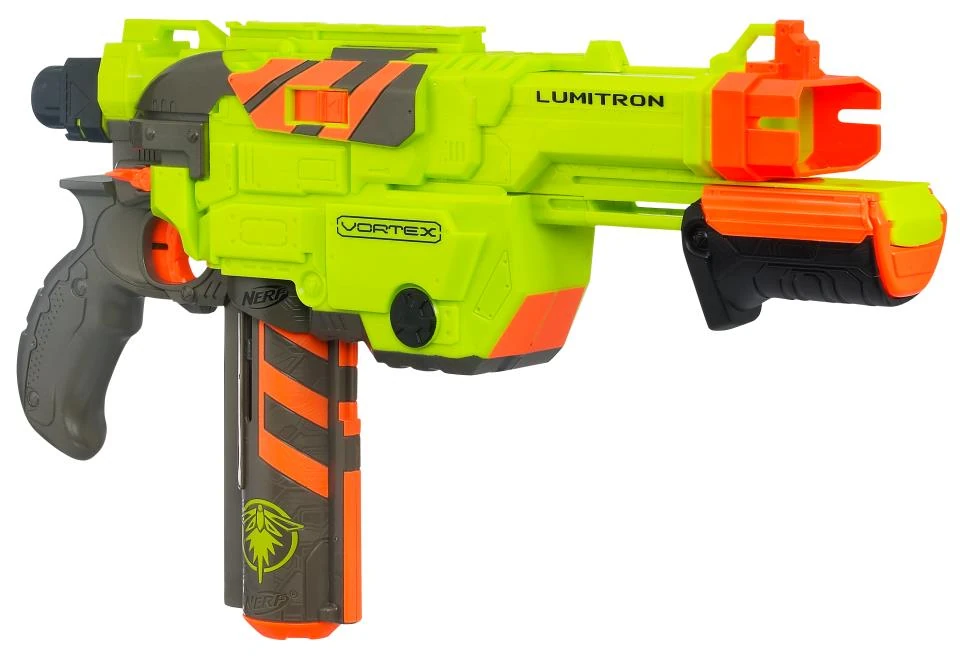
The Lumitron is the glow-in-the-dark entry, and it is best judged in three parts.
The good. The firing mechanism is a lot of fun. The easy-access rapid reload disc clip means no fishing for loose discs in a pocket, the Firefly glow-charge mechanism is genuinely good for night fights, and it makes discs far easier to find afterwards. Ten discs is around 30 seconds of continuous fire before a reload, which in a pitched battle is a long time. It also accepts non-Firefly discs, and you can load a mix so nobody knows what is coming. The sleek neon design looks like it means business.
The bad. The glow gimmick is the main selling point and it does nothing in daylight, so half the time you are carrying an ordinary blaster. Some discs lose their charge over time, and the Firefly Tech mechanism does not always work as advertised. The Lumitron is also on the small side and reads as far less intimidating than a big disc blaster or a Nerf minigun, though it is easier to pump and reload than most dart blasters.
The verdict. Can you fight with it? Absolutely. The discs bounce off surfaces rather than sticking, they travel much further than darts, and while they sting a fraction more they are completely harmless. It is not the most rapid-fire or offensively capable blaster in the armory, but it is reliable, it is stylish, and it is the one whose ammunition you can actually find again after dark.
Nerf Vortex Diatron
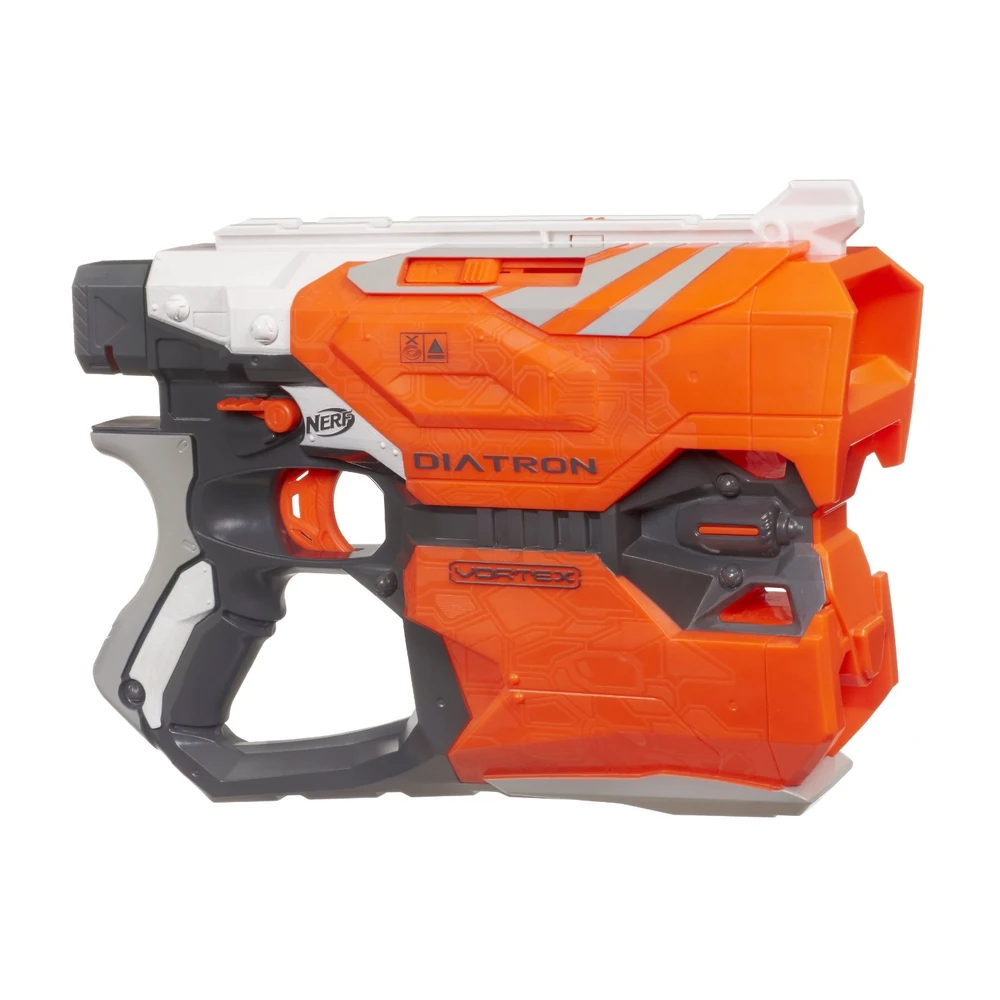
The Diatron is the only multi-shot blaster in the line: every trigger pull sends out a pair of discs, so it bursts ammunition twice as fast as a typical blaster. There is no way to fire a single disc, which makes it a blaster for frantic firers and something to watch during a long battle, because you will run dry twice as fast as everyone else. Range matches the rest of the family, so the extra firepower costs you nothing in distance.
The reload is the compromise. The Diatron uses a lever system, so you pull the lever out to load discs and push it back to prime, which is necessary for the double-disc mechanism but slower on the field. Reload behind cover. It also ships with only eight discs despite a ten disc capacity, so you will be borrowing two from another Vortex blaster to fill it. No stock is included, but the attachment point takes a stock from another Nerf or Super Soaker product, and adding one to what is essentially a sidearm noticeably steadies your aim.
Nerf Vortex Revonix360
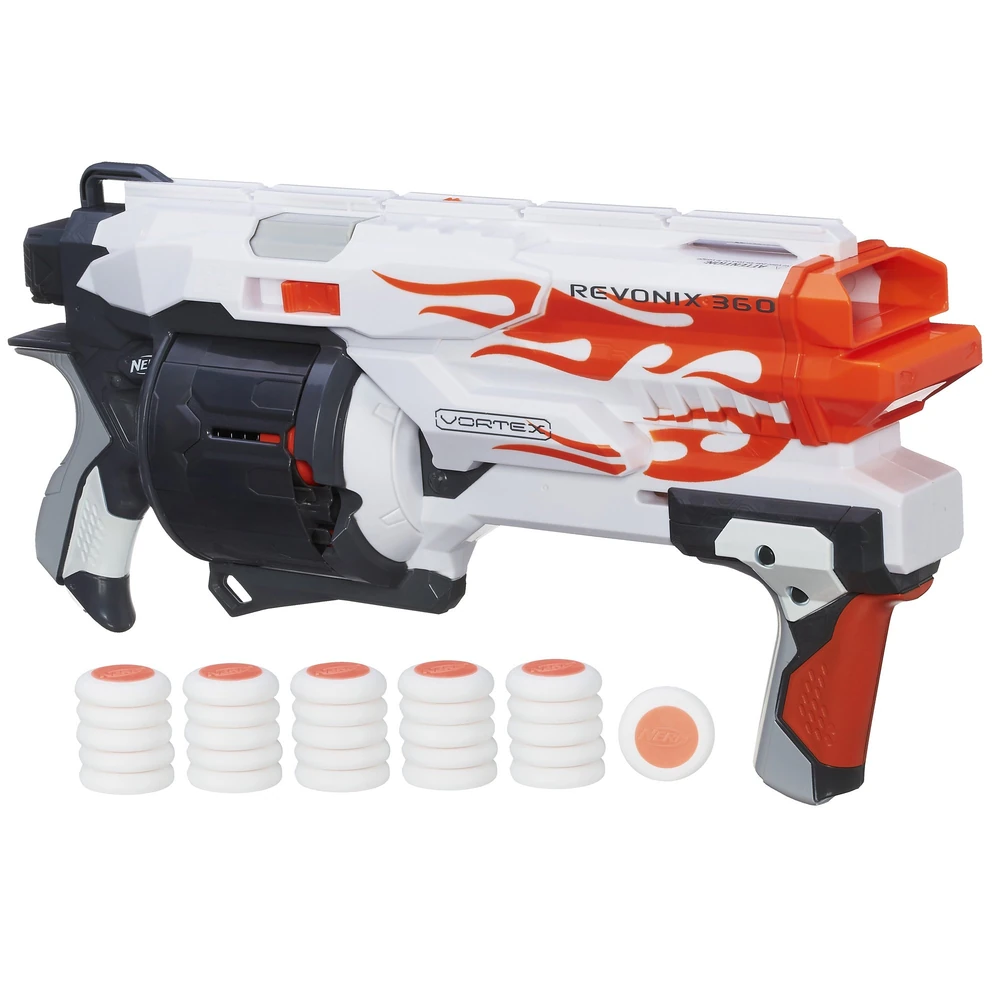
The Revonix360 is the heavy end of the Vortex line. It is built to look like a grenade launcher, with the grenade cylinder replaced by a rotating 30 disc drum, and while that is ten rounds fewer than the Pyragon carries, the drum is integrated far more neatly into the blaster and it is much more portable for it. The trade is that the drum does not come off, so there are no spare drums for a quick reload: when it is empty you are loading discs one at a time.
It slam fires. Hold the trigger down, pump the front handle repeatedly, and the drum rotates after every shot. There is a tactical rail and an attachment point for a shoulder stock. Hasbro advertised a seventy foot range, which puts it at the top of the series, and it launched around the $39.99 mark. Cosmetically it shares the white and orange scheme of the Pyragon and Diatron, with orange flames near the barrel instead of smooth stripes. Expect the same consistent left or right curve as the rest of the line, and expect to be accurate with it once you have learned that curve.
The Vortex line is long out of production, so the Revonix360 and its siblings are secondhand finds now. If you want something current and in stock with the same high-capacity outdoor game in mind, the Nerf Rebel Ops Deadeye is a modern dart-firing equivalent.
Nerf Vortex Nitron
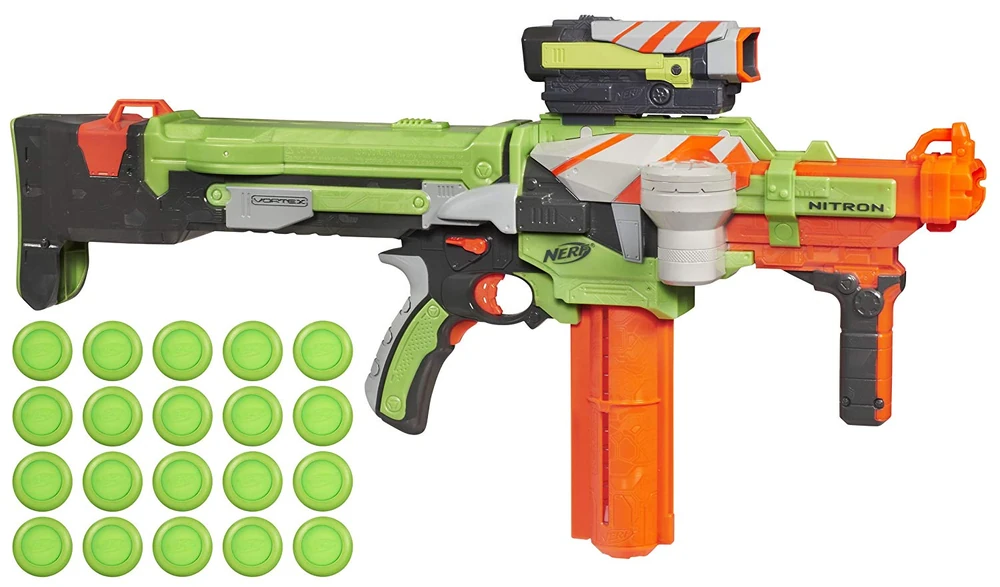
The Nitron is the Vortex flagship, the first blaster in the line and the first disc blaster to require batteries. It is fully automatic, it ships with 20 discs and onboard magazine storage, and its electronic scope centres your aim with pulsating target lights. Power is 6 C batteries for the blaster itself and 2 AAA batteries for the scope, none of which are included, so buy them with it. It rates highest with players who want automatic fire, and it is the one blaster in the line that out-ranges most dart blasters outright. The full review is on the Nerf Vortex Nitron page.
Rails, clips and gear
Two accessories matter on a Vortex blaster and the rest is decoration.
The tactical rail system accessories are sold separately and are compatible with most N-Strike and Vortex blasters that carry a tactical rail, which means the sights and scopes you already own move straight onto a Vortex blaster. The attachments guide covers what is worth fitting.
For carrying ammunition, the Nerf N-Strike Tactical Vest was designed around the dart line but works well as a makeshift Vortex rig. The pouches take spare disc clips comfortably, and the straps need only slight adjustment to hold a couple of extra magazines.
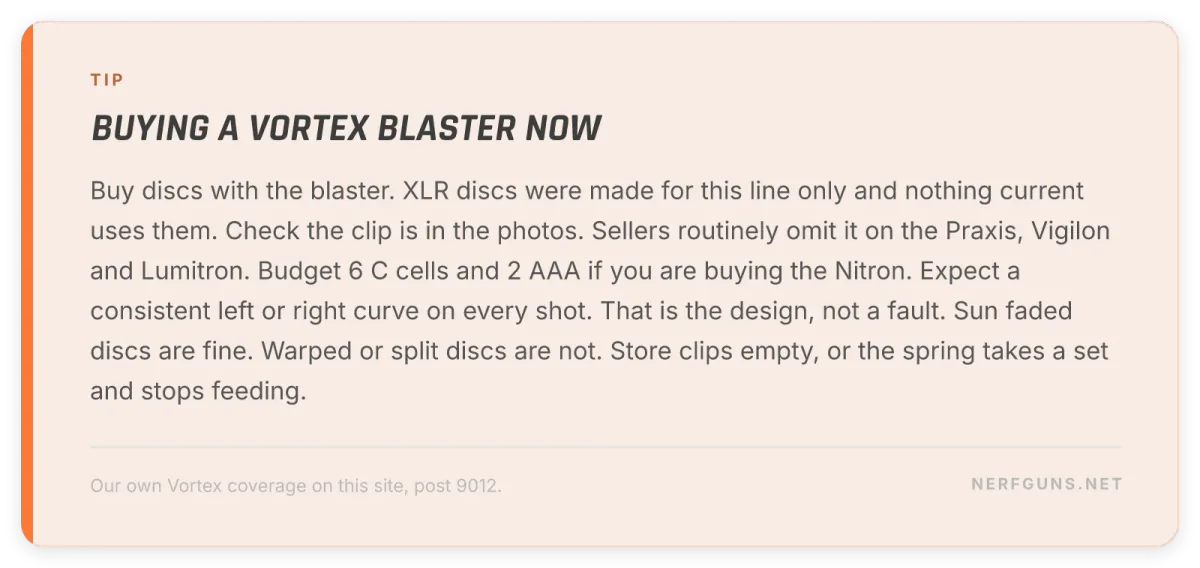
Store every clip empty between games. A magazine spring left compressed all week takes that shape permanently, loses its push and stops feeding cleanly. It is the single most common reason a secondhand Vortex clip does not work, and it is entirely preventable.
Spare discs are the other thing worth buying in quantity while you can still find them. Green discs vanish into grass, and unlike a lost dart there is no current product to replace them with.
Darts or discs?
Hasbro released the Vortex line on September 10, 2011 with four blasters: the Proton, the Vigilon, the Praxis and the Nitron. The Lumitron, Diatron and Revonix360 followed, which is how a four blaster launch became the seven covered here.
The line was pitched as an addition to the N-Strike experience rather than a replacement, and plenty of N-Strike loyalists skipped the adjustment period entirely once they saw two things: the discs shoot farther, and the discs survive being carried around far better than darts do.
Which one you want depends on how you play. The Praxis pump is fast and smooth and rewards the player who likes doing the work. The Nitron is for the player who wants to hold the trigger down.
The Vigilon has a kick and the best reload in the class for the money, and the Proton is the one you carry when you are already carrying something else.
In the end the whole argument comes down to darts against discs, and there is no reason you cannot own both. Every Nerf line, disc and dart, is catalogued on the complete list of Nerf guns.
Is the Vortex line still available?
No. Vortex is discontinued and has been for years. Hasbro retired the whole disc line, and nothing has replaced it, because no current Nerf range fires discs at all.
That means every blaster on this page is a used market find. There is no current shelf equivalent to point you at, and we are not going to pretend there is one.
What to expect when you go looking:
- Discs are the real problem, not the blasters. XLR discs were only ever made for this line, so a Vortex blaster with no ammunition is an ornament. Buy discs with the blaster or do not buy the blaster.
- Check the clips are included. The Praxis, Vigilon and Lumitron all depend on them, and sellers routinely photograph the blaster without the magazine.
- The Nitron needs 6 C cells and 2 AAA, none included, and C cells are the expensive size.
- Sun-faded green discs still fly fine. Cosmetic fade is not a reason to walk away, a warped or split disc is.
If what you actually want is the high capacity outdoor game rather than discs specifically, a current dart blaster does that job and you can still buy ammunition for it. Our best Nerf shotguns roundup and the coolest Nerf guns both cover blasters that are still stocked.
Buying Vortex now
Hasbro stopped making Vortex blasters, so this is a used-market hunt.
Amazon can still show you product pages for most of them, but with no buy box it cannot sell you one. eBay is where they actually change hands: Nitron on eBay | Praxis | Pyragon | Vortex lots and discs.
The one exception, and it matters more than it sounds. Discs are still made. The Nerf Vortex VTX disc refill is current stock, which is the difference between a working Vortex blaster and an ornament.
That is the thing to check before you buy any Vortex blaster secondhand: discs go missing far more often than blasters break. A cheap blaster with no discs is not a bargain, it is a project.
| Check | Why |
|---|---|
| How many discs are included | The single most common shortfall. Refills are still made, so this is fixable, but budget for it. |
| Does the disc feed cycle | Ask for a video. The disc feed is the part that jams, and a photo tells you nothing. |
| Battery bay condition | The Nitron and Pyragon are motorized and these sat in cupboards for a decade. |
| Are the clips there | Vortex clips and drums fit nothing else, so a missing one cannot be substituted. |
Bonus tip: a retired line turns up piece by piece rather than all at once. Save what you are still hunting so you recognise a good price when it appears.
Frequently asked questions
The Vortex questions we get asked most, answered from the blasters above.
Do Vortex discs go further than darts?
Yes, and that was the entire point of the line. Expect the 30 to 50 foot band from the smaller blasters, with Hasbro advertising 70 feet for the Revonix360, which is roughly twice the practical range of a dart blaster of the same era.
Why do Vortex shots curve?
Because the blaster spins the disc to launch it, the same way a thrown frisbee curves. The curve is consistent left or right on every shot, so the first magazine goes wide and everything after it lands once you have learned the drift.
What is the best Vortex blaster?
The Praxis if you want one blaster that plays every position, the Nitron if you want fully automatic fire and the longest reach, and the Proton if you just want a sidearm that survives a pocket.
Can you still buy Vortex discs?
Only secondhand. XLR discs were made for this line alone and no current Nerf blaster uses them, which is the single biggest reason to buy a Vortex blaster and its ammunition together.
Do Vortex blasters take N-Strike attachments?
Yes. The tactical rail is the same, so sights and scopes from an N-Strike blaster fit straight on, and several Vortex models take a shoulder stock from another Nerf or Super Soaker product.
Do Vortex discs hurt?
They sting slightly more than a dart on impact and they are still completely harmless. Eye protection is the same rule here as anywhere else.
Where to go next
The full Nitron write-up is on the Nerf Vortex Nitron page, and the attachments guide covers the rails and sights that fit these blasters.
For the other lines that ended, Zombie Strike and Dart Tag are each worth reading before you buy secondhand. The history of Nerf puts the Vortex experiment in context, and Nerf war games covers what to do with a disc blaster once you own one.