Dart Zone vs Nerf is the question every parent hits in the toy aisle when one blaster costs half what the other does. The short answer: Nerf sells the ecosystem and Dart Zone sells the hardware.
Here is what that means when you are choosing one, a head to head between a flagship from each brand, and what both companies are actually putting on shelves in 2026.
What is on this page
- The short answer
- Who the two brands actually are
- Dart Zone vs Nerf on price
- Dart Zone vs Nerf on darts and ammo
- Dart Zone vs Nerf on clips and accessories
- Dart Zone vs Nerf on availability
- Head to head: Demolisher vs Scorpion
- Build quality and how long they last
- Why we do not trust either brand’s range numbers
- Safety, ages and eye protection
- Which one modders prefer
- What each brand actually ships in 2026
- Which one should you buy
- Frequently asked questions
The short answer
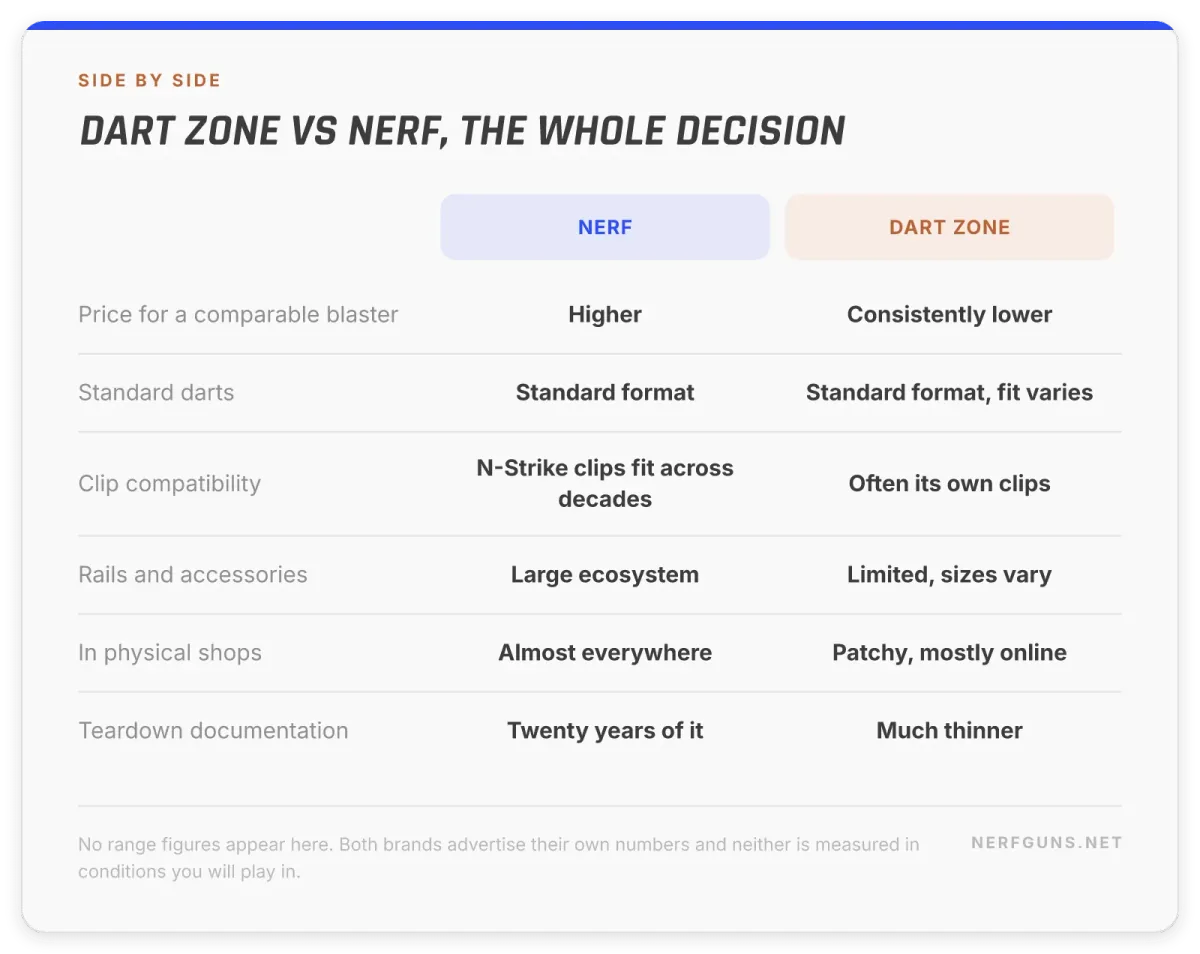
Buy Nerf if you want a blaster that fits everything else in the house, is on a shelf in every shop, and will still have compatible ammo and clips in five years.
Buy Dart Zone if you want the most blaster for the money and you do not care about the badge.
That is the whole Dart Zone vs Nerf decision in two lines. Everything below is the detail behind it.
Who the two brands actually are
Nerf is Hasbro. It has been the default name in foam since the 1970s. The reason it stays the default is distribution, not engineering. A Nerf blaster is in every supermarket, every toy shop and every online listing.
Dart Zone is made by Prime Time Toys, and it competes on value. It turns up next to Nerf on the same shelf at a lower price. It has spent years building a reputation with people who care about performance per pound rather than the name on the box.
The important difference: Nerf is a platform, Dart Zone is a product line. Nerf sells you into a system of clips, darts, rails and accessories that all work together across decades of blasters. Dart Zone mostly sells you a blaster.
Neither of those is wrong. They are different offers, and which one is better depends entirely on whether you already own foam.
Dart Zone vs Nerf on price
This is where the Dart Zone vs Nerf comparison usually starts, and it is the clearest win on the board.
Dart Zone is consistently cheaper for a comparable blaster. The gap is real and it is not a sale, it is how the brand positions itself.
We are not quoting hard prices on this page. Prices move, and a number written today is wrong by Christmas. What stays stable is the relationship: for any given size and mechanism, expect to pay noticeably less for the Dart Zone.
Where that changes is on ammo and accessories over time. A cheaper blaster that needs its own special parts is not cheaper after a year. That is why the darts section below matters more than the sticker.
If the budget is the constraint, the Dart Zone vs Nerf answer is straightforward: you get more blaster for the money from Dart Zone, and that has been true for years.
Dart Zone vs Nerf on darts and ammo
This is the part of the Dart Zone vs Nerf question people get wrong, and it costs them.
Full size foam darts from both brands are broadly interchangeable. Both build around the same standard dart format, so in most cases Dart Zone darts load into a Nerf blaster and Elite darts load into a Dart Zone one.
Broadly is doing work in that sentence. Fit varies. Foam density, head shape and length differ slightly between brands, and even between lines inside one brand. A dart that is a fraction too tight or too loose will feed badly or fly badly. Test a handful before you buy in bulk.
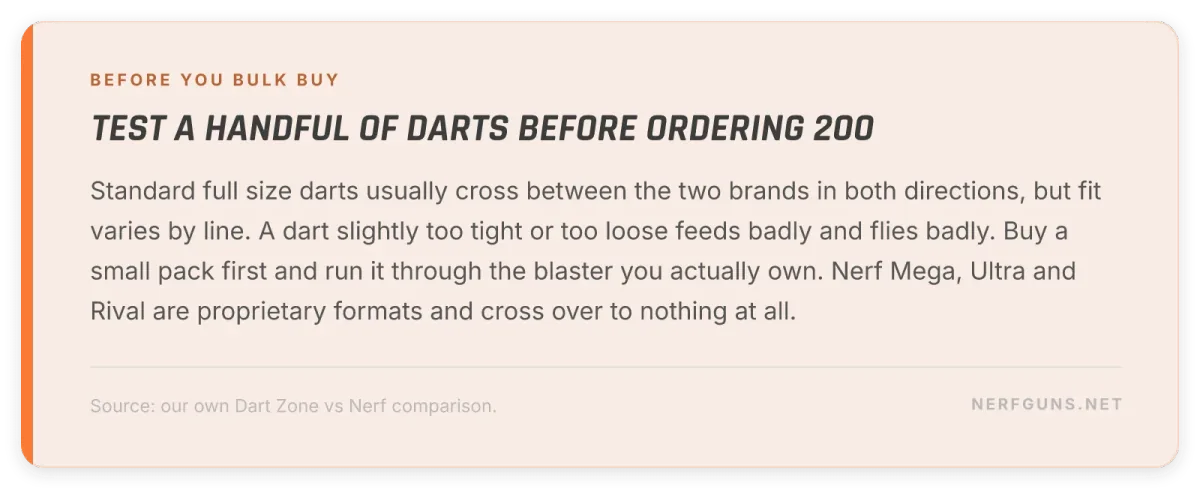
Where compatibility genuinely breaks is on the speciality formats. Nerf’s Mega, Ultra and Rival lines all use their own ammo, and none of it crosses over to anything. Buy into Ultra and you are buying Ultra darts forever. Nerf’s newest N1 darts do the same thing, which the 2026 section below covers.
The practical consequence: ammo is rarely a reason to pick one brand over the other on standard dart blasters, and it is a very good reason to avoid proprietary lines from either.
Our full breakdown of Nerf darts and which blasters take them covers each format and what actually fits what.
Dart Zone vs Nerf on clips and accessories
Here Nerf wins clearly, and it is the strongest argument for paying more.
The N-Strike clip is a standard. Clips and drums from across two decades of Nerf blasters drop into each other. Buy any clip fed Nerf blaster and every clip you already own still fits it.
Rails are the same story. The Nerf tactical rail has been consistent for years, so sights, lights and grips move between blasters freely. A large accessory market is built on that.
Dart Zone blasters often use their own clips and their own rail dimensions. Some are compatible, some are close enough to be annoying, and some are not compatible at all.
So the Dart Zone vs Nerf question changes completely depending on what is already in the house. Buying your first blaster, this barely matters. Buying your fifth, it matters a lot.
If you are building out a loadout rather than buying a single blaster, our guide to Nerf gun attachments and upgrade kits shows how much of that ecosystem exists.
Dart Zone vs Nerf on availability
Unglamorous, and genuinely decisive for a lot of buyers weighing up Dart Zone vs Nerf.
Nerf is everywhere. If a blaster breaks the week before a party, you can replace it that afternoon from a shop you can walk to.
Dart Zone has narrower distribution. It is easy enough to find online and much less reliable in physical shops depending on where you live.
Spare parts follow the same pattern. Neither company sells you a replacement spring over the counter. But the used market for Nerf parts is enormous, and the used market for Dart Zone parts is not.
For a birthday next week, that difference is the entire Dart Zone vs Nerf decision.
Head to head: Demolisher vs Scorpion
Here is the flagship from each brand side by side: Nerf’s N-Strike Elite Demolisher 2-in-1 against the Dart Zone Scorpion, sold as the Super Commando gatling blaster.
Both of these are older blasters and neither has a live buy box on Amazon today. The comparison still holds as a way of showing how the two brands think, which is why it stays on the page. For what each brand sells right now, skip to the 2026 section.
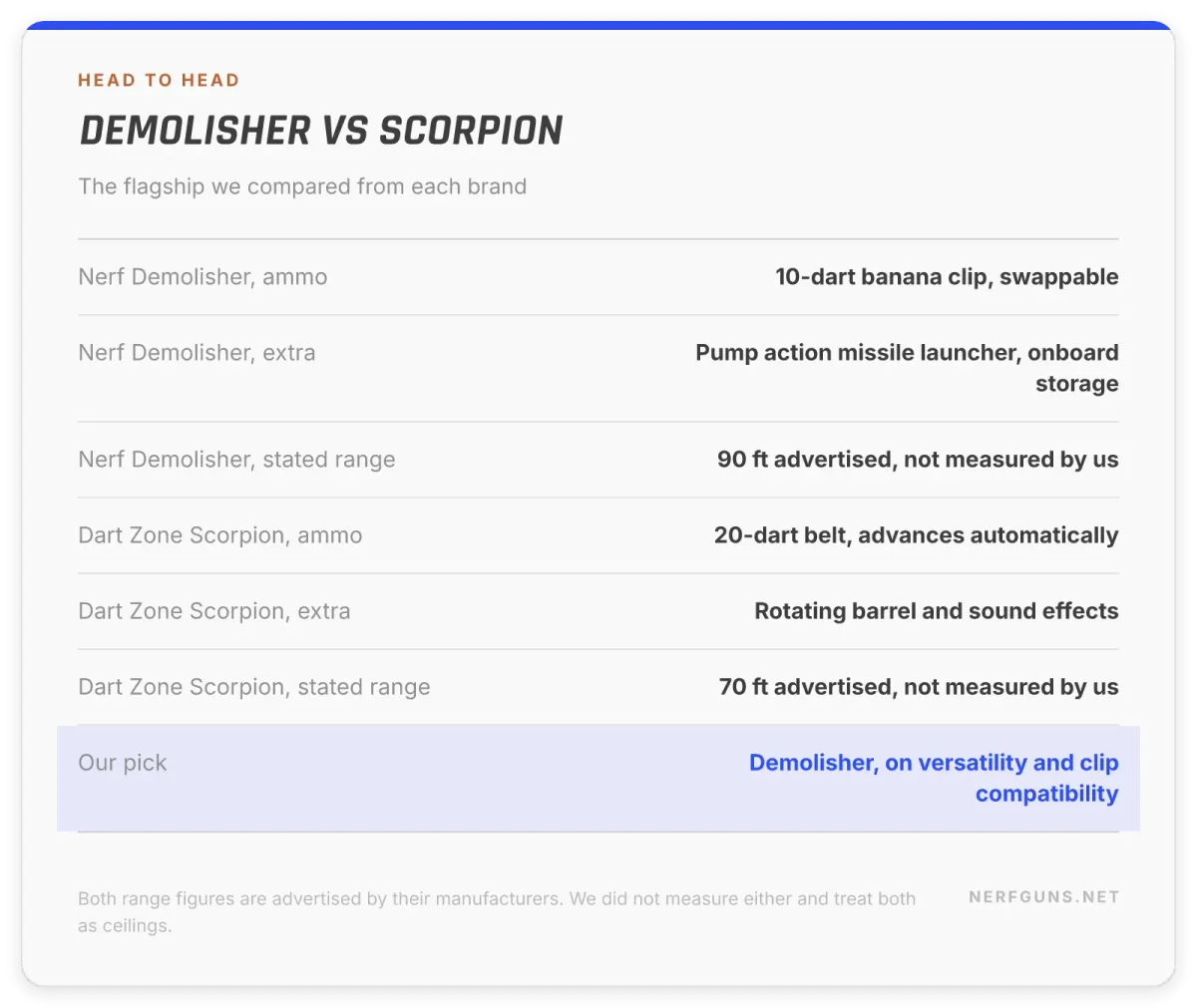

The Demolisher’s case is versatility. It is a motorised clip fed dart blaster with a pump action missile launcher underneath, and the missile is a genuinely different tool rather than a gimmick. It feeds from banana clips that swap in a second, and it carries the missiles on board.

The Scorpion’s case is volume and theatre. It runs an ammo belt that advances automatically, the barrel rotates as it fires, and it plays sound effects while it does it. For a certain kind of player that is the entire appeal, and it is delivered well.
One note on the belt count, because our sources disagree. Our archive recorded a 20 dart belt. Amazon’s own listing for it describes 18-round ammo belts. We cannot tell which version you will find, so count the belt in the listing photos rather than trusting either number, including ours.


Where the Scorpion loses is flexibility. The belt is the belt. There is no clip to swap. When it runs out you are re-belting rather than reloading, and that takes a while.
Where the Demolisher loses is price, and that is the whole Dart Zone vs Nerf trade in one blaster.

Our call: the Demolisher, but not by as much as the price gap suggests. Two tools in one blaster, plus clip compatibility with everything else you own, beats a belt and a sound chip. Take the Demolisher out of the picture and the Scorpion is an easy recommendation.
Build quality and how long they last
The Dart Zone vs Nerf argument usually stops at price, and durability is where the money actually shows up.
Nerf shells are consistent. Decades of the same tooling approach means you broadly know what you are getting. Flexible plastic, screws in sensible places, and a blaster that survives being dropped on a patio.

Dart Zone is more variable. Competing on price means choices get made somewhere, and across the range those choices land differently model to model. Some of their blasters are built as well as anything Hasbro ships. Some feel like the saving came out of the shell.
The failure points are the same on both: clip lips crack, priming handles wear, and battery contacts corrode if cells are left in over a winter. None of that is brand specific.
What Nerf has that Dart Zone does not is a used market deep enough to be a spare parts bin. A broken Nerf blaster is a donor for the next one. A broken Dart Zone blaster is usually just broken.
Over a single season you will not notice a difference. Over five years in a house with several blasters, the Nerf ecosystem quietly saves you money on replacements.

One more practical note on longevity. Blasters from both brands live or die on how they are stored, not on who made them. Cells left in over a winter. Darts left compressed in a clip. A shell on a sunny windowsill. Every one of those ages a blaster faster than actually using it does.
Take the batteries out, empty the clips, and keep them out of direct sun. That single habit does more for a collection than choosing between these two brands ever will.
Why we do not trust either brand’s range numbers
Both brands print a distance on the box. Nerf advertises 90 feet on the Demolisher. Dart Zone advertises 70 feet on the Scorpion.
Those are stated figures, not measured ones, and this page is not going to repeat them as though we put a tape measure on the grass.
Advertised ranges across this whole category are measured in conditions you will never play in. A launch angle chosen to maximise distance, fresh darts, no wind. A blaster that says 90 feet does not put darts 90 feet downrange in a garden.
What is worth comparing is relative, and even that is shaky across brands, because each measures its own way. Treat every advertised range as a ceiling, from both companies equally. That rule has not changed in the dart zone vs nerf argument and it never will.
If you want real numbers, measure them. Our kinetic energy calculator turns a chronograph reading and a dart weight into joules, which is the figure that actually means something.
Safety, ages and eye protection
Worth saying plainly, because safety is the one area where the Dart Zone vs Nerf comparison genuinely does not matter at all.
Both brands fire hard enough to need eye protection. Foam darts are not dangerous in general, and they are perfectly capable of hurting an eye in particular. Cheap safety glasses solve it permanently.

Age ratings on the box are about small parts and priming force rather than muzzle energy. A younger player can usually fire a blaster they cannot comfortably prime, which is the thing to actually check before buying.
Motorised blasters are easier for small hands than a heavy springer, from either brand. That is a better selection criterion than the number printed on the packaging.
Never modify a blaster a child is going to use. Never fire any blaster, from any brand, at somebody’s face at close range. Every organised game writes those two rules down, and they are the same rules whichever badge is on the shell.
Our guide to Nerf war games and rules covers how organised games handle safety, and it applies to Dart Zone blasters identically.
Which one modders prefer
An area where the Dart Zone vs Nerf comparison flips, and it surprises people who assume the cheaper brand cuts corners everywhere.
Nerf wins on community, Dart Zone often wins on internals. Because Dart Zone competes on hardware rather than brand, its blasters have a reputation for putting decent mechanisms in cheaper shells. That is exactly what a modder wants as a starting point.
What Nerf has is twenty years of documented teardowns. Whatever Nerf blaster you own, somebody has written up how to open it, what spring fits, and what breaks. That body of knowledge does not exist at anything like the same depth for Dart Zone.
For a first mod, that documentation is worth more than better internals. Start on a Nerf blaster where a guide exists, then apply what you learn anywhere.
The routes, tools and safety side are all in our Nerf gun mods guide, and the bench list is in the modder’s toolkit checklist.
What each brand actually ships in 2026
The head to head above is a 2013 argument. Both of those blasters are off the shelves. So here is the dart zone vs nerf question asked again, with what each company is selling now. The answer has moved.
Nerf went toward lock-in, which is the biggest dart zone vs nerf change in a decade. The current Loadout and N Series blasters fire N1 darts, and Nerf’s own listings say N1 darts are compatible only with N Series blasters. So the great Nerf advantage on this page, that everything fits everything, does not apply to Nerf’s own newest blasters. Your Elite drawer will not feed them.
Dart Zone went the other way, toward hardware. Blaster Hub’s coverage of the 2026 Toy Fair and its mid-year reports list a Dart Zone Pro range that has no Nerf equivalent at all: the Omnia Pro, the Venom Pro, and the Dart Zone Pro Mk2 and Mk4, the Mk4 with a swappable barrel.
The clearest dart zone vs nerf example is on the budget end. Blaster Hub reports the Adventure Force Axis Switch Pro at $70 with:
- a 2s Li-Ion pack rather than AA cells
- two 20-dart magazines and a magwell that switches between them
- select-fire
- and a PWM knob for adjusting your fps
Read that last one again. A dial on the blaster for setting how fast it shoots. Nerf does not sell anything like it, at any price. That is the 2026 dart zone vs nerf gap in a single feature.
Blaster Hub also reports two cheaper Adventure Force blasters from the same show: the Delta Pro at $14, described as a simple side-prime revolver with an upgrade kit available from Dart Zone at release, and the Nexus Pro X2 at $35, which Blaster Hub puts at 200fps. Those are Toy Fair prices as reported, not what a shop will charge you today.
So the dart zone vs nerf answer has genuinely changed, and it is worth being blunt about how. Two buyers, two different dart zone vs nerf verdicts.
- If you want a toy for an 8 year old that shares darts with the neighbours, Nerf is still the answer, and it always was. Just check whether the blaster takes Elite darts or N1 darts before you buy, because that decides whether your existing foam works.
- If you want hobby-grade hardware, the dart zone vs nerf answer is Dart Zone, which is now playing a game Nerf has left. Li-Ion packs, select-fire and an fps adjustment are not toy-aisle features, and Nerf is not competing there.
One honest limit on all of this dart zone vs nerf talk. We have not fired the 2026 Dart Zone Pro range, and you will find sites quoting big distance and rate-of-fire numbers for it. We could not trace those figures to Blaster Hub or to the manufacturer, so this page does not repeat them. The features above are reported specifications. The performance is not something we have measured.
Bonus tip: nobody ever guesses the right blaster, and a dart zone vs nerf aisle makes it twice as hard. Put the one you actually want on a free wish list, then send the link to whoever keeps asking what you want for your birthday. Start your free Nerf wish list and let them buy the right thing.
Which one should you buy
There is no single Dart Zone vs Nerf winner, because the right answer depends on what you already own. Four buyers, four answers.
- First blaster in the house, budget matters: Dart Zone. You get more hardware for the money and you are not yet locked into anyone’s ecosystem.
- Adding to blasters you already own: Nerf. Clip and rail compatibility is worth the premium once you have a drawer of clips.
- Buying for a group or a party: Nerf, for availability and because everyone’s ammo will work in everyone’s blaster.
- Buying to take apart: Nerf first for the documentation, Dart Zone once you know what you are doing.
The honest summary of dart zone vs nerf: Dart Zone makes the better argument on paper, and Nerf makes the better argument in a house that already has foam in it.
For the wider field beyond these two, our guide to every Nerf line worth knowing covers what each range is actually for, and the Rival series is where Nerf competes on performance rather than price.
Frequently asked questions
As an Amazon Associate and eBay Partner, we earn from qualifying purchases. The Amazon and eBay links on this page are affiliate links. They cost you nothing extra and they are what keeps this catalogue updated. See our affiliate disclosure.
Are Dart Zone darts compatible with Nerf blasters?
Standard full size darts usually are, in both directions. Fit varies slightly by line, so test a few before buying in bulk. Nerf’s Mega, Ultra and Rival formats are proprietary and do not cross over at all.
Dart Zone vs Nerf in 2026: has the answer changed?
Yes, in one important way, and it flips part of the usual dart zone vs nerf argument. Nerf’s newest blasters, the Loadout and N Series lines, fire N1 darts that only work in N1 blasters, so the “everything fits everything” argument no longer covers Nerf’s own current range. Meanwhile Blaster Hub’s 2026 Toy Fair coverage shows Dart Zone pushing into hobby-grade hardware, including an Adventure Force Axis Switch Pro with a Li-Ion pack, select-fire and a knob for adjusting fps. Nerf sells nothing comparable. For a young player sharing darts with friends, Nerf is still the easy answer. For hardware, Dart Zone has pulled ahead.
Is Dart Zone better than Nerf overall?
On price per blaster, generally yes. On compatibility, availability and the accessory ecosystem, no. The Dart Zone vs Nerf answer depends on whether you already own foam.
Dart Zone vs Nerf: which brand shoots further?
Both advertise similar ranges and neither figure is measured in conditions you will play in. Treat advertised ranges as ceilings from both companies and judge blasters on mechanism and dart quality instead.
Which is better for a Nerf war?
Nerf, mostly for boring reasons. Everyone else’s clips and darts will fit yours, replacements are easy to find, and most event rules are written around Nerf formats.
Do Dart Zone clips fit Nerf blasters?
Often not. Clips are where the two brands diverge most, and it is the single biggest practical argument for staying inside one system if you own several blasters.
Where can I buy each brand?
Nerf is in most physical shops as well as online. Dart Zone is easy to find online and much less consistent on shelves, which matters if you need something this week.
Compare current listings: Dart Zone blasters and Nerf N-Strike Elite blasters. The N-Strike Elite Demolisher 2-in-1 and the Dart Zone Scorpion are the two we compared above, and both are searches rather than product pages because neither has a live buy box.
Both are old enough now that the used market is often the better route. Used Dart Zone Scorpion listings on eBay turn up more often than Amazon stock does.
Animated clips on this page were captured from videos by nerfboyproductions, blasterlabs and lorddraconical.