
All, Best and New Rival Nerf Guns in 2026
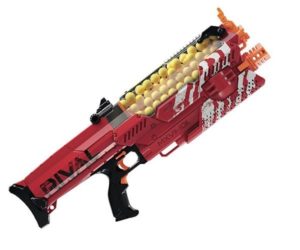
Rival is the grown-up version of this hobby. Round ammo instead of darts, a stated 95 to 102 feet per second at the muzzle, team colors, and a 14 and up age rating that tells you exactly who Hasbro built it for.
Here is the part nobody puts at the top of the page. Hasbro has not launched a new Rival blaster since 2024. The Mirage XXIV-800 and the Challenger MXXIV-1200 arrived that year, and nothing newer has been confirmed since. Rival blasters and Rival rounds are both still sold, but shelf presence is thinner than it was, so check stock before you settle on one model.
What is on this page
- What Rival is, and the 2 mistakes buyers make
- Why Rival exists at all
- The Rival lineup at a glance
- Rival ammo, and what the aftermarket changes
- How hard Rival actually hits
- Age rating and face protection
- Rival is half the story now: Gelfire
- Rival against darts, airsoft and paintball
- The 4 Rival sub-series
- Rails, accessories and tips
- Why dart tag centers run Rival
- Batteries, and what the motorized ones cost to run
- What to buy first
- Buying a retired Rival blaster
- Where to buy Rival blasters
- Frequently asked questions
What Rival is, and the 2 mistakes buyers make
Two mistakes cost people money on this line every week.
- Buying a blaster and finding the rounds are sold separately. Most listings include a starter amount that will not get you through one game.
- Buying darts because the listing said Nerf. Rival does not shoot darts. It shoots high impact rounds, and no dart of any kind will fit.
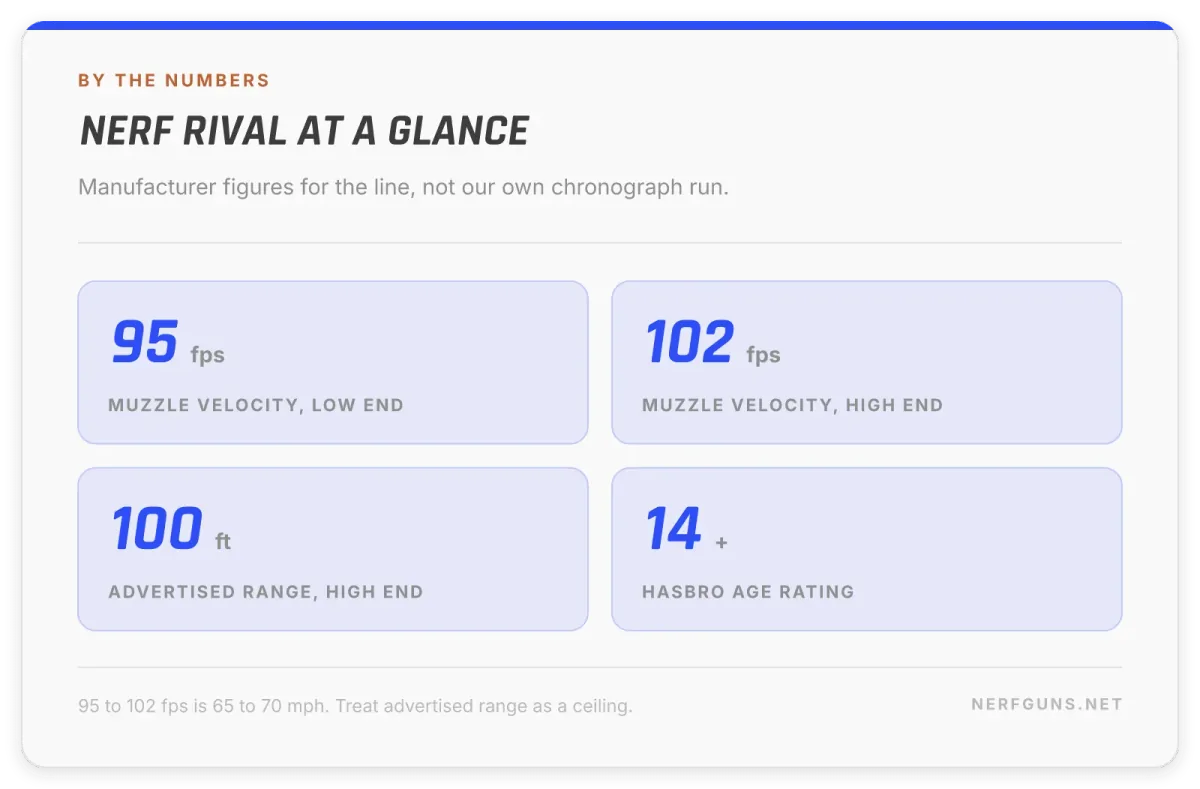
The basics of the line, in one list:
- Fires at 65 to 70 mph (95 to 102 fps)
- The diameter of Rival ammo is 2x that of a dart
- Advertised range of 90 to 100 feet
- Not available in some countries due to safety requirements
- Magazine and hopper fed, from 12 to 100 rounds
- Sold in red and blue to match the line’s team based focus, with other schemes added later
The styling is boxy on purpose. The grips and the overall length are sized for bigger hands, which tells you who this was built for.
Two safety features are worth knowing. These blasters will not dry fire, so nothing happens without a ball in the chamber, and there is a trigger safety you can switch on to stop an accidental shot.
Why Rival exists at all
The oldest problem in dart wars is scoring. If you cannot tell who got hit, you cannot run a tournament.
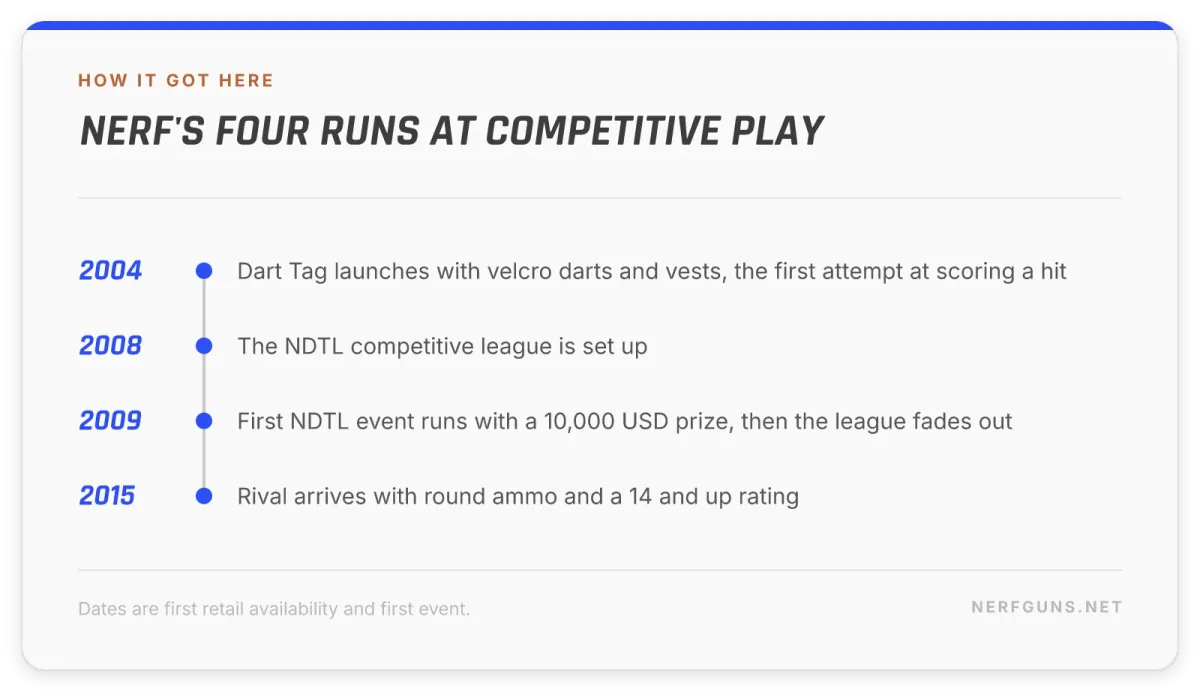
Hasbro’s first answer was the Dart Tag line in 2004, with velcro darts and vests the darts would stick to. Four years later the NDTL was set up, and its first event ran in 2009 with a 10,000 USD prize. It faded out, and Nerf was left without a competitive product again.
Then in 2015 the Rival line of ball blasters arrived.
The case for round ammo
These blasters shoot round, dimpled foam balls at up to 70 mph, which is 30 meters per second. That number reads as dangerous and it is not, for the same reason the old Vortex discs were not. The rounds bleed speed quickly.
What you get in exchange is a shot that is genuinely hard to dodge at close and medium range. A dart arcs and slows and you can watch it come. A Rival round does not give you that much warning.
That is the whole argument for the line, and it is why it works for older players who found darts too easy to read.
The Rival lineup at a glance
All 22 Rival blasters, oldest first. The Roman numerals in each name are the release year, so the years column is a sanity check rather than a surprise.
| Blaster | Year | Rounds | Power | Priming | Status |
|---|---|---|---|---|---|
| Apollo XV-700 | 2015 | 7 | Spring | Slide action | Discontinued |
| Zeus MXV-1200 | 2015 | 12 | Motorised | Motor, trigger | Discontinued |
| Atlas XVI-1200 | 2016 | 12 | Spring | Pump action | Discontinued |
| Khaos MXVI-4000 | 2016 | 40 | Motorised | Motor, trigger | Discontinued |
| Artemis XVII-3000 | 2017 | 30 | Spring | Pump action | Discontinued |
| Nemesis MXVII-10K | 2017 | 100 | Motorised | Motor, trigger | Discontinued |
| Helios XVIII-700 | 2018 | 7 | Spring | Bolt action | Discontinued |
| Kronos XVIII-500 | 2018 | 5 | Spring | Slide action | Available |
| Hypnos XIX-1200 | 2019 | 12 | Spring | Pump action | Available |
| Knockout XX-100 | 2019 | 1 chambered, 4 stored | Spring | Slide action | Available |
| Perses MXIX-5000 | 2019 | 50 | Motorised | Motor, trigger | Discontinued |
| Charger MXX-1200 | 2020 | 12 | Motorised | Motor, trigger | Available |
| Finisher XX-700 | 2020 | 7 | Spring | Slide action | Available |
| Roundhouse XX-1500 | 2020 | 15 | Spring | Slide action | Available |
| Takedown XX-800 | 2020 | 8 | Spring | Pump action | Available |
| Fate XXII-100 | 2022 | 1 | Spring | Direct prime | Available |
| Pathfinder XXII-1200 | 2022 | 12 | Spring | Pump action | Available |
| Vision XXII-800 | 2022 | 8 | Spring | Slide action | Available |
| Forerunner XXIII-1200 | 2023 | 12 | Spring | Pump action | Available |
| Pilot XXIII-100 | 2023 | 1 | Spring | Direct prime | Available |
| Challenger MXXIV-1200 | 2024 | 12 | Motorised | Motor, trigger | Available |
| Mirage XXIV-800 | 2024 | 8 | Spring | Not listed | Available |
Capacity, priming and status compiled from the Nerf Wiki product pages, checked 16 August 2026. The Challenger row is quoted from its Amazon listing instead, checked 27 August 2026.
Read the status column carefully. It says whether Hasbro still lists the blaster, not whether a shop has one in a box today. Those are different questions and the second one changes weekly.
Checking Amazon on 27 August 2026 we could not find a live listing for the Hypnos, Knockout, Charger, Takedown or Fate. That is not proof Hasbro stopped making them, but it does mean those five are a hunt rather than a purchase right now. The ones we could buy on the day are in where to buy.
Once you know the naming convention you can decode most models on a shelf. The Roman numerals are the release year, so Nemesis MXVII is a 2017 blaster because XVII is 10 plus 7. A leading M means motorized, and the number is roughly what it holds.
Only 6 of the 22 are confirmed motorized. That surprises people who think of Rival as the battery line. The Zeus, Khaos, Nemesis, Perses, Charger and Challenger take batteries, and the rest are spring blasters you prime by hand, which is why a Rival kit does not have to mean a bag of D cells.
The Challenger MXXIV-1200 used to be the gap in that count. Its Amazon listing now states the specs outright: motorized, with a removable curved 12 round magazine and 18 Accu-Rounds in the box. The naming rule was right.
The performance gap inside the line is wide. A 12 round magazine blaster and the 100 round hopper on the Nemesis are not the same tool for the same job.
Where the line stands today
What is safe to say without checking anything: the ammo standard has not changed. Rounds bought years ago still feed blasters bought today, and that is unusual enough in this hobby to be worth saying out loud.
Rival ammo, and what the aftermarket changes
Rival rounds are built to fly like a golf ball. The dimples cut through air resistance instead of pushing against it, which is what gets them out to the advertised range. They measure 1 inch across, or 2.5 cm, roughly twice the diameter of a dart.
Official round colors run to red, green, blue, white, yellow, orange, purple, two-tone combinations and a glow version.
Third party rounds
Aftermarket ammo now covers the whole spectrum of foam, from Mega to Vortex discs to Rival rounds. Third party rounds are often denser than the official ones.
Denser means further, and it also means the hit is felt more. That is a trade, not an upgrade, and on a line already rated 14 and up it is worth thinking about before you buy a bag.
The weight consistency question
There has been concern in the community about weight variance between rounds. One group weighing them found a spread of as much as 0.53 grams, and inconsistent weight means inconsistent shots.
For most people this will not matter. Paintball and airsoft ammo have the same problem, and this is the cheapest of the three.
Sources, both still live: the foam rounds measurement thread and the ammo weight consistency thread.
How hard Rival actually hits
Hasbro’s stated figure for the line is 95 to 102 feet per second. In real conditions, expect 90 to 100 feet per second, and expect the same Rival blaster to land at different points in that band on different days.
Foam velocity is not a fixed number. A headwind takes feet off a shot and a tailwind hands them back. Cold air and a cold spring both read lower than a warm afternoon. Batteries sag as a game runs on, so a motorized Rival blaster that starts at the top of the band finishes further down it. The rounds wear too: one that has been stepped on twice and scuffed along a gym floor does not fly like a fresh one out of the bag.
That is why a single number is the wrong shape for this question. Treat the band as the answer, and be suspicious of anyone quoting Rival velocity to one decimal place.
Which Rival blaster hits hardest
Velocity is deliberately consistent across the line. Matched speed is what makes team play fair, so Hasbro did not build a Rival blaster that outguns the rest. What separates them is volume and reach, not power.
So when somebody asks for the most powerful Rival blaster, the honest answer is the Nemesis MXVII-10K: 100 rounds in a hopper and a fully automatic trigger. It wins by putting more foam in the air, not by hitting harder than a Kronos.
Age rating and face protection
Hasbro sets the age range for this series at 14 and above. That rating is printed on the products themselves, not invented here: open the Kronos XVIII-500 listing and you will see it stated on the product itself. Some centers treat 12 and up as fine, and some will let younger players use one under adult supervision.
The point of the rating is not that the blaster is fragile, it is the velocity. Because the rounds move faster than darts, the full face mask sold alongside these blasters is non negotiable rather than optional.
It covers eyes, nose and mouth, the grill is vented so you can breathe while you run, and the band adjusts. Anyone who has played airsoft or paintball will recognize the shape immediately.
Team colors
Red or blue, and the colors do real work. In a game with no hit markers, being able to tell teams apart at a glance is most of what keeps a match running. Masks come in matching colors.
Some listings carry no age at all, and that is worth saying out loud. A few blasters and ammo packs in this line, the Mirage XXIV-800 and the Prometheus MXVIII-20K among them, have listings with no manufacturer age rating on them. This page will not print one for those. Hasbro puts this whole class above the ordinary foam shelf because the rounds travel faster and hit harder than darts. Check the packaging yourself, and do not treat the absence of a printed age as permission.
Rival is half the story now: Gelfire
Amazon shelves Rival under Competitive Class, and it is not alone there any more.
Gelfire is the other half. Instead of foam rounds it fires gel beads that burst on impact, and Hasbro markets it to the same older audience as Rival. If you are shopping the 14 and up shelf, it is the alternative you will see next to every Rival blaster.
How to choose between them:
- Rival fires reusable foam rounds. You pick them up and shoot them again, which suits a long game and a fixed field.
- Gelfire fires gel beads that burst, so there is nothing to collect afterwards, but you are buying ammunition every time you play.
- Both need full face protection. That is the whole reason the shelf is separated from the 8 and up blasters, and it applies to gel just as much as foam.
Our best Nerf guns guide covers the current picks on both shelves side by side.
Rival against darts, airsoft and paintball
Against standard Elite dart blasters:
- Pro. Rounds fly faster and are harder to dodge at close range.
- Con. The blasters cost more than comparable dart blasters.
- Con. The ammo costs more than darts.
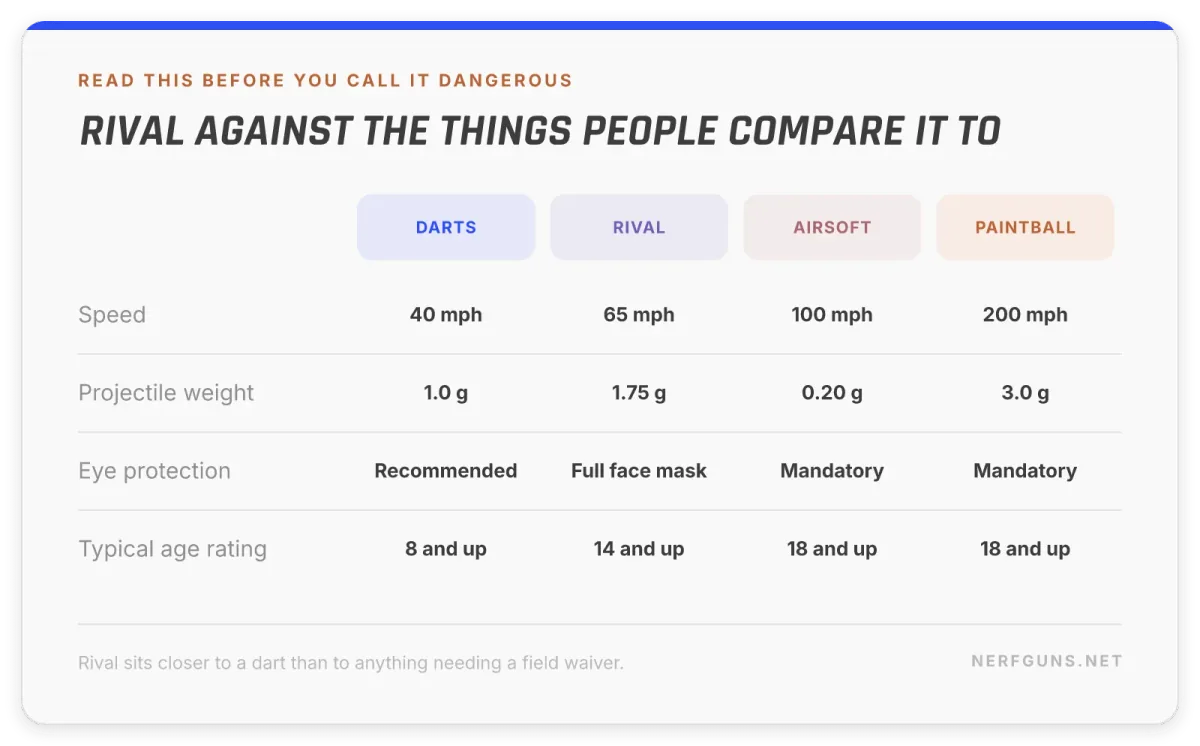
For conversion, 1 fps equals 0.681 mph.
| Ammo | Speed | Weight |
|---|---|---|
| Darts | 40 mph | 1.0 g |
| Rival | 65 mph | 1.75 g |
| Airsoft | 100 mph (145 fps) | 0.20 g |
| Reball | 220 fps | 2.6 g |
| Paintball | 200 mph (300 fps) | 3.0 g |
Read that table before you decide Rival is dangerous. It sits closer to a dart than to anything you need a field waiver for.
Rival against Hyper
Hyper is the closest comparison Nerf makes to Rival, and the two get confused constantly. Both fire balls rather than darts, and both are aimed at older players.
The difference is the size of the ball. A Hyper round is much smaller, so a Hyper hopper swallows far more of them, which is the whole argument for that line. A Rival round is roughly an inch across and twice the diameter of a dart, so you carry fewer and each one is easier to find on the floor afterwards.
The two ammo types are not interchangeable in either direction. A Hyper round rattles straight through a Rival barrel and a Rival round will not enter a Hyper one, so pick a line before you buy a bag of ammunition rather than after.
The 4 Rival sub-series
Rival is not one flat line. Four sub-series sit inside it, and knowing which one a blaster belongs to explains most of what looks inconsistent on a shelf.
Phantom Corps
Black and white instead of red and blue. Phantom Corps blasters are re-released and exclusive models built for players who do not want to be locked to a team colour, and each one ships with two coloured lanyard flags, one red and one blue. Clip the flag to a sling mount, or wear it, and you are on that team for the game.
Edge Series
The accuracy branch. Edge Series blasters run long barrels and a sniper-styled shape, and they are the closest thing the line has to a marksman blaster. If you came here searching for a Rival sniper, this is the sub-series you actually want.
Curve Shot
Blasters you can adjust to bend a round left, right or down. The shells are curvy on purpose so the feature reads at a glance. It is a gimmick that turns out to matter in a corridor, because a curved shot reaches a player behind cover that a straight one cannot.
Camo Series
Camouflage colourways of existing blasters, the Rival equivalent of the BattleCamo run in N-Strike Elite. Same internals, different shell.
Rails, accessories and tips
The Rival tactical rail is not the same rail as the one on your other blasters, so Rival attachments are what fit. You can buy an adapter, or 3D print a picatinny adapter, which opens the rail up to scopes, red dots and action cameras.
Coop772 covered the rail differences in this video. One Zeus owner found a Modulus accessory that fit, which suggests some cross compatibility.
Attachment options across every line are covered in our guide to Nerf gun attachments.
Three tips worth having
- Load the last few rounds in a different color. When you see that color come up, you know you are about to be empty.
- Two Apollos can be run at once. With a simple mod you can latch the top cocking mechanisms together in opposing directions so both cock hands free. NerfGunAttachments demonstrated it in this video.
- Bounce your shots. Rival rounds are springy and bank off walls and around corners in a way a dart never will. It is the most fun thing about ball ammo and almost nobody uses it.
Why dart tag centers run Rival
The Rival line became a favorite of dart tag centers around the world, and the reason is housekeeping rather than performance.
Balls can be scooped off the floor straight back into a magazine, and a leaf blower will herd them into a corner. Try that with darts.
Parents, take the same note. If you are tired of finding darts under furniture, ball ammo is easier to live with.
One dart tag center in the UK calls it the bridge between paintball and Nerf, and in a country where paintball is established they would know. Mega Blaster World describes it as pain free and mess free while keeping the arena feel of paintball.
Batteries, and what the motorized ones cost to run
Half this line is motorized, and the battery bill is the part nobody mentions in a review.
The Nemesis and the Khaos both take 6 D cells. Not AA, not C. D cells are the expensive ones, they are heavy, and 6 of them add real weight to a blaster you are already carrying a hopper on.
Buy rechargeables for anything motorized. Six alkaline D cells cost more than a bag of rounds, and a motorized blaster will go through them in an afternoon of steady play. The same 6 rechargeable cells pay for themselves inside about 3 games.
The Prometheus sidesteps this with a rechargeable pack in the box, which is one of the better arguments for it over the Nemesis despite the price.
The spring blasters need nothing at all. An Atlas or an Artemis works out of the box forever, which is a genuine advantage at an event where you cannot charge anything. If you are equipping several players at once, a spring blaster each and one motorized blaster to share is the sensible split.
What to buy first
If you are starting from nothing, buy in this order. It is the same order we would set up any project in the shop: the thing that keeps you safe, the thing you will run out of, then the toy.
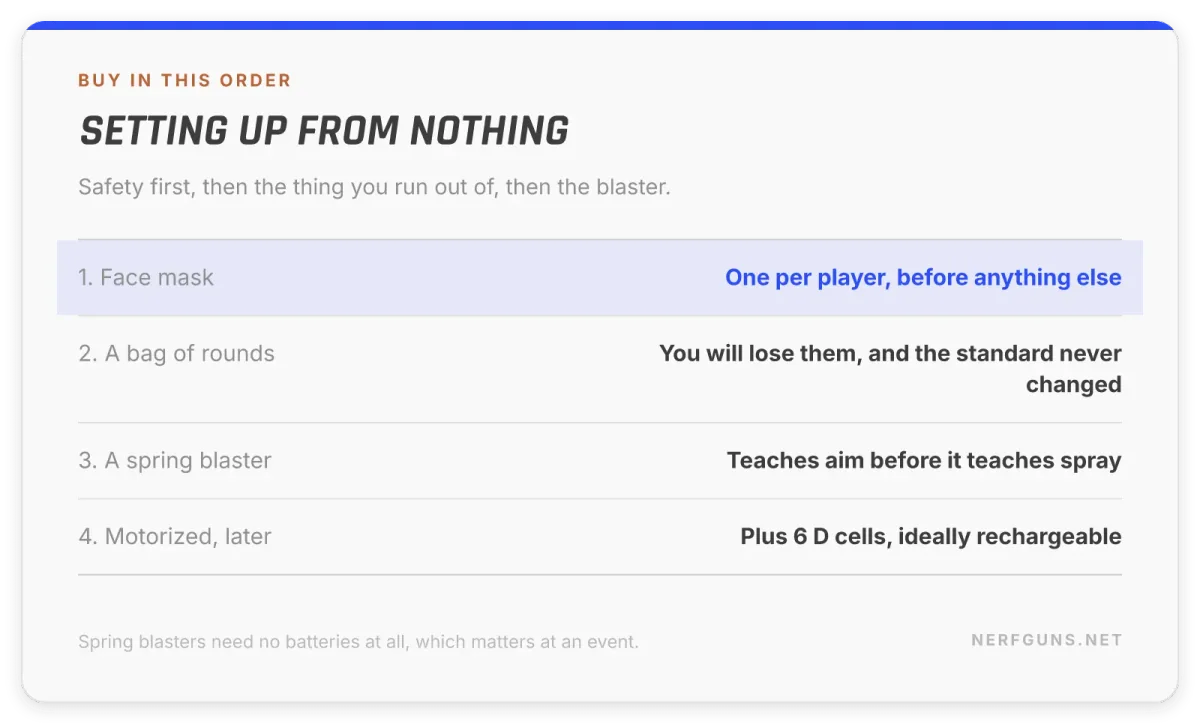
- A face mask. Before anything else, and one per player. At Rival velocities this is the piece you do not skip.
- A bag of rounds. You will lose them. Everyone loses them. A blaster with no ammo is a paperweight, and the ammo standard has not changed across the line’s life, so extra rounds are never wasted money.
- One spring blaster to learn on. A magazine fed spring blaster teaches you to aim before it teaches you to spray.
- The motorized blaster later. On the current shelf that means the Challenger MXXIV-1200, which feeds 12 rounds from a curved magazine. The Nemesis and its 100 round hopper are still the fun ceiling of the line, but that one is a used-market hunt now.
Buying a retired Rival blaster
Most of the Rival blasters people ask about are out of production.
Amazon can still show you a page for them, but with no buy box it cannot sell you one, so the searches below go where they actually change hands.
Nemesis on eBay | Prometheus on eBay | Khaos on eBay | Artemis on eBay | Atlas on eBay | Rival job lots.
The Artemis is the one to watch for. It was in our buy list until its Amazon listing lost its buy box, and 30 rounds across 3 barrels still makes it one of the best spring blasters the line ever had.
Three things to check before you pay.
- Rounds are usually missing. A hopper blaster with no rounds is half a purchase, and the refills are sold separately.
- Check the battery bay on anything motorized. These sat in cupboards with batteries in for years.
- Ask whether the mask is included. It rarely is on a used blaster, and on this shelf it is not optional.
Where to buy Rival blasters
As an Amazon Associate and eBay Partner, we earn from qualifying purchases. The Amazon links on this page are affiliate links. They cost you nothing extra and they are what keeps this catalogue updated. See our affiliate disclosure.
| # | Buy this | Then this ammo | Batteries | Eye protection |
|---|---|---|---|---|
| 1 | Mirage XXIV-800, 8 rounds, pump action. Two ways to load the magazine, so a reload does not cost you the fight. | 50 Accu-Round refill | None | Rival face mask |
| 2 | Forerunner XXIII-1200, 12 rounds, breech load, pump action. The rear sight slides, so this is the one for aiming. | 50 Accu-Round refill | None | Rival face mask |
| 3 | Vision XXII-800, 8 rounds in an integrated magazine, draw-back priming bar. Simple and hard to jam. | 50 Accu-Round refill | None | Rival face mask |
| 4 | Pilot XXIII-100, single shot, break-barrel loading. The cheapest way to find out whether you like Rival at all. | 50 Accu-Round refill | None | Rival face mask |
| 5 | Challenger MXXIV-1200, 12 rounds from a curved magazine, motorized. The battery blaster of the current shelf. | 50 Accu-Round refill | See listing | Rival face mask |
Every blaster above had a live buy box when we checked on 27 August 2026. Rival stock still moves around, so if one has gone quiet, this search shows the Rival blasters actually in stock today.
The retired ones are further up, in buying a retired Rival blaster, and they are a different kind of shopping.
Bonus tip: this is a shelf you build up rather than buy in one go, between the blaster, the ammunition and the mask. Save the pieces you still need so you stop guessing at the checkout.
Frequently asked questions
What is Nerf Rival?
Rival is Nerf’s performance line, launched in 2015. Hasbro rates it 14 and up, and that number is printed on the products themselves. Instead of darts it fires round, dimpled foam balls at 65 to 70 mph, with an advertised range of 90 to 100 feet, out of magazines and hoppers holding 12 to 100 rounds. It was built for competitive, team based play.
Is Rival owned by Nerf?
Rival is a Nerf product line, and Nerf is owned by Hasbro. It is not a separate company or a competing brand, despite the name.
How fast do Rival blasters shoot?
65 to 70 mph, which is 95 to 102 fps. For comparison, a standard dart blaster runs around 40 mph and airsoft runs around 145 fps.
What is the most powerful Rival blaster?
By capacity and rate of fire, the Nemesis, with its 100 round hopper and full auto motorized firing. Velocity is broadly consistent across the line, so power here means volume more than speed.
Is there a Rival sniper or a Rival shotgun?
Not under those names. These blasters are categorized by feed and capacity rather than by role, so what people mean by a sniper is usually a single fire spring blaster with a scope on the rail, and what they mean by a shotgun is one that throws more than one round per trigger pull.
Can Rival blasters shoot other ammo?
The Zeus has been shown firing a Mega dart on video. It is not what the blaster is for and it is not worth doing. Stick to the proper rounds.
Is Rival discontinued?
No. The newest Rival blasters are the 2024 Mirage XXIV-800 and the Challenger MXXIV-1200, and nothing newer has been confirmed since, so the line is quiet rather than cancelled. Blasters and ammo are both still widely available, and because the ammo standard never changed, rounds you buy today feed any blaster in the line.
Does it hurt to get hit by a Rival round?
You feel it, and that is the honest answer. It stings more than a dart and less than an airsoft BB, and it fades in seconds. Bare skin at close range is the combination worth avoiding, which is why long sleeves are common at events even though nobody makes it a rule.
Can you use Rival rounds in a dart blaster?
No. The rounds are about twice the diameter of a dart and will not enter a dart barrel or magazine. The two systems share nothing but the brand on the box, so plan your ammo per blaster rather than per collection.
What do the roman numerals in the names mean?
The release year. Nemesis MXVII came out in 2017, because XVII is 10 plus 7.
What do the numbers in the names mean?
Roughly how much the blaster holds. The Nemesis carries a 100 round hopper and the Zeus feeds from a 12 round magazine.
What does a leading M mean?
Motorized. The Nemesis MXVII is a motorized, fully automatic blaster, which is why it breaks the naming pattern.
Browsing the whole catalogue? Here is every Nerf gun ever made, and the N-Strike line if you would rather stay with darts.
Asking for a Rival blaster as a gift? Put it on a free Nerf wish list and the rounds go on with it, along with a face mask. Rival does not fire darts, and that is the mistake that ruins the day. Found it on a shop page instead? The free Chrome extension puts it on that list in two clicks.