
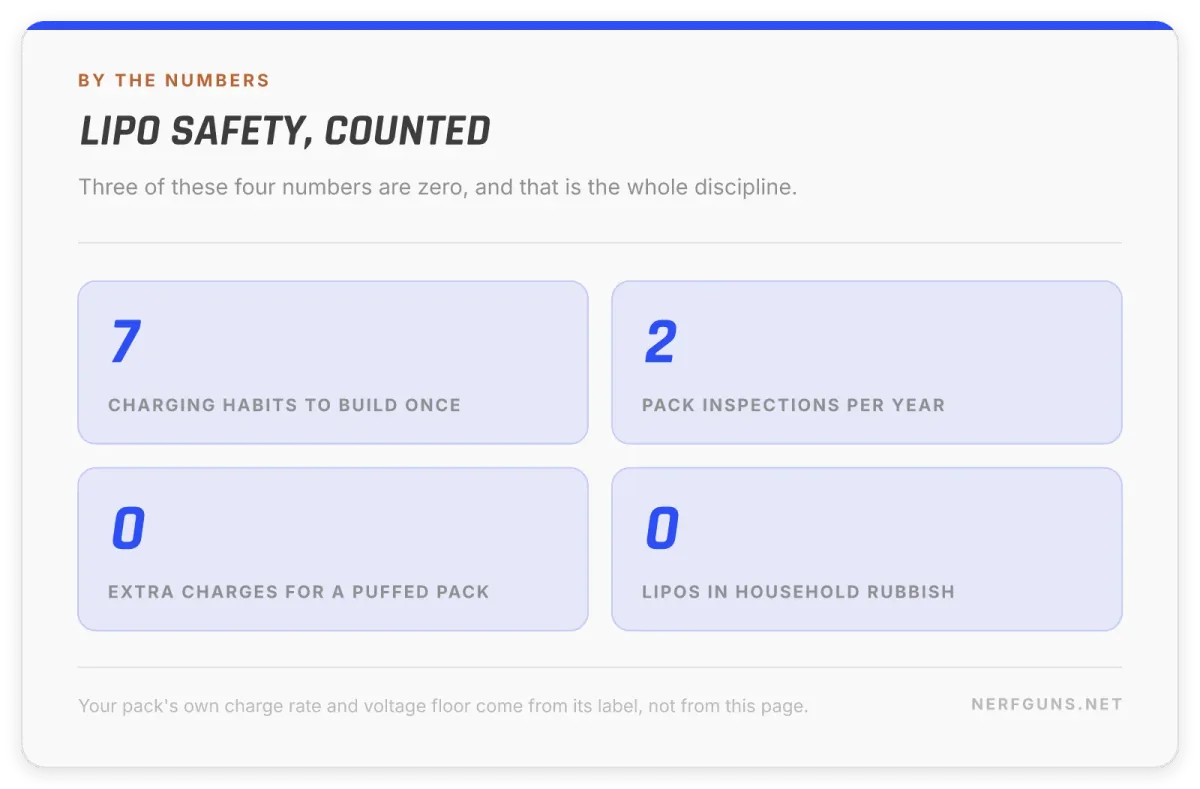
LiPo battery safety is the one part of this hobby that can burn your house down, and every single time it happens somebody skipped a habit on this list. None of it is complicated. It is 7 habits, built once, and then a LiPo is the most boring thing on your bench.
What is on this page
- Why LiPo battery safety is different from other batteries
- Reading the label: mAh, C rating and cell count
- Before you buy: know what you are buying
- Charging, the seven habits
- Storage, the part everybody skips
- In the blaster
- Taking packs to an event
- When a pack goes bad
- If something does go wrong
- If you would rather not run LiPo at all
- The five mistakes behind almost every incident
- The short version, taped inside the charging box
- Gear for this checklist
- Frequently asked questions
Gunner here, and I am going to be straight with you for a minute.
LiPo packs are the reason modern flywheel blasters hit the numbers they hit. Nothing else gives you that much current in that small a package.
I worked in an off road shop for years. We treated batteries with respect there for the same reason. A battery does not care that it is powering a toy.
Why LiPo battery safety is different from other batteries
An alkaline cell that fails leaks. A LiPo pack that fails supplies its own reaction and keeps going.
Everything on this page follows from that one sentence, and it is why LiPo battery safety gets its own checklist instead of a paragraph.
- The energy is packed far tighter. That density is exactly why the pack is worth running, and exactly why it deserves the handling.
- Damage is often invisible from outside. A pack that was crushed or punctured can look fine and fail days later.
- Failure is fast once it starts. There is no slow warning phase to catch up on later.
- Almost every incident traces back to charging. Which is why the charging section below is the longest one on the page.
Nothing here is meant to scare you off LiPo. I run them. The point is that the rules are short, fixed, and worth learning before the pack arrives rather than after.
Reading the label: mAh, C rating and cell count
Most LiPo battery safety mistakes start as a buying mistake, and buying mistakes start with a label nobody explained.
Three numbers do all the work.
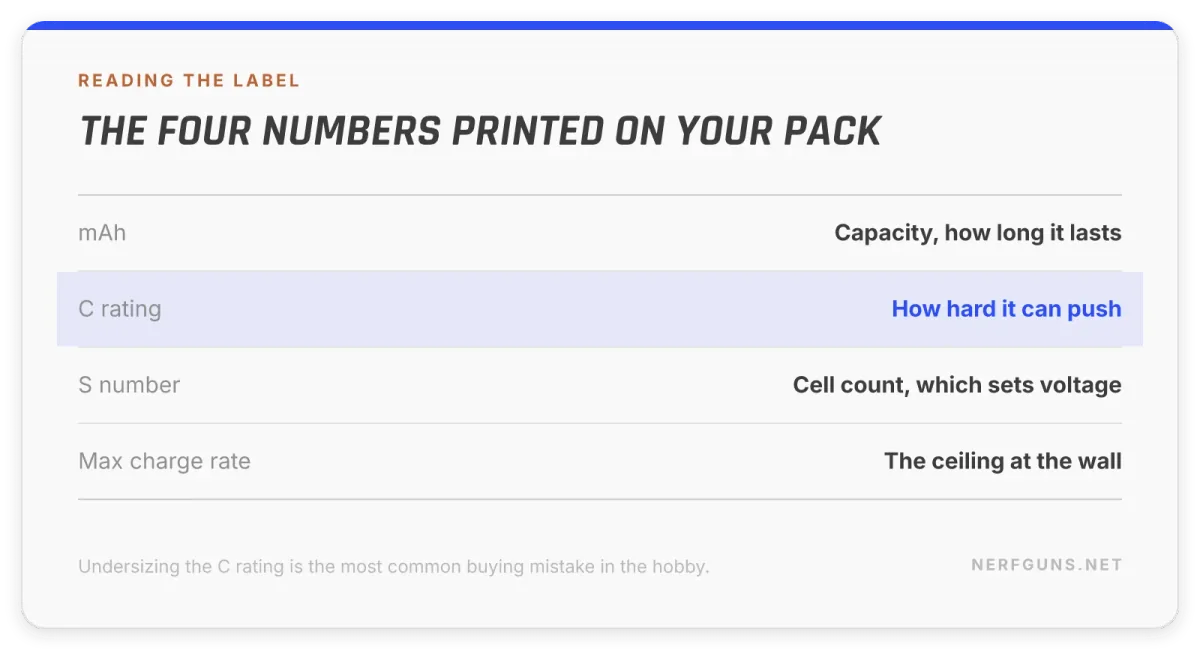
- mAh is capacity. How long the pack lasts before it needs charging. Bigger number, longer runtime, heavier pack.
- The C rating is how hard it can push. This is the one people ignore. It governs how much current the pack can deliver without getting hot.
- S is the cell count, which sets voltage. A 2S and a 3S are not interchangeable, and your build was designed around one of them.
There is a fourth number, and it is the one that matters at the wall: the maximum charge rate printed on the pack. That number is not a suggestion.
Before you buy: know what you are buying
- Read the C rating, not just the mAh. The mAh number is how long it lasts. The C rating is how hard it can push. A pack that cannot supply what your motors pull will get hot, swell, and fail early. Undersizing the C rating is the most common buying mistake in this hobby. The LiPo battery calculator will tell you whether a pack’s own numbers can feed your motors.
- Know your cell count. A 2S pack and a 3S pack are different voltages, and putting 3S into a setup built for 2S is how motors and switches die. Your build has a number. Buy that number.
- Buy from a seller who publishes real specs. If the listing will not tell you the C rating, the seller does not know it either.
- Buy the charger at the same time. A balance charger is not an accessory, it is half of the purchase. See the next section.
The charger is where people economise and it is the worst possible place to do it. LiPo battery safety is mostly charger behaviour.
Charging, the seven habits
- Use a proper balance charger. Not a wall wart. Not a USB cable. A LiPo pack has multiple cells inside it and a balance charger keeps them level. Cells that drift apart are how a pack goes bad.
- Never charge unattended. Not overnight, not while you run to the shop, not “just for twenty minutes”. This is the single rule that turns almost every LiPo incident into a non event, because a pack that is about to fail gives you warning and warning is useless if nobody is there.
- Charge in a fire safe container. A LiPo charging bag, a metal ammo can, or a ceramic tile on a bare surface with nothing flammable within arm’s reach. Not on the carpet, not on the bed, not on a pile of paperwork.
- Charge at the rate the pack says. The pack has a maximum charge rate printed on it or in its listing. Charging faster does not save you a meaningful amount of time and it shortens the pack’s life every single time.
- Never charge a pack that is puffed, dented, punctured or wet. A swollen pack is a failed pack. It does not get one more charge. See the disposal section.
- Never charge a cold pack or a pack that just came out of a blaster hot. Let it come back to room temperature first.
- Take the pack out of the blaster to charge it, unless the blaster was built with a proper balance lead brought out to the outside. Charging through a blaster’s wiring is charging through a switch that was never designed for it.
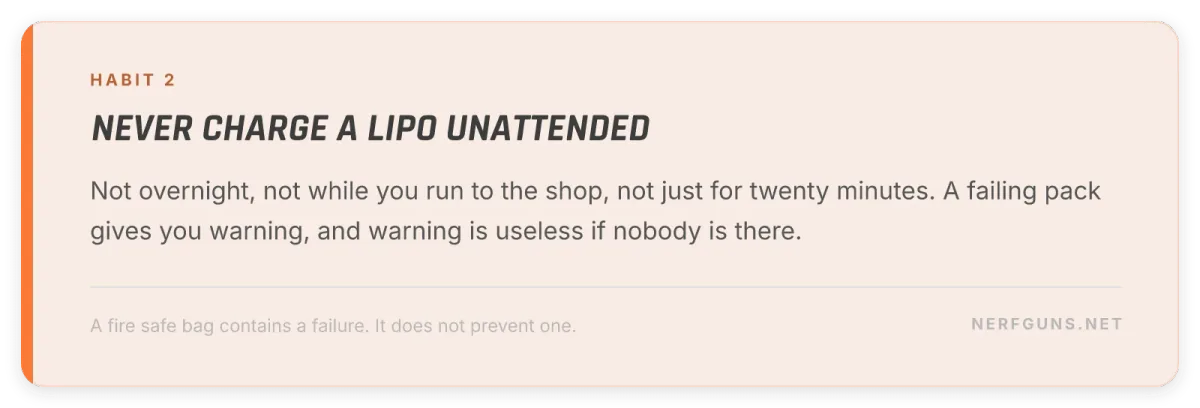
Habit 2 is the one that does the heavy lifting. A pack that fails while somebody is watching is a scare, and a pack that fails at 3am is a house.
Storage, the part everybody skips
- Store at storage voltage, not full and not empty. Every balance charger has a storage mode. Use it. A LiPo left at full charge for weeks degrades measurably faster than one left at storage charge, and a LiPo left flat can be ruined permanently.
- Never let a pack sit deeply discharged. If you drained it at an event, put it on storage charge that night, not next month.
- Cool, dry, and not in a car. A closed car in summer is an oven and heat is what ages a pack fastest.
- In a fire safe container, with the leads covered. A loose LiPo in a drawer full of screwdrivers is a short waiting for a bump.
- Check every pack you own twice a year, even the ones you are not using. Look for swelling, feel for softness, and check the voltage.
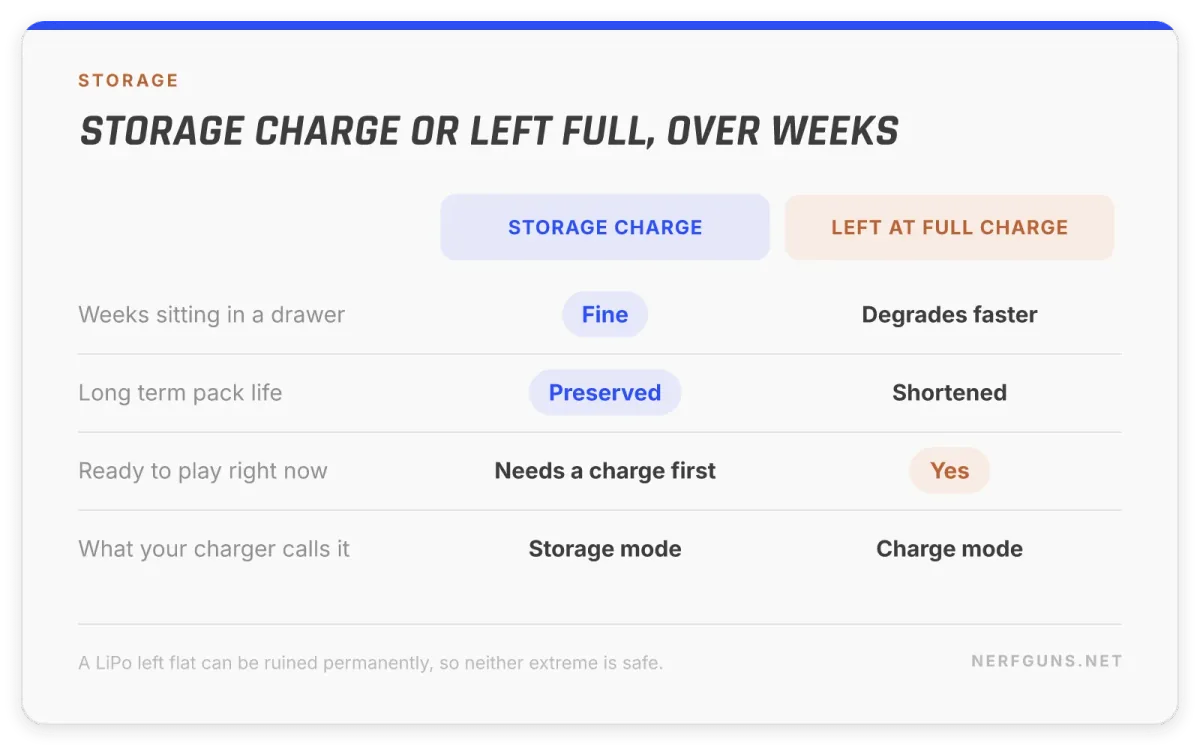
Storage is the section people skip because nothing bad happens today. It is also the section that decides whether your packs last one season or four.
Storage charge is the rare LiPo battery safety habit that saves you money rather than just trouble.
In the blaster
Once the pack is inside a shell, LiPo battery safety becomes a wiring and mounting problem.
- Fit a low voltage alarm or check the voltage between games. Running a LiPo down below its floor is the most common way people quietly kill a pack, and it does not announce itself while you are shooting.
- Secure the pack so it cannot move. A pack rattling around a shell will eventually chafe its own wires.
- Route wires away from anything that pivots or slides. Every mechanism in a blaster is a pair of scissors given enough cycles.
- Nothing sharp near the pack. Ever. A puncture is not a leak, it is a fire.
- If the blaster gets hot, stop. Hot is information. Find out why before the next game rather than after it.
If you are wiring a pack in for the first time, the bench gear for it is in the modder’s toolkit, and the run time question is answered by the battery runtime calculator.
Taking packs to an event
The HvZ loadout checklist tells you to bring charged spares. Here is how they should travel.
- Every pack in a fire safe bag or case, in the bag, not loose. A day bag full of darts, tools and packs is exactly the environment that punctures one.
- Leads covered, always. A bare connector against a screwdriver is a dead short, and a dead short in a rucksack is the worst possible place for one.
- Charged at home, not in a car park. Charging out of a car boot breaks habit 2 and habit 3 at the same time.
- Not left in the car. A closed car in summer will cook a pack while you play, and you will put a heat damaged pack straight into a blaster afterwards.
- Bring the checker, not the charger. At an event you want to know a pack’s voltage, not to top it up on site.
Flying to an event? That is a different rule book. Spare LiPo packs are not allowed in checked baggage at all. The FAA’s PackSafe guidance puts spare lithium batteries in carry-on only, with the terminals protected against a short circuit. It says the same thing if your carry-on gets gate checked: the packs come out and travel in the cabin with you.
- Spare packs ride in the cabin. Every time. That is the rule, not a preference.
- Cover the terminals. Same habit as the rucksack, for exactly the same reason.
- Know the watt hour rating. The FAA lists 100 Wh and 160 Wh as the points where a pack needs the airline’s approval or is refused outright. The number for your pack comes from your pack.
- Ask your airline before you go. Carriers are allowed to be stricter than the FAA, and plenty of them are.
Worth sorting out before you pack, because LiPo battery safety at an airport stops being your decision. They will simply take the pack.
Transport is where LiPo battery safety most often gets quietly dropped, because the pack is not doing anything and it feels like the risky part is over.
When a pack goes bad, and they all eventually do
- Puffed, swollen or soft means retired. Not “one more game”. Not “it still works”. Retired.
- Get it outside, away from anything that burns. Do not put a suspect pack back in a drawer inside the house.
- Discharge it fully before disposal, then dispose of it at a battery recycling point. Most hardware stores and many electronics shops take them. The salt water bucket method gets repeated all over the internet and it is not a substitute for taking it somewhere that handles batteries.
- Never put a LiPo in household rubbish or normal recycling. It gets crushed in a truck, and then it is somebody else’s fire.
Every pack you own is going to reach this section eventually. That is not a defect, it is the lifespan.
If something does go wrong
- A LiPo fire is not a water fire. It is a chemical fire that supplies its own reaction, and it will reignite.
- People first, then property, then the pack. Get everyone out, call the fire service, do not carry a burning pack anywhere.
- The whole point of every rule above is that you are standing there when it starts. A pack that fails while somebody is watching is a scare. A pack that fails at 3am is a house.
If you would rather not run LiPo at all
That is a completely reasonable position and I am not going to talk you out of it.
Rechargeable NiMH cells are the usual answer. They are heavier for the same energy, and they will not push current the way a LiPo does. A high end flywheel build will feel softer on them.
What you get in return is a battery with none of the handling rules on this page.
If the LiPo battery safety routine sounds like more than you want to take on, run NiMH and enjoy the hobby. A pack you handle carelessly is worse than a pack you never bought.
The five mistakes behind almost every incident
Strip out the detail and the same short list turns up again and again. Every LiPo battery safety rule on this page exists to close one of these 5 doors.
- Charging unattended. Habit 2, and on its own it accounts for more than any other single cause.
- Charging on a flammable surface. A bed, a carpet, a desk covered in paper. The failure was survivable, the surface was not.
- Charging a damaged pack. Usually because it still worked yesterday.
- Using the wrong charger. A wall wart cannot balance cells, so the drift never gets corrected.
- Storing at full charge for months. Slow, invisible, and the reason a pack puffs in a drawer having never been used.
Not one of those is exotic and not one of them is bad luck. Every one is a habit that was skipped rather than a component that failed, which is the whole argument for treating LiPo battery safety as a routine instead of a worry.
The short version, taped inside the charging box
- ☐ Balance charger, always.
- ☐ Never unattended.
- ☐ Fire safe container, every time.
- ☐ Charge at the rate on the pack.
- ☐ Storage charge if it is not being used this week.
- ☐ Puffed means retired, no exceptions.
- ☐ Recycle it properly.
Seven lines. That is the whole of LiPo battery safety, and it fits on an index card.
One last thing, and I mean it. The specific numbers for your pack, your cell count, your charge rate and your voltage floor come from your pack and your charger, not from me and not from a forum post. This checklist is the habits. The numbers are on the label. Read it.
Keep this where you charge. LiPo battery safety is a set of habits, and habits hold better when the list is somewhere you can actually see it. Put your email in below, click the confirm link we send, and the checklist lands in your inbox, ready to pull up next to the charger.
The newsletter comes with it. It is occasional, it is Gunner writing, and every email carries an unsubscribe link.
Gear for this checklist
As an Amazon Associate I earn from qualifying purchases. The Amazon links below are affiliate links. They cost you nothing extra and they are what keeps guides like this one being written. See our affiliate disclosure.
These are search links rather than single products, because the right charger and pack depend on your build and stock changes constantly.
| Category | Item | Find it |
|---|---|---|
| Charging | Balance charger | LiPo balance charger |
| Charging | LiPo safe charging bag | LiPo safe bag |
| Charging | Fire resistant storage case | LiPo storage case |
| Monitoring | Low voltage alarm | LiPo low voltage alarm |
| Monitoring | Cell voltage checker | LiPo cell checker |
| Monitoring | Multimeter | Digital multimeter |
| Packs | 2S and 3S packs | LiPo battery 2S 3S |
| Wiring | XT60 connectors | XT60 connectors |
| Wiring | Heat shrink tubing | Heat shrink tubing |
| Safety | Safety glasses | Safety glasses |
| Alternative | Rechargeable NiMH, if you would rather not run LiPo | Rechargeable AA NiMH |
Frequently asked questions
Is LiPo battery safety really that big a deal for a Nerf blaster?
The pack does not know what it is powering. A 3S pack in a blaster and the same pack in a drone carry identical handling rules.
The good news is that LiPo battery safety rules are short and they never change.
Can I charge a LiPo overnight if I use a fire safe bag?
No. The bag contains a failure, it does not prevent one, and the entire value of LiPo battery safety habit 2 is that a person is present.
Unattended charging is the single most common factor in the incidents that make the news.
My pack looks slightly puffed but still works. Can I use it?
No. Puffed means retired, and that is the one line on this page with no exceptions.
It has already told you it is failing. The next thing it tells you is more expensive.
What charge rate should I use?
The one printed on your pack, which is the only source that knows. Charging faster saves a few minutes and costs pack life every time.
Do I need a fireproof case if I only own one pack?
Yes, and it is the cheapest item in the whole LiPo battery safety kit. One pack is enough to cause a fire.
Is the salt water bucket a real disposal method?
It circulates constantly and it is not a substitute for a battery recycling point. Discharge the pack, then take it somewhere that handles batteries.
How often should I check packs I am not using?
Twice a year. Look for swelling, feel for softness, check the voltage, and put anything suspect straight into the retired pile.
Put it in the calendar. LiPo battery safety on a schedule beats good intentions.
Related pages: the LiPo battery calculator, all the checklists, the battery runtime calculator, the HvZ loadout checklist, the modder’s toolkit, and the mod guides when the pack is sorted and the motors are next.
It’s Nerf or Nothin’!
Replacing gear after reading this? Put the charger, the bag and the spare packs on a free Nerf wish list so nothing safety related gets left off the order.