
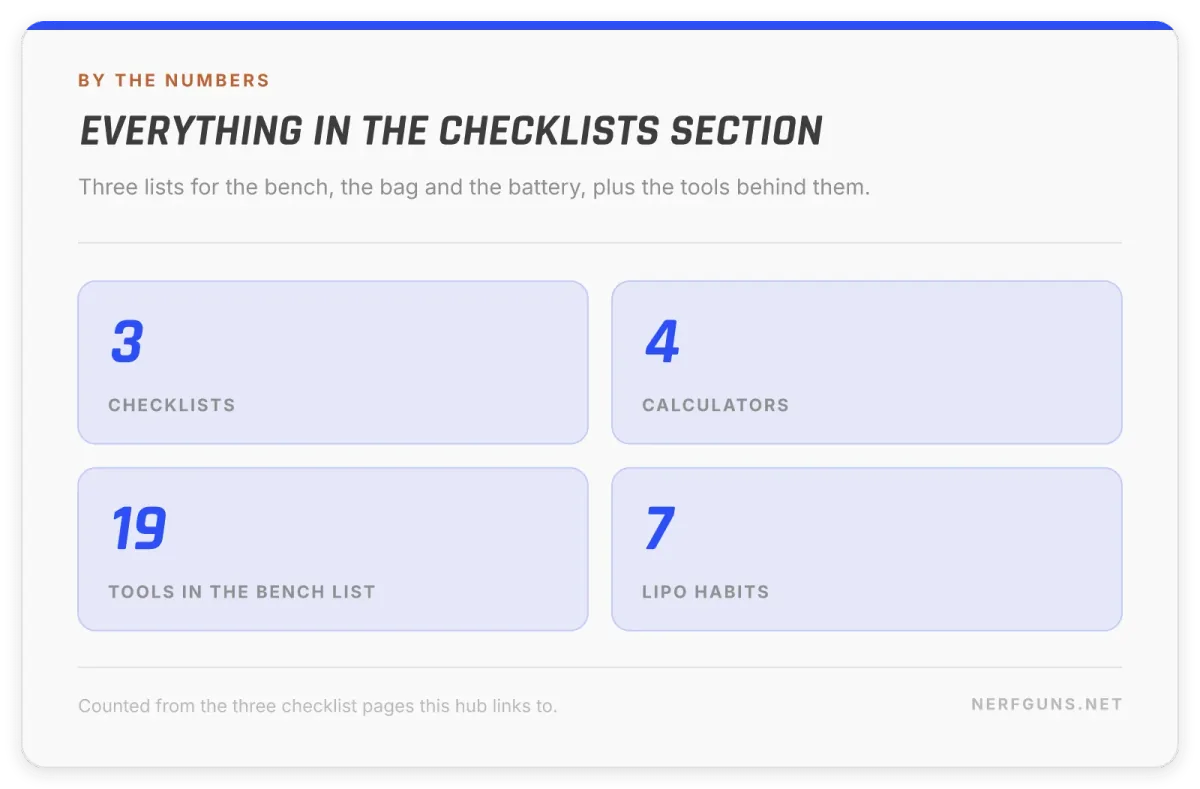
These are the checklists I actually keep in the shop, written down so nobody has to work them out twice. Three lists cover the bench, the game bag and the battery. The 4 calculators handle the numbers those lists depend on. If you are opening a blaster, packing for an event, or wiring your first pack, start here.
What is on this page
- Which list to start with
- The modder’s toolkit
- The HvZ loadout checklist
- LiPo safety and care
- The 4 calculators
- Rule zero got harder
- Springer or flywheel: what applies to you
- What a first year actually looks like
- What is deliberately not on these lists
- How to use these checklists
- Which tool answers which question
- Why any of this is written down
- The gear every list starts with
- Frequently asked questions
Gunner here. Some things in this hobby you figure out once and then never want to figure out again.
What belongs on the bench. What goes in the bag. How to treat a battery so it stays boring.
These are those lists, in the order you will actually use them.
Which list to start with
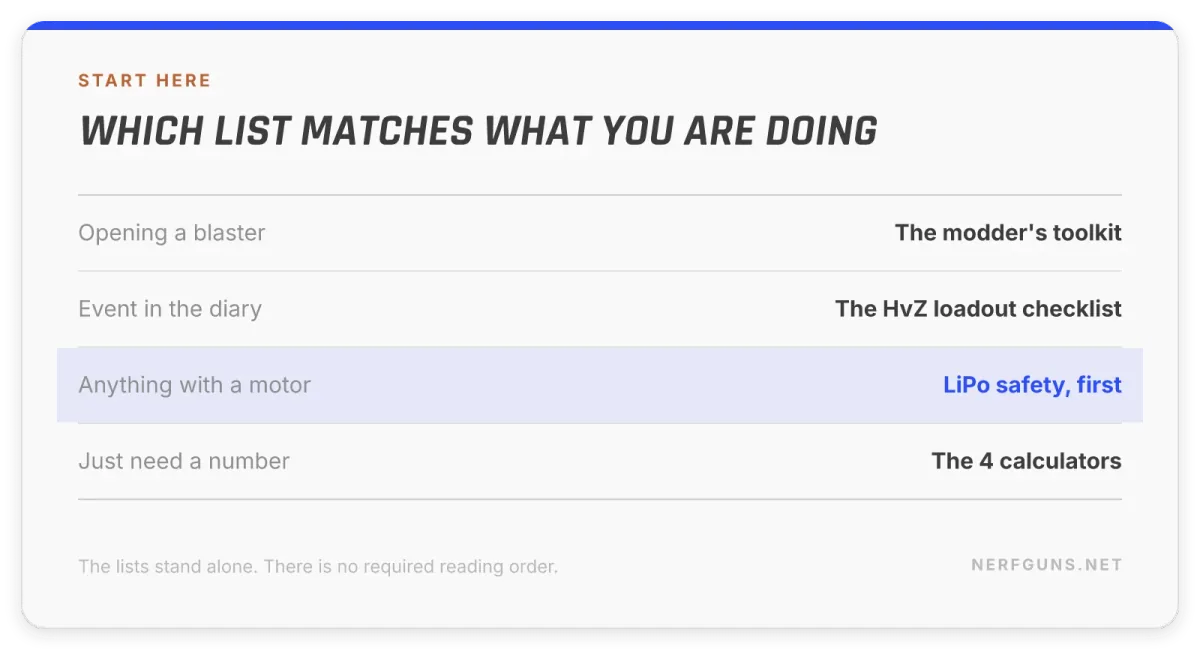
All 3 checklists stand alone. You do not have to read them in order. There is still a best place to begin, and it depends on what you are about to do today.
- About to open a blaster for the first time? Start with the modder’s toolkit.
- Going to an event in the next fortnight? Start with the HvZ loadout.
- Anything you own has a motor and a rechargeable pack? Start with LiPo safety, before either of the others.
- Just need a number? Go straight to the calculators.
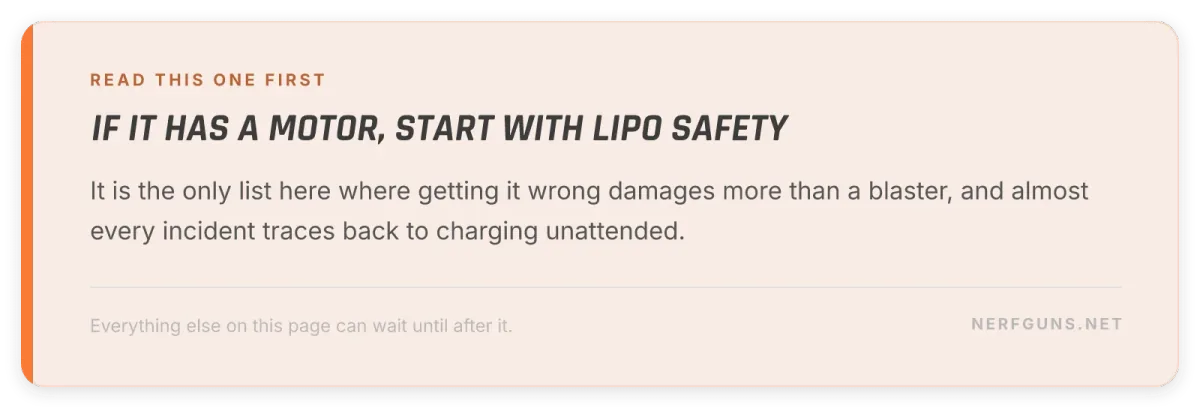
That last one is worth repeating. If you run LiPo, the safety list is the one to read first, because it is the only list here where getting it wrong damages more than a blaster.
The modder’s toolkit
Everything you need on the bench before you open your first blaster, sorted into 3 groups. The gear you need before you open anything. The gear that puts it back together better. And the gear you buy once you know you are staying.
It is 19 items in total, and the first group is 5 of them.
The reason it is grouped rather than alphabetised is that you should never own a tool you have not already needed. Buy group 1, open a blaster, then decide.
It also covers the 3 things deliberately left off the list. Top of that pile: branded mod kits, which are a screwdriver and a spring at four times the price of both.
The three groups break down like this.
- Group 1, before you open anything. Precision screwdrivers, safety glasses, a parts tray, your phone on a stand, and a hobby knife. Nothing electrical, nothing expensive.
- Group 2, putting it back together better. Flush cutters, a soldering iron, solder, heat shrink, wire, plastic epoxy, grease and sandpaper. This is where a teardown becomes a mod.
- Group 3, once you know you are staying. A multimeter, helping hands, barrel material, spare springs, O-rings and a rotary tool.
It also walks a full first teardown, start to finish, and lists the 6 mistakes that cost people a blaster.
Read it: The Modder’s Toolkit.
The HvZ loadout checklist
What to pack before game day, from rule zero through to the last 10 minutes before you walk in.
Rule zero is the one that matters most: one ammo type, across every blaster you carry. Get that wrong and half the darts you pick up off the ground are dead weight.
The rest covers blasters, ammunition quantity, what goes on your body, and power. Then what changes on a multi day game, and what to do when you get tagged and switch sides.
It ends with a door check you read out loud, which catches more problems than everything else on the page combined.
The parts people underestimate are the boring ones. Four to six loaded magazines beat any blaster upgrade, A cross body sling matters more than it sounds, too. A blaster you cannot let go of stops you climbing, carrying or opening anything.
It also covers the half of the game nobody packs for, which is what happens after you get tagged and join the other side.
Read it: The HvZ Loadout Checklist.
LiPo safety and care
The 7 habits that keep a battery boring: buying, charging, storage, transport, and what to do when a pack goes bad.
LiPo packs are the reason modern flywheel blasters hit the numbers they hit. They are also the only part of this hobby that can burn your house down.
Almost every incident traces back to charging, and usually to charging unattended.
If the handling rules sound like more than you want to take on, that page also covers running NiMH instead and enjoying the hobby with none of them.
The habits themselves are short: a proper balance charger, never unattended, a fire safe container, the charge rate printed on the pack, nothing puffed, nothing hot or cold, and the pack out of the blaster.
Storage is the section people skip because nothing bad happens today, and it is the one that decides whether packs last one season or four.
Read it: LiPo Safety and Care.
The 4 calculators
The checklists tell you what to do. These 4 tools work out the numbers behind them. All of them run right in your browser, with nothing stored or sent anywhere.
- The kinetic energy calculator. Dart weight plus muzzle velocity gives you joules, then checks that figure against example field caps.
- The joules to FPS calculator. Your club posts an energy cap, this tells you the fastest you can legally run it with the dart you actually shoot.
- The LiPo battery calculator. Whether a pack can actually feed your motors, and how long it lasts once it can.
- The battery runtime calculator. How many charged packs a war actually takes.
They pair with the checklists directly. The loadout list tells you to know your FPS number before you arrive, and 2 of these tools are how you work it out.
Rule zero got harder
Here is the one thing that has really changed since these checklists were written.
Nerf now sells 3 dart formats at the same time. That makes rule zero, one ammo type across every blaster you carry, harder than it used to be. Not impossible. Just something to check before you buy, instead of after.
- Elite darts. The classic. Still the most common thing on any field, and still what most of the blasters in your cupboard eat.
- N1 darts. Shorter and wider, with a flatter head and a peg at the back. The Nerf Wiki lists them as the ammunition for the N Series line, and Amazon’s own listings for those blasters say the darts are compatible only with N1 blasters. The Loadout line runs them too.
- Rival and Gelfire rounds. Balls and gel, not foam at all. These were never going to share with anything, and they still do not.
So there is one extra line at the shopping stage now: find out which dart your blaster eats before you buy a second blaster. A drawer full of Elite darts will not feed an N1 blaster. And an N1 blaster cannot hand its darts to anybody else on your team.
It is not a one way road either. Blaster Hub’s coverage of the 2026 New York Toy Fair reports that the newer Rebel Ops blasters go back to Elite darts. The advice on all 3 checklists is the same as it always was. There are simply more ways to get it wrong than there used to be.
Springer or flywheel: what applies to you
Roughly half of what is written here does not apply to a spring powered blaster. Worth saying out loud, rather than leaving you to find out the hard way.
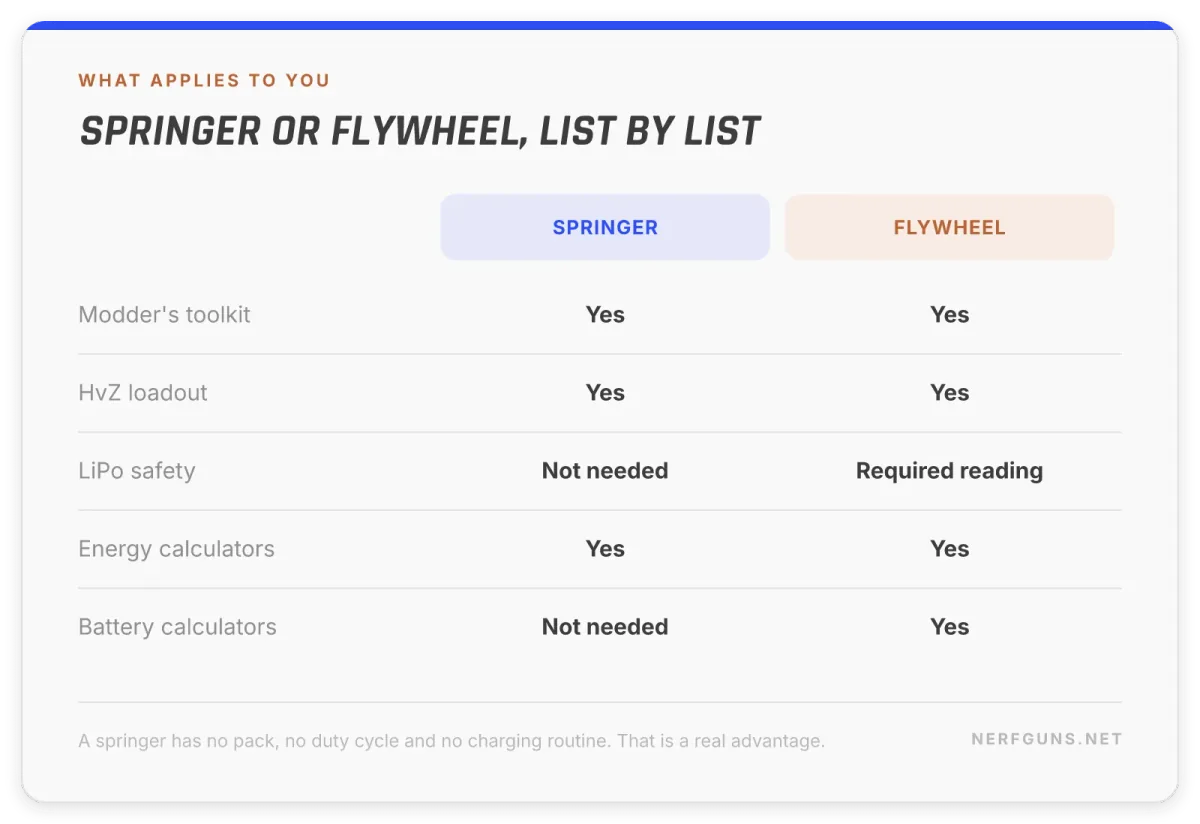
Springers keep the bench list and both energy tools. They skip the battery list and both battery tools entirely, which is a smaller job in every direction.
A springer has no pack, no duty cycle and no charging routine. That is a genuine advantage and one of the reasons experienced players still run them at long events.
A flywheel blaster gets you a higher ceiling and hands you the battery half of these checklists in return. Neither choice is wrong, they are just different lists.
What a first year actually looks like
People ask what order all of this happens in. Here is the honest shape of a first year, and where each list lands in it.
- You buy a blaster and play with it. No list needed. Enjoy it.
- You want it to do more. The bench list starts here, and group 1 is 5 cheap items.
- You open your first blaster. Air restrictors, a spring, some grease. Still no soldering iron.
- Somebody invites you to an event. The loadout list becomes urgent, and magazines matter more than blasters.
- You get chronographed for the first time. This is where the energy calculators stop being abstract.
- You move to a flywheel build. Now the battery half arrives, and LiPo safety stops being optional reading.
- You start planning packs per day rather than per blaster. The runtime tool covers this.
Nobody needs all of it on day one. That is why these are separate checklists rather than one enormous page, and why each of them says which parts you can skip for now.
Most players spend a year somewhere around step 3 and there is nothing wrong with that.
What is deliberately not on these lists
A list is only useful if it stops somewhere, so here is what these ones leave out and why.
- Anything I have not used. Every item on every list is something that has been on my bench or in my bag.
- Prices. They go stale within a season and a wrong price is worse than none. The lists describe the shape of the spend instead.
- Brand loyalty. Where a specific product is named it is because it earns it, not because it is the only option.
- Beginner traps dressed as essentials. Branded mod kits, a 3D printer on day one, a chronograph before your first mod.
- Anything a rule book should tell you. Event caps, ammunition rules and protective equipment standards vary, and your organiser is the authority, not me.
That last one matters. These checklists prepare you for an event, they do not overrule it.
How to use these checklists
They are written to be used rather than read, so a few notes on getting value out of them.
- Read the whole list once before you act on any of it. Several items only make sense in the context of a later one.
- Do not buy the whole list at once. Every one of the checklists is grouped or ordered so you can stop partway and still be useful.
- Print the short versions. The LiPo page ends with 7 lines meant to be taped inside a charging box, and the loadout page ends with a door check.
- Run the door check out loud. Silently reading a list is how you skip a line.
- Come back after your first event. The lists will read completely differently once you have context for them.
None of these checklists are theory. Every item on them is there because it went wrong on my bench or on a bench I was standing next to.
Which tool answers which question
The 4 tools look similar from outside and they answer completely different questions. Here is the plain version.
- “How hard does my blaster actually hit?” Kinetic energy. Feed it dart weight and muzzle velocity, get joules.
- “My club caps energy, how fast can I run?” Joules to FPS. It is the same physics solved for the other unknown.
- “Will this pack even work in my build?” LiPo battery. Capacity and C rating against your motor draw.
- “How many packs do I bring on Saturday?” Battery runtime. Pack size, draw and how much you actually rev.
The first two are about rules and legality. The second two are about not running out.
Every one of them runs on your own numbers, so weighing a handful of darts and measuring your real current draw improves all 4 answers at once.
Why any of this is written down
Most of what goes wrong in this hobby is not skill. It is logistics.
- A rounded screw head costs you a blaster, and the right driver would have prevented it.
- One magazine instead of four loses you a game you were winning.
- A pack charged unattended overnight is the only item on any of these lists that can cost you more than money.
- A blaster nobody has fired since last season fails in the first hour, every time.
Not one of those is a difficult problem. They are all problems that get solved once and then forgotten, which is exactly what a written list is for.
That is the whole argument for these checklists. Figure it out once, write it down, stop paying for it.
The gear every list starts with
As an Amazon Associate I earn from qualifying purchases. The Amazon links below are affiliate links. They cost you nothing extra and they are what keeps guides like these being written. See our affiliate disclosure.
Each of the checklists carries its own full gear table. These 3 items appear across all of them, so they are worth owning whichever list you start with.
| Item | Why it is on every list | Find it |
|---|---|---|
| Safety glasses | Required at events, and on the bench when you cut spring steel | Safety glasses |
| Precision screwdriver set | Opens every blaster you own without rounding a screw | Precision screwdriver set |
| Digital multimeter | Settles every electrical question on the bench and at the field | Digital multimeter |
Bonus tip: if a birthday is coming, hand people the list. Half the gear on these checklists is cheap, boring, and exactly what nobody thinks to buy as a present. Safety glasses. A screwdriver set that actually fits. Spare magazines. Put them on a free Nerf wish list and family get one link instead of a guess.
Frequently asked questions
Which of these checklists should I read first?
LiPo safety, if anything you own has a motor and a rechargeable pack. The modder’s toolkit otherwise.
The HvZ loadout only becomes urgent once you have an event in the diary.
Do the checklists assume I already mod blasters?
No. The bench list is written for somebody who has never opened one, and it says which items you do not need yet.
Are these checklists specific to Nerf brand blasters?
Mostly not. The tools, the safety habits and the loadout logic apply across foam blasters generally.
The specifics that are Nerf shaped are called out where they matter, like driver sizes and ammunition types.
How often do the checklists change?
Rarely, which is the point. Tools, batteries and game logistics move slowly, so the checklists change when something is genuinely wrong rather than on a schedule.
Do I need all 4 calculators?
Only the ones matching your setup. Springer players need the 2 energy tools and neither battery tool.
Who writes these and why should I trust them?
Gunner Vance, an off road mechanic who has been modding and writing about foam blasters since February 2009.
The short answer on trust is that nothing here is recommended that has not been used, and where something has not been measured the page says so instead of inventing a number.
What if I disagree with something on a list?
Then you probably know your own setup better than a general guide does, and you should trust it.
These pages are patterns that hold most of the time. They are not rules, and the two places they will not bend are eye protection and how a battery gets charged.
I only play backyard games. Is any of this relevant?
The bench list is, if you ever open a blaster. The rest is scaled for organised play and you can safely ignore most of it.
Bring water and eye protection anyway.
Do the checklists cover Rival and Ultra?
The loadout logic does, and rule zero applies to them exactly as it does to darts, because they share ammunition with nothing else.
The bench list is dart focused where it gets specific, but the tools are the same tools.
Something on a list is wrong for my blaster. What now?
Trust the blaster. These checklists are general patterns, and a specific model always wins an argument with a general rule.
Is there a printable version of the checklists?
Not as a separate download. The short versions at the end of each page are deliberately sized to print or photograph, and they are the parts worth having on the wall.
Related pages: the mod guides, the paint guide, Nerf war games, the Zombie Strike lineup, and every Nerf gun ever made. Planning a birthday? The Nerf party guide has its own run-up checklist.