
Nerf history starts with a foam ball in 1969, twenty years before the brand fired anything, and NERF itself stands for Non-Expanding Recreational Foam. This page is the whole timeline, from that ball to the blaster empire, plus the community moments this site covered first-hand from 2009 onward. Every source is our own reporting, linked throughout.
What is on this page
1969: a foam ball, not a blaster
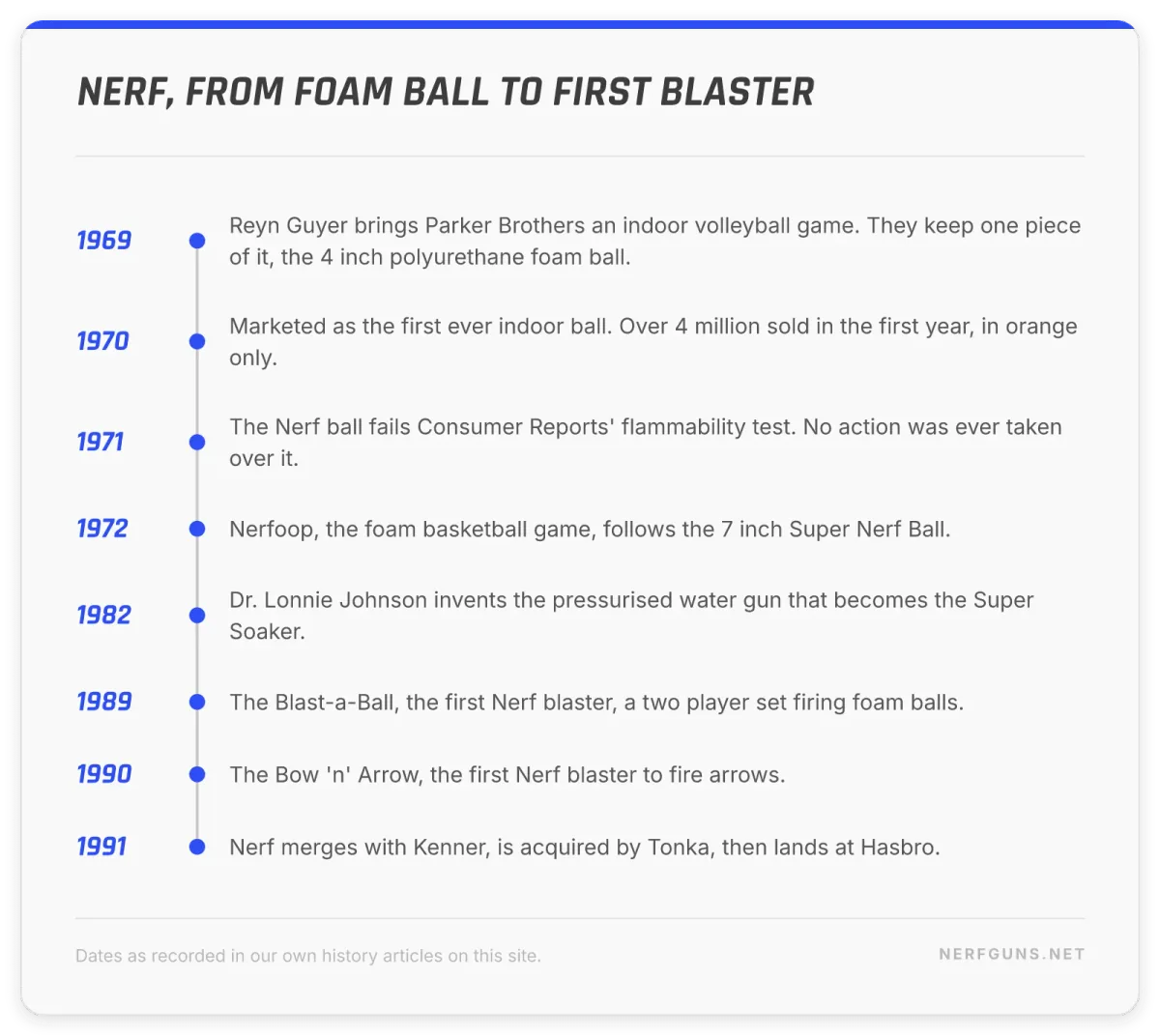
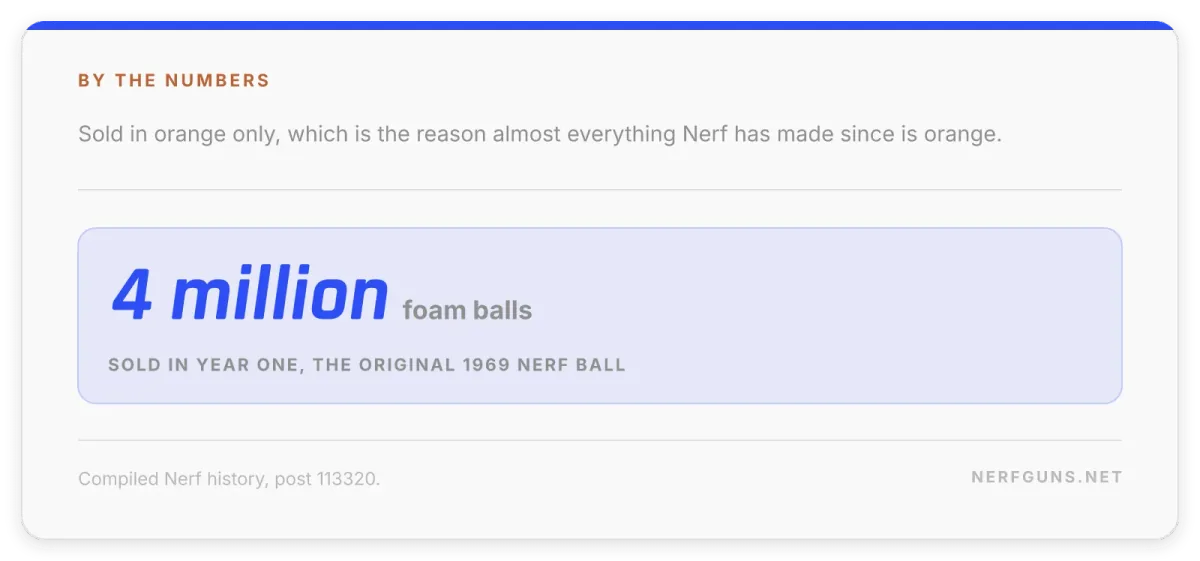
Nerf history begins with Reyn Guyer, the same man who came up with Twister. He brought Parker Brothers an indoor volleyball game, and Parker Brothers kept exactly one piece of it: the 4 inch polyurethane foam ball. The name came from 1970s off-road slang, where “nerf” meant the foam padding on a vehicle. Marketed in 1970 as the first ever indoor ball, with the unimprovable slogan “Throw it indoors; you can’t damage lamps or break windows. You can’t hurt babies or old people,” it sold over 4 million units in its first year. It came only in bright orange, which goes a long way toward explaining the color of everything Nerf has made since.
The follow-ups came fast. This is the stretch of Nerf history that set the brand up. First the 7 inch Super Nerf Ball, which added yellow, blue, green, red, aqua and purple to the range. Then the Nerfoop foam basketball game in 1972. Then the Nerf football, the most popular ball of them all. Nerf Table Hockey, Pool and Ping Pong were also tried and went nowhere.
Not every early headline in Nerf history was a good one. In 1971 the Nerf ball failed Consumer Reports’ flammability test, described as bursting into flames about two seconds after contact with a lit match. That fell short of the standard set by the 1969 Child Protection and Toy Safety Act. By our reading of the record, no action was ever taken against Parker Brothers or the brand over it.
1989: the first blaster

The single biggest gap in Nerf history is this one: it took nineteen years for the brand to fire its first projectile. The Blast-a-Ball arrived in 1989: a two-player double blaster set using a push-and-pull system, packaged with four foam balls. Arrow blasters followed in 1990 and dart blasters two years after that, and darts have been the center of the brand ever since.
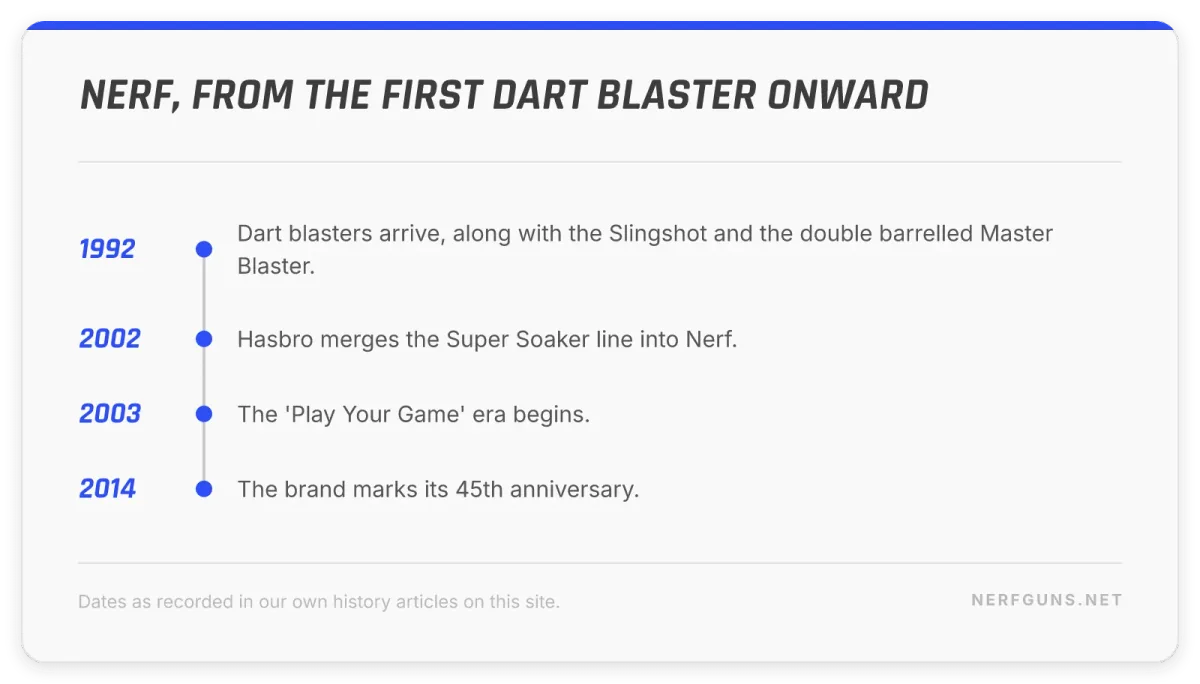
The next first in Nerf history was the arrow blaster. The Bow ‘n’ Arrow was a single fire pull-and-release design running a direct plunger. Its bow string was there for looks and did no work at all. It was the first Nerf blaster to fire arrows. In 1992 came the Slingshot and the Master Blaster, both firing ballistic balls. The Master Blaster was the interesting one. Double barrelled, holding up to eight balls at a time. That was enough of a jump in volume to change how early Nerf wars were fought.
The corporate half of Nerf history moved just as quickly. In 1991 Nerf merged with Kenner Products, was acquired by Tonka, and then landed at Hasbro, where it remains. The slogans track the eras: “There’s only one Nerf,” then “Get Real. Get Nerf,” then “Play Your Game” from 2003, and finally the one this site signs off with, “It’s Nerf or Nothin’!” In 2014 the brand marked its 45th anniversary.
1982 to 2002: the Super Soaker joins the family

The water side of Nerf history has its own origin story, and it is the better one. In 1982 Dr. Lonnie Johnson was an engineer who worked on spacecraft. He was testing a heat pump at home. A nozzle hooked to his sink fired a jet of water clean across the room. His water gun launched in 1990 as the Power Drencher. The marketing flopped. It was renamed the Super Soaker 50, and then it sold two million units in 1991. Hasbro merged the brand into the Nerf line in 2002. The full water side of Nerf history, plus every soaker we reviewed, now lives on the Super Soaker page.
2009 onward: the Nerf history we covered ourselves
This site has been writing about Nerf since February 2009. So this stretch of Nerf history is the part we watched happen, not the part we read about. The moments worth remembering:
- The Dart Tag World Championships. The only sanctioned league in Nerf history. Nerf ran an official competitive league, the NDTL, holding regional tournaments along the Dew Tour with a $25,000 grand prize and two age divisions. Our coverage of the 2010 Dart Tag Championship captures how seriously Nerf took organized play in that window.
- Nerf on a game console. A one off in Nerf history. The N-Strike video game for the Nintendo Wii shipped with a holder. It let the Wii-mote be gripped and triggered like a blaster. The bundled Nerf gun could fire real darts on its own. Our review is a time capsule of the brand’s video game experiment.
- Fan-made advertising. The Battle of the Ads contest put a $10,000 prize on 25 second fan commercials using N-Strike, Super Soaker or N-Force products. The top 10 finalists show how big the fan filmmaking scene already was.
- The viral video years. Amateur filmmakers turned Nerf into a genre of its own; our top 10 viral Nerf videos collects the ones that defined it.
- Humans vs Zombies meets campus authority. Missouri State’s twice-yearly, university-sanctioned HvZ game triggered a 911 call from a professor and talk of banning blasters, covered in our Missouri State story. The game format itself, and every other way to play, lives on the Nerf war games page.
- Nerf goes to print. Hasbro licensed an official book. NERF: The Ultimate Blaster Book, by Nathaniel Marunas, covers more than 40 years of foam across the three companies that have owned the brand. We reviewed it: written for younger readers, N-Strike focused, with a brief history of the brand’s beginnings.
- Record books. Nerf has even reached Guinness territory. The foam and water records we reported at the time are now collected in the records section of our Super Soaker page.
The Nerf Dart Tag League, as we covered it at the time
The most organised moment in Nerf history was the Dart Tag World Championship. It ran as a real circuit. The second year of it followed the Dew Action Sports Tour. Registration ran through a Hasbro newsletter signup that opened a members-only site, plus a team registration form that had to be faxed in. That form was later pulled.
How the only official league in Nerf history worked, as it stood when we wrote about it:
- Team size: teams of four.
- Age divisions: 8 to 12 and 13 to 17, so nobody faced a player more than four years older.
- Game format: timed capture the flag elimination.
- Tournament format: round robin, every team playing every team. The two highest scoring teams advanced to the finals, and the winner of the finals went on to the championship tournament.
- Grand prize: $25,000.
- Blaster of record: the Furyfire was the blaster used in 2009. No blaster had been named for the following year when we published.
That circuit is the high water mark of competitive Nerf history. The 2009 tour stopped in Chicago, Boston, Portland and Salt Lake City. Regional qualifiers at each stop fed the 2009 World Dart Tag Championship. That kicked off in Orlando on October 17th, 2009. The following year’s Dew Tour dates were set as June 25 to 27, July 23 to 25, August 12 to 15, September 16 to 19 and October 14 to 17. The host cities were still unannounced at the time.

The Wii game era
The strangest detour in Nerf history was a video game. The N-Strike title was built exclusively for the Nintendo Wii, and the reason was the controller. It is a reworking of the classic arcade shooter, with moving targets on screen. The Wii-mote was the only big-name controller you could hold like a blaster. The box came with a gun holder that the Wii-mote dropped into so it could be gripped and triggered the way a blaster is. The shell was not a prop, either. The Nerf blaster packaged with the game fires real darts and works on its own. The Wii-mote pulls back out and works bare.
In game, the levels are straightforward, follow the instructions and you will do fine, and the interest comes from the arsenal. Different levels call for different blasters, and the roster runs from a Gatling gun to sniper rifles. On one level it is a repackaged arcade shooter for the living room. On another it is the only time the brand let anyone step into a virtual version of itself.
The cheat codes were published in their own post here, and they are collected below exactly as they were listed. The Goliathan Nitro is the blue blaster with flames on it.
- Goliathan Nitro Blaster: fiero2
- Longshot Street: Longst5
- Magma Vulcan: Magma3
- Maverick Midnight: Mavmiv7
- Semperfire Ultra and Firefly Elite: Cromo1 and heliox6
- Semperfire Ultra: Cromo
- Spartan NCS-12: Thisis12
- Mercurio: RSMERC9
- Firefly Elite: HELIOX6
- Crusher SAD-G: CRUSH14
- Blackheart Vengeance: BHDETA8
Battle of the Ads, the $10,000 fan commercial contest
Nerf put $10,000 on a fan-made commercial, which is the point in Nerf history where the fans became the marketing. Entries had to run under 25 seconds. They had to feature N-Strike, Super Soaker or N-Force products. And they had to be clean enough for television, so family friendly with no bad language. The rule everyone remembers is the one Nerf called playing nice. It meant no physical contact between people on camera. That is fairly clever drafting for a contest about shooting your friends. The rest of the rulebook banned modified blasters, shots aimed at the eyes, extreme stunts, filming somewhere dangerous, and the use of personal information.
The contest opened in May 2010 and narrowed to ten finalists, with public voting deciding the winner. The prize came with a shot at having the commercial aired on November 21st at 8/7c during The Simpsons on FOX. The finalists were not short on ideas. One staged a mini-battle between rest-home residents. One had cavemen finding a Nerf hoop and ball. One built a chase scene around free-running moves.
The viral video years
Somewhere in the 2010s, filming a Nerf war became its own genre, and Nerf history stopped being written by Hasbro alone. These are the ten that defined it, as we ranked them:
- Most Epic Nerf War in History. Australian amateur filmmakers Danny and Michael Philippou had no airsoft guns and no gun props, so they shot their gun-battle epic with Nerf blasters instead. The title turned out to be accurate.
- Surprise Zombie Clear-out. A girlfriend turned a surprise birthday party into a zombie outbreak. There was a note explaining the takeover. There were two blasters with laser sights. And there was an apartment to clear.
- Office Star Wars Nerf Battle. The Warp Zone mixed light sabers, blasters, graphics and explosions into an office fight that spills into the break room. The staff are armed with everything from the Zombie Strike Crossfire Bow to the Strikeblade.
- Nerfinator compilation. Two robotics students built a turret blaster that tracks and fires at range, with laser correction doing the aiming.
- Nerf Gun Tooth Pull. A loose tooth, a length of string, and a blaster. It was popular enough to make America’s Favorite Home Videos.
- Nerf Blasters Edition, by Dude Perfect. The trick shot channel pointed a Modulus ECS-10 at breakfast and hit a pancake in mid flip.
- Toy Wars. Two grown men, blasters, Hulk Hands and Spider-Man gloves.
- If you did this in America. A prankster ran around London firing foam darts at police. Entertaining to watch, not something to copy.
- Nerf Gun Control. A comedy sketch that plays the gun control debate out over foam.
- Toilet Paper Gun Prank. The classic welcome-home ambush, foam darts and toilet paper on arrival.
Missouri versus foam, the two stories that ran together
For one stretch, Missouri produced two blaster stories in a row, and they are the part of Nerf history nobody at Hasbro would have chosen. We covered both as news at the time.
The drive-thru. KMOV of St. Louis reported that a couple in Fenton were arrested and charged with third degree assault after shooting a fast food drive-thru cashier with a foam dart. They ordered nothing, pulled straight to the window, and the passenger fired a single shot that hit the cashier in the shoulder. The dart did no harm, though police pointed out that an eye would have been a different story.
The whole thing was on the restaurant’s video, and a two day investigation identified both of them. In Missouri, scaring someone can be treated as assault. The charge carried a fine of up to $300 and as much as fifteen days in county jail. No report we could find named the blaster used, which is its own small lesson for anyone writing up a foam dart crime.
The campus. Missouri State’s Live Action Society ran a campus-wide Humans vs Zombies game twice a year. It was an official university activity with a faculty adviser. Players carried a blaster at all times for the full week of the event. One winter it drew a 911 call. A professor took the blasters for a real threat. A teacher locked down her classroom believing there was an active shooter.
The Safety and Transportation Department’s report to student government counted roughly twenty complaints, and officials floated banning blasters on the grounds that they looked too realistic. The club’s own rules already banned painting a blaster black or silver. The blasters in play, Hammershots and RapidStrikes among them, carried the orange tips the law requires. Members made the other argument: 481 people turned out for the last game, most of them outdoors and moving, and the friendships were the point.
NERF: The Ultimate Blaster Book, reviewed
The one printed record of Nerf history came out of Nathaniel Marunas’s own research and his time at Hasbro headquarters. Nerf licensed the result. That makes it the closest thing to an official printed record, covering more than 40 years of foam across the three companies that have owned the brand. Our copy came with six exclusive N-Strike Elite camo darts packaged into the cover.
What it is: the only book length account of Nerf history aimed at readers eight and up. N-Strike blasters from 2004 onward take up most of the listings, and while there is a brief history of the brand’s beginnings, the pre-N-Strike years are thin. Ammunition gets proper treatment, current and discontinued, from the original Mega Darts through to Vortex discs. Chapters are split by blaster class, heavy, medium, light and accessories, with technical specs on the page and trivia like measurements and release dates. Paint schemes get very little space. The stated ranges never say whether the shot was flat or angled. That is the one thing a serious reader wants to know.
The terminology pages are the sleeper strength. They explain priming, direct plungers and the rest. They go right down to why a Dart Tag dart will not feed from an N-Strike magazine. The design process and timeline pages, how long a blaster takes to reach production and how designers test them, were our favourite part of the book. The honest verdict: if you are new to Nerf, or buying for someone who is, it is a great book. Long-time members of the community will find a lot of it familiar.
2023 to 2026: the Nerf history happening right now
Most timelines stop around 2010. That is a shame, because the last three years hold the biggest change since the dart replaced the ball.
Nerf changed its dart. Again.
The N Series line arrived with a new dart called the N1. It is not an Elite dart. It does not fit an Elite blaster, and an Elite dart does not fit an N Series one.
That sounds small. It is not. Every dart change splits the shelf into before and after. This is the third big one in Nerf history, after the ball and after the Elite dart.
Current N Series blasters include the N Series Shadow Storm , the break-action N Series Topbreaker and the N Series Infinite . They all run N1 darts .
Loadout, the swap-and-stack idea
Loadout is the line Amazon’s own Nerf store leads with today. The idea is attachments you move between blasters instead of buying a new one every time.
- Loadout Galactic Commander , the motorized flagship, 3 firing modes and 48 N1 darts.
- Loadout Shadowspeed Recon , pump action with a 6-dart cylinder.
- Loadout FlareFusion , an Amazon Exclusive and the cheap way in.
- Loadout Phantom Blitz Recon , a 2026 release with a rotating drum.
Rebel Ops, and the Elite dart comes back
Hasbro showed a line called Rebel Ops at the New York Toy Fair in February 2026. It is built around player roles. The interesting part, for anyone reading Nerf history, is that it puts the Elite dart back at the centre of the platform.
Both models are hard to buy right now, so these are searches rather than product pages: the Rebel Ops Deadeye and the entry-level Rebel Ops Ammohawk. If your household still has a box of Elite darts, they are about to be useful again. The bulk Elite dart pack, 250 darts is still on the shelf.
Note: Toy Fair reveals are announcements, not shipping dates. Lines get renamed, delayed and quietly dropped, so treat a reveal as a plan rather than a promise.
For the collectors
As an Amazon Associate and eBay Partner, we earn from qualifying purchases.
- The Nerf N-Strike Elite bundle for Nintendo Wii, the console experiment from our review above
- Nerf balls on Amazon, where the brand began
- Nerfoop, the foam basketball game, the 1972 follow-up to the ball
Where the old stuff actually lives. Amazon sells what is being made now. The blasters in the Nerf history above stopped being made decades ago. The collector market for them is eBay. These searches are the honest route to it: vintage Nerf balls | Blast-a-Ball | Sharpshooter | Bow ‘n’ Arrow | Master Blaster | Dart Tag League gear.
Buying a 30 year old blaster? Three things go first: the spring goes soft, the plunger seal dries out and cracks, and the plastic goes brittle where the sun hit it. Ask for a firing video before you pay collector money for one.
Bonus tip: collectors always remember the one that got away. Write the grails down somewhere you will actually look.
Frequently asked questions
The Nerf history questions we get asked most, answered short.
What does NERF stand for?
Non-Expanding Recreational Foam. The name itself came from off-road slang for foam padding.
Who invented Nerf?
Reyn Guyer, inventor of Twister, whose indoor volleyball game gave Parker Brothers the original foam ball in 1969.
When was the first Nerf gun made?
1989, the Blast-a-Ball, a two-player set firing foam balls. Arrow blasters came in 1990 and dart blasters in 1992, which is the moment Nerf history turns into the brand people recognise now.
Who owns Nerf?
Hasbro, after the brand passed from Parker Brothers through Kenner and Tonka in the early 1990s. Three owners in three years is the busiest stretch in Nerf history.
Who invented the Super Soaker?
Dr. Lonnie Johnson, in 1982. It went on sale in 1990 and joined the Nerf brand in 2002.
Where Nerf history continues. Nerf Super Soakers covers the water half. Nerf war games is what people actually do with the gear. And licensed Nerf blasters are the franchise crossovers.
For the lines that came and went, Zombie Strike, Vortex and Dart Tag are each a chapter of Nerf history that ended. Every Nerf gun ever made is the full catalogue.