
A Nerf battery runtime calculator answers the only battery question that matters on game day: how many charged packs do you need in the bag. Motor time and field time are wildly different numbers, and confusing them is why people arrive with one spare and run dry at lunch. Put your setup in below, then read on for what drives the answer.
What is on this page
- How to use the Nerf battery runtime calculator
- Motor time and field time are not the same
- Duty cycle is the input that decides everything
- The math, in four lines
- Why it only spends 80% of the pack
- Packs needed, by play style and pack size
- Bigger pack or more packs
- Charging between games
- How to measure your own duty cycle
- Knowing when to swap, mid game
- Planning a multi day game
- If you run springers
- Five reasons the real number comes out worse
- Frequently asked questions
Battery Runtime Estimator
How long a pack lasts on the field, and how many you should have charged before you leave the house.
Your setup
LiPo or NiMH, the label number.
Average while the motors are spinning, not peak.
Rev on trigger sits low. Motors held on all round sits high.
Total time on site, breaks included.
Result
Estimate only. Real draw swings with cage tension, dart type, temperature and pack age, and a pack that has been through a season will not hold its label capacity. Running a LiPo flat damages it, so plan on swapping well before the blaster feels slow.
As an Amazon Associate I earn from qualifying purchases.
How to use the Nerf battery runtime calculator
Four inputs, and only one of them is hard to guess. The Nerf battery runtime calculator does the rest in a second.
- Pack capacity in mAh. Straight off the label, LiPo or NiMH.
- Average draw in amps while the motors are spinning. Average, not peak.
- Duty cycle, the percentage of field time the motors are actually running. This is the one people get wrong, and it moves the answer more than anything else.
- War length in minutes. Total time on site, breaks included.
The Nerf battery runtime calculator then gives you field minutes per pack and how many packs cover the day.
Motor time and field time are not the same
This is the whole idea behind the page, and it is why raw runtime figures frighten people unnecessarily.
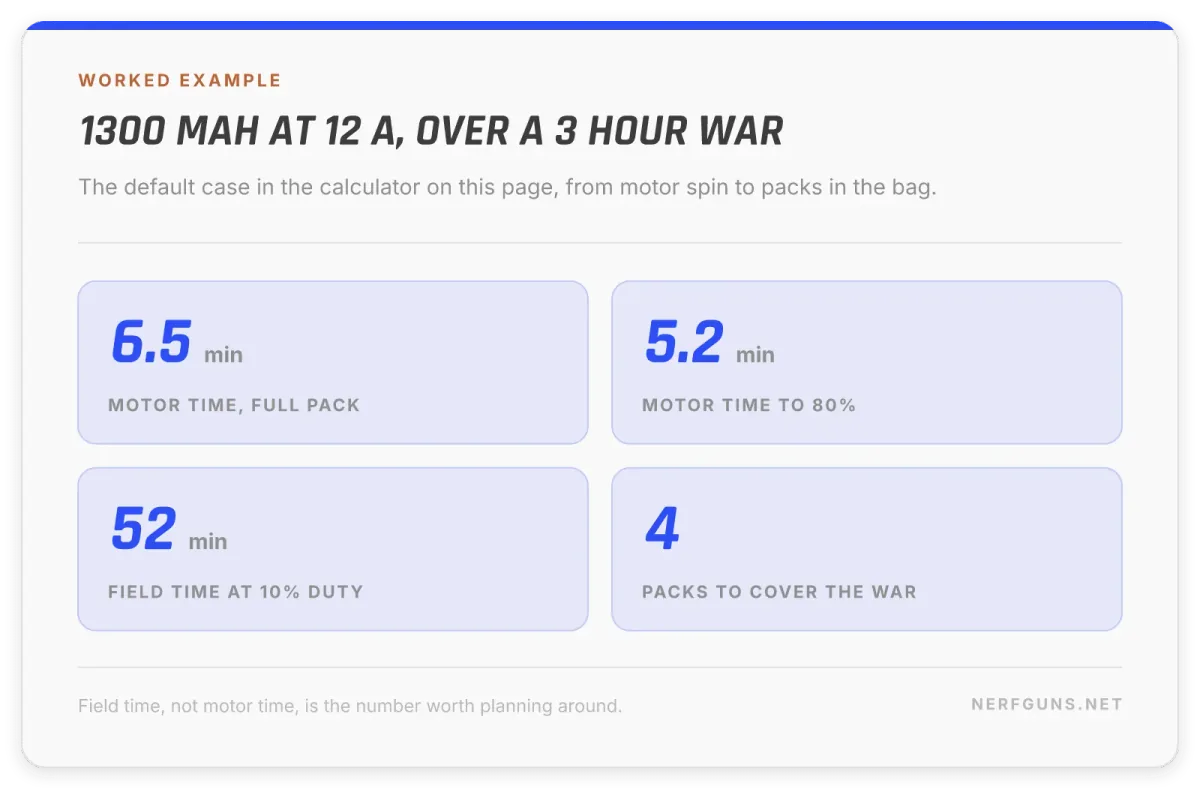
A 1300 mAh pack at a 12 A draw gives about 6.5 minutes of motor spin. Written down like that it sounds useless.
But your motors are not running for the whole game. They spin when you rev and they stop when you do not.
At a 10% duty cycle, those 6.5 minutes of motor time stretch across roughly 52 minutes of actual field time once the tool has set aside the part of the pack you should not spend.
That is the number worth planning around, and it is the one the Nerf battery runtime calculator leads with.
Duty cycle is the input that decides everything
Change the pack and the answer moves a bit. Change the duty cycle in the Nerf battery runtime calculator and the answer transforms.
- Rev on trigger, disciplined play: low. The motors spin for a second or two per engagement.
- Rev and hold through a firefight: middle. The common real world case.
- Motors held on all round: high. Comfortable, and it empties packs fast.
- Full auto with a pusher: highest. Both the draw and the duty cycle go up together.
Most players guess low on this input, then wonder why the real day did not match. If you are unsure, guess higher than feels right.
Being wrong here costs you a dead blaster in the last game, which is the one that mattered.
The math, in four lines
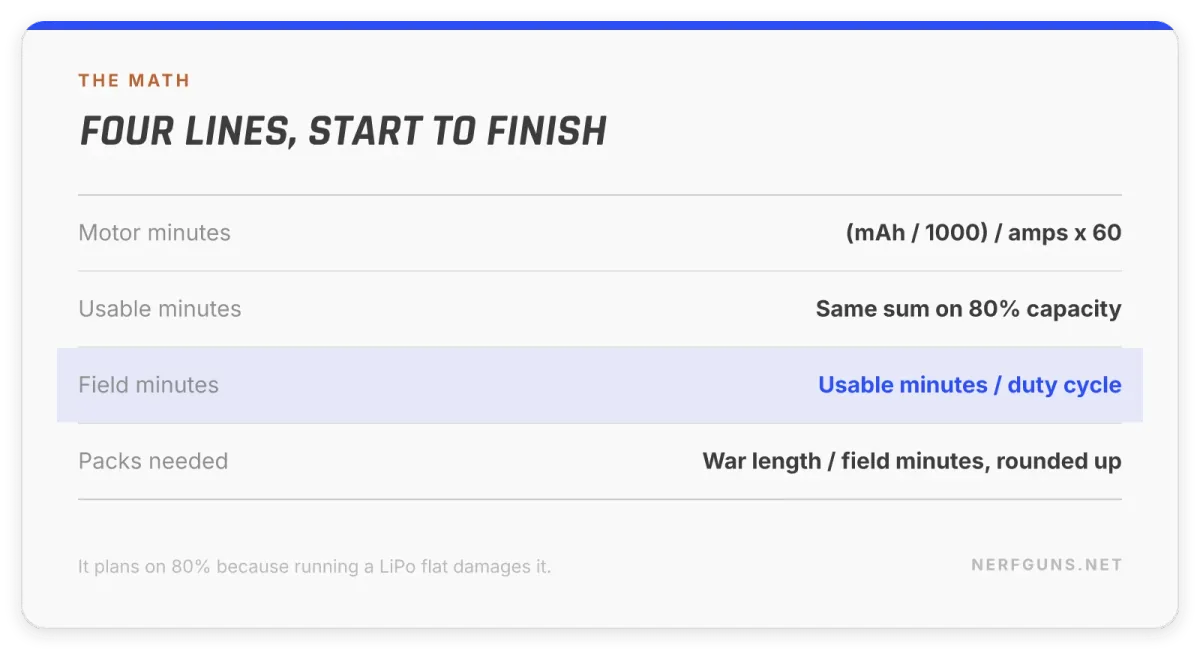
Nothing in the Nerf battery runtime calculator is hidden, and you can reproduce all of it on paper.
- Motor minutes = (mAh / 1000) divided by amps, times 60.
- Usable motor minutes = the same sum on 80% of the capacity.
- Field minutes = usable motor minutes divided by the duty cycle.
- Packs needed = war length divided by field minutes, rounded up.
Work the default case through. A 1300 mAh pack at 12 A gives 6.5 motor minutes, 5.2 of which you should actually spend. At a 10% duty that is 52 field minutes, and a 180 minute war therefore needs 4 packs.
Why it only spends 80% of the pack
The Nerf battery runtime calculator deliberately does not plan around the whole pack, and that is not conservatism for its own sake.
- Running a LiPo flat damages it. Deep discharge is one of the fastest ways to ruin a pack, which is covered properly in the LiPo safety checklist.
- Performance falls off before the pack is empty. The last stretch of capacity comes at a sagging voltage, so your blaster is already slower.
- You want a margin you never planned to use. Games overrun.
So the honest figure is the usable one, and planning on the full pack is planning on a number you should never actually reach.
Packs needed, by play style and pack size
Every row assumes a 12 A draw and a 180 minute war, spending 80% of the pack.
| Duty cycle | Play style | Field minutes per pack | Packs for a 3 hour war |
|---|---|---|---|
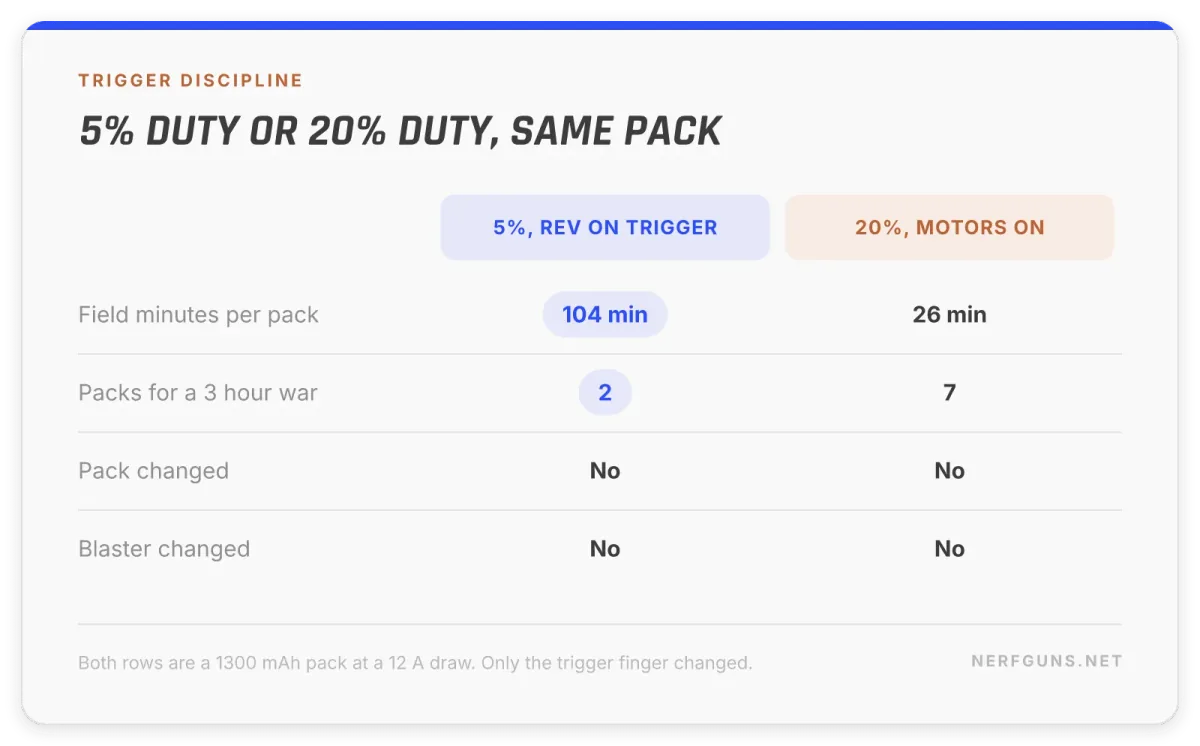
| 5% | Disciplined rev on trigger | 104 min | 2 |
| 10% | Typical mixed play | 52 min | 4 |
| 15% | Rev and hold in firefights | 35 min | 6 |
| 20% | Motors on most of the round | 26 min | 7 |
| 30% | Full auto, motors barely stop | 17 min | 11 |
Two packs or eleven, from the same blaster and the same battery. That is trigger discipline, not equipment.
Now hold the duty cycle at 10% and change the pack instead.
| Pack capacity | Field minutes per pack | Packs for a 3 hour war |
|---|---|---|
| 850 mAh | 34 min | 6 |
| 1300 mAh | 52 min | 4 |
| 2200 mAh | 88 min | 3 |
| 3000 mAh | 120 min | 2 |
Capacity helps, and it helps less than trigger discipline does. Run both tables through the Nerf battery runtime calculator with your own draw and the shape stays the same.
Bigger pack or more packs
Once the Nerf battery runtime calculator tells you that you need more field time, there are 2 routes and they are not equivalent.
- A bigger pack means fewer swaps. Fewer moments where you are standing still with a shell open.
- More packs means less weight in the blaster. The spares live in the bag rather than in your hands.
- A bigger pack has to fit. Capacity is irrelevant if the shell will not close on it.
- More packs need more charging. Which is a schedule problem the night before, not a game day problem.
- Check the C rating either way. A larger pack still has to feed the motors, which is what the LiPo battery calculator checks.
Most players end up with two decent packs rather than one large one, because a swap takes seconds and a pack that does not fit takes a rebuild.
Charging between games
The pack count the Nerf battery runtime calculator gives you assumes every pack starts charged.
On a single day event that means charging them all at home, the night before, attended.
On a multi day game it becomes a nightly routine, and the rules do not relax because you are away from your bench.
- Charge attended, in a fire safe container, every time.
- Never charge in a car park or out of a car boot.
- Bring a voltage checker, not the charger, to the field. On site you want to know a pack’s state, not top it up.
- Put spent packs on storage charge if they will sit for more than a few days afterwards.
All of that is in the LiPo safety checklist, and the packing side is on the HvZ loadout checklist.
How to measure your own duty cycle
Duty cycle is the input that decides your answer, and almost nobody measures it. It is easier than it sounds.
- Play one normal round with a stopwatch running. Note the total round length.
- Count your engagements. Roughly how many times did you actually spin the motors.
- Estimate seconds per rev. Two seconds is typical for rev on trigger, considerably more if you hold.
- Multiply and divide. Engagements times seconds per rev, divided by the round length in seconds, times 100.
Twenty engagements at 2 seconds each in a 10 minute round is 40 seconds of motor time out of 600, which is a duty cycle of about 7%.
Do it once and you never guess again. Put your real figure into the Nerf battery runtime calculator and every answer it gives you afterwards is yours rather than an average of somebody else’s play.
Knowing when to swap, mid game
The Nerf battery runtime calculator tells you how many packs to bring. It cannot tell you when to change one, and guessing that is how packs get run flat.
- Fit a low voltage alarm. The cheapest and most reliable answer. It tells you before the pack is in trouble rather than after.
- Or swap on a timer. Take the field minutes figure, knock a bit off, and change at that interval whether or not it feels necessary.
- Do not swap on feel alone. By the time a blaster feels slow you are already into the part of the pack you were trying not to spend.
- Check voltage between games, not during. Two seconds with a checker in a break beats a decision made under pressure.
- Label your packs. Charged and spent look identical in a bag, and mixing them up wastes the planning entirely.
A pack swap takes seconds. A flat pack takes the rest of the game.
Planning a multi day game
A one day war is a packing problem. A multi day game is a charging problem, and the Nerf battery runtime calculator handles it one day at a time.
- Run the numbers per day, not for the whole event. Work out one day’s packs, then decide whether you recharge overnight or carry multiples of that.
- Recharging halves what you carry. If you can charge safely and attended each night, one day’s worth is enough.
- If you cannot charge safely, carry the full count. That is a bigger bag and it beats charging somewhere unsuitable.
- Add a day. Games overrun, and a spare day of capacity is cheap insurance.
The overnight routine matters as much as the count, and it is set out in the LiPo safety checklist.
If you run springers
None of this applies to you, and that is worth saying plainly rather than leaving you to work it out.
A spring powered blaster has no motors, no pack and no duty cycle. The Nerf battery runtime calculator has nothing to tell you.
That is a genuine advantage of springers and it is one of the reasons plenty of experienced players still run them at long events.
Your equivalent planning problem is ammunition and magazines, which is on the HvZ loadout checklist.
Five reasons the real number comes out worse
The math in the Nerf battery runtime calculator is exact. The inputs are estimates, and they all drift the same direction.
- Duty cycle guessed low. The single biggest source of error, every time.
- Cold weather. Packs deliver less in the cold, and that is a real loss of field time.
- An ageing pack. A pack that has been through a season does not hold its label capacity.
- Draw estimated rather than measured. A clamp meter usually reports more than people expect.
- Games overrunning. The 3 hour war that becomes 4 hours.
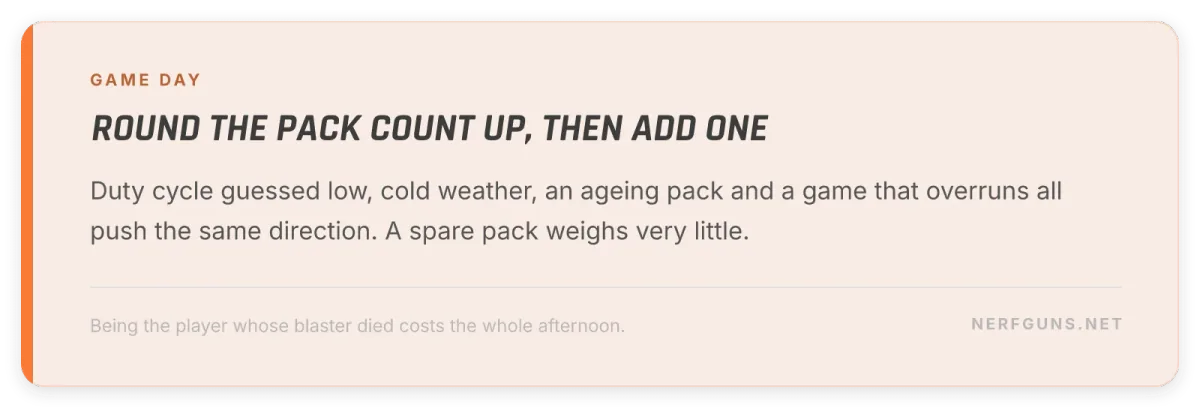
So round the pack count up, then add one. A spare pack weighs very little and being the person whose blaster died costs the whole afternoon.
Frequently asked questions
Is one big pack ever the right answer?
Yes, when it fits properly and you would rather not stop to swap. A 3000 mAh pack covers a 3 hour war at a typical duty cycle where an 850 mAh pack needs 6 changes.
The catch is always physical. Measure the battery space before you buy, in all 3 dimensions, including room for the leads to bend.
Do I need to run the Nerf battery runtime calculator for every blaster I own?
Only for the ones with motors, and only once per configuration. Change the motors, the cell count or the pack and the answer changes with them.
Write the field minutes figure on a piece of tape inside the battery door and you will never re-derive it.
What duty cycle should I use if I have never measured one?
Start at 10% for typical mixed play, and go to 15% or 20% if you tend to rev and hold.
If in doubt, use the higher number. The cost of being wrong is asymmetric.
Why does the Nerf battery runtime calculator not use my full pack capacity?
Because running a LiPo flat damages it and performance sags before the pack is empty. It plans on 80%, which is the part you can actually use.
Can I trust the Nerf battery runtime calculator for a brand new build?
Treat it as a starting point. A new build’s real draw is unknown until you measure it, and the draw figure is the second most important input after duty cycle.
Bring more packs than the first estimate suggests, then measure your actual usage on the day and re-run it.
Does this work for NiMH packs?
Yes. The runtime math is the same for any chemistry, since it is capacity divided by draw.
How do I measure my actual draw?
A clamp meter on the battery lead with the motors running under load. Otherwise use the presets on the LiPo battery calculator as a starting point.
My packs die faster than the calculator says. Why?
Almost always duty cycle, then pack age, then cold. Work through those 3 in that order.
Does a higher C rating make a pack last longer?
No. C rating governs how much current a pack can deliver, not how much energy it holds.
Runtime comes from capacity, which is why the Nerf battery runtime calculator asks for mAh and not for C.
How many packs do most people actually carry?
Two or three for a typical day, which usually matches what the Nerf battery runtime calculator produces at a realistic duty cycle.
Players who carry one are usually the ones who have not run the numbers.
Does the Nerf battery runtime calculator account for cold weather?
No, and nothing working from label figures can. Cold reduces what a pack delivers, so treat a winter game as needing more packs than the number suggests.
Should I bring the charger to a one day event?
No. Bring charged packs and a voltage checker instead, and keep charging to a place where you can do it attended and safely.
Related pages: the LiPo battery calculator, the LiPo safety checklist, all the checklists, the kinetic energy calculator, the joules to FPS calculator, the modder’s toolkit, and every Nerf gun ever made.
It’s Nerf or Nothin’!
Want the next tool?
These calculators are free and there are more coming. Leave your email and we will tell you when the next one is ready. That is all it is for.
More Nerf calculators
Every tool here is free and runs in your browser. The full set is on the Nerf calculators page.
- Dart compatibility checker, which darts fit your blaster
- Kinetic energy calculator, dart weight and velocity into joules
- Joules to FPS calculator, your maximum legal velocity
- Spring FPS estimator, what a spring swap will chrono
- LiPo battery calculator, whether a pack can feed your motors