
A joules to fps calculator answers the question your club rules leave hanging: the cap is published in energy, and your chronograph reads in feet per second. This page converts one into the other for the dart you actually shoot. Put your limit in below, then read on for the reference tables and the margin you should leave.
What is on this page
- How to use the joules to fps calculator
- Why a joule cap and an FPS cap are different rules
- The formula, rearranged
- Max FPS at common joule caps
- Swapping ammo changes your ceiling
- Why you should sit under your ceiling
- Chronographs disagree, and that is normal
- What the number means in play
- How to actually hit your target speed
- Why events set different caps
- A five minute routine before an event
- What to do if you chrono over on the day
- Four ways this goes wrong
- Frequently asked questions
Joule Limit to Max FPS Calculator
Your club posts a joule cap. This tells you the fastest you can run that cap with the dart you actually shoot.
Your setup
Whatever the event rules list as the energy cap.
Typical values. Heavier ammo means a lower FPS ceiling at the same joule cap.
Weigh a handful and average them.
Result
Same limit, other ammo
| Dart | Weight | Max FPS at your limit |
|---|
Swapping ammo mid event changes your legal ceiling. Same blaster, different number.
Estimate only. Limits and the way they are measured vary by event, and chronos disagree with each other. Leave yourself margin and chrono on site.
As an Amazon Associate I earn from qualifying purchases.
How to use the joules to fps calculator
Two inputs and you have your ceiling. The joules to fps calculator does the rest, and the whole thing takes under a minute.
- Enter the energy limit your event publishes. Whatever number appears in the rules, in joules.
- Pick your dart, or type a custom weight. Presets cover Elite, half length, Rival and Mega.
- Read the max FPS figure. That is the fastest that dart can legally travel under that cap.
- Check the table underneath. It shows the same limit applied to every other ammo type, which is the part that catches people out.
The output is a ceiling, not a target. More on why that distinction matters below.
Why a joule cap and an FPS cap are different rules
They look interchangeable and they are not.
An FPS cap limits speed. A joule cap limits energy, and energy depends on both speed and weight.
- Under an FPS cap, every dart gets the same speed allowance. A heavy dart at the cap carries far more energy than a light one.
- Under a joule cap, every dart gets the same energy allowance. Light darts are allowed to travel much faster to reach it.
- Neither is wrong. FPS is faster to marshal, joules is fairer between ammo types.
This is exactly why a joules to fps calculator is useful rather than a novelty. Your legal speed is a property of your ammo, not of your blaster.
Working the other direction, from your current setup to an energy figure, is what the kinetic energy calculator does.
The formula, rearranged
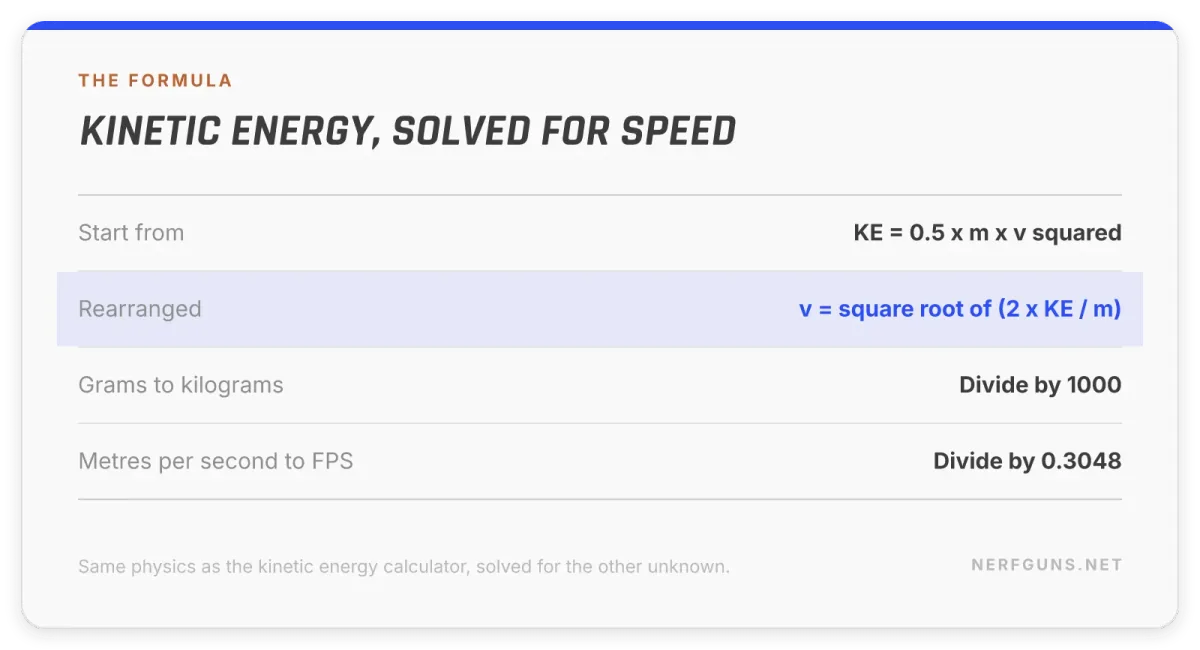
Kinetic energy is KE = 0.5 x m x v squared. Solve that for velocity and you get the line this page runs.
v = square root of (2 x KE / m), then convert metres per second back into FPS by dividing by 0.3048.
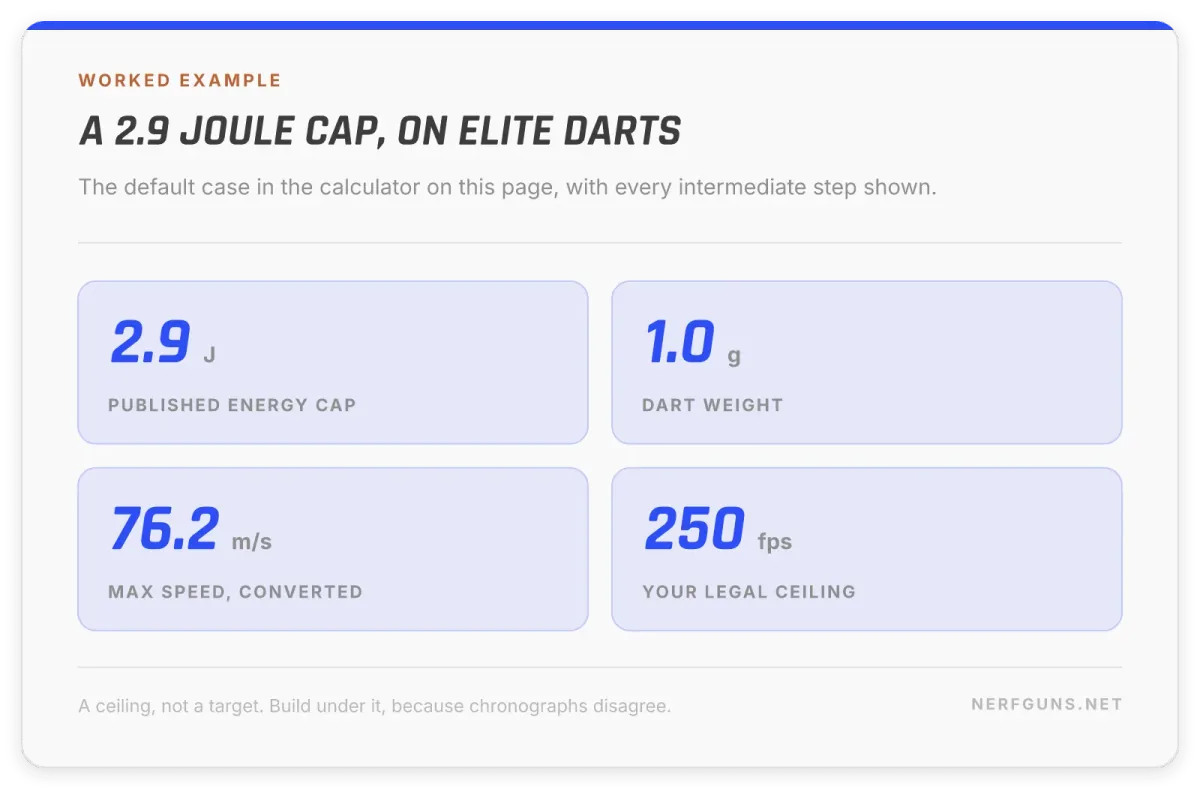
Take the default case. A 2.9 joule cap with a 1.0 g dart.
- Mass: 1.0 g becomes 0.001 kg.
- Velocity in m/s: square root of (2 x 2.9 / 0.001), which is 76.2 m/s.
- Back to FPS: 76.2 divided by 0.3048, which is about 250 FPS.
That is the number the joules to fps calculator displays, and you can check it on any scientific calculator.
Max FPS at common joule caps
Every figure below is the formula above, nothing measured. Find your event’s cap on the left and your dart across the top.
| Joule cap | Half length 0.85 g | Elite 1.0 g | Rival 2.5 g | Mega 4.5 g |
|---|---|---|---|---|
| 1.0 J | 159 FPS | 147 FPS | 93 FPS | 69 FPS |
| 1.5 J | 195 FPS | 180 FPS | 114 FPS | 85 FPS |
| 2.0 J | 225 FPS | 207 FPS | 131 FPS | 98 FPS |
| 2.9 J | 271 FPS | 250 FPS | 158 FPS | 118 FPS |
| 3.5 J | 298 FPS | 274 FPS | 174 FPS | 129 FPS |
Read across any row and the spread is enormous. At a 2.9 J cap a half length dart may legally travel more than twice as fast as a Mega dart.
These are the caps you will actually run into, not a standard. Use the joules to fps calculator for the exact number your own rules and your own dart weight produce.
Swapping ammo changes your ceiling
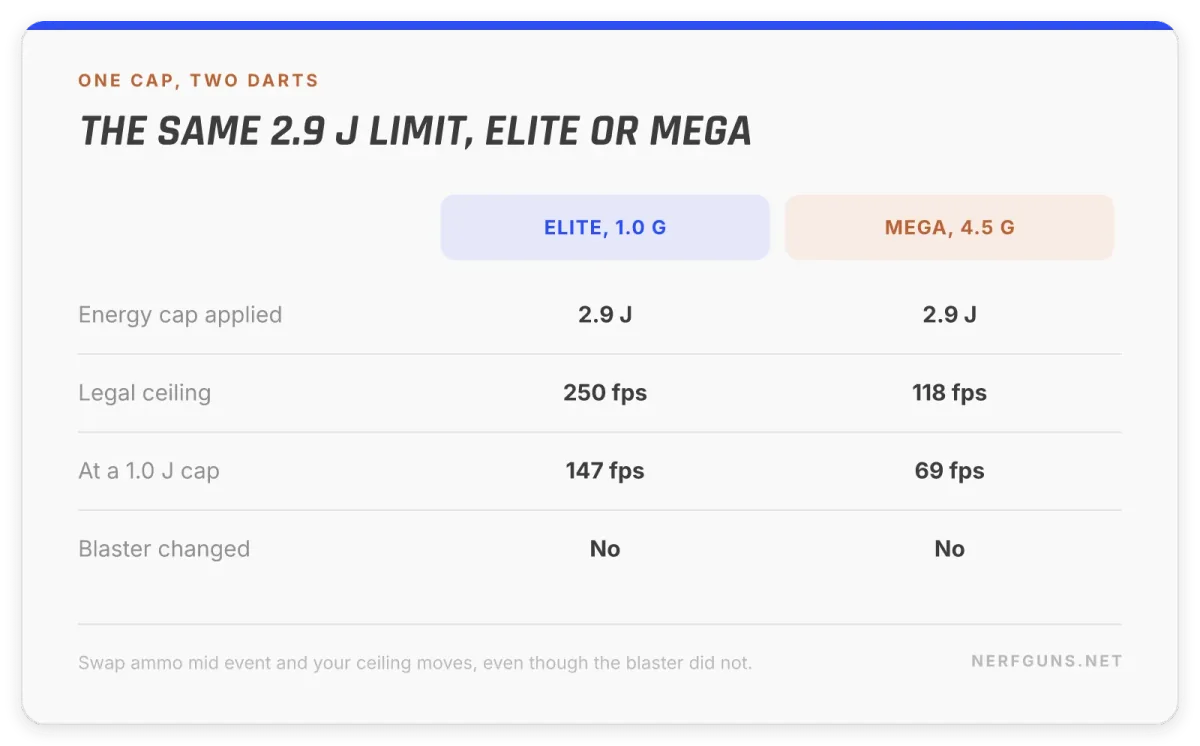
This is the failure mode the tool exists to prevent, and it happens mid event.
You chrono in legal on Elite darts in the morning. At lunch you run out and borrow a bag of Mega darts from a friend.
Your blaster has not changed and your legal ceiling has just collapsed.
At a 2.9 J cap, moving from a 1.0 g Elite dart to a 4.5 g Mega dart drops your allowance from about 250 FPS to about 118 FPS. If your blaster runs anywhere near its morning number, you are now well over.
Run the joules to fps calculator before you change ammo, not after somebody re-chronographs you.
Why you should sit under your ceiling
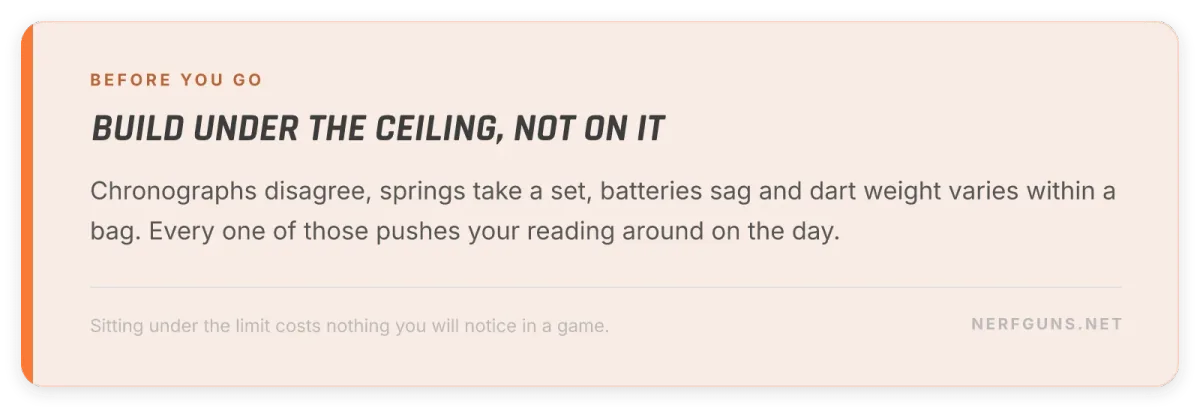
The number this page gives you is the absolute maximum. Building to sit exactly on it is a bad idea for 4 reasons.
- Chronographs disagree. The event’s unit is the one that counts and it is not the one you tested on.
- Blasters drift. Springs take a set, motors wear, and a fresh battery reads higher than a half spent one.
- Dart weight varies within a bag. Your average is an average, and the heavy end of the batch carries more energy.
- Temperature moves things. The same blaster does not read identically in a cold hall and a warm one.
Leave yourself a real margin. Sitting a bit under costs you nothing you will notice in a game and saves you being sent back to the car.
Chronographs disagree, and that is normal
Two units pointed at the same blaster will rarely give identical readings, and neither of them is lying.
- Sensor distance matters. How far the muzzle sits from the first gate changes the reading.
- Lighting matters on optical units, which is most of them.
- Cheap units vary more. Repeatability is what you pay for.
- Shot to shot spread is real. Even a perfect chronograph is measuring a blaster that is not perfectly consistent.
So take an average, and treat the joules to fps calculator output as the line you must stay under on somebody else’s equipment.
What the number means in play
A legal ceiling is a rules fact. What it feels like on the field is a different question, and worth understanding before you chase the last few FPS.
- Faster darts fly flatter. Less drop over the same distance, so less holdover and an easier shot at range.
- Faster darts arrive sooner. Shorter time to target means less lead on a moving player.
- Light darts lose speed faster. They start quicker and give more of it back over distance.
- Heavy darts hold a line better in wind. Outdoors, that is worth real accuracy.
So the fastest legal setup is not automatically the best one. A joules to fps calculator tells you what you are allowed, not what you should want.
Plenty of good players deliberately run under their ceiling on heavier ammo because it suits how they play.
How to actually hit your target speed
Say the tool gives you a ceiling and your blaster is nowhere near it, or worse, over it. These are the levers, roughly in order of effect.
- Spring rate, on a springer. The most direct control you have. A stronger spring raises velocity and usually needs the shell reinforced to survive it.
- Voltage, on a flywheel blaster. Cell count is the coarse control. This is where the LiPo safety checklist becomes required reading rather than optional.
- Motors and cage. Different motors and how hard the wheels grip both move the number, and they interact.
- Air restrictors and barrel fit, on springers. Freeing the air path and reducing blow by.
- Dart choice. The lever people forget. A lighter dart raises your legal ceiling without touching the blaster at all.
The bench gear for the first 4 is in the modder’s toolkit.
Change one thing, then re-chrono. Two changes at once and you have no idea which one moved the number, or by how much.
Why events set different caps
It can look arbitrary from outside. It usually is not.
- Indoors versus outdoors. Shorter engagement distances mean less time for a dart to slow down, so indoor caps tend to sit lower.
- Who is playing. Mixed age events and family games run more conservative numbers than an adults only war.
- What protective gear is required. An event mandating full face protection can reasonably allow more than one requiring only glasses.
- What the venue allows. Some halls and insurers set the number, and the organiser has no say at all.
- How they measure. Some cap at the muzzle, some measure differently, and some publish both an energy and a speed limit.
None of that is worth arguing about at the chrono table. Read the rules, run the joules to fps calculator, and turn up legal.
A five minute routine before an event
Do this at home in the week before, not in the queue on the day.
- Find the published limit and note whether it is energy, speed, or both.
- Weigh 10 darts from the bag you are actually bringing and average them.
- Put both into the joules to fps calculator to get your ceiling.
- Chrono 5 warmed up shots per blaster, on the battery state you will play on, and average those.
- Compare, and leave margin. Adjust now, while you have a bench and time.
- Do the secondary too. It is the one that gets forgotten and it gets chronographed just the same.
Write the final numbers on a piece of tape on each blaster. Then you can answer the marshal with a figure instead of a guess.
What to do if you chrono over on the day
It happens, and it is not the disaster people treat it as. You usually have several options before the blaster goes back to the car.
- Switch to heavier ammo. The fastest fix available, because it lowers your velocity without touching the blaster. Check the new ceiling in the joules to fps calculator first, since heavier ammo also lowers the limit you are being measured against.
- Drop a cell, on a flywheel blaster. Going from 3S to 2S is a large, immediate reduction.
- Swap the spring back, on a springer. Which is why the stock spring is worth keeping in the bag.
- Ask what exactly they measured. Which dart, which chronograph, how many shots. An average of 5 is a fairer test than the single hot shot that flagged you.
- Ask if there is a lower bracket. Some events run more than one cap and can move you rather than exclude you.
What does not work is arguing. The marshal’s chronograph is the one that counts, and that is the whole reason to build with margin.
Every one of those 5 options is easier if you already know your numbers, which takes about 5 minutes at home with the joules to fps calculator.
Four ways this goes wrong
- Using the advertised dart weight. Weigh a handful and average them, especially with third party darts.
- Entering a burst or peak reading. Averages only.
- Assuming the cap applies to the blaster. It applies to the combination of blaster and ammo.
- Forgetting the secondary. Sidearms get chronographed too, and they are the ones nobody tested.
All 4 are on the HvZ loadout checklist as part of the pre event routine, because they are much cheaper to fix at home.
Frequently asked questions
My event publishes both an FPS cap and a joule cap. Which applies?
Both. You have to clear each one independently, and with heavy ammo the energy limit usually binds first.
What joule cap is typical?
It varies a great deal by country and by event, which is exactly why the joules to fps calculator takes your limit as an input rather than assuming one.
Your event’s published rules are the only authority.
Why does the joules to fps calculator give my Mega dart such a low number?
Because energy rises with mass. A 4.5 g dart reaches the same energy at a much lower speed than a 1.0 g dart, so its legal ceiling is lower. That is the rule working as intended, not the joules to fps calculator being harsh.
Does a lighter dart make me more competitive under a joule cap?
It raises your legal velocity, which usually means flatter trajectory and shorter time to target.
It also means less energy arriving, and light darts are more affected by wind. It is a trade, not a free win.
Should I set my blaster right at the calculated FPS?
No. Leave margin, for all 4 reasons in the section above.
Does this work for Rival?
Yes. Rival rounds are about 2.5 g and the formula does not change for them.
Can I just use the table instead of the joules to fps calculator?
If your cap and dart weight happen to be on it, yes. The tool exists because most people are somewhere between the rows, on a dart they weighed themselves.
Why does my number drift down over a game day?
On a flywheel blaster it is almost always the battery sagging as it empties, which is what the battery runtime calculator helps you plan around.
On a springer, a spring that has been left compressed takes a set over time.
Do I need to re-check after every mod?
Yes, and it is the step people skip. A change that felt like nothing can move you over a cap, and a change that felt enormous sometimes barely moves the number.
Re-chrono after each single change, one at a time.
My darts are third party. Does that matter?
It matters more than with first party ammo, because weights vary further from the advertised figure.
Weigh them yourself. A 0.01 g scale removes the guesswork permanently and costs less than a bag of darts.
Is a heavier dart a way around an FPS cap?
Under an FPS only cap it does raise your energy while keeping you legal, which is precisely why more events have moved to capping joules instead.
Do not treat it as a trick. If the event caps energy, the joules to fps calculator will show your ceiling dropping the moment you go heavier.
Does the joules to fps calculator save my numbers?
No. Everything runs in your browser and nothing is stored or sent anywhere.
Related pages: the kinetic energy calculator, the LiPo battery calculator, the battery runtime calculator, all the checklists, the modder’s toolkit, the mod guides, and every Nerf gun ever made.
It’s Nerf or Nothin’!
Want the next tool?
These calculators are free and there are more coming. Leave your email and we will tell you when the next one is ready. That is all it is for.
More Nerf calculators
Every tool here is free and runs in your browser. The full set is on the Nerf calculators page.
- Dart compatibility checker, which darts fit your blaster
- Kinetic energy calculator, dart weight and velocity into joules
- Spring FPS estimator, what a spring swap will chrono
- LiPo battery calculator, whether a pack can feed your motors
- Battery runtime estimator, how many packs a war needs