
You are about to spend money on a spring. The question is simple: what will it actually chrono?
This spring FPS estimator gives you a range, not a promise. That is deliberate, and the reason is below.
Put your spring rate and plunger travel in. Get a likely FPS out.
What is on this page
- How to use the spring FPS estimator
- The 2 numbers the spring FPS estimator needs
- The number nobody can measure
- The math, and why travel matters more than rate
- Using the spring FPS estimator to choose without wasting money
- Check your event cap before you buy
- 5 ways to get a wrong number
- What the spring FPS estimator cannot see
- The order to do upgrades in
- Where the number stops being a hobby number
- Keep your builds straight
- Frequently asked questions
Spring FPS Estimator
Spring rate and plunger travel give you the energy stored, then an efficiency band turns that into a likely muzzle velocity. An estimate for choosing a spring, not a substitute for a chrono.
Your setup
The number on the spring listing. Kits are usually sold in lb/in.
1 lb/in is 175.13 N/m.
How far the plunger actually moves when primed, not the spring’s free length.
About 1.0 g for a full length Elite dart. Weigh yours, batches vary.
This is the guess in the calculation, and it moves the answer more than anything else.
Estimated muzzle velocity
The same spring across all three bands
| Efficiency | Dart energy | Estimated FPS |
|---|
Estimate only, and the honest weak point is efficiency. Nobody can measure it at home, real blasters lose energy to friction, dead space and air escaping past the dart, and two blasters with the same spring can chrono differently. Use this to choose between springs, then chrono the result before you take it to an event. If your event caps joules rather than FPS, the kinetic energy calculator converts what you measure.
As an Amazon Associate I earn from qualifying purchases.
How to use the spring FPS estimator
You need 4 inputs. Three are printed or measurable. One is a guess, and the tool is honest about which.
- Spring rate. On the listing. Kits are usually sold in lb/in
- Plunger travel. How far the plunger moves when primed, in mm
- Dart weight. About 1.0 g for a full length Elite dart
- Efficiency band. The guess. Pick the one that matches your blaster's condition
The tool then shows the same spring across all 3 efficiency bands, so you see the spread rather than one confident number.
The 2 numbers the spring FPS estimator needs
Spring rate comes off the product page. A 6 lb/in spring is a common upgrade. If a listing gives N/m instead, switch the unit in the tool.
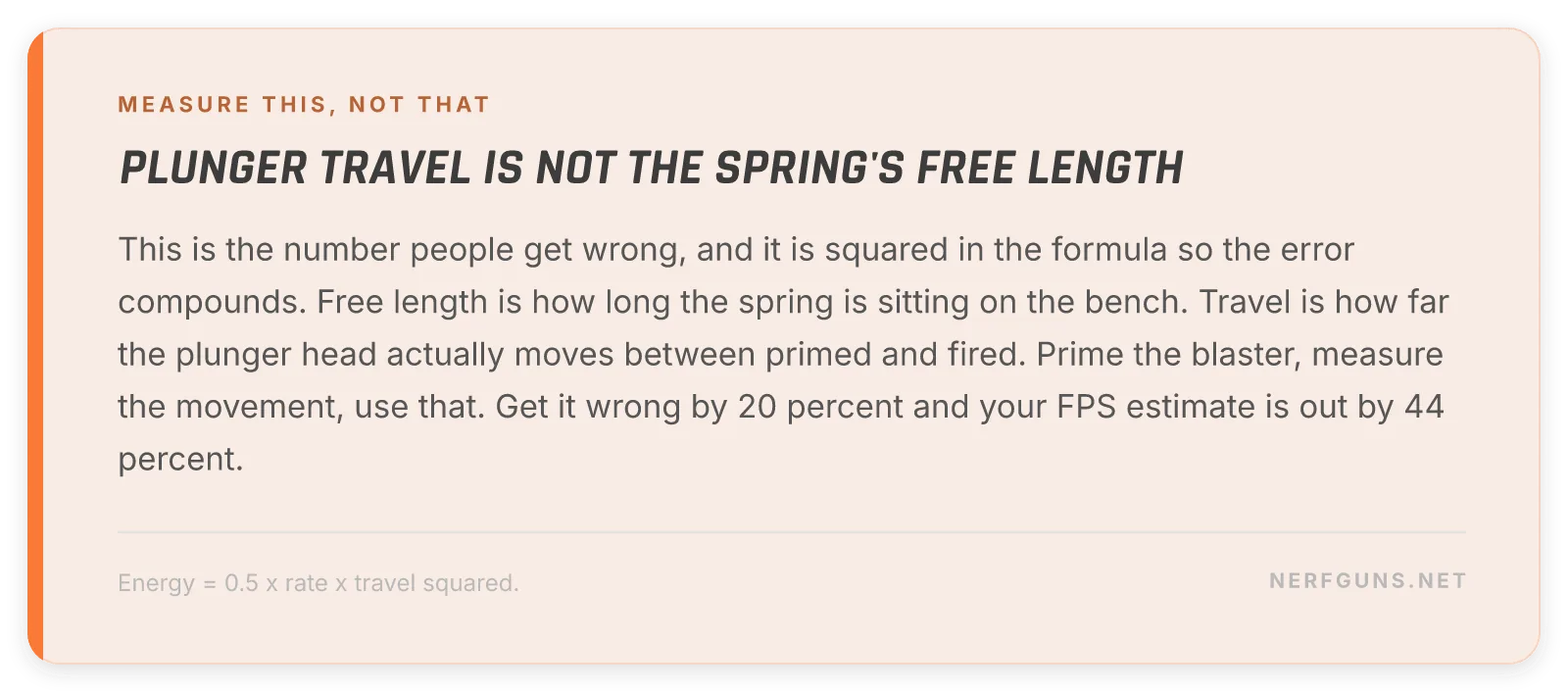
Here is the one people get wrong.
Plunger travel is not the spring's free length. It is how far the plunger actually moves between primed and fired.
- Prime the blaster
- Measure how far the plunger head has travelled back
- That number, in mm, is what the tool wants
Get this wrong and the answer is wrong by a lot, because travel is squared in the formula.
The number nobody can measure
A spring stores energy. Only some of it reaches the dart.
The rest goes to friction, dead space in the plunger tube, air escaping past the dart, and the noise the blaster makes.
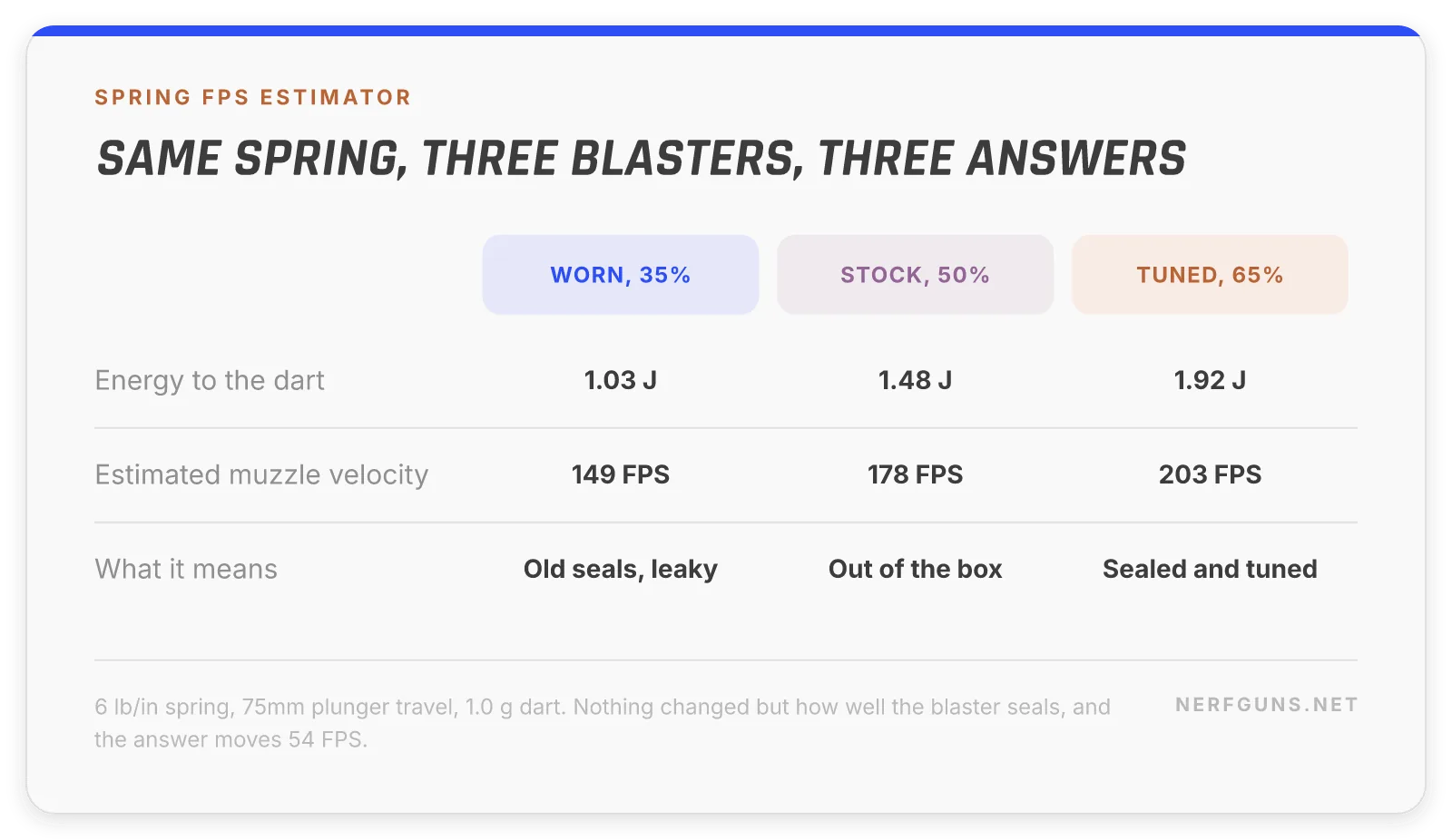
That fraction is efficiency, and you cannot measure it at home. So the tool offers 3 bands instead of pretending to one number:
- 35%, worn or leaky
- 50%, typical stock blaster
- 65%, sealed and tuned
Bottom line: efficiency is the biggest uncertainty in the whole calculation, which is why this is an estimator and not a calculator.
The math, and why travel matters more than rate
Two formulas, both shown in the tool as you type.
Energy stored: E = 0.5 x k x x squared, where k is the spring rate and x is the travel.
Velocity out: v = square root of (2 x dart energy / dart mass).
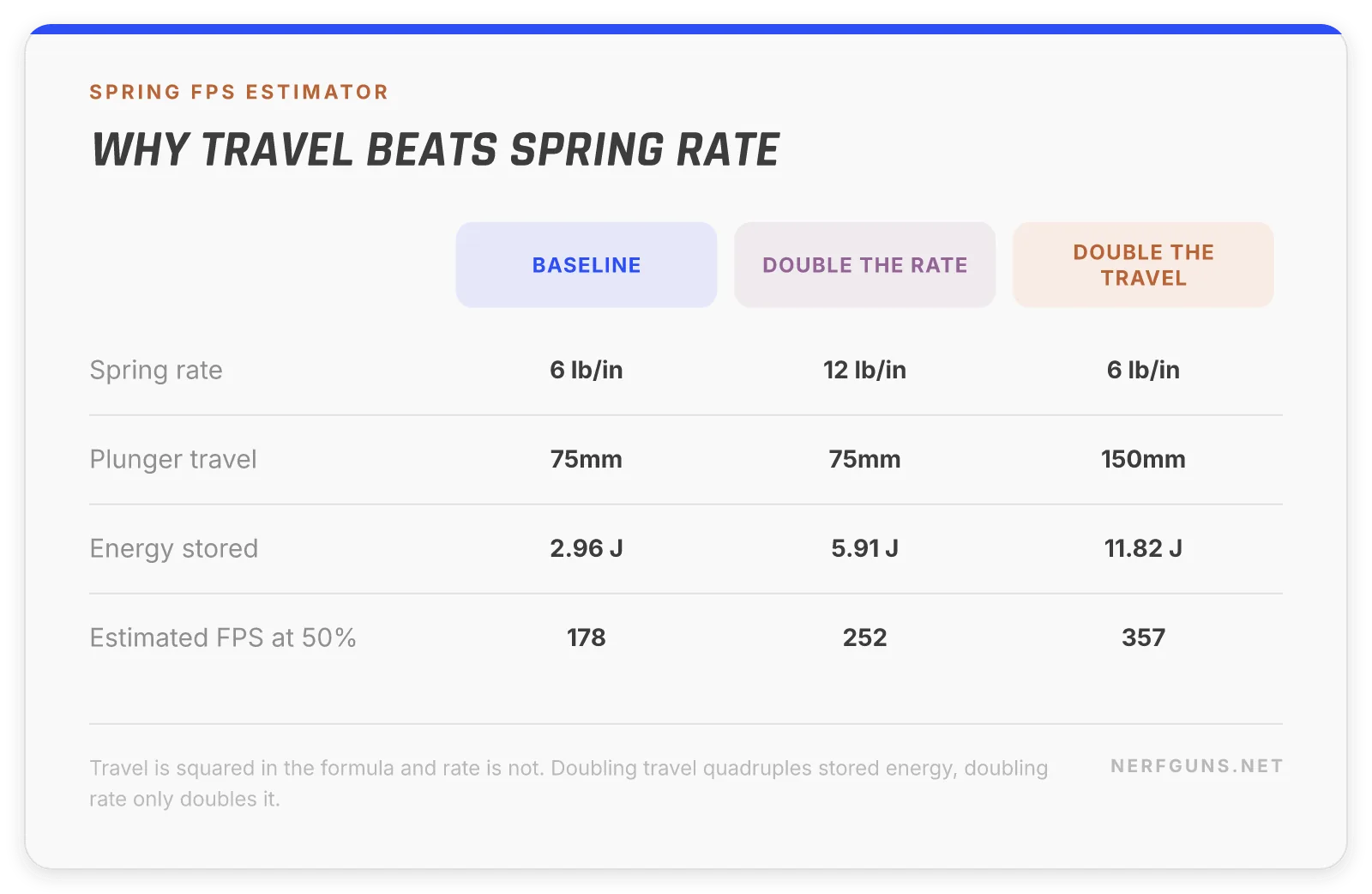
Here is the thing. Travel is squared. Rate is not.
- Double the spring rate and stored energy doubles
- Double the travel and stored energy quadruples
That is why a longer plunger stroke usually beats a stiffer spring, and why a blaster with short travel resists being made fast no matter what you put in it.
Using the spring FPS estimator to choose without wasting money
Use the estimator to compare candidates, not to predict a single number.
- Put your travel and dart weight in once
- Change only the spring rate between candidates
- Compare the 3-band spread of each, not the middle number
If two springs overlap heavily across their bands, the difference between them will probably disappear inside your blaster's own variation. Buy the cheaper one.
If one is clearly above your event cap even at 35%, it is the wrong spring regardless of how it feels in the hand.
Check your event cap before you buy
A blaster that arrives above your local field's limit is a blaster you cannot use.
Work it out in this order:
- Find your event's cap. Some publish FPS, a growing share publish joules
- If it is a joule cap, use the joules to FPS calculator to convert it for your dart weight
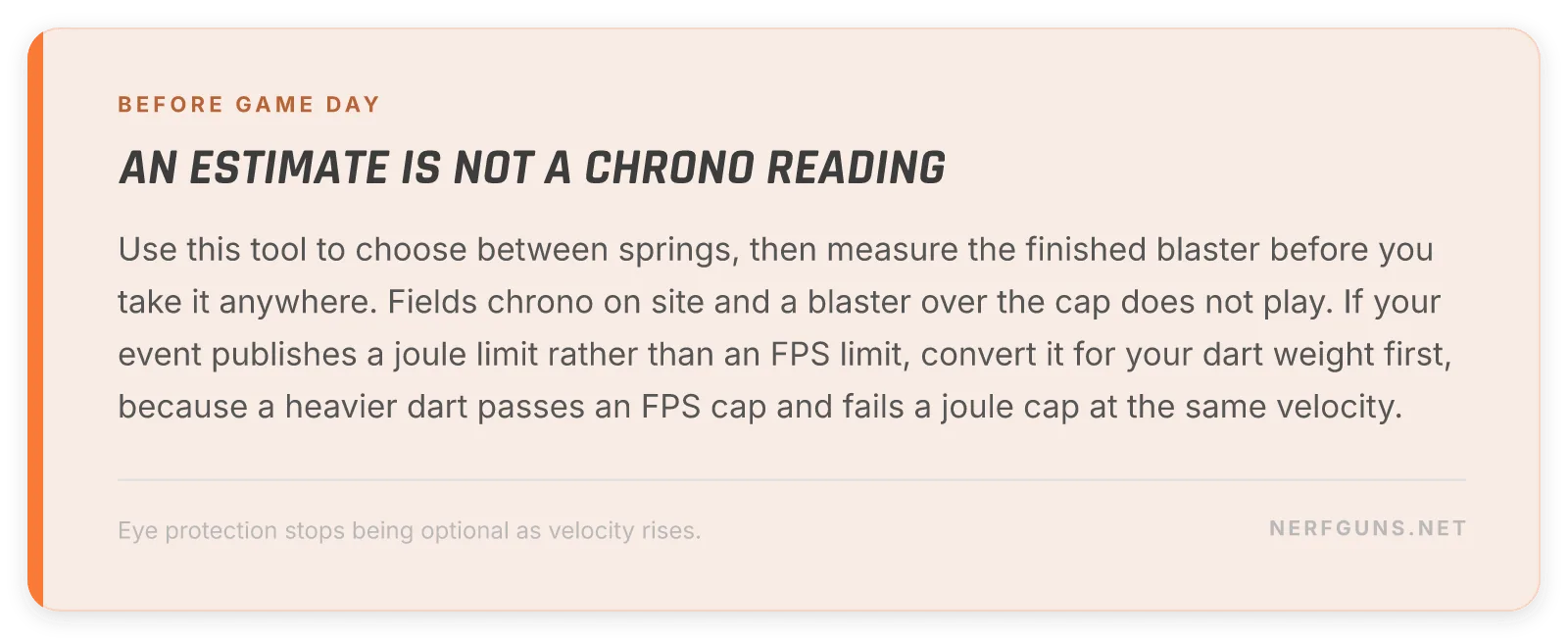
- Estimate the spring here, then chrono the finished build before game day
- Confirm what you measured with the kinetic energy calculator
Eye protection stops being optional as velocity rises. That is not a legal note, it is an eye.
5 ways to get a wrong number
- Using spring free length as travel. The single most common error, and it is squared
- Guessing dart weight. Batches vary. A 0.01 g scale costs less than a spring
- Picking 65% on a stock blaster. Sealed and tuned means sealed and tuned
- Mixing units. lb/in and N/m differ by a factor of 175. The tool converts, but only if you set the dropdown
- Treating the output as a chrono reading. It is an estimate for choosing parts
What the spring FPS estimator cannot see
The formula knows your spring and your dart. It knows nothing about the blaster around them.
Four things change the real number and none of them are inputs:
- Barrel length and fit. A dart that seals well accelerates for longer. A loose barrel bleeds air past it
- Dead space. Air volume left in the plunger tube at the end of the stroke is energy that never reaches the dart
- Air restriction. A narrow port throttles the flow no matter how hard the spring pushes
- Wear. Old seals leak, and a leak is efficiency loss by another name
All four are folded into the efficiency band, which is why the band is a range instead of a number. If you seal a blaster properly you move up a band. That is usually a bigger gain than the next spring up.
The order to do upgrades in
Most people buy the spring first. It is usually the wrong first move.
- Seal it first. Free or nearly free, and it moves you up an efficiency band
- Then check travel. More stroke beats more rate, because travel is squared
- Then the spring. Now you are adding energy to a blaster that can actually use it
- Then the barrel and dart choice. Fine tuning, and only worth it once the rest is sorted
Run the spring FPS estimator at each step with the band that matches where the blaster actually is. The gap between 35% and 65% on the same spring is 54 FPS, and no spring swap in that price range gives you that.
Where the number stops being a hobby number
Foam is soft. Energy is not.
A dart at 200 FPS carries roughly double the energy of the same dart at 140 FPS, because energy scales with velocity squared. That is the same relationship that makes travel matter more than rate, working against you this time.
- Eye protection, always, no exceptions above stock velocities
- Check the cap before the build, not after
- Do not hand a tuned blaster to someone who does not know it is tuned
None of that is a legal disclaimer. It is the difference between a hobby and an injury.
Keep your builds straight
Once you are 2 or 3 springs deep, remembering which blaster got what stops being easy.
Our free Nerf wish list holds your blasters, the parts you have bought and the parts you still want, in one place.
- Planning a build? Keep the spring, the battery and the darts on one list
- Somebody buying for you? Share it and skip the guessing
Frequently asked questions
How accurate is a spring FPS estimator?
The physics is exact. The efficiency assumption is not, and it dominates the answer. Treat the output as a range for comparing springs, then chrono the finished blaster.
What spring rate do I need for 150 FPS?
It depends on your plunger travel and dart weight as much as the spring. Put your own travel in the tool and adjust the rate until the middle band lands near 150.
Does a stiffer spring always mean more FPS?
More stored energy, yes. More FPS at the muzzle, usually, but not proportionally. A stiffer spring can also make a blaster harder to prime and wear the internals faster.
Why does travel matter more than spring rate?
Because travel is squared in the energy formula and rate is not. Doubling travel quadruples stored energy. Doubling rate only doubles it.
What is a realistic efficiency for a stock blaster?
The 50% band is the sensible default. Use 35% if the blaster is old or leaky, and 65% only if it has been sealed and tuned.
Should I use lb/in or N/m?
Whichever your spring listing uses. Set the dropdown to match. 1 lb/in is 175.13 N/m.
Does the estimator store what I enter?
No. It runs entirely in your browser. Nothing is sent anywhere and nothing is saved.
The rest of the toolkit
- Dart compatibility checker, which darts fit your blaster
- Kinetic energy calculator, dart weight and velocity into joules
- Joules to FPS calculator, your maximum legal velocity
- LiPo battery calculator, whether a pack can feed your motors
- Battery runtime estimator, how many packs a war needs
All free, all on the Nerf calculators page.
Want the next tool?
Our calculators are free and there are more coming. Leave your email and we will tell you when the next one is ready. That is all it is for.